
Two Decades in…

Tureen in the wild
Tureen in the wild

On Wednesday, Mr S and I will mark our twentieth wedding anniversary, and due to some unfortunate timing, one of us has a medical procedure scheduled for that day, so we won’t actually celebrate on the day itself. (In sickness and in health, you know…)

Instead, we went antiquing in New Bedford on Sunday, after Mr S spent Saturday clearing brush at Minute Man National Historic Park. New Bedford was a nice change from the places we usually go in Rhode Island, and I always enjoy looking in Massachusetts, because objects there are typically free of Rhode Island connections, which means I can actually make encumbrance-free purchases.

I don’t know how encumbrance-free this purchase was…for now we are encumbered with a large hard paste porcelain tureen decorated with cranes and a federal eagle.

The platter it sits on may not be its original platter, but do I care? No. Look at that fantastic, crazy thing. The face the Young Mr made when this was unwrapped in front of him was priceless, but he has long questioned my sanity; now he will question my aesthetics.

Pride of place, with a friend's painting and Mr B's hats
Pride of place, with a friend’s painting and hats by Mr B

It sits in pride of place on our mantle now, and as far as I can tell, it’s typical of the shape of tureens made for the American market ca. 1790-1810. I’ve not seen the cranes before, and I still haven’t found this pattern in a museum or auction house, though Winterthur’s tureen collection is pretty amazing.

If the thing is real (and it looks and feels like the real ones at work), its voyage has been  incredible: from China to a port in Massachusetts, down through time to a shelf in an old mill building, to my mantle.  Think of the person who ordered this– and the set it was likely part of– by letter, and then waited for months for the goods to arrive. Some sets were as large as 250 pieces, custom-monogrammed at the factory, and then packed into barrels and crates lined with straw and loaded onto ships bound back to the East Coast.

I’d love to know this piece’s story, but even without a provenance, the object itself is pretty astonishing, and fits into our already eclectic china (and yes, mantle business).  Now, for a soup party!
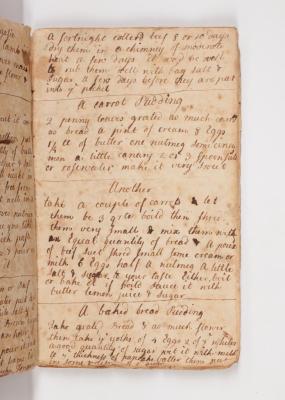
More historical receipts online

server

Thanks to the American Antiquarian Society and a grant from the Pine Tree Foundation, you can now access digitized versions of the AAS’s manuscript recipe/receipt/cookery books. Pretty cool, right? Because I know you want to experiment with every variation possible of carrot pudding. (Mr S got a stomachache just now and doesn’t know why…)

I first read about this in a twitter link to the MassLive article, and I’d like to point out up front that you go to the AAS GIGI portal and search in the box for Pine Tree Foundation. That’s the quickest way to access the books. I also searched for cookery or recipe and ended up in some interesting places with carrot pudding recipes.

One of the AAS staff members has been trying out the various recipes, and blogging about them here. There appear to be manuscript books as early as the late 17th or early 18th century, which is very cool (and still about puddings!).


Boil and Not Too Much Trouble

Camp cooking can get old. Stew, sigh. Bread, sigh. Cheese, sigh. Apples, sigh.

Don’t get me wrong: all of the above are delicious today. Historically, New England troops are all about cheese and cider, and have much to say about the quality of beef, but menu can be repetitive and lacking in challenge.

Ever since I had boiled flour pudding at Coggeshall Farm, I’ve wanted to make it since I so much enjoyed the texture.

When I found it mentioned by Enos Hitchcock, I was particularly excited.

1777 May 24
Dined upon flowr puding & Venison Steak.

Flowr puding? I love that guy! But there it is, documented, even if eaten by the officers and not the private soldiers. It’s common enough that I think it likely almost everyone knew how to make it. The trick would have been getting hold of eggs and milk, which is easy enough for me, if not for the soldiers of 1777. Fortunately, as we drove down Cottrell Road headed for home, a flock of Plymouth Rock chickens crossed the road in front of us: there were the eggs, at least in our time.

postcard of kittens eating christmas pudding
Not your chaplain’s pudding.

The method I had tried at home worked: I beat three eggs and four spoons of milk in my tall redware mug, and added the liquid slowly to the flour and salt mixture. The whole mixture went into a cloth bag, which I tied with a string and boiled in the smallest kettle, not want to risk any damage to the beef stew. I’ll test the works at home on my nearest kin and willing victims before I loose it upon a regiment and hungry guests.

Although the pudding was a strange shape, it cooked up quickly in about 45 minutes, had a firm texture and a satisfactory enough flavor. I would have liked it to rise a bit more, which is an argument either for beating the eggs with a fork in the confined cylinder of the cup, or risking the splash of the whisk in a bowl, or, finally, for a smaller whisk.

Still, not too bad for expanding the camp cooking repertoire of Things That Can be Boiled and Eaten.