
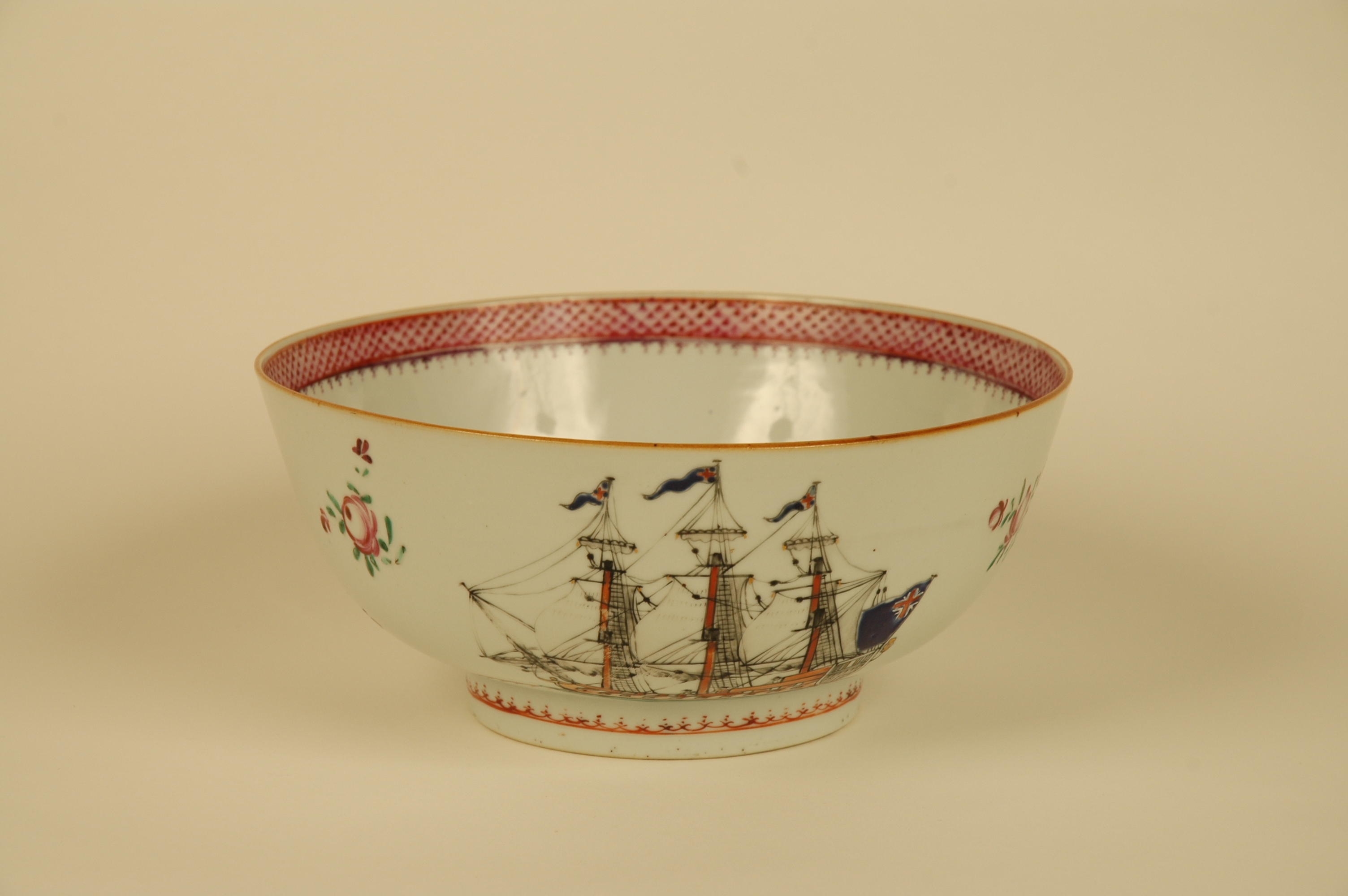
Feeling Materialistic

Chinese Export Porcelain bowl for the American market, 1790-1810. RIHS collection

I went to Newport yesterday for a History Space program on material culture. I don’t know why I  was nervous, really, because I love stuff. I try not to accumulate too much stuff in my own life, and to be a careful curator, but really: beautiful objects make me really happy, and I love talking about “the thingness of things.”

Living history is fun for me for a lot of reasons, some esoteric and personal. I spent a lot of time in school thinking about images of America, and what they meant (it was the age of semiotics and Derrida) so creating living history personae and clothes and based on images and research is a way of making art of history, or else dressing up in funny clothes and enjoying loud noises.

Historical research is most fun when it asks questions– the journey is as good as the destination–and there are good questions to ask the things you carry with you or use in living history. (They’re probably good to ask if you’re in a mood to downsize at home, too.)

  • What is it?
  • When was it made?
  • Who made it?
  • What is it made of? Where did the materials come from?
  • Where did you get it? When did you get it?
  • How does it work, what does it do?
  • What does it mean to you?

If you can answer those questions, you’ll be a lot closer to knowing the why of what you have.

It’s the stories we tell about our objects that give them meaning: sometimes it’s who made or used a thing, sometimes the story has a meaning that you can’t tell from the object itself.

Think of this: I crossed the Pell bridge last night to come home, the road climbing into a storm cloud, the car lashed with rain and wind on a road surface daguerrotype-reflective and hard to read. The buffeting gusts on the car reminded me of the carpenter who didn’t like crossing the bridge to work in Portsmouth. Still, he told a story about crossing the bridge in storm on a motorcycle, with a girl riding behind him. The wind would rise, you’d both get scared, and she’d squeeze closer. He shivered inside his t-shirt as he told the story, with a tiny smile, and you knew he’d gone to Newport in that weather, on that bike, with that girl, on purpose.

You’d never get that story just from a jacket, a helmet, or a bike, but somewhere, there’s a object tied to that story.

History Camp Next Weekend!

Gradient--Boston2015

Where will you be on March 28th, now that the LTB muster is cancelled? How about HistoryCamp 2015? You can register here for free if you volunteer or for a nominal fee otherwise.

You can check out sessions here, but I know there’s a really good one on living history…because I’ll be presenting along with Elizabeth Sulock of Newport Historical Society in the Risky Business: Living History Events in Tradition Museums session. There’s a lot of other good stuff, too, so if you’re in the area, why not register so you can check it out?

Glaciers in the House

IceDamFeb2015

I don’t mean the ice dams and icicles that plagued the house and streaked the service ell’s windows as they melted: I mean change.

I’m reading The Half Has Never Been Told (it kept selling out, so I only just got a copy), and thinking about the representation of a past that people would rather forget, and sometimes actively deny in the North– and the South, as you will tell from reading African-American History Fail.

Change in historic houses can be glacially-paced, as staff and docents alike resist changes to interpretation. Resistance to change is usually about comfort and confrontation, especially when the change is large.

I get that: Oh no, new stuff to learn. What was wrong with what we did before? But docents and staff get comfortable and loose sight of the context of the content they present. They say some interesting stuff.

Most jaw-dropping of all: Sometimes I like to pretend I’m Mrs Owner of the House. That one was creepy, to me. But it did give me some insight into the “ooh, wish I lived here” backwardly aspirational tour motivation.

How would you feel if living here meant you owned and traded slaves? Defended the slave trade in Congress? If a small girl had the care of your horses? We don’t ask those specific questions, but I think we need to. Slavery is slavery.

In the 1790 census of Rhode Island, there are 948 slaves, representing 1.3% of the population. That would be 13,000 people of Rhode Island’s total population today, less than the city of Central Falls (19,383 in the last census, and one of our smallest towns).

We think it’s a small number, but to those 948 people, being enslaved was everything. I don’t necessarily want to make our visitors feel personal guilt about slavery– that’s up to them–but I do want to them to think about what slavery meant, and what it did, as an economic system.

I want visitors to understand that the beauty of the house they see is built in part on the ugly and forced exploitation of a class of people. If they relate that to the rest of the world they inhabit today, even better. I think we owe at least this much to every site where enslaved people worked or lived.

Less is More

Though it may seem contrary to previous posts, there are times when I really believe less is more, and that’s when we’re out in the field.

Each year I’ve tried to improve our kit and impression by replacing or removing items, mostly to increase our accuracy but also to reduce what we carry. The less we have to carry, the less I have to pack and clean and think about and the more I can think about the history. This iteration of “What the heck can I quit?” was prompted by reports of a conversation with someone I respect, which caused me to rethink what we were hauling along and how I could change it.

The Box of Doom with the Pitcher of Inaccuracy

We have stripped away most of what we used to bring for the comfort of the kid; as he has grown up, he’s needed less to feel comfortable and “at home.” We traded ground pads for bed sacks* very quickly, and we never had any iron to begin with. I’ve tried to keep within seasonal and historical cooking guidelines, but the largest hurdle and heaviest literal burden is the wooden cooler box.

Feeding the Young Mr is a tricky thing: he likes what he likes, and he likes a lot of it. What he likes are carrots, apples, and meat. There’s some swapping that can be done with seasonal fruit, but the largest hurdle is meat: if I can scrap fresh, needs-to-be-kept-cool meat, I can leave the cooler box at home. (At this moment, several gentlemen are suddenly feeling empty inside, with a taste of ash in their mouths. Dirt stew, boys: it’s coming.)

No iron, but what goes into the kettle?

I had gotten about as far as pease porridge when, in a completely costuming context, I came across links to The Sewing Academy.

The squeamish and childless may writhe at the handouts on dealing with nursing babies, hygiene, and winter clothes for children, but these Civil War resources have utility for all of us trying to be more accurate in our portrayals of the past.

I had not thought about packing frozen meat and storing it underground, and though I like the idea very much, it will not suit in cases where digging is forbidden. But it is certainly a way around the cooler box, and one I’m willing to entertain. (Check “No Refrigeration Required.”) “The Progressive Questions” help sketch out a responses to a variety of situations.

Quoth the Mavens” contains this excellent definition: A truly progressive mind-set tries to figure out the logic of what was indeed used, rather than rationalizing modern logic into a period situation.

There’s nothing more to add to that pithy statement, but a renewed sense of dedication to accuracy and “less is more” thinking.

*As accurate as my attitude would be after resting arthritic bones on the ground, no one really needs to experience that. Call it a safety measure.