Lately, I have felt like a street preacher exhorting people to change their ways.
Feel the power of the primary source.
Behold the possibility in the unknown.
Surrender to uncertainty.
It’s not for everybody, I know. But rethinking reenacting will change not just you and your appearance, but the way you “do” history. The more you dig in, the more you question and change, the more engaged you’ll be—and the more engaged your visitor will be. The more fun you have, the more fun the public will have.
“That’s great, Aunt Kitty,” you say. “But how am I supposed to do that? I’ve already learned rabbtre sous le main and buttonholes and pinning my stomacher and making soap. What more can I do?”
Stop asking how. Start asking why.
Look, I get it. Those 18th century skills are hard to acquire. Tons of people have better skills than I do, and I willingly and happily admit my general incompetence.
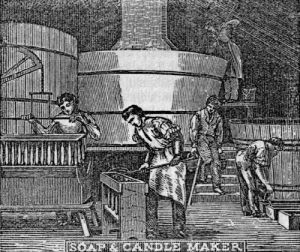
The Soap Boiler and Candle Maker. Popular Technology or, Professions and Trades.
Take soap. I cannot make soap. I know that it takes lye and tallow and heat. I know it is slimey and hot and dangerous and vaguely disgusting. (I’ve done my time with tallow candles, thanks.) So I respect the soap.
But honestly, so what? is the question I ask when y’all tell me how to make soap. I want to know why you’re making soap.
Are you selling it? What will you wash with it? How often do you do laundry? Do you share the soap? And if you’re selling soap, how do people know to come to you? Why is your soap better than, say, Bono Brown across the river? He’s cheaper by a penny, why is your soap so special? If you do sell it, what do you do with the money? Are you married? Does your husband drink the profits?
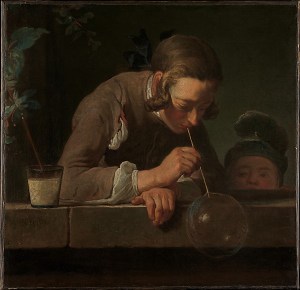
Jean Siméon Chardin Soap Bubbles, ca. 1733–34 The Metropolitan Museum of Art, New York, Wentworth Fund, 1949 (49.24) Soap bubbles I can do.
Tell me a story. Tell me why you’re doing something, or why it was done in the past, not just how. Then I might give a damn. But telling me only how a musket works, and not why you have it and where you got it and what you’ll do with it and whether the sergeant yelled at you the last time you failed to clean it and the punishment you got when you failed AGAIN to clean it…. Well, you see what I mean.
Change the question, change the answer, change how people see history.
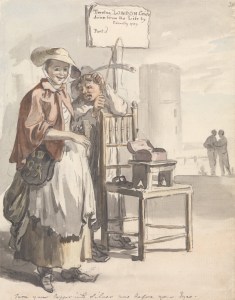
Paul Sandby RA, 1731–1809, British, London Cries: “Turn your Copper into Silver Now before Your Eyes” (Title Page Design), 1760, Watercolor, pen and gray and brown ink over graphite on medium, cream, slightly textured laid paper, Yale Center for British Art, Paul Mellon Collection
Not everyone who’s standing on the corner is up to no good. Some have legitimate business.
In the London of the past, just as in, say, the Manhattan of today, street vendors hawked a variety of goods. Having gone through multiple versions of Cries of London, I’ve come up with a basic list of the items sold on the street.
Love songs
Stationery
Oranges
Boot laces
Reeds for chair mending SaloopSee also salop.
Gingerbread
Muffins
Hot cross buns
Doormats
Cats’ and dogs’ meat
Coal
Lavender
Ribbons
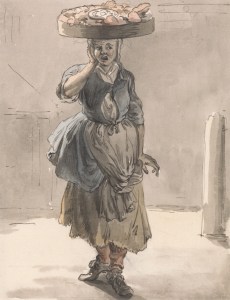
Paul Sandby RA, 1731–1809, British, London Cries: A Girl with a Basket on Her Head (“Lights for the Cats, Liver for the Dogs”), ca. 1759, Watercolor, pen and brown ink, and graphite on medium, cream, slightly textured laid paper, Yale Center for British Art, Paul Mellon Collection
Boot black
Brushes
Flounders
Rhubarb
Walnuts to pickle
Cucumbers
Bandboxes
Baskets
Brooms
Rabbits
Pins
Mops
Wash balls (soap)
Strawberries
New peas
Rosemary and bay
Strings of onions
Turnips and carrots
There’s seasonality to this, of course. Strawberries and cucumbers are not being hawked on the streets of London, Boston, Newport or New York in February. I’ll tell you: being a Cat’s-meat-[wo]Man is practically a childhood dream, since I knew I could never really learn to speak to the animals, and as it happens, Sandby depicts one. It seems there was gender equity in supplying food for pets and stinking of meat.
Paul Sandby RA, 1731–1809, British, London Cries: A Milkmaid, ca. 1759, Watercolor, pen and brown ink with graphite on medium, cream, slightly textured wove paper, Yale Center for British Art, Paul Mellon Collection
I’ve long been fond of the milkmaid, probably because she’s relatively clean, has a cloak for warmth, and I can understand what she does. As much as I love “Turn your copper into silver,” I lack real skill at charlatanry. And gambling. I don’t play poker: my face is too easy to read. Still, if you’re doing this right, there’s a lot to invest in being a milkmaid: kettles (likely pewter), measuring cups (tin? or possibly pewter), and a yoke. It’s a commitment. Cat’s meat– if you’re good with stank and have the right basket*, you’re pretty okay.
If not stank or drank, then gaming. It looks like the object of the game is to knock down the three balls at left in the background by hitting another ball, or perhaps a stone, with the stick. Ha’penny a throw? Maybe you just throw the stick.
Paul Sandby RA, 1731–1809, British, London Cries: Throws for a Ha’penny Have You a Ha’penny, undated, Brown wash, gray wash, graphite, and black chalk on medium, cream, slightly textured laid paper, Yale Center for British Art, Paul Mellon Collection
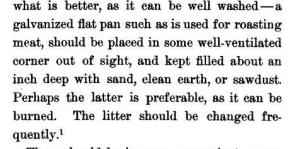
This is another instance wherein I am faced with historical things I don’t know nearly enough about: gambling and street games, pet care and keeping. Cat boxes: when we were they invented? We know cat litter is a 1947 invention, and that sand or ashes were used in cat boxes when cats were kept inside, but for the most part, they went in and out, and mostly out, until cat boxes and neutering became common, though an 1895 manual recommended that “the cat in civilization must be fed, looked after, and guarded in its moments of freedom.“**
Yes, I went there. I looked it up.
It’s more than 100 years after the time I’m investigating, but I don’t want to fall too far down this cat’s meat rabbit hole– but this does tell me that the historical images of indoor cats come with oat or straw filled baskets in sunny corners, and recommendations for galvanized pans filled with sand, clean earth, or sawdust, which may be ideal, as it can be burned.
My point is, there’s a lot to sell on the streets of any town, images to support the material culture and reference books from which we can derive contextual clues to the impression of something as random as a cat’s meat man or woman. I don’t know that I’m leaping to be a Cat’s-meat-Woman, but it leads to a lot of interesting interpretive points about domestic life, pets, and families that visitors can relate to much more easily than street sales. Of course, if you choose to be the Cats-meat-Man, I won’t stop you from calling yourself Mr Friskies.
**Huidekoper, Rush Shippen, 1854-1901. The cat, a guide to the classification and varieties of cats and a short treaties upon their care, diseases, and treatment. 1895: New York, D. Appleton and company
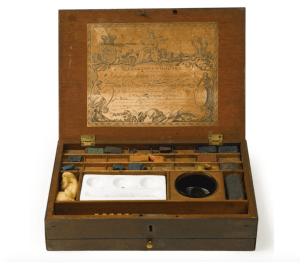
Lot 738, Sotheby’s Sale N09466 REGENCY MAHOGANY PAINT BOX BY W. REEVES & WOODYER, FIRST QUARTER 19TH CENTURY
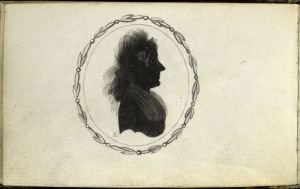
Every young lady of some means would have had a watercolor box suited to her station (they came in a variety of sizes), and young ladies with leisure time occupied themselves with diaries, commonplace books, amateur silhouettes, and paintings. Diana Sperling is one of the better-known examples of amateur artists, with drawings occasionally appearing at auction. The best of these watercolors give us a literally transparent look at the long 18th century from inside.
May 25th. Henry Van electrifying – Mrs Van, Diana, Harry, Isabella, Mum and HGS. Dynes Hall.
Museums try to connect the people of the past to the people of the present, and sometimes in focusing on similarities critical differences are missed.
It’s not just that the people of the past accepted racism, slavery, and sexism. They literally saw the world differently. I’ve watched contemporary amateur artists try to recreate the imagery of the past, and it’s hard. I wonder, as I try my own had at the task, if we can manage it. Color sensibilities were different; taste was different (checks from hell, remember?). My own style is more graphic and bold than an 18th or 19th century artists’– more Fairfield Porter than Edward Malbone.
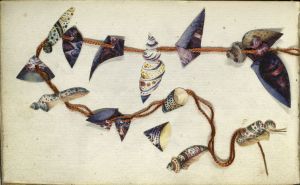
Carl H. Pforzheimer Collection of Shelley and His Circle, The New York Public Library. (1795 – 1834). Threaded shells.
We are, each of us, products of our environment and our time. Can we really recreate the past? We can dress correctly, carry the right stuff (or almost no stuff at all), but how can we overcome our own thought barriers, our own vision? I think it’s by attempting that effort that we can do better at replicating the past whether we try in four dimensions, or in two– and acknowledge the unbridgeable gap to the past.
It’s auction season again, the best one of all: the major Americana sales and the Winter Antiques Show in New York. I won’t be at any of the exhibitions or sales, which is just as well for me; my friends know the twitchy “must-touch” finger motion that means I need to leave my wallet and checkbook in wiser, saner hands.
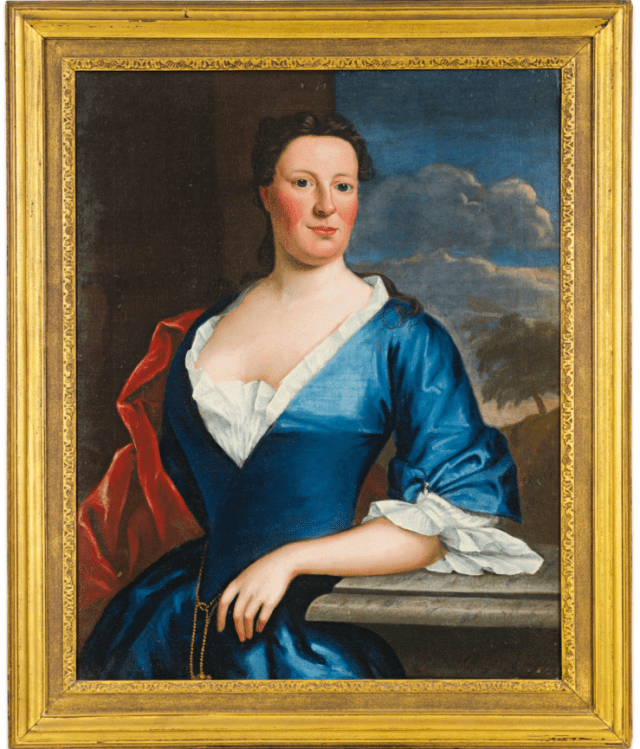
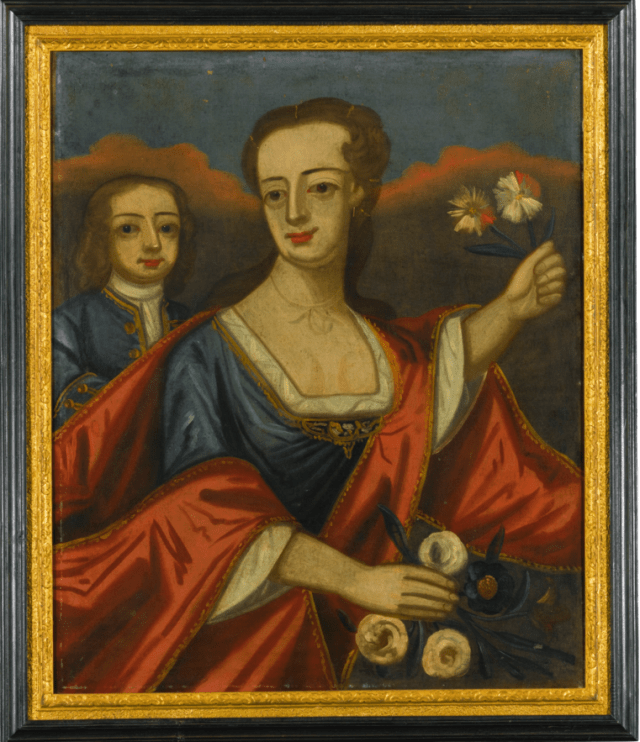
Still, even if we can’t buy, we can learn. This time around, I was delighted by the juxtaposition of two pre-1750 paintings in the Sotheby’s sales.
Robert Feke (1707 – 1752) PORTRAIT OF MRS. TENCH FRANCIS In what appears to be the original frame; Bears a label on the back of the frame: Mr. Willing, Bryn Mawr. Painted circa 1746. Label on the back of the stretcher: Philadelphia Museum of Art, Robert Feke, Portrait of Mrs. Tench Francis, 11-1969-2. Lender: Mr. E. Shippen Willing, Jr. Oil on canvas 36 by 28 1/2 in. Sotheby’s Sale N09456 Lot 1595
Francis. Shippen. Willing. This thing is DEEP in the history of Philadelphia, and by my fave 18th century RI painter.
It was a THING, that blue silk gown business with a red silk wrapper. Better yet? This one:
Attributed to J. Cooper 1685 – 1754 WOMAN WITH YOUNG BOY Appears to retains its original frame attributed to J. Cooper. oil on canvas 30 in. by 25 in. CIRCA 1715. Sotheby’s Sale N09466, Lot 398
What I love about the J. Cooper is how crude it is: that painting looks more like a woolwork picture than a painting. But that vernacular adaptation tells us how prevalent this portrait style was, and how desirable.






 Kirsten Hammerstrom
You must be logged in to post a comment.