Fine Art Friday

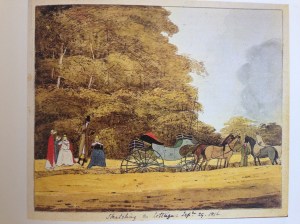
Sketching a Cottage, Sept 29, 1816. Watercolor by Diana Sperling

In a mere four weeks, I will pack the Subaru and head west into New York State as so many Rhode Islanders have before me. And while I will have clothes suitable for the time of the RI Quaker Migration, I will be leaving not to found a more utopian society nor to seek my fortune on a farm. Instead, I’ll be joining some dear friends for a weekend sketching party (minus the horse and carriage).

This new enterprise has required some additional research, and while I look forward to painting miniatures at some point this summer, I suspect this venture will be a simpler proposition. A new dress and apron are the least of my worries: brushes, watercolor boxes, sketchbooks, pencils and pens all require research just when I should be thinking more seriously about the way the Revolution played out as a civil war in New Jersey.

Anne Rushout, ca. 1768–1849, British, 3 sketchbooks of 82 drawings by Anne Rushout (B1977.14.9506-9587), 1824 to 1832, Watercolor on moderately thick, slightly textured, cream wove paper, Yale Center for British Art, Paul Mellon Collection
Anne Rushout, ca. 1768–1849, British, 3 sketchbooks of 82 drawings by Anne Rushout (B1977.14.9506-9587), 1824 to 1832, Yale Center for British Art, Paul Mellon Collection

Still, the Yale Center for British Art has rarely failed me: a simple search for sketchbook turned up a catalog record for three sketchbooks of 82 drawings by Anne Rushout. These are lovely, well-executed landscapes in a fine British tradition, far more sophisticated than Diana Sperling or Sophie DuPont– I fear I will closer to Sperling and DuPont when I take up sketching again, and can at least console myself that my wonky drawings will be part of a fine tradition of ladies’ accomplishments.
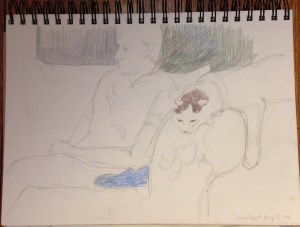
Man and cat, 2004
Man and cat, 2004

The Yale Center for British Art also has a nice Romney sketchbook for Paradise Lost, which demonstrates the cartoon-like nature of preliminary drawings (and I mean cartoon in the old sense, not the Animaniacs sense, though the uses are related). And as I sew my dress of unmatched checks, I have art programming to entertain me: Fake or Fortune, thanks to a tip from Ms B, has provided happy, envious hours of conservation labs, artists’ colourmen, and auction rooms. Vicarious delight, indeed.

Wicked Inspiration

You know that musical? The one you can’t get tickets to unless they were willed to you by your grandmother because she was lucky enough to stumble out of the Tardis right at the box office on opening day, but had to buy them for, like, six years from now, and they’re actually for the Kansas City production? The one in which the founding fathers are, you know, brown? My friends and family assumed I’d hate the whole idea, but I don’t. Like so many people, I love it, and not just for the music, though my preferred method of psyching myself up for GeeDubs1790 or What Cheer Day is listening to the Stones or the Beastie Boys all the way up.

So, what then, interests me in “Hamilton,” and why do I think it relates to interpretation? This: the way that the show filters the concerns of the late eighteenth century through the lens of the twenty-first could make for enlightening listening.

My Shot gives me goosebumps: why? Is it because history and civics are finally sexy?

Maybe. But “Hamilton” as a whole, per Rebecca Mead in the New Yorker, “is a hymn to the allure that America promises the immigrant who aspires to reach its shores; it is also an argument for the invigorating power that this nation’s porous borders, and porous identity, have always offered.”

Porous identity. That’s part of why I’m fascinated. But just as “Sleep No More” and Occupy Providence (really really) were partial inspirations for What Cheer Day, “Hamilton” strikes me as the kind of production worth paying attention to. No, I am not suggesting that the paunchy reenactors start channeling their inner Biggie, though I might well pay to see that.

No, what I’m suggesting is that we reconsider what it is we’re doing out there on the field and in the historic houses, and not just what but how and why. Hamilton takes an unexpected approach to history and it’s going gangbusters, while Amazing Grace tanked. So it’s not about the costuming authenticity, though I implore you not to give that up. It’s about the passion. It’s about coming at things sideways.

What makes you love doing laundry, drilling with precision, telling local gossip, making soap, or whatever it is that you love best about your place in the past? Why does all this matter to you so much? What is it that we can learn about today as you teach us about the past? Let loose that love and passion, share those insights, and ten to one you’ll have more fun and excite more visitors.

Women’s Work

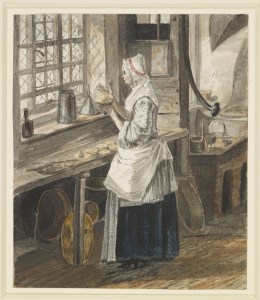
Paul Sandby (1731-1809) A kitchen scene circa 1754 Pen and ink and watercolour | RCIN 914332
Paul Sandby. A kitchen scene circa 1754. pen and ink and watercolour | RCIN 914332

The irony is not lost on me: I do stereotypical women’s work as I struggle to bring a feminist interpretation to a traditionally male hobby: 18th century living history or reenacting.* Even as it irks me, I enjoy being busy and believe in the importance of the everyday, the mundane, the lulls. Life moves pretty fast, as the saying goes, and the moments when you think nothing’s happening are often the most important.

Everyday work is what most of us do, and most of us will be remembered not at large, like Abigail Adams, but writ small, like Bridget Connor. But we matter, and the roles we play and the work we do matters, too, to the people close to us, and the details of our lives– not just the mugs, chairs, and shoes, but the vacuum cleaners and the way we live our lives– would matter to us in two hundred years if we were recreating 2016. So why do we skip over the domestic details?

EnglishBarracks_Malton
English barracks/ drawn & etch’d by T. Rowlandson ; aquatinta by T. Malton. [London] : Pub. Aug. 12, 1791, by S.W. Fores, N. 3 Piccadilly. Lewis Walpole Collection

Look: if  mopping barracks is good enough for Kubrick, it’s good enough for me, especially when you consider that the military understood the importance of hygiene in the 18th century, and that there are multiple treatises to be found on the subject, freely available online. Keep them barracks clean.


Observations on the means of preserving the health of soldiers and sailors : and on the duties of the medical department of the Army and Navy

So I clean barracks, as a means of bringing the everyday back to life, because daily life, even in the military, is in fact remarkably mundane and domestic, centered not around the glory of battles but around the minutia of cleaning barracks, washing clothes, and preparing food.

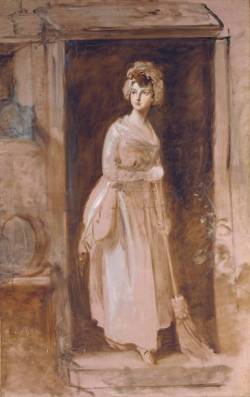
Thomas Gainsborough, The Housemaid. 1782-86. Tate Museum, Presented by Rosalind, Countess of Carlisle 1913, N02928

Is this also the feminization of masculine space? Perhaps it is, in the way that our culture associates indoor domestic tasks with women. Either way, maintaining hygiene and cleanliness within a military environment is  documentable in detail and a critical, if sometimes overlooked, area of interpretation.

* I use living history to describe the re-creation of daily life. Re-enacting or enacting [the past] is, I think, better used for events of either military or date-place-and-time specific historical commemorations.

Zen and the Art of Living History

sandpitGate
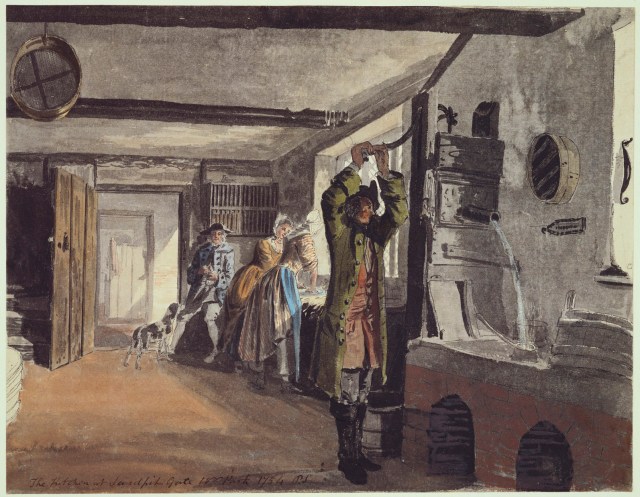
Paul Sandy. The Kitchen at Sandpit Gate, ca 1752 RCIN 914333

or, Embrace the Everyday

Chop Wood, Carry Water is taken from a Zen saying: Before enlightenment, chop wood, carry water. After enlightenment, chop wood, carry water.

Yes, I read the classic book decades ago when my life had fallen apart pretty completely, and when I dismantled it again recently, similar principles applied. After processing archival collections, sorting sewer bills and love letters– toiling in the salt mines of the mundane–I came to appreciate Chop Wood, Carry Water even more. The world isn’t really binary, but it can feel that way.

Paul Sandby. At Sandpit Gate circa 1752 Pencil, pen and ink and watercolor. RCIN 914329
Paul Sandby. At Sandpit Gate, ca 1752 RCIN 914329

We look up out of the trench of daily life and think we see giant, heroic figures doing great things, and we feel jealous. We want to feel special. Some of us want to feel pretty, or handsome, or important.

Some of us want to chop wood, carry water.

Paul Sandy. The Kitchen at Sandpit Gate, 1754. RCIN 914331

The way to make living history more interesting and more relevant is to go deep into the everyday. I don’t mean spinning– unless you tell me why you’re spinning, and I hope it’s part of Boston’s failed “We’ll make it all ourselves!” Little-Red-Hen experiment of the late 1760s–I mean living. Everyday things.

Dishes, laundry, three meals, sweeping, making up beds, mending, chucking the cat out the window, checking on dinner, chucking the cat out the window again. That’s the background against which all of the Great Men and Remembered Ladies stride and saunter. Us. You and me. Waking up with frowzy hair, blinking in the pale light of dawn. That’s the world the Great Men woke up in. That’s the world they occupied most of the time.

When we recreate Great Moments, we’re only replaying the highlight reel. Without context, those moments have less meaning. You’ve heard this sentiment before.

Chop wood, carry water. Embrace the everyday, bring everyone back into history.