LBJ Had a Question

Swearing in of LBJ as President

In 1963, Lyndon Baines Johnson was inaugurated as president on a hot, over-crowded airplane on the tarmac at Love Field outside Dallas. He had spent the years since JFK’s inauguration in 1961 becoming increasingly irrelevant, unnecessary, and humiliated. All the power that LBJ had built up first in the house and then in the senate–the place where he became the master of power, process, and of men–all that power was gone.

The Treatment: LBJ & Chicago’s Mayor Daley

He knew what lurked in the hearts of men, and knew how to use it or to buy it. He knew how to get things done, good and ill. It was Robert Caro’s recent book, The Passage of Power, that fully explained to me how kickbacks work. LBJ didn’t get rich by working hard in the conventional way. And yet: he never forgot Cotulla, Texas. Never forget the road gang, never forgot working hard with his (admittedly enormous) hands.

LBJ and MLK at signing, Voting Rights Act, 8-6-1965

With the benefit of hindsight, does LBJ become clearer? We can never forgive him Vietnam, but we can remember the 1964 Civil Rights Act, the Voting Rights Act of 1965, and the Great Society. Johnson’s hero was FDR, his model the New Deal. In late 1963, when an ally told him that the fight for civil rights was a lost cause, Johnson had a rebuttal, according to Robert Caro.

“Well, what the hell’s the presidency for?”

Johnson, not elected to the office he now held, and with another election about to swing into gear, asked that question. What was the presidency for, but to fight for lost causes, noble causes. Why else would you work so hard to build political capital, but to spend it?

What the hell’s the presidency for, but to fight for what a nation, or a nation’s most vulnerable people, need?

LBJ was corrupt, profane, adulterous, and coarse. I can’t say what he would have done in the political climate today, but the question he asked is worth asking today.

All images from the Lyndon Baines Johnson Presidential Library‘s photo archive.
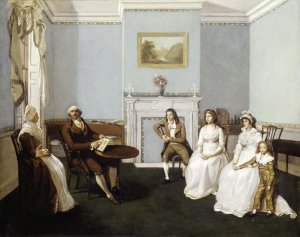
Domestic Bliss

Museum of London
Museum of London, John Middleton &tc

I’ll come back another time to John Middleton & His Family, 1797 from the Museum of London, but today, this group portrait represents one of the online galleries at The Geffrye Museum of the Home in London. Their website has some nice features, and while I did get distracted playing the Topsy-Turvy Timeline game, what I really like playing with exploring is the Life in the Living Room 1600-2000 gallery.

The Geffrye Museum

This has proven useful in keeping on (slightly distracted) track as we polish silver and think about lighting, entertaining, and the ways rooms were used in the past. In particular, since we settled on the idea of setting a formal table for the “holiday themed tours,” and on the After Dark tours, I’ve been thinking about lighting.

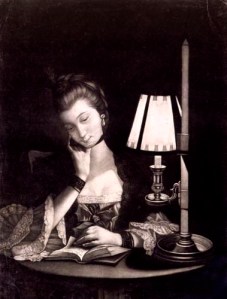
Not only is it clear that the expansive use of candles represented expense and disposable income, it’s also clear that it was uncommon. Special occasions on high-style homes: yes. Everyday use in middling homes: no. Even the charming and well-dressed lady reads by just one candle (though that is also a composition choice, and not purely documentary).

More hilariously to the point, this satirical engraving from the Lewis Walpole Libary:

The Pantry Apparition
Lewis Walpole Library, The Pantry Apparition

Consider the Chicken

https://i0.wp.com/farm9.staticflickr.com/8311/7995409969_f925f8a7eb_n.jpg
Nobody puts Dumber in a pot

With apologies to the late David Foster Wallace

The majority of us do not consider the chicken. We may consider whether the package of chicken we purchase is free range, organic, cage-free, grain fed, cruelty free. But we are unlikely to think about the implications for the physical being, the essence of chicken-ness, that the chicken’s conditions create for it.

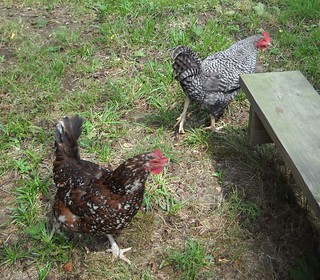
And I am here to tell you that the cage-free, organic, free-range chickens and chicken parts that you purchase at Whole Foods or your other large vendors bear little to no relationship to the actual free-range, catch-as-catch can, ne’er-do-well chicken of the historic barn yard. For one thing, living history chicken is ripped.

https://i0.wp.com/farm9.staticflickr.com/8205/8243387583_072e352ff9_n.jpgIt’s well-developed physically, with strong, sturdy bones and robust ligaments. Its musculature is tight: this is not a bird in need of a personal trainer. Its meat, when cooked, is not white. It is dark meat, not so dark meat, and sort-of white meat. Its taste was described to me as gamey, but I disagree. It was chicken, but earthy, sweet and fresh and rich.

But all that came after the meeting of human, knife, and chicken.

Disassembling the chicken fell to me; I declined rubbing butter into flour having prevented a fall down cellar stairs by putting my hand in fresh goose guano, so I after I washed my hands, I addressed the chicken in its bowl, and took up a knife.

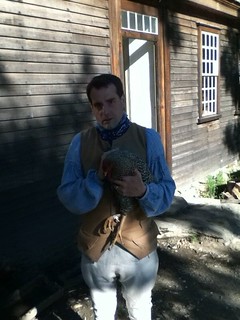
Dumber & Friend

By this time, post-carrots, -parsnips, -squash, -string, -tallow and -suet, the knife lacked the purest essence of knife, that is, sharpness. But it functioned well enough for the task, with some persuasion. The skin was much thicker and more resilient than a store-bought chicken, and greasier, though not in an unpleasant way at first. The muscles were well-developed, and pink. Rosy pink, deep pink, dark like wine. There were no large slabs of the shiny, flaccid, pale meat you find on the chickens in the store. Those aren’t chickens any more: those are products.

The process of quartering the chicken took strength and pressure on the knife, and the strength of my hands. I did have to rip joints apart, and break the carcass’s back. All of this had a sound, and a mild smell of chicken, mixed with the melting tallow. But it was the sound that, with the greasy, slick knife, and the grease that soon covered my hands and wrists, that kept bringing me back to what I was doing, and that, when the bird was broken apart and in the pot and my hands washed, again (they itched), send me outside and up the hill for air and sky.

We boiled the chicken in a kettle we’d already boiled crook neck squash in; later, we added sage, thyme, parsnips and carrots. It was delicious. The broth was incredible, and the whole meal very simple. That’s the whole of the recipe: boil a chicken, add herbs and root or fall vegetables, boil until done, serve. Use any uneaten broth and bones/meat for  stew, pie or other dishes. That’s it.

The product chickens from the market are bred to fall apart. They haven’t got what a running, pecking, eating everything chicken’s got in muscle, ligament, and tendon.

On Sunday, after we came home, I looked at the food in our cupboards. There were boxes, cardboard, plastic, layers of packaging. The cheese was square. These things came from the good market, but were they food, or were they products? I felt like a passenger on the ship in Wall*E, and I was appalled.

Working Weekend

https://i0.wp.com/farm9.staticflickr.com/8482/8239978492_81e339d5fe_n.jpgThis is the house at the farm museum where we went to work on Sunday. That bright orange under the window is squash. The part painted red is an office addition and not interpreted space.

This is the view from the site.https://i0.wp.com/farm9.staticflickr.com/8062/8238909459_f9165ff136_n.jpg It is not exactly what the tenant farmers would have seen, even discounting the power lines and road surface.   But even with the caveats of constant change in mind, I do not have access to a better lab for understanding the past. There are times when even the smart and sophisticated among us cannot come up with a better (just between us) interpretation than, “1799 sucked. And it was greasy.”

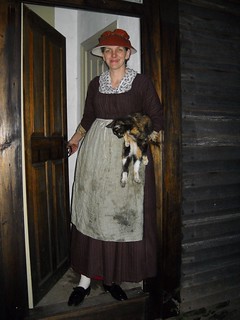
https://i0.wp.com/farm9.staticflickr.com/8210/8238912881_454a7e8b67_n.jpgThat’s not what we want the visitor to learn (everything in the past was hard) though sometimes I fear that is all they take away. Callie, seen here swearing in my hand, was trying to take away leftover chicken and so was taken away herself.

The more time I spend stooping to reach a vat of tallow, or tearing a chicken carcass apart with my hands and a dull, greasy knife, the more I think that what we fail to grasp is not that people thought differently in the past. It’s why they thought differently.

Lives could be a great deal smaller: tasks were hard and all-consuming. Even as I realized that work would be faster with greater familiarity, I also saw that repetition would not breed enlightenment, because increased speed would only make the next task come more quickly.