Petticoat Burns

Per Hillstrom, Kitchen Scene

You know this site, right? History Myths Debunked examines the stories about the past many like to think are true, and Death By Petticoat is one of the favorites. Here it is on an English site catering to reenactors. There’s a variation I’d never heard, about wetting petticoat hems to keep them from engulfing the wearer in flames. (OK, mild exaggeration: to keep the petticoat from igniting fully, thus… hat tip to Back Country Maiden for pointing this out.)

As someone who just finished mending a petticoat, you’d think I’d leap at the chance to drench my hem in water to prevent future mending episodes, but not so. For one thing, in the house or in the camp, that’s water I had to haul or cause to have hauled, and I’m not wasting it. Wet the hems and what’s next? Caked lumps of ash, mud, and.or other filth. No thanks.

High-tech historical cooking

The burns I got in my dress were acquired at the end of the day when we were hearth cooking and were practically in the fireplace ourselves. That is where you must be if you wish to stir the sauce until it thickens, and there was the hoisting of roast in its pan a couple of times, and general playing with fire in pursuit of food. My ca. 1799 dress is longer than my 1770s petticoats and gowns, and the extra inch or two probably contributed to the burns. But I wasn’t engulfed by flames, because the damn thing is wool. Self-extinguishing wool, worn with linen and wool petticoats and a linen apron. not going to go up in flames. Also not going to get dipped in water–and wouldn’t that result in steam and hence scalded shins?

I don’t know where these rumours start, but they could have started with a cynical curator joking with house tour guides who failed to get the joke. Not that I know anything about a story of about Providence kitten named Georgie in honor of George Washington’s visit to a large brick house on a hill .
A Visit with the Ladies

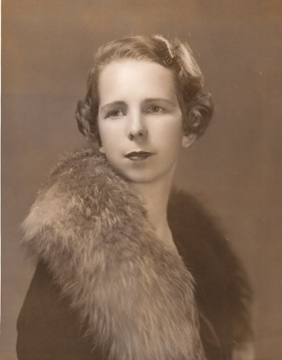
The apple never falls far from the tree, my mother used to say, of me and my grandmother, her mother, Elsa. Elsa went to a woman’s college, majored in botany, graduated in the mid-twenties, and went back to western New York State, where she opened an eponymous dress shop.

Elsa, Studio Portait ca 1935
Elsa, Studio portrait ca 1935

Elsa managed that shop for more than 50 years, dressed most of the women in town (or at least the type of woman who knew how to dress, and be dressed), and even dressed a woman who later became a donor to the architectural collection I managed in St. Louis.

She was a controlling woman, no doubt, and carefully managed and cared about her appearance. She was also a lady of a steely, ladder-climbing type native to the 1940s and 1950s, full of the foibles and desires of the daughter of immigrants who spoke Swedish at home. The stories they told about her would make a cat laugh: the day the local radio station called and Elsa answered the phone (on air? That part was never clear) to find out that the household had won a month’s supply of white bread.

“Oh no,” she said. “I don’t believe we care for that,” and hung up.

Not of the quality to which she had become accustomed, you see: she insisted on some picky particular white sandwich bread for fancy lunches, and otherwise ate the limpa rye the cook or  Ingeborg made. All the household help was Swedish, as were the women who did alterations at the shop.

Elsa married late, at 35, and her husband moved into the house she shared with my great-aunt and their father, August, known as Morfar after my mother was born. Buying trips to New York for her store resulted in the delivery of boxes from Saks Fifth Avenue, deliveries that came so often, in such quantity that my grandfather questioned her.

“I don’t know,” she said. “They just keep sending them.”

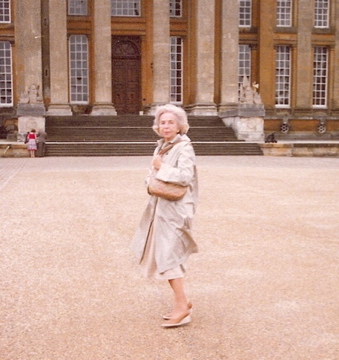
Elsa in Italy ca. 1980

They were boxes of shoes, spectators and sling backs, pumps, court shoes, Cuban heels, stilettos, peep toes, sandals, every kind of shoe you can imagine, and all in brown, tan, beige, ecru, off-white, cream, none of them black or red or blue or green. Beige: that was her signature color, beiges and browns with occasional accents of coral or green or gold. She assigned blue to her younger sister, my great-aunt Gladys, and when Gladys once dared to buy a beige dress she liked, Elsa had a temper tantrum. A quiet one, but effective.

She died before she could meet my husband, died before I was married, and I am sorry about that. But I remembered her this week when I went with my friend (and Registrar) to visit two older ladies, sisters, on the East Side. We picked up a collection of clothing worn when the two ladies (now in their early 90s and late 80s) were babies, the wedding dress their mother wore in 1918, the dress one wore in 1939 that her daughter wore again in 1970, with quite the wrong black moccasins, at a Christmas Eve party in Georgetown.

The sisters reminded me of my grandmother and aunt, and the clothes reminded me of what my grandmother sold and boxed and wrapped in her store. Sitting at the mahogany table for lunch, drinking tea and eating a slightly stale roll, I missed Elsa and Gladys terribly, but was glad for all they’d taught me about how to behave and what the world was like for independent women in the 1940s and 1950s

Sleeping 18th Century-Style

the_idle_servant1There was a mild flurry about a year ago around the release of Evening’s Empire, by Craig Koslofsky. Like the 2005 book by Roger Ekirch, At Day’s Close: Night in Times Past, Koslofsky’s book examines pre-electric lighting patterns of behaviour at night, including sleep patterns.  The BBC has a nice article on the two here. Both Koslofsky and Ekirch assert that until the 19th century, humans typically slept in two blocks of about 4 hours each, and scientists confirm this natural tendency.

Last year, between December and March, I had the luck to test this theory, and once again, it seems I will be sleeping old school, in blocks of time. Unfortunately, these blocks of time are often 2 hours and not 4 hours, as the scientists and historians claim we need. User testing of one shows me that 2 hour sleep blocks (or 4 hours followed by 2 hours) are inadequate and I may be near-hallucinatory by March, just as I was last year.

When doing living history, its always better not to skimp on resources.

Linings, perhaps not Silver

MMA, 2011.104a–c, Silk & linen suit, 1780-1790

The house is cleaned up for Christmas, which means all the sewing things have been put away, which is rather sad. Cassandra is banished to the basement, fabric stashed and stacked. It’s only ten days: better if I don’t count all that lost time when I could be pleating! Better to finish up some portable plain sewing, like shift and shirt.

On Friday, I spent part of the morning in the Cave of Wonders known as Textile Storage with a historical costume expert who specializes in men’s clothing. He had already promised to leave and sworn not move in before I opened the door, and that was probably a good thing. But I got a chance to ask some questions and here are the answers.

The frock coat tail linings of calendered linen: Nancy wanted to know if they didn’t stick to men’s breeches, linen catching on broadcloth, in the plainer suits. No, my source says, because the linings were slick. That was the point of the glazing. When it was new and fresh, it was much slicker than it is now. After 220+ years, slickness will fade. Calendered fabric has been pressed and heated, and that process makes it slick. If you’ve ever pressed a wool dress with too hot an iron, you might have achieved a glossy, slick finish that you weren’t expecting. Calendering is similar, but on purpose.

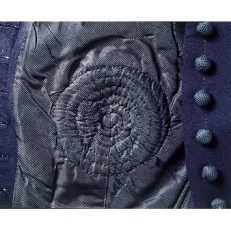
Incroyable-No3-detAnd then there’s padding. Sabine made an amazingly beautiful jacket based on an original. The lining is really interesting, because it is padded. Well, that padding is about style. In the plate at left, the shoulder line of the jacket is high, and the collar rises up as well. The chest is rounded, as we can see along the side. The way to achieve that look is through tailoring, including the use of padding.

The militia jackets in the collection at work include one with some pretty intense (several inches thick) padding in the front. That was for line, not repelling bullets, or even so much for warmth. The padding we find in men’s and women’s tailored clothes is about style, and maintaining a line. You’ll see this often in women’s riding habits or “Amazones.”

V&A T.158-1962
V&A T.158-1962
V&A, T.158-1962, overview

On pages 160-161 of Nineteenth-Century Fashion in Detail, there are two examples of padding used to shape garments. The first is a riding habit, seen here in detail and in overview. (Click for the record & larger views.) The padding here has been used to create the smooth, conical silhouette.