
Anachronisms, ahoy!

Deborah Sam[p]son (Gannett), oil on paper by Joseph Stone, 1797. RIHS Museum Collection, Gift of Jesse Metcalf, 1900.6.1

There’s a petition circulating in certain government circles in support of a campaign to give Deborah Sam[p]son her very own stamp. This is, in part, fueled by the upcoming 250th anniversary of the founding of Sharon, MA.

I’ve got no problem with that—commemoration is something we humans do and need. And Deborah Samson’s is an interesting story, but possibly not for the reasons cited in the letters from officials who shall remain nameless. They describe her as “a pioneer of promoting women’s rights and eliminating gender barriers” and “a trailblazer for gender equality,” phrases that would have been just about nonsense in the Revolutionary war period.

And that’s my problem with it: the anachronistic representation of a woman’s story, bent to the purposes of the present. Don’t get me wrong—I’m a feminist, I’ve enjoyed Deborah Samson’s story since I read about her as a kid in one book or another, so I sympathize with the Stamp Movement.

What makes me crazy is bad history.

Hannah Snell, as depicted in an excerpt from "The Life and Adventures of a Female Soldier," the narrative of the most famous cross-dressing British soldier of the century. It appeared in Isaiah Thomas's New England Almanack (Boston, 1774). Printers recycled the image on other imprints. American Antiquarian Society.
Hannah Snell, as depicted in an excerpt from “The Life and Adventures of a Female Soldier,” the narrative of the most famous cross-dressing British soldier of the century. It appeared in Isaiah Thomas’s New England Almanack (Boston, 1774). Printers recycled the image on other imprints. American Antiquarian Society.

In Masquerade, Alfred Young tells Sampson’s story well, busting myths that both we—and she—created. (This short bio is a good overall sketch of Deborah’s life. ) What struck me the most about Deborah Samson’s life was the lack of certainty, stability, and material comfort. We’ll never know the specific circumstances that led her to enlist, though Young does yeoman’s work to unearth everything he can about her life and circumstances, and the context in which she lived.

I’m not an unbiased reader—I did get a little shouty on the third floor when I read “trailblazer for gender equality,” and that phrase has lingered and grown tattered as my colleagues and I have chewed it over—but Young’s point about women of the lower sorts is well taken.

Here’s an excerpt from an interview with Young about the book:
“In cross-dressing, Deborah was like a good many other plebeian women we are discovering who were in flight: to escape indentured servitude, to avoid the shame of a pregnancy, to get out of the reaches of the law, and so on. But to explain why she carried it off so long, you have to fall back on her skills and resourcefulness.”

So much for that pioneer of promoting women’s rights—Samson was a pioneer in skillful deceit (no mean feat) and in using that deceit to further the main chance, that is, Deborah Samson’s chance. What’s wrong with that? I like that better, and that’s my bias and my interests.

Reading about Deborah Samson helped me think about Bridget Connor and the women like her, probably less skilled and less educated than Samson, probably even more impoverished. It’s a mysterious mix of personality and circumstances that drives us all, but considering what we can know about Deborah Samson helps us understand her not so much as a pioneer for gender equality but as a self-interested human being acting for herself despite the barriers of class, education, and gender. And that can help us understand the people we can know even less about, like Bridget Connor.

For a taste of historical prose, you can find an annotated version of Samson’s story written by Herman Mann here, at Harvard University Library’s digital page delivery system.
The Monuments Meh

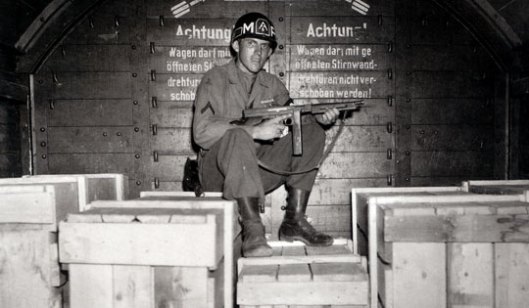
GI guards works of art stolen by the Nazis

Mr S and I went to the movies on Saturday afternoon to see the long-awaited Monuments Men movie. It had been the hotly anticipated film in my set– guns, art, George Clooney: what’s not to like? We knew the history would be bad, we expected inaccurate museum practices, but still. The ingredients were sound, how bad could it be?

Well…not so bad that I’m sorry I went to see it, but sadly lacking in oomph. When a movie has a website that includes lesson plans, maybe you should not be surprised by its leaden, film-strip qualities.

I’d read the Times review, I knew what I was getting into when we bought our tickets, and we bough them anyway. Art, guns, Clooney, remember?

Here’s what I thought, in somewhat random order:

That movie’s not done. The soundtrack is horrible and needs to go. Also, the voice-over. George Clooney can read me the dictionary at bedtime any time, but the kill the heroics. Please.

But that’s just a symptom of the film and director’s insecurity. This movie isn’t brave enough to be convinced of its own mission, not unlike museums today. It keeps trying so hard to sell me on the idea that art is humanity, our collective soul, that must be saved and is, in fact, worth a life. Dude, I bought that program before I was 12. To toss a cliche back, Just believe. Everything else will follow. If the film, the director, and the star keep trying to sell me on the principle idea, there’s something wrong.

A Rembrandt self-portrait recovered at a German salt mine that had been used as a storehouse, with Harry L. Ettlinger, right. Monuments Men Foundation

There’s no clear enemy, and that leads to the film’s core flabbiness: no tension. Clooney looks slender as I expect my 1940s-era heroes, but the center doesn’t hold. Narrative, dramatic films need tension. (You know, plot.) “Get the art before something bad happens” doesn’t quite do it. Before Hitler burns it? Before the Soviets scoop it up and haul it back to the USSR? Ultimately, Clooney doesn’t need Nazis or Soviets as enemies: his real enemy here is time.

Surely Mr. Clooney schooled himself in the one of the loopiest but most entertaining WWII caper films, Kelly’s Heroes. Acting out of pure self-interest, a group of American soldiers on 3 days R&R race 30 miles behind enemy lines to steal $16 million in gold. It’s not great art, but this is a good movie. Anachronistic? You bet. Oddball is an unlikely character, a Joseph Heller minor figure crossed with a healthy dose of filthy hippie. Crapgame’s a stereotype and so is Big Joe. But there’s tension in this movie, helped along by a pleasant lack of music, which allows us to experience the crunches, thrums, clicks and booms of war. A few scenes in The Monuments Men refer to Kelly’s Heroes (Goodman and Dujardin’s scene on a road is reminiscent of a road ambush in the Eastwood film), but the places where you might expect to find parallels, I found the Eastwood film better. (Yes, we went home and watched it.)

And then there’s Sam Epstein from Newark via Germany. This Monuments Men character left Germany in 1938, with his parents, but his grandfather stayed behind. By 1944/1945, his grandfather had not been heard from in 4 years, but the family knew he’d been sent to Dachau. Though the family lived in a town with a museum with a Rembrandt self-portrait, Sam has never seen it; they weren’t allowed into the museum, because, as the grandfather said, they were ‘too short.’ Why can’t the film confront the confiscation of Jewish property more directly? Why can’t it do a better job with the Holocaust than Clooney’s scene with the German officer? There’s brief scene with a barrel of gold that is absolutely chilling: and I think the film would have been better served with more upfront recognition of that barrel’s contents, what ‘too short’ really means, and the pervasive anti-Semitism of most of the world in the 1940s. (Gentleman’s Agreement, anyone?)

I don’t know enough about the actual history to quarrel over that, and while I will hunt up the books and read them, I was more taken with what seemed like obvious cinematic, movie-making failings– the “I’m heroic!” soundtrack, the lack of central tension, and the curious blindness to, or oddly tangential portrayal of Nazi racial hatred that fueled confiscation programs.

(For another movie about French resistance to Nazi art theft, there is always The Train: Burt Lancaster, art, and guns.)

I wish Clooney had been more willing to frighten us, to make a Saving Private Ryan about saving (or failing to save all of) the art. Feeling the losses and the failures more might have let us see the greatness, the monumentality, if you will, of what the team did accomplish.

Pluses: Good costuming with uniforms that age over time. Plenty of hardware.
Minuses: Soundtrack, unconvincing replicas of masterpieces. Also, nobody had 2014 Hollywood teeth in the 1940s.
Damn terrifying: The vision of Clooney to come in the final scene.

Book Notice: Wearable Prints, 1760-1860

This just in, literally, from the mail carrier: Susan W. Greene’s long-awaited book, Wearable Prints, 1760-1860. It’s discounted (and out of stock) at Amazon, but should be shipping soon, since I have one right here on my desk.

It’s fair to call this book lavishly illustrated (1600 full-color images in almost 600 pages), and while I have access to a copy at work, I am seriously thinking of buying my own copy, based solely on about 10 minutes skimming the book. There are images not just of fabric samples but also of garments, paper dolls and illustrations that help put the fabrics into context. Images of garments from collections I can’t get into? Delicious! Information to help me understand how to use a printed cotton? Even better.

The book is organized in three main sections: Overview, Colors, and Mechanics. Appendices include timelines, prohibitions, price comparisons, print characteristics, and more, as well as a glossary and an extensive bibliography.

The photographs are amazing, and show a range of print designs of greater variety than we may have credited heretofore. Particularly useful is the section on evaluating and identifying printed dress fabrics, and the questions one should ask about fabrics. I think that the criteria could be used forensically on modern as well as historic textiles, and we could think more critically about the fabrics we use.

ETA: I wrote this while the downstairs room was being painted with oil paint, and it’s loopier than I expected. The book is still an excellent resource, and I highly recommend it. While it’s heavy for carrying to the fabric shops, it would be dead useful while shopping online. I have definitely seen bolts of fabrics very similar to those illustrated in Greene’s book. As Anna notes on her blog, Ms Greene’s collection is now at Genessee Country Village.  Wow. It’s amazing. If you can’t get there easily, well, the book will certainly help, and the images will you visual access to a plethora of collections. 

Les Oublies

Les Oublies. Le Bon Genre Plate 79: three ladies and a child look at a sundial in a garden, watched by a man. August 1815 Hand-coloured etching. British Museum 2003,U.14

I was first attracted to this image by the gentleman and his shapely legs, as you might expect, since tight buttoned gaiters or overalls do turn my head. This plate doesn’t make much sense to me: I can’t really grasp the satire, I can only guess. The explanation given for the series doesn’t help immensely. “The series is devoted to costume, mostly set in fashionable interiors, but the plates are treated in a semi-caricatural, humorous way that links them with French social satire.”

My best guess is that this plate from 1815 is showing off the latest filmy white fashions and tiny pink Spencers in contrast to the forgotten origins of the classical influence, personified by the gentleman in common dress at left. His hat and the gaiters suggest the French revolution, now forgotten (see “oublier” though the reference is also to the small cakes being eaten by the woman under the tree). The clock provides a reference to the passing of time, and forgetting, but I don’t think it is actually a sundial. The strap makes it look as if the man can carry it, and that’s a needle, not the fixed vane of a sundial.

Whatever it all means, I do find this more interesting for the man’s clothing than the women’s; after a while, the subtle differences between white columns is lost on me, but that’s a pretty interesting buff-colored waistcoat.