Looking for a Ship

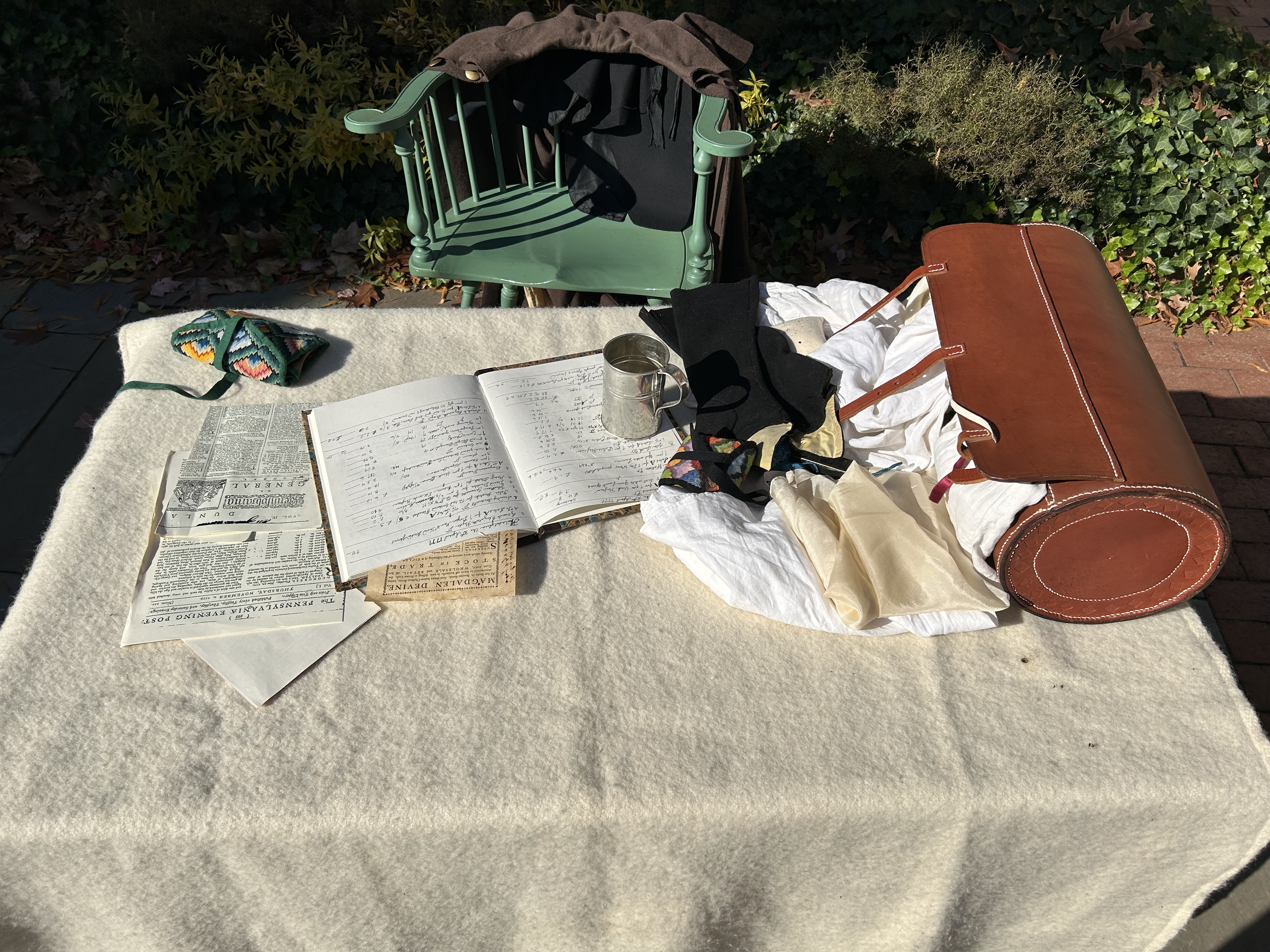
a table covered by a blanket with reproduction newspapers, a ledger book, and a leather bag
Collecting debts and packing up.

This past weekend (November 1-2) at the Museum of the American Revolution’s Revolutionary City (Pre-Occupied) event, I was pleased to represent Magdalen Devine, a feme sole trader in Philadelphia who ran a mercantile business between 1762 and 1775. Devine’s situation in 1775 reflects the tensions and uncertainties felt by many at the start of the American Revolution, and continues to resonate today.

a printed broadside advertising textiles for sale by Magdalen Devine in 1775
Broadside, Magdalen Devine, printed by John Dunlap, n.d. [1775] Historical Society of Pennsylvania, Ab[1780]-16

In 1775, Magdalen Devine, “being determined to leave off business,” advertised that she was selling “at Prime Cost, for CASH ONLY, WHOLESALE AND RETAIL, all her STOCK IN TRADE.” Devine first appeared in a Philadelphia newspaper ad in September 1762, selling imported goods with her brother, Frances Wade. By the following spring, the siblings had dissolved their partnership, and Magdalen had set up her own shop in Second Street between Market and Chestnut.

Devine’s ads reflected a keen sense of merchandising, including woodcuts illustrating printed and check fabrics and tightly wound fabric bolts. For more than a decade, Devine imported and sold goods on Second Street, eventually moving into a house she owned that was equipped with “two show windows with very large glass,” probably among the first instances of London-style shop windows in Philadelphia. 
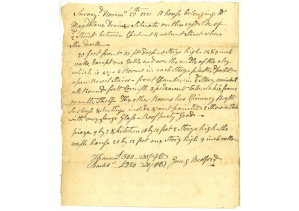
Fire Insurance Survey, “A house belonging to Magdelane Devine.” Insurance Survey S01561

For more than a dozen years, Devine traveled between Philadelphia and London, selecting, importing, and selling “a large and neat assortment of European and India goods.” The chintzes, linens, cottons, and woolens that Devine imported represented the wide range of textiles available, many with specific applications from jean cloth for clothing enslaved workers, tickings for mattresses, and hair cloths for sieves along with the chintzes, taffeties, and superfines that dressed the city’s elite. 

By April 17, 1775, she had “determined to decline business, as she intends for England shortly” and published ads in the Philadelphia newspapers calling in debts. Although she initially gave debtors two months (until mid-June), in August she was still in the city and advertising her intention to put debts “into a lawyer’s hands” if not paid within two weeks. An August 30th paper reprinted her ad of August 1, suggesting that the debt collection was not going as she’d planned in April, and the weeks and months kept stretching ahead. The ad placed on August 30th suggests she planned to leave not later than September 15th.

This slideshow requires JavaScript.

Unfortunately for Devine, mid-September saw a slowdown and stoppage of ships coming in and going out of Philadelphia. By September 18th, no ships were reported outward bound from the city. Magdalen Devine was stuck. 

A woman in a brown eighteenth-century dress with a straw hat and a white apron, standing in front of a painted door set into a brick wall.
“Magdalen Devine” dressed in brown silk with a new straw hat.

Did she get out on an early September ship bound for Cork or Dublin, and make her way from there to England? Perhaps, but it seems more likely that she miscalculated and was caught in the city as insurers, shippers, and sea captains struggled to make sense of the news from Boston, Providence, and London. Newspapers published English threats to burn all the port cities of the American colonies, and warships plying coastal waters from North Carolina to Maine surely made sailing seem unwise. 

Why did Magdalen Devine decide to close her business and leave Philadelphia for England? Just one year before, in 1774, she had acquired the shop with the “two show windows.” What made leaving a good idea? The threads are hard to find, let alone pull, but perhaps her childhood and young adulthood in Dublin suggested that the violence the British were willing to use against a rebellious colony. Famines and strikes in the 1740s prompted British reprisals against a country that served as a laboratory of colonialism.
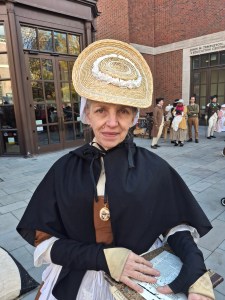
a woman in a straw hat and short black cloak
With my ledger in hand– and a fabulous new hat.

In the absence of passenger lists, it is hard to know whether Devine made it back to England in 1775, or whether she had to wait until 1783. We know she made it to London, because her death is recorded there in late 1783. 

Resources on the English in Ireland 

http://www.sneydobone.com/webtree/history-ir.htm

https://www.tcd.ie/news_events/articles/2023/how-ireland-served-as-a-laboratory-for-the-british-empire/

https://www.nam.ac.uk/explore/timeline-ireland-and-british-army

https://daily.jstor.org/britains-blueprint-for-colonialism-made-in-ireland/


A Milliner’s Wardrobe

Among the things I ponder about Anne Pearson Sparks is what she wore, and how much clothing she had. She would have seen the latest fashions and fabrics when she traveled to England to buy millinery goods. How did she translate those styles for her Philadelphia customers, like Mrs. Cadwalader, and how did she interpret them for herself? It’s largely unknowable since there are no known images of Anne. Probate inventories provide insights into the quantity and type of clothing women had in the 1770s. They skew higher income since people without wealth had so much less to leave, but given that Anne Pearson owned her own house, and had a £2700 marriage settlement, she certainly had means.

(Above right, Portrait of a woman by Charles Willson Peale, ca 1775. Metropolitan Museum of Art Accession Number: 26.129.2)

The February 1778 inventory of Mary Cooley’s estate, digitized by Colonial Williamsburg, provides an extensive list of clothing and other items owned by a York County (VA) midwife, including 10 gowns, 6 petticoats, 9 shifts, 5 pairs of shoes (4 leather and one black satin), 15 caps, 9 “chex” (checked) aprons, and 4 other aprons, presumably white. The type of gown is not specified, that is, they are not itemized as “nightgowns,” “sacks,” or “negligees,” though there is an additional wrapper. No bedgowns appear on the list, and there is only one pair of stays. Since only items with value (i.e. sale value) were listed, Mary Cooley’s total inventory probably included bedgowns. The clothing worn by the enslaved woman Bett and her child Peter was also probably not on the list. Bett and Peter appear at the end of the list after items typically found in a kitchen, where they probably worked, lived, and slept; it is likely their clothes were few and had no value.

What does Mary Cooley’s list suggest for Anne Pearson?

The gowns include:

  • 1 Brown damask Gown 60
  • 1 black Callimanco Gown 60
  • 1 Striped Holland Gown 70
  • 1 dark ground Callico Do. 70
  • 1 Callico Do. £5 
  • 1 flower’d Do. £7 
  • 1 India brown Persian Do. £3..10/
  • 1 Purple Do. £5 
  • 1 flower’d Crimson Sattin Do. £12
  • 1 Striped Holland Gown 70/

That gives us:

  • 2 Holland (fine linen) gowns suited to the hot, humid Tidewater.
  • 1 Calamanco (glazed woolen) gown, best for winter 
  • 1 Damask (probably silk, could be silk and wool) gown, worth 60 shillings ( £3), so less than the silks
  • 3 Calico (cotton, probably all printed, one with a dark ground), also suited to Tidewater 
  • 3 Silk gowns, in “India brown,” flowered crimson satin, and purple Persian. 
Woman’s Round Gown (Robe à l’anglaise) c. 1775-1780s. Striped cotton plain weave. Accession Number:
1959-113-1 Philadelphia Museum of Art

Linen, wool, silk. Living in Philadelphia, Anne Pearson probably had more wool than Mary Cooley; how many more? Would we swap one linen and cotton for two woolen (stuff or worsted or calamanco) gowns? Would we swap a cotton gown for a riding habit? Anne traveled back and forth between Philadelphia and London for years, and a riding habit or (and?) a Brunswick would make sense for travel. With appearance a key part of advertising her trade and reputation, Anne probably had more than 10 gowns, but call it 10 and add at least a riding habit.

Then we add petticoats. Petticoats expand a wardrobe by matching or contrasting with open robe gowns. Six petticoats! That’s a good number of options, but remember, they need to balance the seasons.

Mary Cooley has:

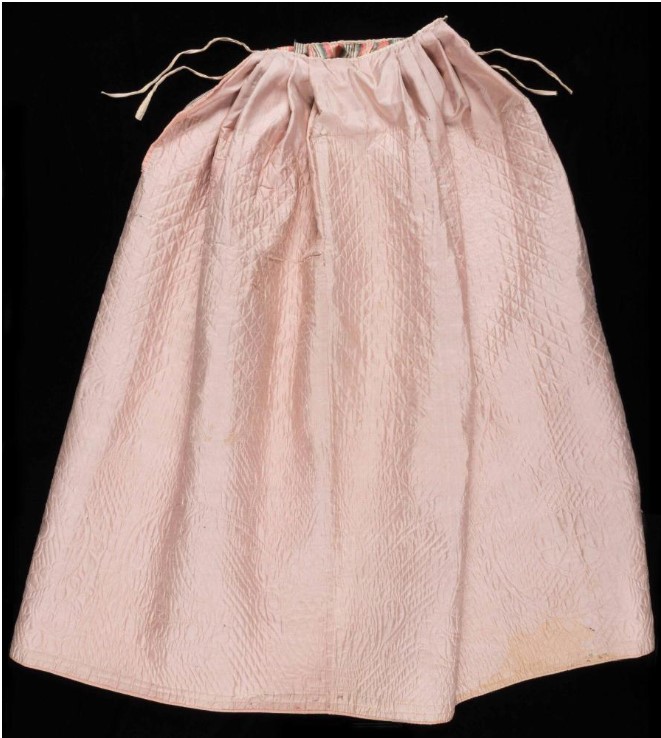
  • 1 Pink Persian Quilt
  • 1 Black Shalloon Petticoat
  • 1 Blue Callimanco Petticoat
  • 1 India Cotton Petticoat
  • 1 old striped Stuff Quilt
  • 1 blue Quilted Petticoat
Quilted Petticoat, 1770-1775. Colonial Williamsburg OBJECT NUMBER 1995-191

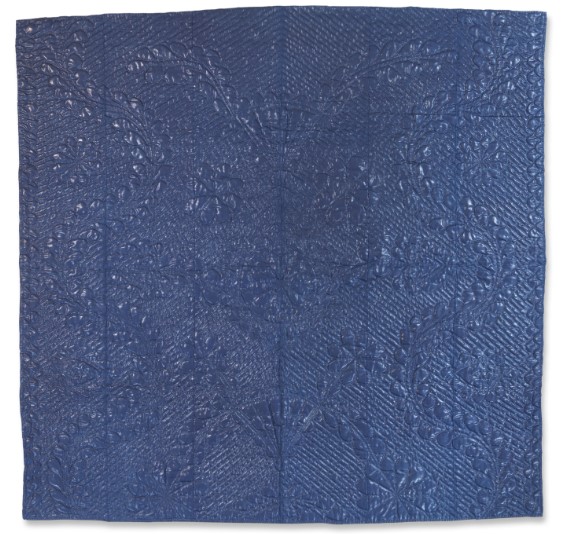
The pink Persian (silk) quilted petticoat certainly came from a milliner’s shop, and was likely made in England; it could easily be worn with those silk gowns. Having the color here helps us begin to imagine the combinations. Pink Persian and brown damask? Black shalloon and black calamanco? Black calamanco and blue calamanco? The India cotton petticoat was probably worn with one of the calico gowns, and we can contemplate striped stuff with a striped Holland gown. In any case, Mary Cooley’s two, possibly three, quilted petticoats helped her keep warm in silk, calico, or linen. The blue calamanco petticoat might also have been quilted; there are many calamanco whole-cloth quilts, and I like to imagine one as vibrant and shining as this quilt or perhaps this one. Quilted or not, under candlelight both gown and petticoat would glisten. 

Deep Indigo Glazed Calamanco Quilt, Probably New England, Late 18th Century

Reading Double

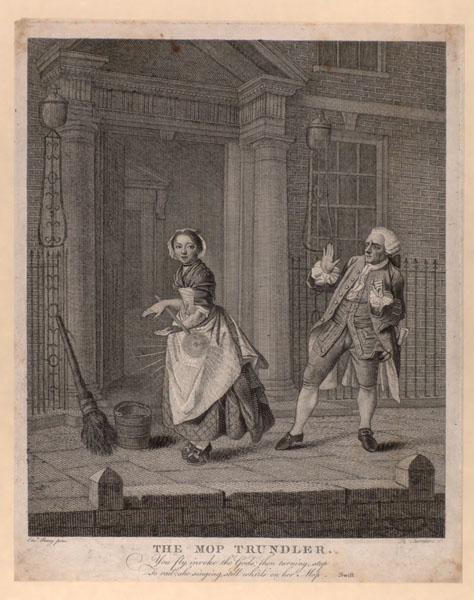
The mop trundler. Chambars after Penny. Bodleian Library, University of Oxford: John Johnson Collection

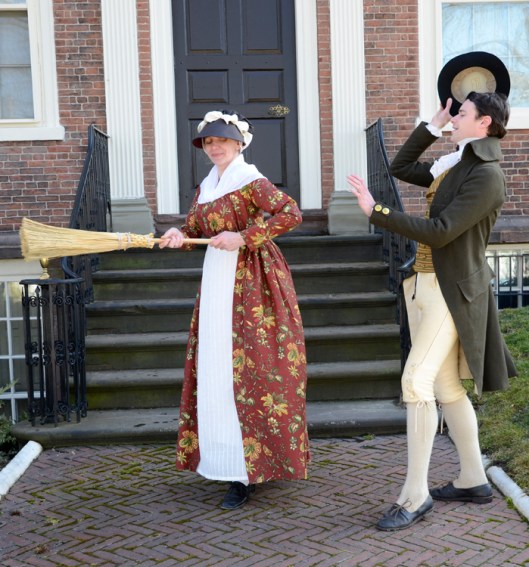
Photo by J. D. Kay, 2013

I love this image, and the original on which it is based. I love it so much that we’ve recreated it (in a later time period) whilst fooling about during a photoshoot.

But what does it really show? The image in the print depicts a passage in Jonathan Swift’s poem, A Description of a City Shower,

Such is that sprinkling which some careless quean
Flirts on you from her mop, but not so clean:
You fly, invoke the gods; then turning, stop
To rail; she singing, still whirls on her mop.

Straightforward, right?

Well, not so fast. Thanks to the wonders of ILL, I’ve been reading The Satirical Gaze: Prints of Women in Late Eighteenth-Century England, by Cindy McCreery, and looking at prints anew. Her chapters on prostitutes and old maids are particularly interesting, and confirm some of what I had been thinking about when we use prints as documentation.

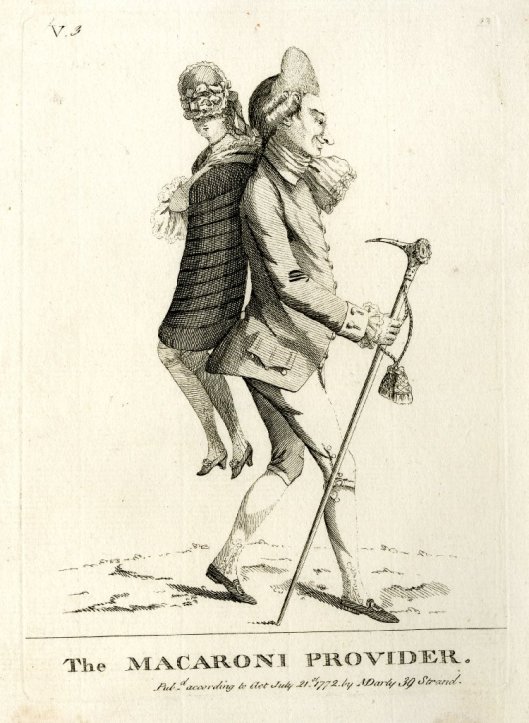
Here, in the Macaroni Provider, we have what is “Probably a portrait of some (alleged) notorious procurer; perhaps Thomas Bradshaw whose portrait he somewhat resembles.” We have a pimp, folks.

The Macaroni Provider / Macaronies, Characters, Caricatures & designed by the greatest personages, artists &c graved & published by MDarly, 39 Strand. 1772 (Vol.3). British Museum

So, with this information in hand, let’s look again at The City Shower. We have a maid– one of the few classes of women found in city streets unaccompanied, and a class of women often associated with prostitution (along with street vendors and market sellers). The fashionably dressed man recoils from the spray from her mop– is he rejected the literal filth, or the implied filth of a “maid of all work,” who may have a venereal disease? Is it reasonable to wonder if Swift is using double entendres in the lines Such is that sprinkling which some careless quean
Flirts on you from her mop, but not so clean, 
so that the mop is the woman’s pubic hair, and not so clean suggests she is diseased?

I don’t know, and absent intensive research or a time machine, I may never know. But once again I wonder how we use and understand these images, and think that they pose more questions than answers. McCreery’s book (based on her dissertation) helps get at some of these issues, and is well worth a read. (I found the Amazon review hilarious, myself, once I had the book in hand. No, it’s not a compendium of prints; it’s an analysis.)

Ceci n’est pas une assiette

Historic American Buildings Survey, George F.A. Palmer, Photographer, 1937 DETAIL OF PARLOR FIREPLACE. – Jeremiah Dexter House, 957 North Main Street, Providence, Providence County, RI

Last weekend, Drunk Tailor and I delivered the Giant to his new life as a college student back in New England, and paid a call on of my oldest friends, a 96-year-old former OSS agent and descendent of the Dexter family. My eldest friend had something she wanted to give me: a souvenir of the Dexter House, in recognition of the hours I’d spent working with her identifying and organizing several hundred years of family papers.

In the photo at left, the coffee pot on the mantle is now in a museum collection, as are the miniatures, the bellows, and the pipe box (which is now on display in a historic house museum). What my eldest friend gave me is not in the image of the house, but resembles the plate to the left of the fireplace: a Staffordshire transferware “Village Church” pattern plate with a wild rose border, ca 1825.

Transferware soup plate ca. 1825. Unknown maker, Staffordshire, England.

I’m a fan of blue and white china, and while I prefer earlier Canton ware, this plate is more special to me than the ones I’ve bought at auction or in New Bedford antique shops: because of course it’s not a plate, it’s memory, or an emotion, made solid.

Drunk Tailor and I spent an early Sunday afternoon on my friend’s porch listening to stories about her children, in particular about her daughter Mary, now an artist living in Mexico. Is it a comfort or an annoyance to learn that schools have been misjudging children since schools were invented, trying hard to fit round pegs into square holes? Mary, always more interested in drawing than in lectures, once left a classroom when the teacher said, “If anyone doesn’t want to hear this lesson, then they can leave now.” Out Mary went, three other girls following her out to play on a beautiful spring afternoon.

That story, and many others, aren’t apparent in the plate with its crazed face and discoloration. Only my memories (and anything I write down and keep with the plate) make the associations. But it is always the stories about the objects that make them important (even big-ticket dec arts items, like Plunkett Fleason easy chairs.)

Last night, before Drunk Tailor and I watched The Maltese Falcon, we watched Adam Savage’s TED talk on his obsession with objects. The TED talk is worth a watch for anyone interested in material culture and objects. Our human fascination with things goes beyond the shiny surface of new things (tabernacle mirrors or iPhones) as they become repositories of memory, symbols of feelings or moments.

War correspondents and personnel of the Office of Strategic Services, leaving from the Railhead, Camp Patrick Henry, Virginia, enroute overseas. NARA. National Archives Identifier: 542171 Local Identifier: 336-H-17(E8671)
Creator: War Department. Army Service Forces. Office of the Chief of Transportation. 3/12/1943-6/11/1946

This: In my desk drawer, I have a buckeye Drunk Tailor picked up and handed to me in a garden in New Jersey. It’s useless: inedible, too light to be a paperweight, but it reminds me of that November afternoon, the soft green of the garden, and how shy I felt. Anyone cleaning out my desk would toss that bit of organic matter, even as I keep it as a talisman of one of our first dates: the places, the smells, and the feelings.

And this, too: My friend is 96. I may never see her again, though when I left her, she was healthy and cheerful, making plans for the fall with her children, grandchildren, and great-grandchildren coming to visit. Given my reticence and her old-fashioned New England reserve, I may never be able to tell her how much she means to me (I try), or how interesting I think she is. (“I’m not interesting, dear, I just worked hard,” is what she says when I try to convince her to donate her personal papers to an archive.) But I have a plate that was in a house that had a great deal of meaning to her, and my best guess is that her gift of that plate to me means she knows how much I like and admire her. It reminds me of her, and reminds me of how little time there is before all that’s left is the plate and my memories.