Providence, After Dark

IMG_6651

Yes, I like to burn my candle at both ends: let’s get that out of the way up front, as I admit that yes, I am recovering from strep throat contracted a mere week before the evening program, and that immediately after said program, I hopped on the night train to Virginia for a quick vacation.

I walked to the train station, and was struck by the contrast between the closeness of the house lit only by [LED] candlelight and the openness of a city incandescently bright. I’ve walked Providence streets at night for decades, and never appreciated street lights so well until I knew the city didn’t have oil street lights until 1820.*

The LED candles aren’t as bright as real candles, but they’re safer and come remote-equipped.** In the end, I ordered a total four dozen, forgot I’d ordered four dozen, and requested only six dozen AA batteries (each candle takes two), so spent the late afternoon scrounging power sources. With this many candles, we were able to put eight in the Waterford crystal chandelier in the formal parlor, and watch the light play upon the ceiling, even if the room wasn’t fully illuminated.

IMG_6653

We kept the hallways and central stair lit for safety, and gave guests or groups of guests battery-powered candles to carry as they made their way through the house. (All sixty-plus spots on the two tour slots were fully booked.) Downstairs, each of the three docents from our study group interpreted a room: Mrs JF in the dining room, talking about dining and entertaining; Mrs MF in the formal parlor talking about sin, crime, and control; and Mrs AB in the informal parlor talking about novels, music, and family gatherings.

Upstairs, the Director of Education, Ms T, took over one bedroom where she talked about sex and I took another to talk about bedtime, bedding, bedbugs, vermin, chamber pots, and hygiene. Of all sixty-plus visitors, only one, a young man, asked about menstruation. Perhaps the rest were too overcome by the thought of Hannah Glasse’s bug bomb (ignite a pound of brimstone and a Indian pepper in a tightly closed room, exit quickly, and leave it for five to six hours) to ask more intimate questions.

IMG_6661

It was a popular program, and I can imagine doing it again. It does make me wonder about a What Cheer Night, and what that could be like; how far can we push the ways we use a historic house and its contents, when it’s only one day a year?

*It took until 1822 to get a sidewalk committee to concern itself with smoothing the rough patches and straightening the paths; we could use a reconstitution of that committee, thank you.

**Yes, I believe the site manager feels like Dumbledore every time she uses the remote, though she is not yet saying “Nox” as she wields it.

Fashionable Furniture, or, The Glories of the Past

include window drapes.

Ackermans's Repository of Arts., etc. April, 1817.
Ackermans’s Repository of Arts., etc. April, 1817.

Every now and then, someone argues with me that the historic house where I work would not have had window curtains or drapes. Sometimes they like to expand that argument to “there were no curtains at all” in early Federal America. The reasoning is usually that textiles were too expensive to “waste” on window dressing. If you know me, you know this kind of argument is a Bad Idea. The public fight (I was angrily accosted by a now-former docent during a public presentation) is known as The Great Curtain Kerfuffle, and resulted in my reply that the owner of the house could very well afford anything he pleased. Fabric is Money.*

There’s another iteration of my argument: Color is Money.

Ackermans's Repository of Arts., etc. April, 1817. page 244
Ackermans’s Repository of Arts., etc. April, 1817. page 244

Those of us who shop at IKEA are not going to have “the most fashionable style of decoration” in our 1817 homes. The Willings and Binghams of Philadelphia were models for the  most fashionable families of Providence, and while well before this 1817 plate, the Binghams were recorded draping their chairs with orange and red silks. In early 19th century Providence, the John Innis Clark family had silk covers on their sofas and chairs in 1808, and plenty of carpets and curtains in their Benefit Street home from the 1790s on. 

“Crimson is very rich, but blue is handsomer,” wrote Eliza Ward to her sister, Mrs John Innis Clark, in the 1790s. Curtains and covers were fringed (Mrs Hazard Gibbes was blue and yellow). Windows were dressed, and younger, less affluent relatives received hand-me-down curtains. In 1803, Elizabeth Watters in Wilmington, North Carolina was having a carpet “wove in true Scotch taste in imitation of Highland plaid.”

John Phillips (1719-1795) Oil on canvas by Joseph Steward,1794-1796. Sack Gallery, Hood Museum of Art, Dartmouth College.

Some carpets, no? Maybe the new mantra is Carpets are Money.

But quite aside from an obvious display of wealth, what we have to realize about these images and letters is that they are depicting a world that looks very different from our own. Color sensibilities, tolerance for pattern mixing, non-matchy-matchy sewing and dressing. We have to abandon our 21st century aesthetic sensibilities when we dress ourselves or our spaces for the past, and really embrace the vivacity of that world. Sensory overload, perhaps, but getting closer to what the world of the past looked like will help us see– in every sense– the way the people of the past did.

*I may or may not have made additional statements afterwards to the effect that of course wealthy Americans squatted naked in the corners of their well-appointed mansions gnawing raw meat until Benjamin Franklin invented fire and fabric. I should be sorry about that, but I don’t seem to be.

Objectification

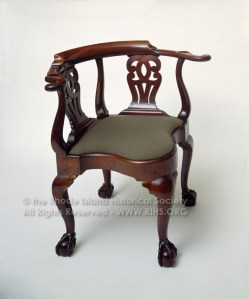
Corner chair. Mahogany with fabric-covered slip seat. John Goddard, 1763. RIHS 1990.36.1 RHix5136

I’ve had more alone time than usual at work, which is to say, I’ve been the only living creature in 16,000 SF for multiple consecutive days, which allows me both time to get lots of work done but also permits my mind to wander more than it might otherwise. One of the ideas I continually return to is about the objectification of objects. That’s a terrible phrase, isn’t it? What is the essential thingness of any given thing?

Let’s take chairs: I really like chairs, which is to say that I have, at last, succumbed to the seductive qualities of chairs.[i] But what makes a chair a chair?

Most simply, a chair is to be sat upon. Keeps your rump off the cold, cold ground. Supports your legs and back. Sometimes a chair is for lolling. Sometimes it’s for working. Sometimes it’s for projecting power. But essential, a chair is for sitting.

If use– specifically human use[ii]– is what chairs are for, what happens when a chair is removed from use, and placed on display in a museum?[iii] And what difference does it make whether that chair is on a white plinth in an art museum, or in a historic house, or in the historic house where it was used? When is a chair most a chair, other than the times you are sitting in one?

As I said: a lot of alone time.

servant mannequin in 18th century room
That’s no ghost, that’s my kid. Corner chair just in front of the ghost.

Within a historic house, it seems that the ideal situation is the chair in the room in the house.

That would seem to maximize the “realness” of the thing, right? But we don’t always have the chair, and even when we do, we may not know which room it was used in most often.

The way a chair is displayed and understood in an art museum: Object of Beauty is very different from the way a chair is displayed and understood in a history: Who Sat Here? It’s a conundrum though, because just as the chair become Beautiful Thing in an art museum, it can become Story from the Past in a history museum. Neither presentation/interpretation really gets at Chairness, which is really best experienced by sitting in the chair yourself.

Did I mention I spend a lot of time alone with objects?

Storeroom, Rhode Island Historical Society. RHix17 399

The way that I think these questions about Chairness relate to living history is by realizing that just as museums fetishize objects on white pedestals, living history interpreters/reenactors sometimes fetishize objects without contextualizing them. You know: Muskets. Clothes. Spinning Wheels.[iv]

Putting the chair in the room where it was used gives it context, and the visitor a new perspective that wouldn’t be gained from a white pedestal, or from the curb. The same is true of the things that we carry as interpreters. Context matters. It’s how meaning is derived and understood. Like repetition, isolation can rob an object—or a person—of meaning. Not that I’m lonely. I have all those chairs, after all.

____________________________

[i] Not to get too weird, though: I won’t rhapsodize (yet) about the sensual curve of a chair leg, or a delicate, finely-turned ankle, as I have heard some (fetishistic?) curators so. Yet: there’s still time.

[ii] Sorry cats: chairs were not actually made for you. Now get down!

[iii] If you know anything about art history and theory, you can probably guess which decade I was in graduate seminars.

[iv] My *favorite* thing to see in a military setting.

Experiencing Eastfield Village

The Young Mr on site.

Mr Hiwell, the Young Mr and I ventured out to Nassau, New York this weekend to be part of Founders Day Celebration at Eastfield Village. The gents were part of the 1833 militia muster, while I traveled out intending to interpret tailoring with Mr JS, and to provide meals for the militia.

It’s an interesting assemblage of buildings, and we were pretty curious about what the site and the experience would be like. While OSV and Genesee are also assembled villages, they’re museums, with different missions and guidelines; they’re also larger, with electricity and flush toilets for visitors and volunteers alike. That means they’re lovely, but not nearly as immersive as the pitch-dark privy experience.

The back of the Benjamin Culver house, or, our dining room for dinner.
Wear all the patterns possible, please.

There was a lot to consider at Eastfield, but I’m tired from driving back and will stick to the simple things for now.

I was incredibly fortunate to have a bed—indeed, the entire 1787 Benjamin Culver house—to myself for sleeping. Friday night, after changing into period clothes, we went up to the Yellow Tavern to eat our supper (pasties brought from home, with hard cider for Mr JS and myself). The candle lit taproom was cozy, and I understand from Mr JS that the sleeping quarters upstairs were even cozier.

We cooked our meals in the Yellow Tavern kitchen, and ate sometimes in the taproom, and sometimes standing in the kitchen, except for dinner, which was served picnic style on the grass behind the Culver House. (Saturday supper was provided by Eastfield Village and prepared by Neil DiMarino with able help; that deserves a post all its own.)

Cozy is as cozy does.

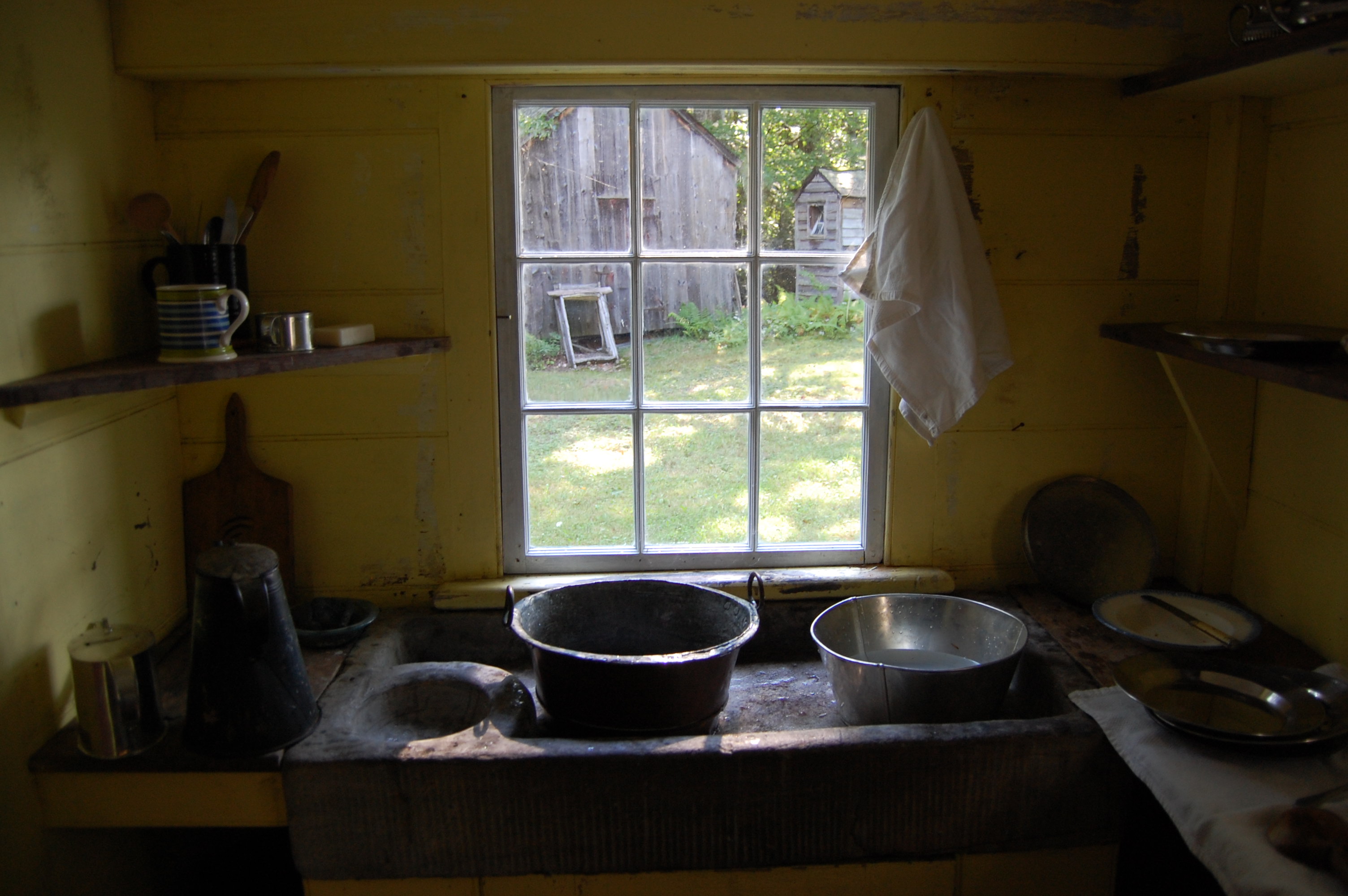
Much of time was spent on women’s work, interpreting daily tasks to a stream of visitors travelling through the house from front door to back, and sometimes upstream. The scullery—for want of a better word—had a soapstone sink which drained through the wall, which made dish washing pretty plush, and provided entertainment for all who cared to witness it. No chickens were present, but from washing dishes at Coggeshall Farm, chickens would have enjoyed the ground beneath that window drain.

The view from the scullery: not bad, really.

There are always curious questions, from “Is this a house?” in a tone of wonderment, to “Where did you get the water?”

Gentle reader: these stumped me, briefly, until I was able to gather my wits enough to reply, “Yes, it’s a house, built in 1787,” and to assure the visitor that people had, in fact, managed to live in it. The water question was somewhat more perplexing.

I started with, “Well, I got this from the hose, but they would have had a well,” when the visitor stopped me. “No, I mean, how did you get it hot?”

The kettle had been over the fire in what would be the kitchen room where Mr JS and I were set up to sew, and the fire was still producing heat, albeit from coals. Then I realized she had not been among the clump of people watching me remove the kettle from the crane so that I could pour hot water into my basins. I pointed to the kettle, and said, “Over the fire.”

Fire hot.
Fire hot.

It’s hard: there’s so much we take from granted in our own daily 21st-century lives, let alone what we become accustomed to when we inhabit the past. Interpreting between the two worlds, things can be lost in translation.

I’m always curious about what I’ll learn when I travel to a different century, and I think what I learned, again, was that I find it hard to find a way to interpret women’s lives and work in the past that does not reinforce stereotypes of “life was hard” and “roles were constrained.” Enough! I tried explaining the greater freedom some women enjoyed in the early Federal era, in contrast to the pre-Revolution and post- Great Awakening eras, but that wasn’t entirely successful, and would you believe that story from a woman washing dishes?

What I may really have learned is that I’ve done enough time in the kitchen and the scullery; I’d rather be the tavern keeper than the cook or scullery maid. Women were in business, and while never on the scale of partnerships like Brown & Francis, women as merchants, tavern keepers, landlords, and, yes, tailoresses, are underrepresented. It’s easier to talk down the scale than it is to talk up the scale from the washbasin to the shop or tavern, so it’s time to leave the wash basins aside for a bit.

Done with dishes for now, thank you.