In a continuing effort to simultaneously destroy my hands and make all the bonnets, I set out recently to recreate a bonnet in the Met’s collection.
Silk Bonnet, British, ca. 1815. Brooklyn Museum Costume Collection at The Metropolitan Museum of Art, Gift of the Brooklyn Museum, 2009; Designated Purchase Fund, 1983 2009.300.1613
It’s a curious thing, isn’t it, with that flipped-up brim? It looks more 1915 than 1815. But a little looking turned up this fashion plate:
Items 2 and 6, while not of silk, show the turned-up brim seen in this example. (To be fair, the original black and white photo suggests some confusion about the bonnet’s orientation.)
My version is admittedly imperfect, but a home-made interpretation that gets as close as I can (for now). I started with a lightweight buckram frame, to which I stitched slim round caning.
The brim is covered in two layers of the copper silk, and edged on the bottom side with the contrasting silk trim. the crown, or caul, is a simple tube gathered to a silk-covered buckram circle. In the absence of matching (or even sort-of-close) ribbon, my choices are to trim what’s left of the fabric and piece it together…. or start an online-ribbon hunt. At least the extant example has ribbon that’s close but not a match, giving me some leeway if I decide to save my hands for other projects and click instead of stitch.
Drypoint by John Theodore Heins, Jr. British Museum 1858,0417.362
Bonnets. Who doesn’t like them? They’re the cupcake of costuming, just enough sugar to be delicious, not enough trouble to count. I know I have far too many, they fall from the hall shelf nearly every time I get my coat.
But I started asking myself questions about bonnets when a friend asked me questions about bonnets: shape, color, and how they’re worn (rakish angle? pulled down low?).
We’re planning on going to an event in March, and I’ve been thinking about head wear, especially bonnets. Now that the question’s been asked, I don’t want to randomly cram black silk taffeta on my head and call it a day: I’m back to “don’t know mind.” Time to start looking. So far, I’ve searched the Tate, the British Museum, the National Portrait Gallery UK, the Lewis Walpole Library, the Yale Center for British Art, the Met, the V&A, and the BBC’s Your Paintings site.
I started at the British Museum. Here are the results for a collections search using the term bonnet and the production dates 1765-1772. Hmm. No classic black bonnet. Dammit, actually, because I really like mine.
James Caldwall, A Ladies Maid Purchasing a Leek, 1772, YCBA, B1977.14.11105
Man, this is a pain, right? Where are the bonnets? 1772 is actually too late for my purposes in this instance.
The Lewis Walpole Library Digital Collections lack a feature for limiting or sorting by date, but they tag bonnets in their prints. Still: no big black bonnets in early prints.
Anne (née Day), Lady Fenoulhet by Richard Purcell (Charles or Philip Corbutt), after Sir Joshua Reynolds, mezzotint, (1760) National Portrait Gallery UK D1939
Nelly O’Brien by Samuel Okey, after Sir Joshua Reynolds, mezzotint, circa 1765-1780 (circa 1762-1764) National Portrait Gallery UK D19911
Lady Fenoulhet is wearing a lampshade. Nelly O’Brien is wearing an interesting, more hat-like device. Her imprint is ca. 1765-1780, but other impressions are dated ca. 1760. The 1762-1764 seems plausible. But that’s still early for my purposes. The lampshade really is, too; Mrs Mary Smith of Portsmouth may be wearing one, but considering that the artist who drew this plate died in 1766, I think we can place this form in the 1750s to early 1760s. Lampshade is too early. The”Lady’s Maid buying a Leek” is too late.
I debated with myself about whether or not it was OK to piece the lining, and then I figured that it was what I had, so I would make do. It was a hot mess, all freehand, and I was convinced of total failure until I started stitching the lining down just over the millinery wire. Then the shape began to pull tightly and behave better. If I were to do this again, and if I were to make recommendations to another hat fiend, here’s are two changes I’d suggest:
1. Make an actual tidy pattern of your hat circle on a large piece of paper (newspaper, wrapping paper, whatever).
2. Trim and tidy edges so you are piecing straight, radial lines and not curves or tangents; better yet, buy a new remnant and don’t piece. I was too afraid of ‘wasting’ my scraps, so I pieced on the tangent. It’s OK, but I could have made this a bit easier for myself.
Happy birthday, Mr S!
Beyond those minor points, this is easy; piecing and fitting on the fly got a little wonky. Also, though your mileage may vary, 4:00 AM may not be the best time to start new projects. Wait till 5:00, when your coffee has kicked in.
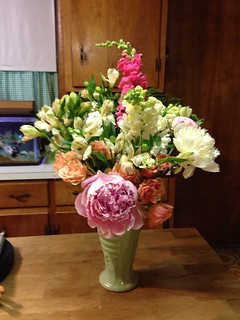
We had real, not printed fabric, flowers in the house on Tuesday, which was Mr S’s birthday. I chose peonies because they looked so Dutch, though you cannot see the little variegated petals here.
Kitty wishes to know if you are getting all your leafy greens, because he is.
Really, the power of the interwebs. Not that I shouldn’t have contacted the hat maker, but the hat is soft and lovely and looks just like one in a painting at work. And I so readily saw it ornamented with ostrich plumes that would have made it twice as pettable.
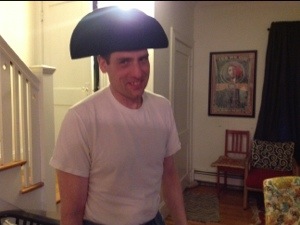
But the hat maker emailed and recommended a technique I will call “steam and cram” but which involves the judicious application of steam followed by placing the hat on the head. So I pulsed steam into the crown of the hat, avoiding a) the neat label pasted on the top and b) the sides, which have such a lovely feel and verticality. And then hat was then placed firmly on Mr S’s head.
Felt is such amazing stuff: I love the way the wool changes as you felt knitting. There is a moment when the fibers change– it’s hard to describe, exactly, but there’s a feeling of release, and then the knitting as a whole becomes more plastic and malleable.
The same thing happened with this hat: while atop Mr S’s head, he felt it relax, and voila! Hat! Fitting!




 Kirsten Hammerstrom
You must be logged in to post a comment.