Would I Lye to You?

Now, really, would I lye to you?

img_7993Some people will tell you I overextend myself, and while those people may be correct, my enthusiasms compel me to do more, try more, travel more, and to that end I found myself preparing for an event by turning my 1962 Ossining kitchen into an experimental laboratory.

I was taken by Hannah Glasse’s receipt for cleaning pewter, copper, and tin in her section for The Scullion, so of course I had to try it. It’s simple enough: boil wood ash with unslaked lime for half an hour, let cool, and pour off the clear liquid. Easy-peasy, until you realize you have forgotten your high school chemistry, the Young Giant is not at home, and google searches for lime turn up too wholesome uses and unsavory quantities.

Happily, a more scientific brain than my own pointed out potash/pearl ash/potassium carbonate, which Amazon can provide in small quantities. Wood ash proved a little more challenging. Happily for me, I am one of those East Coast foodie fools with a backyard grill and a fondness for hardwood charcoal, so an overdue chore later, I had an enamel kettle of ash.

The receipt calls for “a pail” of wood ash to a “half- pail” unslak’d lime, boiled in four pails of soft water. Since “pails” is a general sort of term, I decided to use the quantity of wood ash I scavenged as the approximate measure of a pail, figuring that proportions mattered more than actual grams or liters. I have resigned myself to the fact that this is more art than science. Four pails of soft water included the remains of a few gallons of water stockpiled for hurricane preparedness years ago, bolstered with water from the tap.

Pail, schmail.
Pail, schmail.

Fortunately, art did not turn into science gone wrong. The boiling was rather placid, considering, and dissolved the fine ash and the potash. I filtered the liquid mixture through a screen (ok, the spatter screen for my frying pan) to ensure that when I poured off the clear, it would be as clear as possible.

By the time it had cooled, I had fished out appropriate containers into which I could “pour off the clear.” This recipe, seat-of-the-pants as it is, makes a fair quantity, a mason jar of which I have left with the Drunk Tailor so that he might better clean his officer’s pewter and copper, because, yes! This does work to brighten silver and copper. Tune in next time for details on getting shiny.

Front and a center: A liquor for cleaning pewter, etc.

In a Pickle

Yes, for breakfast.

I like pickles. I don’t like being in a pickle, and I have to say that work this week has been as bitter-tasting as any week since February, so it’s a fine thing that the pickles I made last weekend are ready for eating.

The recipe is based on the Hannah Glasse recipe my co-commissariat made for Cambridge, and which I sampled in the NPS staff kitchen. I thought they were delicious, and so proceeded to make my own version, with some variations.

Here’s my version:

  • 3 large cucumbers
  • 1 medium onion
  • white vinegar
  • salt
  • whole peppercorns
  • fresh ginger
  • ground mace

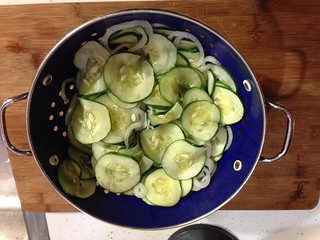
Slice the cucumbers and onion thinly and evenly (I used my old Martha Stewart Everyday mandolin from K-Mart). Layer alternately, sprinkling with salt, in a shallow dish or bowl, and cover, for 24 hours, in the fridge. Drain in a colander, pressing with paper towel to remove excess water.

Place the drained cucumber and onion slices in a bowl and cover with white vinegar for at least four hours, or while you go to work and are unable to leave early as you had planned. Pour the vinegar into a saucepan and boil with a little salt.

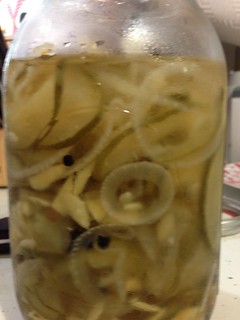
Peel and slice the ginger into sticks, and add to the cucumbers and onion. Sprinkle all with mace to taste, and add whole peppercorns as desired. Pour the boiled vinegar over all, decant into clean, boiled jars and seal.

I tasted these first over the weekend, and they were strong and spicy! The ginger made them a little hotter and sweeter than the ones I had in Cambridge. They seem a little mellower now (I had some with breakfast this morning) and I think they will be OK at OSV this weekend…if I take them. Glass jars seem crazy to pack for camping.

All that glitters…

An Old Woman Cooking Eggs, Diego Velazquez, 1618. National Gallery of Scotland, NG 2180

…could be pewter. Or do I mean tin? Carolina had excellent points about pewter being, yes, that shiny, though we think it is not. Our perception is probably based in large part upon the extant items in museum collections. And museums don’t polish their pewter–at least we don’t, and I don’t know anyone who does. Is it because we’re so unaccustomed to using pewter daily that we no longer know how to care for it?

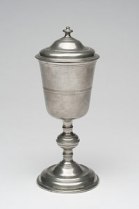
Covered chalice, pewter, c. 1756-1780. Philadelphia Museum of Art, 2008-110-1a,b

I thought it could be interesting to experiment with polishing pewter (not in the collection) so I turned for advice to that touchstone of housework past, Hannah Glasse.  In The Servants Directory, Part V: The Scullion Mrs Glasse lays out To clean Pewter, Tin, and Copper.

Take a pail of wood-ashes (either from the baker’s dyer’s, or hot-pressers; the latter is the best) half a pail of unslack’d lime, and four pails of soft water; boil them all in a copper together, stirring them; when they have boiled about half an hour, take it all together out of the copper into a tub, and let it stand until cold, then pour off the clear, and bottle for use.

When you clean your pewter, lay a flannel on the dresser; set your dishes one on another by themselves, the plates to likewise; then heat liquor according to the quantity you have to clean, pour some on the uppermost plate and dish, and as you use them pour it on the other. Take a piece of tow to rub them with, then having two little basons of red sand, pour some of the liquor on each; with the first scour your plates well, and rince them in cold water; with the second clean them, rince them into two waters, set them to dry, and they will look like new. Thus you may clean them at any time with very little trouble.

Very little trouble for you, Hannah Glasse! The red sand is definitely something museums won’t do: we have this prejudice about not abrading the collections, or applying chemicals, so the lime/ash/soft water mix probably won’t appear in our workroom either.

Willem Claesz.Heda, Still life with gilt goblet, 1635. Rijksmuseum, Amsterdam

I also took a look in my books for paintings that showed pewter with sheen, and for objects. I suspect that pewter’s softness will not allow it to achieve the high-gloss shine of tin, but that it can be brought to brightness. I do think the best way to find out is to start polishing, so I’m in the market for some wood-ashes from the hot-pressers, and a good place to lay a fire and boil some chemicals. Who wouldn’t volunteer for open-fire chemical boiling?