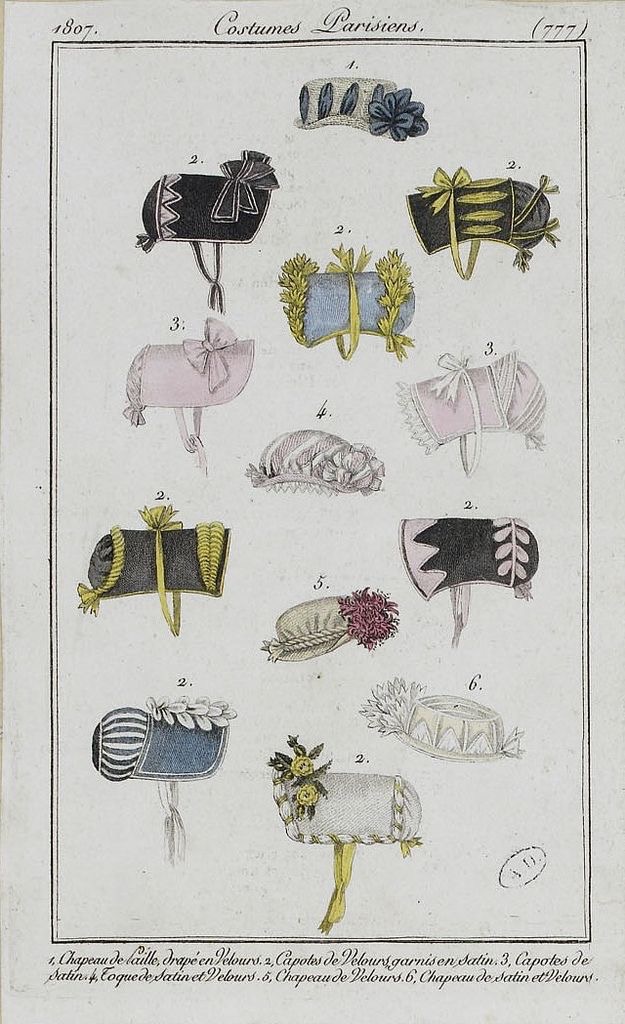
Capote de Velour garnis en satin

Costumes Parisiens, 1807

This plate has stuck with me for years: those mailbox shapes, in velour! In 1807, velour was not what we think of today (and I don’t mean Zapp Branigan). Valerie Cumming’s Dictionary of Fashion defines velour as “Wool or wool mixture cloth, soft and smooth with a closely-cut pile or nap resembling velvet.” Not having access to wool velour in the scrap bins at work, or in the fashion aisles at the local fabric store, I opted for velvet; the scrap bin provided pink silk taffeta, which I thought made a nice contrast to the texture and finish of the velvet. It is true that “velure” dates to the 17th century, and describes imitation velvet. The wool velour I’m familiar with from upholstery is too dense and heavy to drape well over a bonnet (it’s really made for sofas and armchairs), so erring on the hand of the fabric seemed a reasonable choice. Wool velour with silk satin would be an amazing textural contrast, but with this color combination, almost any fabrics will give a pleasant optical shock.
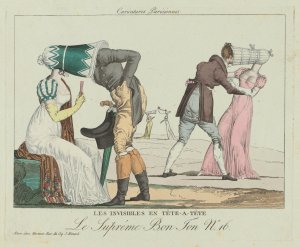
French 19th Century, Les Invisibles en tête-à-tête (Tête-à-Tête with Poke Bonnets), c. 1805, etching with publisher’s hand coloring in watercolor on pale green laid paper, Katharine Shepard Fund 2015.49.4

Shaping the brim was an exercise in paper and pasteboard, winging it a bit until I achieved a length and width that was mailbox-like but not too drainage tunnel. The cartoons of the period make clear that these are deep brimmed bonnets. I do like that the bonnet on the left is trimmed so like the ones in the fashion plate; the one at right is probably corded or reeded, judging by the ridges.
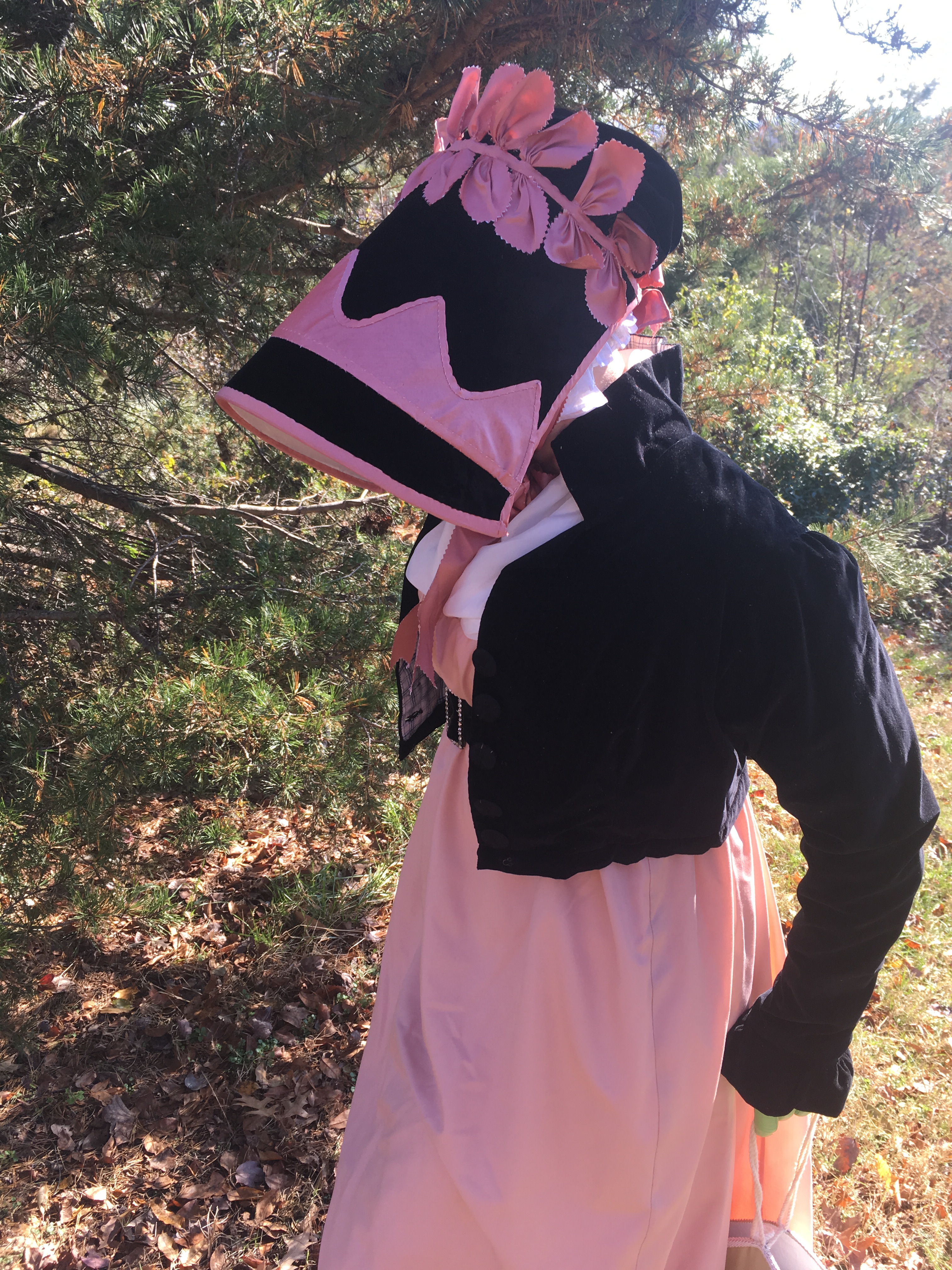
The trickiest bit was shaping the silk to the compound curve of the brim. Three patternings got me there– until I realized the silk needed body to hold up to binding, and took a short cut. Ask not of the sin of fusible interfacing, for I have learned my lesson. Yes, the silk piece shrank and no longer curved evenly from the front edge. Thank goodness Drunk Tailor was watching The Pacific, so any foul language I may have used was disguised by movie dialogue. The binding is bias-cut silk, easy enough. After the debacle of the Vandyke trim, I opted not to cut and bind the leaf shapes, but rather to cut the ovals with pinking shears and attach them along a silk band. Would I do it differently another time? Possibly, if only because I like to imagine the different ways an American milliner might interpret a French fashion plate.

Once I settled on making the bonnet, I decided it was time to finish a pink wool petticoat I started in 2015 after a trip to Mood. It’s a tropical weight Australian wool, according to its selvedge, and has a high-waisted bodice with a drawstring closure. I covered the bottom drawstring (and added some bling) with a black velvet belt closed with a period paste buckle. (Every now and then someone doesn’t know what they’ve got, and lets it go for a price I can afford.) On top, the gathered back cotton velveteen canezou/Spencer made for my first trip to Genesee. Having a wardrobe extensive enough to mix-and-match almost the way I do from my modern closet is pretty satisfying, if a little crowded.

This isn’t a bonnet for wearing while crossing a busy street, though it will successfully shelter the wearer and a cat from any sudden downpours, and one is unlikely to get sunburned wearing this. I didn’t find it distracting to wear– but I didn’t go far, and I had a companion. But what price fashion?

Go Big When You Go Home

heading north

A year after moving, Virginia feels like home, even as I continue to experience accent-based misunderstandings and yearn for different apples. But if home is where the heart is, my home is split between the place where my kid grew up and goes to college, and where I live now. After having all vacations cancelled (thanks, Fairfax County Jury System), we scheduled one for the end of the summer, a chance to visit friends, antique (and buy a new school wardrobe for a college sophomore).

You can never have enough eagles or feathers.

The trip hinged on the Militia Days event at Old Sturbridge Village, with Drunk Tailor mustering as a member of the Oxford Light Infantry or “Ollies.” The OLI has a ridiculously shiny and ornamented shako, which contributes to the appeal of the impression. The early Federal-era militia units certainly appeal to me, with gold buttons, chain, tassels, and plenty of eagles everywhere. There’s a lot of visual myth-making to unpack there, and the fact that the muster re-enacts a sham battle makes it ever so much more so wonderful and New England. This is meta-enacting (or re-re-enacting), and I am all for it.

A new time period meant a new dress. And a new bonnet. And new hair– that last complicated by the new summer haircut. (I had a wool gown from the Turkey Shoot several years ago, but wool in August at Sturbridge is possible but not recommended.) So, what to wear? I remembered some lightweight chintz gowns in the Kyoto Costume Institute collections, and happily there’s one on their website (my copy of the book is still in storage). While I prefer the audacity of many of the reproduction cotton prints, the hand of the quilting cottons is often heavier than I want, so I ordered a print from India– one that has been used for many other dresses in different time periods.

The pattern is a straight-up version of the Past Patterns Lowell Mill Operative’s gown. The first 1830 gown I made was from the State Historical Society of Wisconsin pattern, which did not fit as well over the collar bones; the Past Patterns neckline resolves well and fits like a dream– the only change I would make the next time around is to make the back pieces smaller. I had way more overlap than I really needed, but otherwise, I was lucky that this required no adjustments to fit pretty well. Every now and then, it’s nice to have a break from drafting my own patterns and fighting with fit.

Hair a la Titus and the Resting Bingley Face

Reader, it is hot where I live. June, July, and August are tiresome months here, humid and warmer than what I became accustomed to in New England. After a year, I realized I’d had enough of trimming my hair myself. I texted a friend with good hair, and found someone to liberate my neck. Excellent, right? Well…it’s all good until you want to dress up.

19th century history hair being somewhat mullet-like, my short in the back bob was not going to get the job done for last weekend’s Jane Austen Ball at Gadsby’s Tavern. What to do? Cap it, of course– there’s no way I could figure out how to tie a turban elegantly and reliably without giving up the hope of finishing some other projects I really want to finish this month. So, a cap/hat/sewn headdress. Aside from the examples seen in film adaptations of Jane Austen’s novels, what evidence is there for these concoctions?

ladies heads with various wraps and feathers
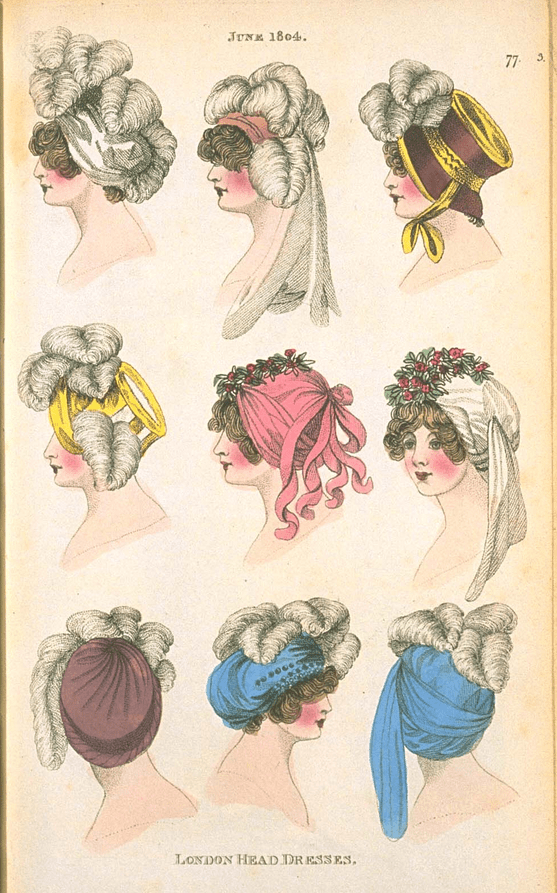
London Head Dresses, June 1804
woman in a gray tam o-shanter cap
Detail, Plate 11, April 1799 Journal des Luxus und der Moden.

Enough, it would seem, to be getting on with. In addition to the 1804 Ladies’ Head Dresses plate, there are plates in the Journal des Luxus und der Moden showing headdresses and wraps, as well as an image of a pelisse and matching tam-o-shanter-like hat. These are simple enough to make, and I managed one in less than 24 hours.

two couples in historical dress
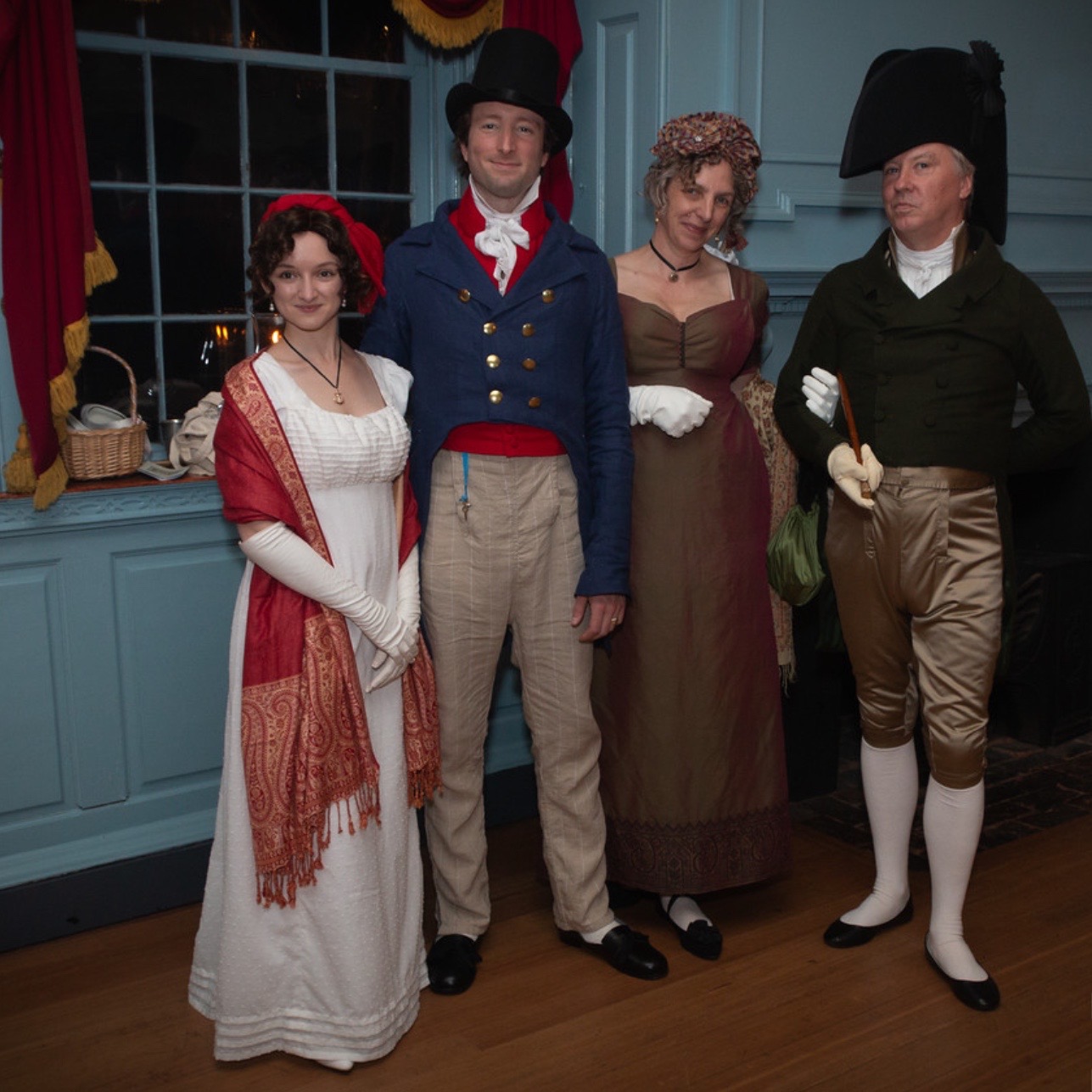
I had no idea Drunk Tailor and I would color coordinate so well. Also, Dat Hat.

The fabric is left over from a gown I made to wear to a dance in Salem one spring, , but which happily coordinated well enough with the sari gown made for a photoshoot, and also worn to Salem for a dance. Briefly, the cap is made from scraps, ornamented with a two-layered rosette centered with a paste button, with the bulk of the caul gathered up and stitched down to hold the shape and embellished with three coordinating tassels looped onto a gold silk-wrapped cord. In the end, not too resting Bingley face, and a satisfactory cover for what I’ll call my hair a la Titus when I’m not in the current century. Drunk Tailor’s hat covered, somewhat, here.

Luxury and Fashion


Sometimes this is a hard hobby to love. My hands hurt, my creativity feels dead, and there’s no place to go all dressed up. After a long, unpleasant spring, I finally feel like sewing and playing. Drunk Tailor and I definitely missed some things we very much wanted to do, but now we’re reinspired, we could take baby steps back to our normal semi-hectic pace– except of course, we are plunging back in with three events in August after a whirlwind trip to Ticonderoga.

Wedding dress in cotton muslin ca. 1797. Nationalmuseet Danmark.

With the summer heat in mind, I ordered batiste and voile, thinking I would make the Tidens Toj gown, but when the fabric arrived, it seemed that the purveyor had confused the two fabric types, so a new plan was required. Alas, the trials of costume research and falling down the fashion magazine rabbit hole for hours at a time…

1798 Gown, watercolor by Ann Frankland Lewis, 1798. LACMA, Costume Council Fund (AC1999.154.1-.32)

Next up: an open robe or wrap-front gown over a matching petticoat, trimmed in blue-and-white Greek key trim, with a pair of pointy-toed ribbon-tied slippers and a sleeveless blue silk waistcoat, in three weeks or so.

The waistcoat construction is finished, scaled up from the original garment patterned in the DAR’s “An Agreeable Tyrant” catalog. I chose to line mine, possibly from pure habit of making men’s clothing, possibly because I’m not that great a teeny-tiny hemming and require a lining to hide my sins. With gold silk cord trim and covered buttons, I think it will have a pleasantly military vibe.

For the gown and petticoat, cotton in Virginia’s August heat seems like a solid choice, though by the time the layers are on and the sun is up, it’s possible that nothing will be really cool. (The majority of the day will be spent in air conditioning, so really, anything would be okay.) The trim arrived last night, and has a body that will need batiste (and not voile) for support. The combination causes me to entertain fears that this aesthetic is a little too boat-shoes-and-belts-with-embroidered-whales for 1797-1799, but when topped with something not unlike Drunk Tailor’s militia cap, the aesthetic will tilt from yachting to the Good Ship Lollipop.