Hot Topic

I’m of an age (none of your beeswax, thanks for asking) where most of the clothes in the shops are simply not for me. Not only am I picky about labor standards, fabric and construction quality, the styles aren’t for me. I’m too old. I create enough havoc walking (falling) down the street as it is that I do not need to look like the mid-life crisis I’m having involves a desperate search to recapture my youth through H & M or Hot Topic or whatever-the-kids-are-wearing clothing. I’ve achieved “a certain age,” and as with my everyday closet, my living history wardrobe has to reflect my age as well. Pity, really.
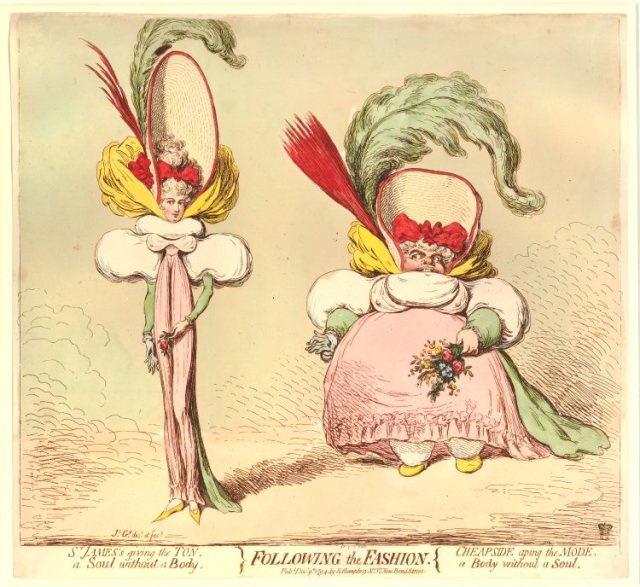
Following the Fashion. Hand colored etching by James Gillray, published by Hannah Humphrey, 1794. British Museum 1851,0901.706

But more’s the pity here: I don’t have a clear idea, really, how age was perceived in the various decades I interpret. I have a clearer idea of how different body shapes and class levels were perceived and taunted, though sometimes body shape is an analogue for age.

Is this my daughter Ann? Pen and ink print study by Samuel Hieronymus Grimm, 1774. British Museum 2011,7084.56

There’s a classic image that juxtaposes age and youth.  Here’s how the British Museum describes this image:

‘Is this my Daughter Ann?’; satire on fashion. A street where, before a house [on the right], over the door of which the name ‘Love Joy’ is written, a sedan chair has been brought, in order to carry away a young lady, who, in a towering toupée, and other articles of fashionable attire of this period, is leaving the house in company with a young soldier, who caresses her as they go; she looks fondly at him. An old woman, in what was then an ‘old-fashioned’ costume is interposing to prevent the departure of the damsel. 1774

Okay… “An old woman, in what was then an ‘old-fashioned’ costume.” You will note that the old woman is wearing what we typically wear here in New England to represent everyday clothing for middling and lower sort American colonists for most of the 1770s. I don’t want to put too much stock in the cataloger’s description, because I’m not sure that print curators or curatorial assistants always know as much about material culture as they think they do. And we know that six weeks is not six years when it comes to transmitting fashion changes and updates across an ocean. I think “old fashioned” might not be exactly or entirely right as a descriptive phrase.

What does the old woman’s clothing really signify? That she’s rural and not urban? That’s she’s poor? That she’s old? How ‘old fashioned’ is that costume by 1774… in a context other than London courtesan couture? And how do we translate the clues we have trouble deciphering into a dress code for living history?

Is this my Daughter Ann, mezzotint by James Watson after S. H. Grimm, published by Sarah Sledge, 1774. British Museum J,5.104

Well, happily, there’s a verse under the image in this print.

Is this my Daughter Ann

The Matron thus Surprised exclaims,
And the deluded Fair One Blames
But had the Mother been as Charming

She had Thought the Mutual sport no harm.
This Moral’s an undoubted Truth
Age envies Still the Joys of Youth

So this print is not about fashion. It’s about sex. (Well, duh. You were wondering when I’d bring that up.) It’s also, in a way, about hypocrisy, isn’t it? But the verse gives us the clue that the mother’s clothes are meant to be matronly.  “Conservative because of her age” might be a better descriptive phrase than “old fashioned” in that catalog record.

But does that mean that those of us who have achieved “a certain age” might also consider whether we, too, should be dressing in a more “conservative because of her age” style? I don’t really know.

But look here: Zoffany, ca. 1762.

David Garrick and Mary Bradshaw in David Garrick's "The Farmer's Return". Johann Zoffany, ca.1762. YCBA B1981.25.731
David Garrick and Mary Bradshaw in David Garrick’s “The Farmer’s Return”. Johann Zoffany, ca.1762. YCBA B1981.25.731

Here we’re looking at a rural woman ten to twelve years before “My daughter Ann.” The costumes are very similar; maybe the mother in Ann really is just old fashioned.

Here’s another version of “My daughter Ann,” this time more clearly fashion focused, without the sexual overtones.
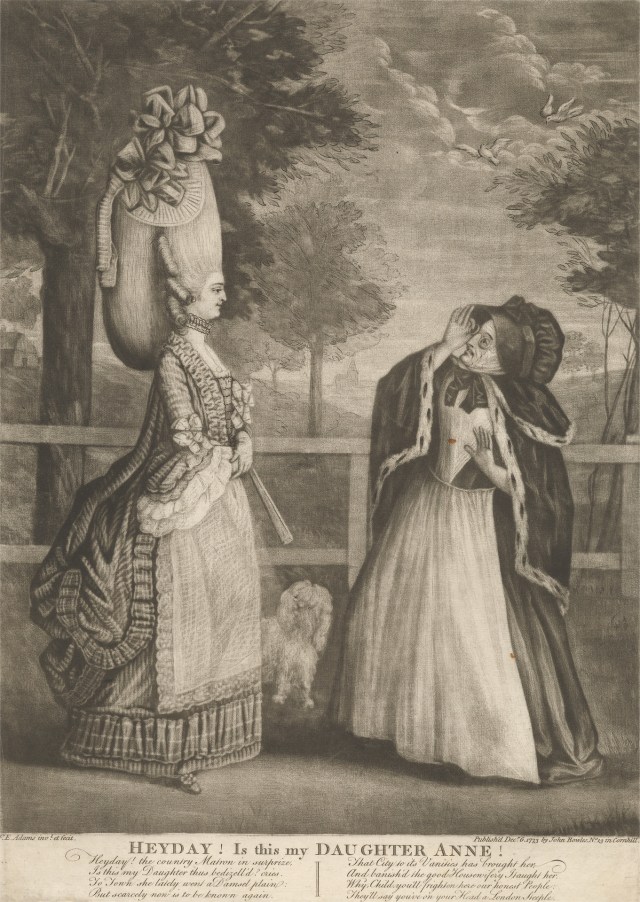
Print made by Francis E. Adams, active ca.1760–1775, British, Heyday! Is This My Daughter Anne!, 1773, Mezzotint and etching on medium, moderately textured, cream laid paper, YCBA, B1970.3.820

Yale helpfully provides a transcription of the verse at the bottom:

HEYDAY! Is this my DAUGHTER ANNE! | Heyday! the country Matron in surprize, | Is this my Daughter thus bedizell’d? cries. | To Town she lately went a Damsel plain: | But scarcely now is to be known again. | That City to its Vanities has brought her, | And banish’d the good Housewifery I taught her. | Why, Child you’ll frighten here our honest People: | They’ll say you’ve on your Head a London Steeple.

My best guess is that this print is skewering both Anne and her mother: Anne, for being so outlandishly fashion-forward, and her mother, for being so far behind. But again, that’s only a guess.
The Authenticity Challenge

We’re going up to Minute Man on August 24, or at least that’s the plan. We have hostages to exchange (one ends up with other folks’ spoons and bowls when one does the dishes) and drilling to do for the September 28 event in Boston.

Immediately after Sturbridge, the authenticity question blossomed on the interwebs, as there was an unusually fine crop of bodices on view in the village that weekend. (To be clear, I am pro-authenticity and anti-bodice, but I am still working over my thoughts on authenticity, which veered into hermeneutics, and are therefore not really germane to the conversation.)

Authenticity and standards are in the ether, and for this year’s event, all participants are asked to provide documentation, not just the people taking part in the challenge. I plan attend but not to partake of the challenge, as I have no desire to relive my childhood of never-even-third-place, thank you. Instead, I’m merely queasy and scrambling, as the only person in our household who seems really documented to me is the Young Mr, with his snuff-colored trousers  currently under construction, and two jackets from which he may be able to choose (presuming I get all buttonhole inspired). So he’s good. Run away!

I’ve been working on a ‘secret’ gown that’s not totally secret, but don’t feel I can adequately document it for this event. I have examples of the fabric advertised for sale, and a period print. But so far, the only gowns of this fabric type described in runaway ads have dark grounds. Granted, servants might tend to wear darker, more dirt-hiding colors, but I don’t feel that one print and some wrong-ground ads are enough. Next!

Anne Carrowle is Philadelphia, not New England: she’s passable for Monmouth and other Mid-Atlantic events. Chintz jackets: also fine for those runaway Dutch servants in NY and Philadelphia. Next!

Brown wool seemed too heavy for August, but the way the weather has been of late, maybe not. Well, anyway, it could get hotter. Next!

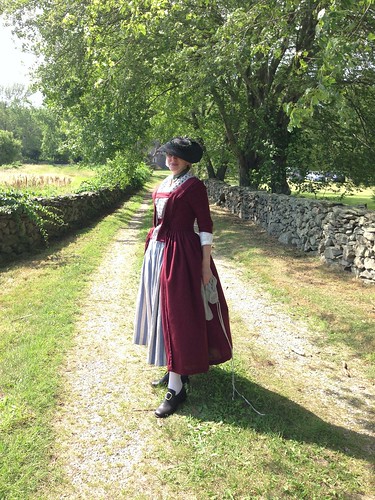
1772 red pompadoreThat leaves me with the New Favorite Gown, which I like, but which is based on an earlier British watercolor, so must be slightly altered at the sleeve or cuff as well as documented. At first I could find nothing to suggest that the color and fabric were within the realm of documentary possibility. Eventually I did find an ad in the Newport Mercury for what might be a likely candidate.

“Ran away on Sunday the 19th instant, from the subscriber at Newport, an Irish indented maid servant, named Elioner Clievland, pretty tall, who is very corpulent, with a red complexion, brown hair, and has a scar and a large dent in one of her arms, had on a red pompadore gown, and light broadcloth cloak: ” Newport Mercury, 8-10-1772

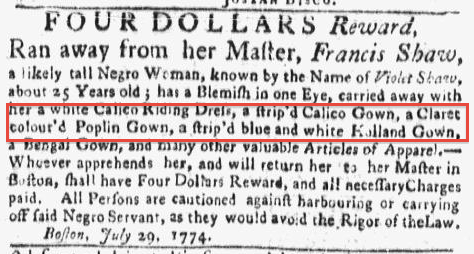
claret poplinTwo years later, “ a likely tall Negro Woman, known by the name of Violet Shaw, about 25 years old; has a Blemish in one Eye, carried away with her a white Calico Riding Dress, a strip’d Calico Gown, a claret colour’d Poplin Gown, a strip’d blue and white Holland Gown, a Bengal Gown, and many other value Articles…” Boston Evening Post, 8-1-1774

Well, I’m tall, and far from 25, but thankfully, I am not corpulent. But here are two wool or wool-blend, gowns, in reddish colors, in the right time period and place. Unfortunately, I have not yet found striped, or striped linsey, petticoats in Rhode Island, Connecticut or Massachusetts in 1772-1775—plenty in Philadelphia, where there are more servants running away—so what to do? I’ll look a damn fool without a petticoat.
brown petticoat newport

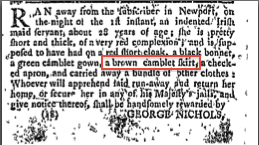
ShortGown There’s the brown petticoat solution. There is one in Boston (Weston), in August, 1774, and another in Newport, in January, 1773. I like the “brown camblet skirt;” I don’t have camblet, but at least the drape of the lightweight wool and cotton will be closer to camblet than to wool. I can agonize over the suitability of fabrics (and the vagaries of style) in some other post.

I made the gown intending to wear it with a blue and yellow striped as-yet-unmade petticoat (to look like the watercolor), but have some brown wool I can make up instead. Better documented than not (or nude).