A Case Cover for a Chair

With a brief, sort-of-break from school, I have time to think about the research and making I’ve done recently, if “recently” can encompass the past two-ish years.
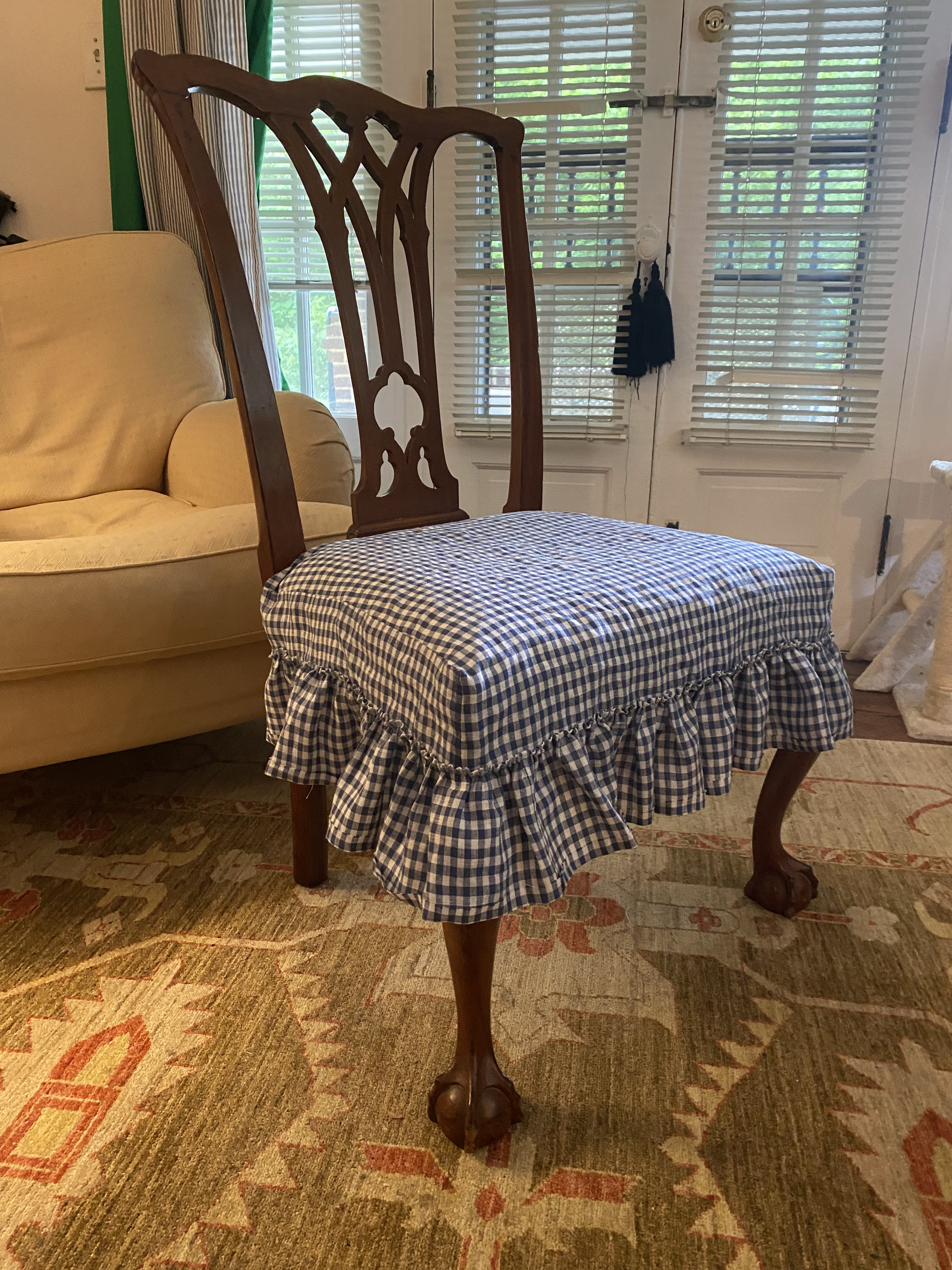
Last May, I made a slipcover or case cover for a Chippendale side chair. I love this chair very much and while I have not (yet) recovered the slip seat in something more appropriate, a case cover seemed appropriate.

I am under no illusion that this chair is Cadwalader quality, but it offers the opportunity for crossover between my upholsterer and Cadwalader obsessions. When John Cadwalader was outfitting his townhouse on Philadelphia’s South Second Street in 1770-1772, he ordered covers in fine Saxon Blue check, with fringe, for his chairs.  
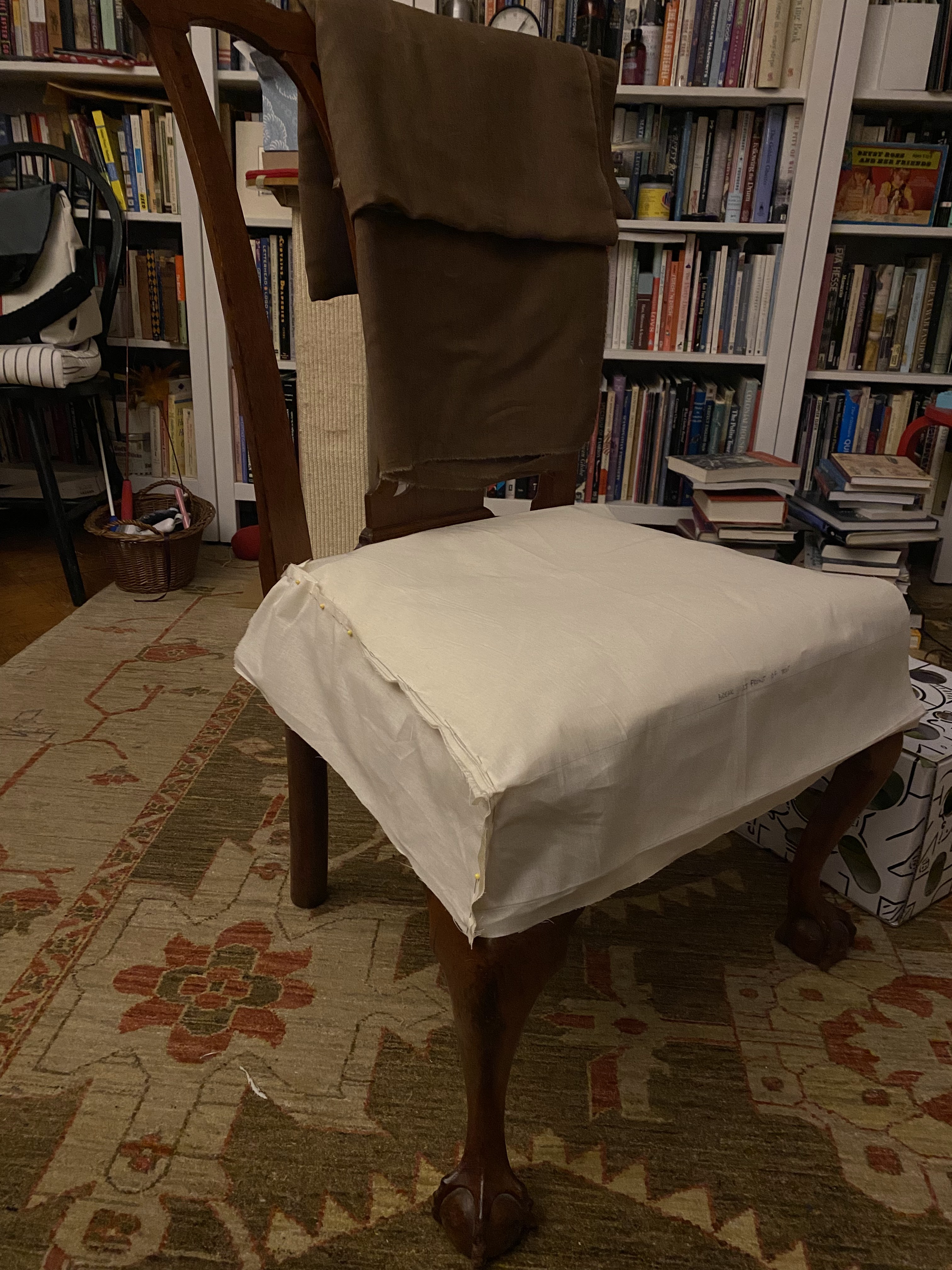
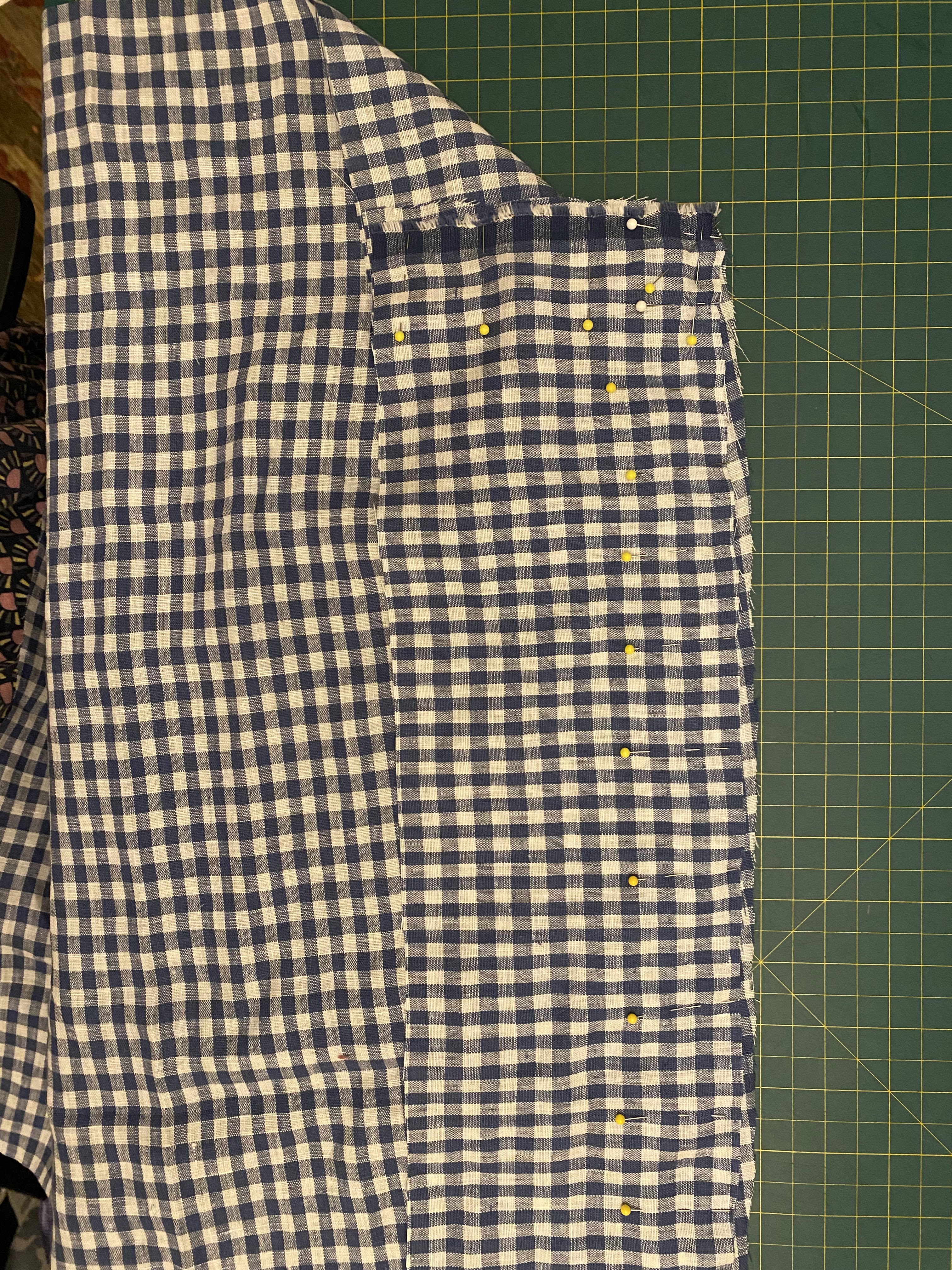
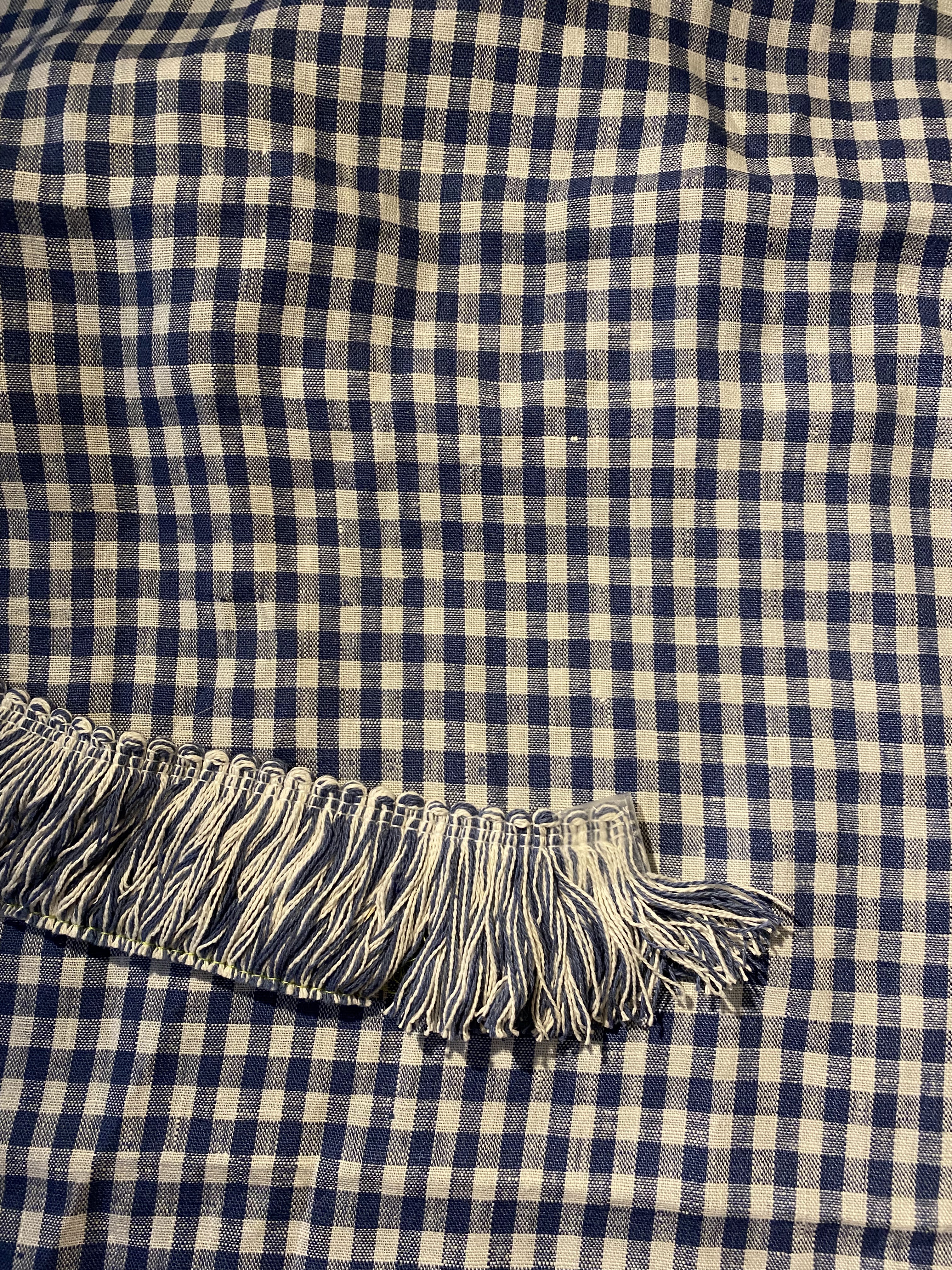
I started by making a muslin to create a pattern; this seemed like a better idea than just using measurements. It’s really a simple design: a top (the seat), front and sides, and a ruffled skirt. I based this on an original at Colonial Williamsburg. The cover attaches at the back with quarter-inch linen tape. I ordered fringe, but not enough, so for now, the cover remains fringe-less. 

Checked or striped linen was a common material for covers, durable and easily washable. Yes, this is where “furniture check” comes from: the large-scale checks used for these and other covers. (Samuel Johnson’s are particularly bold.)

Wilson, Benjamin; Conversation Piece; Leeds Museums and Galleries; http://www.artuk.org/artworks/conversation-piece-38209

Linen covers protected expensive upholstery (wool or silk damask, for example) from wear and light damage. Covers could be switched seasonally, but they were almost always made “en suite,” that is, in the same color as the wall coverings and/or curtains. The Cadwaladers had a blue room and a yellow room, both of which must have been like walking into a jewel, with shimmering silk damask on the walls, as curtains, and upholstering the furniture.
My cover may be simpler, and my house un-jewel-like, but I love it just the same. (It also fits other chairs, like this one at Historic Lewes.)

A Brief Bibliography:

Baumgarten, Linda. “Protective Covers for Furniture and Its Contents.” American Furniture. Chipstone Foundation, 1993. https://chipstone.org/article.php/376/American-Furniture-1993/Protective-Covers-for-Furniture-and-its-Contents.

Graves, Leroy and Luke Beckerdite. New Insights on John Cadwalader’s Commode Seat Side Chairs. American Furniture. Chipstone Foundation, 2000. https://chipstone.org/article.php/437/American-Furniture-2000/New-Insights-on-John-Cadwalader%E2%80%99s–Commode-Seat-Side-Chairs.

Prendergast, Susan Margaret. “Fabric Furnishings Used in Philadelphia Homes, 1700-1775.” University of Delaware, 1978. http://udspace.udel.edu/handle/19716/26040.

Swain, Margaret. “Loose Covers, or Cases.” Furniture History 33 (1997): 128–33. http://www.jstor.org/stable/23408074.
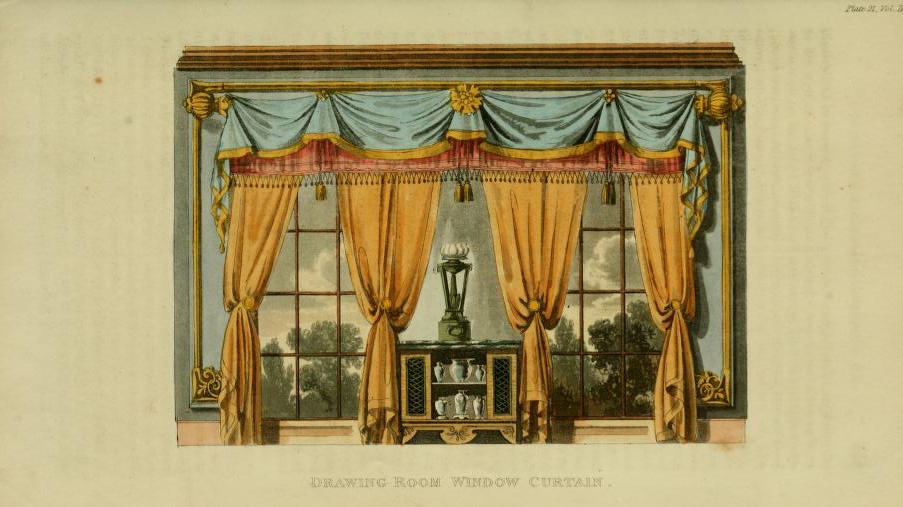
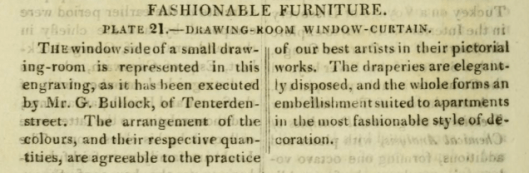
Fashionable Furniture, or, The Glories of the Past

include window drapes.

Ackermans's Repository of Arts., etc. April, 1817.
Ackermans’s Repository of Arts., etc. April, 1817.

Every now and then, someone argues with me that the historic house where I work would not have had window curtains or drapes. Sometimes they like to expand that argument to “there were no curtains at all” in early Federal America. The reasoning is usually that textiles were too expensive to “waste” on window dressing. If you know me, you know this kind of argument is a Bad Idea. The public fight (I was angrily accosted by a now-former docent during a public presentation) is known as The Great Curtain Kerfuffle, and resulted in my reply that the owner of the house could very well afford anything he pleased. Fabric is Money.*

There’s another iteration of my argument: Color is Money.

Ackermans's Repository of Arts., etc. April, 1817. page 244
Ackermans’s Repository of Arts., etc. April, 1817. page 244

Those of us who shop at IKEA are not going to have “the most fashionable style of decoration” in our 1817 homes. The Willings and Binghams of Philadelphia were models for the  most fashionable families of Providence, and while well before this 1817 plate, the Binghams were recorded draping their chairs with orange and red silks. In early 19th century Providence, the John Innis Clark family had silk covers on their sofas and chairs in 1808, and plenty of carpets and curtains in their Benefit Street home from the 1790s on. 

“Crimson is very rich, but blue is handsomer,” wrote Eliza Ward to her sister, Mrs John Innis Clark, in the 1790s. Curtains and covers were fringed (Mrs Hazard Gibbes was blue and yellow). Windows were dressed, and younger, less affluent relatives received hand-me-down curtains. In 1803, Elizabeth Watters in Wilmington, North Carolina was having a carpet “wove in true Scotch taste in imitation of Highland plaid.”

John Phillips (1719-1795) Oil on canvas by Joseph Steward,1794-1796. Sack Gallery, Hood Museum of Art, Dartmouth College.

Some carpets, no? Maybe the new mantra is Carpets are Money.

But quite aside from an obvious display of wealth, what we have to realize about these images and letters is that they are depicting a world that looks very different from our own. Color sensibilities, tolerance for pattern mixing, non-matchy-matchy sewing and dressing. We have to abandon our 21st century aesthetic sensibilities when we dress ourselves or our spaces for the past, and really embrace the vivacity of that world. Sensory overload, perhaps, but getting closer to what the world of the past looked like will help us see– in every sense– the way the people of the past did.

*I may or may not have made additional statements afterwards to the effect that of course wealthy Americans squatted naked in the corners of their well-appointed mansions gnawing raw meat until Benjamin Franklin invented fire and fabric. I should be sorry about that, but I don’t seem to be.

Why Do We Buy Things?

The Sunday, November 9th Guardian had a series of short articles on collecting, including one on why people collect things. This was similar to the New York Times’“Room for Debate” series on Why We Collect Stuff.

Chair, table, chair.

I liked the Guardian’s “Love, anxiety or desire?” question, and asked it of myself: why do I collect?

Collecting is something that I had given up for a while, given that so much of what Mr S and I had collected was stashed in boxes in our basement after an apartment move nine years ago. Nine years! If you haven’t unpacked in that time, do you really even care about those things?

No, not really. Many the things I unpacked recently as we went through the basement again are destined for Etsy: McCoy pottery vases, colorful Pyrex, FireKing glassware. I bought it at a time when I liked green pottery—it was an outgrowth of the blue and yellow creamware I’d begun collecting when I first lived in Rhode Island.

But now, I’m done with it: done with the mid-century modern, and going back to the early American things. There’s an aesthetic quality I like in both styles: simple lines, bright colors.

The most recent acquisition is a drop-leaf table in a very country Sheraton style, with a tiger maple skirt. I watched this table for months before finally committing to it, and dragging Mr S up there late Saturday afternoon. He was game, and in the past day the table has grown on him.

Why did I want it? For one thing, it reminds me of a maple drop-leaf Sheraton-style table my mother has, so perhaps there’s an element of nostalgia, or a desire for approval. I also imagined it exactly where it is, though it will require some adjustment in lighting. Did I buy a piece not only of the American past, but of my own? Is this what adulthood looks like? Or am I just responding to shape and color?

The table and chairs are low, and not comfortable in the way that modern furniture is: I wouldn’t want to sit in the chairs or work at the table every day, but these things give me pleasure, whether bought for love, anxiety, or desire.

Frivolous Friday: Comforts of a Rumpford

A companion pl. to BMSat 9813. A pretty young woman wearing a décolleté négligé, stands with her back to the fire, her gown raised to leave her posterior naked. She holds a book: 'The Monk - a Novel by M' ['G. Lewis', cf. BMSat 9932]; another is open on the floor: 'Œconomy of Love by Dr Arm[strong', 1736]. A cat rolls on its back. On a table are a decanter of 'Creme de Noyau', and an open book: 'The Kisses'. On the mantelpiece are flowers and an ornate clock with embracing cupids. A picture partly covered by a curtain represents Danaë receiving the golden shower. The room, apparently that of a courtesan, is luxuriously furnished. 26 February 1801 Hand-coloured etching, British Museum, 1935,0522.7.12
A companion pl. to BMSat 9813. A pretty young woman wearing a décolleté négligé, stands with her back to the fire, her gown raised to leave her posterior naked. She holds a book: ‘The Monk – a Novel by M’ [‘G. Lewis’, cf. BMSat 9932]; another is open on the floor: ‘Œconomy of Love by Dr Arm[strong’, 1736]. A cat rolls on its back. On a table are a decanter of ‘Creme de Noyau’, and an open book: ‘The Kisses’. On the mantelpiece are flowers and an ornate clock with embracing cupids. A picture partly covered by a curtain represents Danaë receiving the golden shower. The room, apparently that of a courtesan, is luxuriously furnished. 26 February 1801
Hand-coloured etching, British Museum, 1935,0522.7.12

I’ve left that caption intact, though it seems quite long enough for a blog post itself. This image turned up on Twitter (you can follow me there @kittycalash, expect randomness) and delighted me at the end of a long, tough week. I’m particularly taken with the cat, which resonates with an lolcat that floated about the interwebs last winter. The interwebs can be a strange place…

But aside from that silly cat, there are a wealth of details in this image, some of which are explicated in the caption.

What struck me- after the cat– was the slipcover on the sofa. How lame is that– but it’s true. Floral print, I suspect, but possibly woven, it’s loosely draped and long. I’m more familiar with the checked linen slipcovers seen in representation of New England interiors, so the floral really struck me. I suppose those linen checks symbolize all the puritanical uprightness and restraint of early Federal New England dons (if you believe in that kind of thing), while the loose floral print drapery tells you everything you need to know about our Rumpford friend.

We all see what we want to see…cats, slip covers, or courtesans.