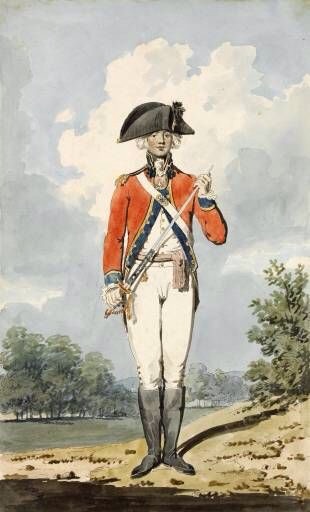
Officer of the Third Regiment of Foot Guards, 1792 British Museum 1890, 0806.2
Every now and then, my interests collide in unexpected ways. While searching the Tate Collection for something completely different, I came upon this image of a fine-figured officer. I love a man in a uniform, and this one comes with a bonus: the curator’s comments. “According to Binyon the outline etchings are by Thomas Kirk, after a drawing by Edward Dayes, coloured by Turner as a boy.”
You can see Turner’s style latent in those trees and in the dramatic sky, and even in the shadow that lies at the officer’s feet.
18th century coloring book, or image defaced by inchoate genius: you be the judge.
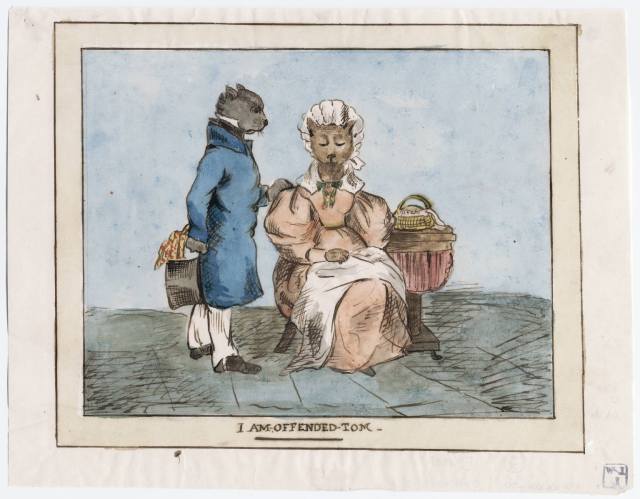
I am offended Tom. Watercolor, 1830s. Lewis Walpole Library, Drawings Un58 no. 29 Box D108
I don’t know the backstory here, but the summary is satisfying: A standing cat attired in men’s 19th century fashion rests his paw on the shoulder of a sitting cat attired in women’s 19th century fashion. The latter declares “I am offended Tom” while engaged with a sewing project.
Really, the lolcat is a historic tradition, and it’s research I’m doing when I wander over there on lunch break, honest. So, let’s research this up:
Whatever has happened between these two (I don’t need to tell you about a tom cat’s reputation), the watercolor does a nice job of depicting a fairly common domestic scene in which only the trappings change. Those anthropomorphic emotions have played out, and will play out, in many a parlor, drawing room, chamber, living room and studio.
Let us hope we all avoid domestic stresses this weekend, except when truly warranted.
This morning, the Twitterz provided me with a link I’d missed back in November, to a piece about the Clash’s Vanilla Tapes. I listened to the cut of London Calling, and heard the ways in which it was not the final cut, and thought of authenticity. What a fabled state of grace: authenticity.
You think, if I just get this one thing right, I’ll be done.
What matters is the process. I know, how tiresome: it’s the journey not the snow leopard. But it’s true: what makes history in any expression fun are the questions, the new things to learn.
Yes, I have always liked to dress up, and to get my friends to join me.
I realized, too, that the joy I felt seeing the Clash at the Aragon ballroom none-of-your-business years ago was not unlike the pleasure I get from living history– and that’s not just because of the funny clothes and loud noises, though both sub-cultures share a taste for natty dressing and unusual music.
I find joy in the physicality of living history*, for although a milliners’ shop is no mosh pit, when your clothes, shoes, and accessories are as right as they can be, you will move and feel differently than you do in your office or workout clothes.
There’s joy for me in the difficulties, too: from Saratoga to cooking, I like a problem to solve, a process to learn.
I’ll never get everything just right: I’ll get closer to right, and the fun is in figuring out how.
The Romps, by William Redmore Biggs. (c) Leeds Museums and Galleries
What Cheer Day is around the corner, and while we won’t have the delight of the babies this time, when browsing the BBC’s Your Paintings site, I found this painting by William Redmore Biggs. It pretty well captures the level of activity I’d like to bring to the museum–or at least a level just short of spilled ink.
As always, I’m looking for what working women wore, and in this image, I think we see the mistress of a dame school with her charges, who have clearly been romping in earnest.
The details abound, from the portfolio on the mantle to the baize on the floor and the ink spots on the little girls apron. The room is simply furnished, but we get a sense of domestic and dress details. The shortest girl in the front trio is disheveled, her sash undone and her gown slipping from her shoulders. (What a romp they’ve had!)


 Kirsten Hammerstrom
You must be logged in to post a comment.