Flopsy Mopsy

Mop sellers, red chalk on paper, Paul Sandy, 1759. Museum of London 65.59/5#sthash.EaUTT9dg.dpuf
Mop sellers, red chalk on paper, Paul Sandy, 1759. Museum of London 65.59/5

They’re pretty consistent: mops appear to be made of fibers attached to a handle. These look like they’re simple string mops. A stick and string? A stick and rags strips? Something along those lines. But what kind of string? What kind of fiber? How was it attached?

I’ll confess that I have been too lazy to search collection for extant mops– no, seriously, if someone offered me an 18th century mop my first reaction after “Absolutely!” would be, “Wait a second…how can there be anything left of an 18th century mop? My own mops don’t last all that long….” so I assumed no such critter exists in captivity (feel free to prove me wrong, I could use an assist here). Instead, I went ahead with the daft notion of replicating what I saw in images.

Sandby helpfully supplies us with mop sellers who carry fuzziness on a stick. Most likely wool, since sheep were plentiful and cotton expensive in this period. But maybe not. In any case, a simple business.

Supplies assembled
Supplies assembled

After work on Saturday, I went mop-top-shopping. It was not one stop. An internal rant developed about how companies can call anything “wool” that is less than 100% wool, but I managed to contain myself and with enough hunting turned up hero cord, 100% wool yarn and 100% cotton yarn as well as dowels. Sadly, I could not find wool roving in any color but grey. So, making a mop from craft and hardware store supplies is a pretty easy thing, especially when you don’t have many tools to complicate the business.

IMG_6275

This is not my first rodeo where string is concerned, so I wrapped the yarn around a cutting board just the way you’d make a pom pom. How else will you get it all the same length (more or less)? The result: a somewhat sad hank in search of purpose, tied off in the more-or-less middle of the strands.

Secured temporarily with a rubber band, I tied the hank to the dowel with hemp cord. Then I turned the wool (and later cotton) back over itself, and tied it off again. I pulled as tight as I could manage, much to the chagrin of my now-blistered pinky finger. Small price to pay, though, for two new entrants in the experimental archaeology of cleaning. As I looked at the images in Sandby’s drawing and in the prints, I was pretty confident the mops are not tied off again in this second way, but one band didn’t seem secure enough. So, yet another compromise, but one that I hope will result in less hilarity from losing mop heads in the midst of washing floors.

Now, if I would but turn my attention to the lint, string, and yarn scattered about my floor at home…
Mopping Up

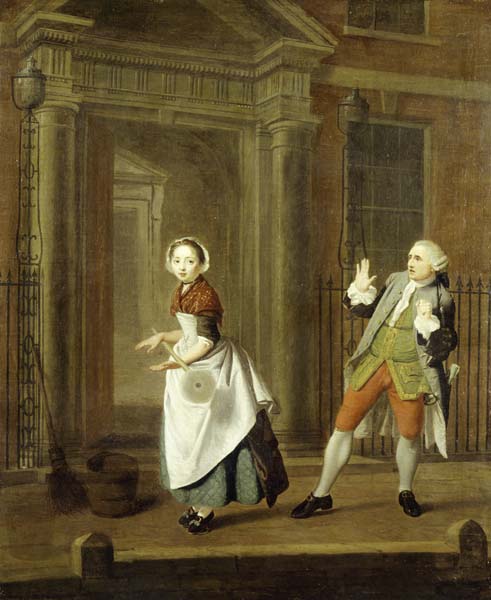
A City Shower. Oil on canvas by Edward Penny, 1764. Museum of London

Springtime sadness is best remedied by scouring[1], so in the best Scandinavian fashion, I have been looking into 18th century cleaning. Dem barracks, right?

First of all, were you wondering about what exactly they “smoked and cleansed” smallpox victims’ rooms with? Brimstone and frankincense.[2] Now you know what Edward Langford would wake up smelling when the house next door was free of smallpox.

But what about those floors? They need to be cleaned. Swept, yes, and scrubbed with sand. But also mopped, and the doorstep mopped.

Tit for Tat. stipple etching, London, Printed for R. Sayer Map, Chart & Printseller N° 53 Fleet Street, as the Act directs Novr 24. 1786. British Museum 1861,0518.958

I have a broom and a whisk broom, and can substitute a kettle for my sad bucket[3] but I lack a suitable mop. Lack never deterred me, whether of skills, knowledge, or supplies, so off to the interwebs and library I went.

I started with Foul Bodies, the 2009 monograph by Kathleen M. Brown. Nothing on floors, sadly.

I remembered the 10th Massachusetts Orderly book from 1782, that was more helpful.

Some part of the Camp and about the long Barracks in particular is relaxing into nastiness. Regimental QuarterMasters have been ordered to have them Clean and keep them so. An Officer of each Company has been ordered to visit the Barracks every day and to Confine & Report those who throw bones of meat Pot Liquor or filth of any kind near the Barracks. Yet all this has been done and no report has been made. it is hatefull to General Howe to Reitterate orders as it ought to be shamefull those who make it necessary.

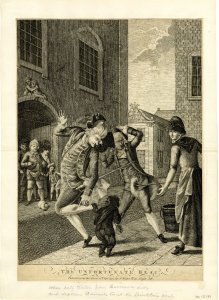
The Unfortunate Beau, etching, Publish'd as the Act directs 12th Sept 1772, by S.Hooper, No.25 Ludgate Hill. British Museum 1991,1214.20
The Unfortunate Beau, etching, Publish’d as the Act directs 12th Sept 1772, by S.Hooper, No.25 Ludgate Hill. British Museum 1991,1214.20

Nastiness. Those barracks sound noisome, don’t they? We can’t have that.

So let’s cast out the bones, sweep the floors of the branches and dirt and grit the men have brought in, and mop them, too, now that it’s spring.

Mop, you say?

What did mops look like the in 18th century?
And how on earth will we acquire one?

Tune in next time for another exciting installment of “historical cleaning instead of cleaning my own house.”


[1] Dude, I have scrubbed baseboards with a toothbrush. Not one of my finer moments, but a memorable one.

[2] Kathleen Brown, Foul Bodies: Cleanliness in Early America. (New Haven: 2009) p. 129

[3] Really really: I meant it when I said keep the bucket wet.

Fort Moonrise Kingdom

Fort Ti was described to me as “Disney World for Re-enactors,” but my vote is for Living History’s Moonrise Kingdom.

Idyllic, ain't it?
Idyllic, ain’t it?

I almost didn’t go when my Saturday night roomshare cancelled on Monday and then I developed an ear ache on Wednesday, but on Thursday, Low Spark , Mlle Modiste and I arranged a carpool, so on Friday morning, a Carload of Rhode Islanders (a thing to behold and to be wary of) set off for points north.

Our initial plan was to to sleep in the soldiers’ huts, but they proved extremely crowded and smokey, so when Mlle Modiste and I were offered a bunk in the barracks, we took it… unfortunately, only one of the blankets I’d brought for us did not make it back up to the fort or into the car heading home.

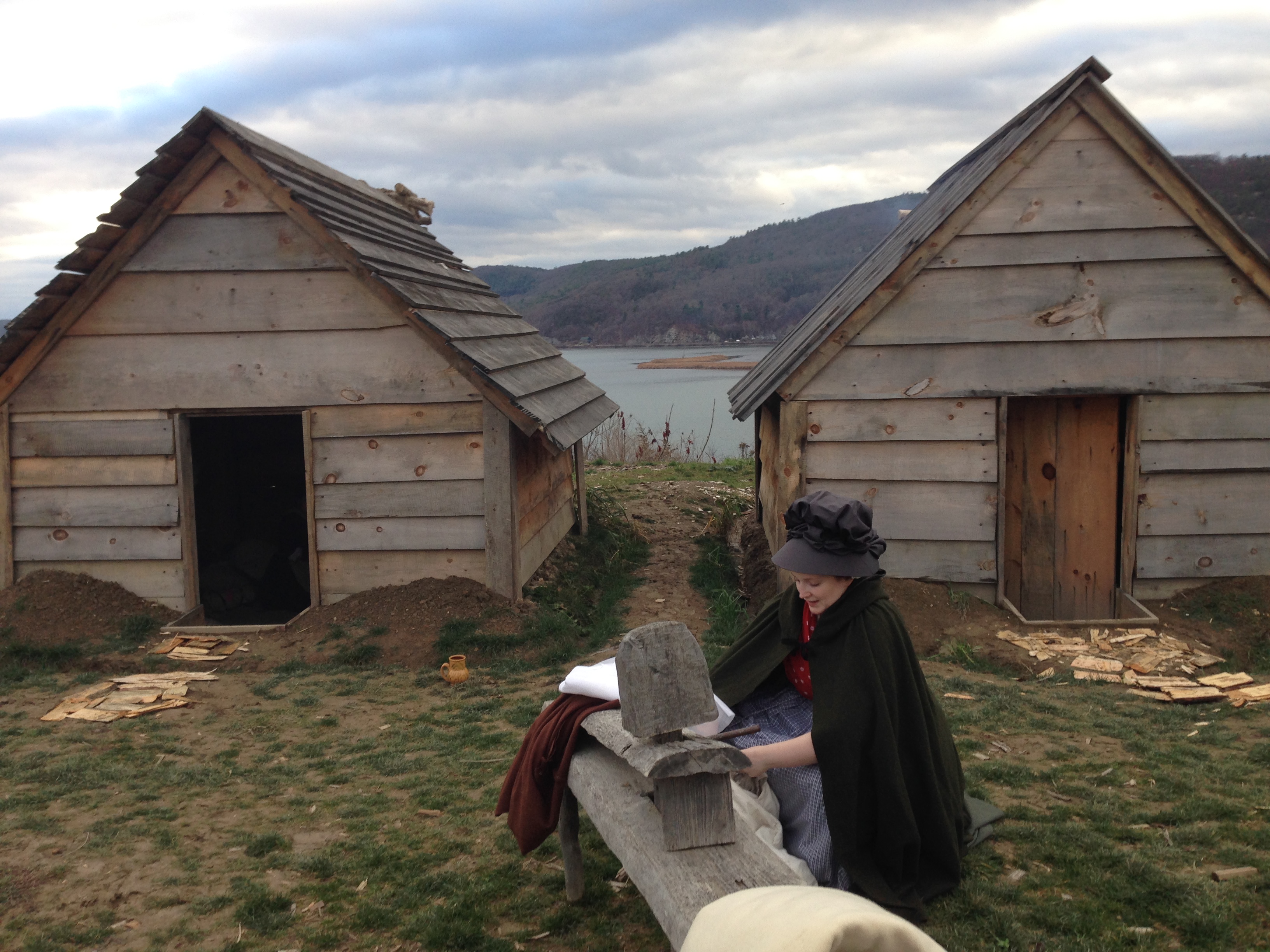
Mlle Modiste at the huts

Before supper, we stuffed bed ticks, started a fire, startled a bat (I was not the source of the shriek that brought officers, women, and soldiers running), and stuffed straw in the hole we thought it flew into (thank goodness I’m tall, I guess).

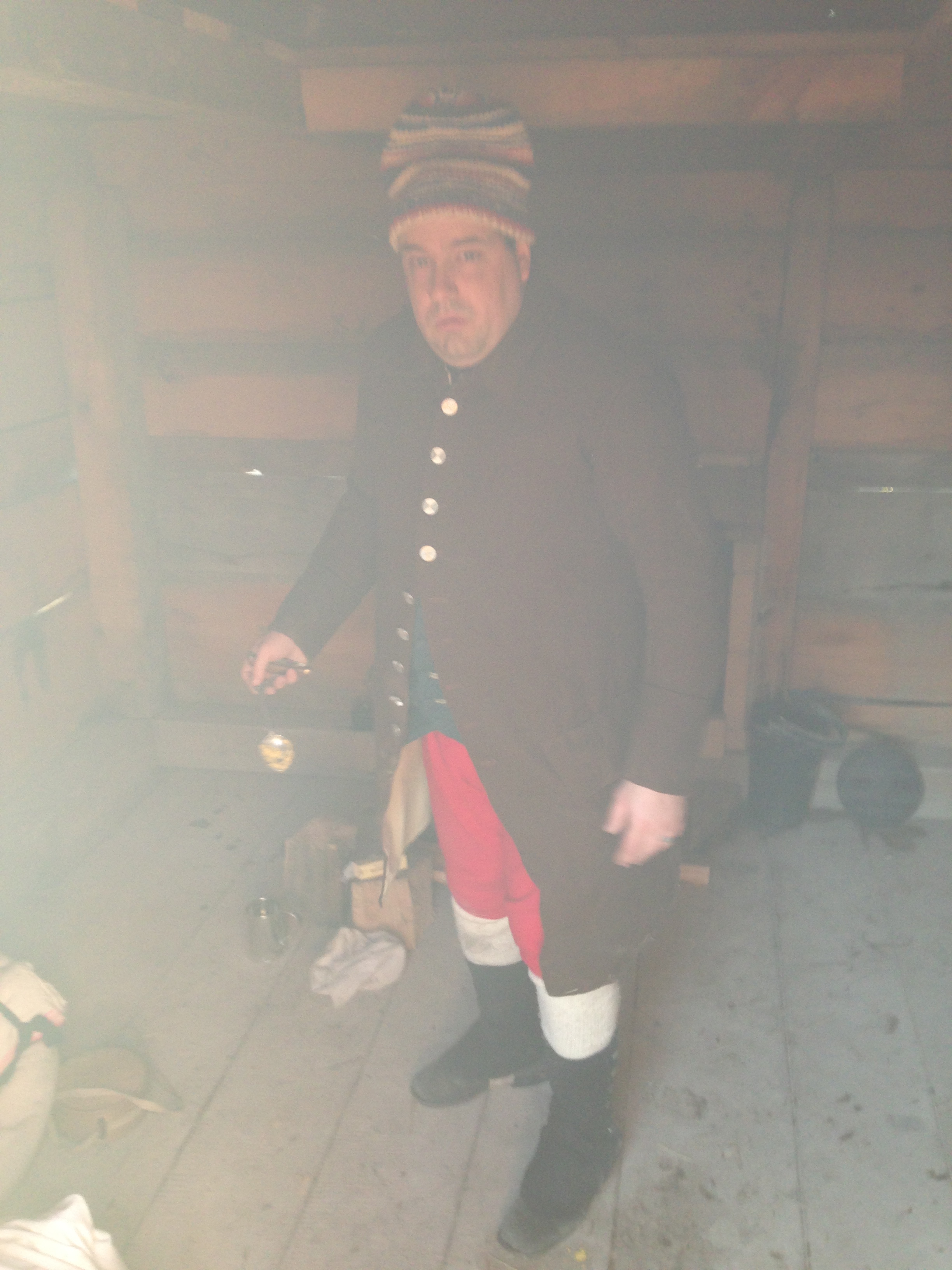
Smoke didn't just get in your eyes...
Smoke didn’t just get in your eyes…

The tavern moved up to the would-be armory at the barracks, though I’m certain multiple political deals and presidential candidacies could have been plotted and bought down at the smoke-filled huts. Instead, it was reenactor politics as usual: parallel experiences for men and women (not ladies, thank you, and if I hear you use “distaff” about me, expect to find one has become part of your anatomy). Just because I’m used to it doesn’t mean I don’t notice it, understand it, and still dislike it.

We’d expected to attend to “sick” soldiers in the hospital, but Saturday was such a lovely day that we spent most of it outdoors, starting and tending a fire to boil laundry and make dinner for the women’s mess. This pleased me mightily, even as I may have distracted troops despite my advanced age as I crouched at the fire being a human bellows. You try getting low in stays and see how you do: immodesty, thy name is fashion.

While I kept the fire going, much credit should go to Rory, a bad-ass woman in men’s clothing who split wood a-plenty for us.  Rory made me want badly to make myself a suit and wield an axe. I find myself wanting to do the same work as the men (I have always been this way), and I was intrigued by the debate that was reported to me: should a woman do men’s work in women’s clothes, or in men’s clothes? In the end, they chose men’s clothes, and Rory wore them well. Reader: I was jealous. I was also covetous of an axe, having realized all the cutting and hewing tools are no longer domiciled with me.

Aunt Kitty's coming' for you. boys.
Aunt Kitty’s comin’ for you, boys.

Saturday really revolved around three things for me: food, free agency, and feminism:

  • I ate some interesting things, including a smoked chocolate cake (left overnight in a hut, I can describe its flavor best as sucking diesel exhaust through a chocolate cupcake).
  • Now that I’m a free agent attending events sans unit, I have much more fun.
  • I am determined and dedicated to effecting well-researched roles for women in living history events of all kinds.