Blame the Milk Maid

Sandby: A Milkmaid. ca. 1759, YCBA
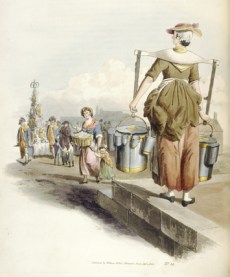
Pyne, Milk Woman, 1805, MoL
Pyne: Milk Woman, 1805, MoL

What do pewter and tin have to do with costuming? Well, aside from the many expensive buttons Mr S and the Young Mr wish to sport, I got interested in the milk maids’ pails because of their similarity to the tinned kettles used by RevWar reenactors. The uses converged in December in a conversation I had with a colleague about Carl Giordano’s beautiful kettles. (He made my wash basin, but my kettles came from Missouri because I needed them very quickly; the fur trade & rendezvous reenactors have similar material culture interests and needs, because of time period & culture overlap.)

1793: Milk Below Maids, V&A
Milk Below Maids, 1793, V&A

The milk pails look like tin, don’t they? One from ca. 1759, the other from 1805, and both appear to be carrying shiny, seamed metal buckets with brass details at the base and rim. The captions call them pewter, though. So I went to the V&A and the Museum of London looking for pails, but only found more milk maids.

I began to wonder: if the pails were really made of pewter, wouldn’t they be awfully heavy? And wouldn’t there be extant examples? Pewter is highly collectible. There’s a George II pewter milk pail on Worthpoint, but it looks nothing like the pails in the images. Is pewter ever so…shiny? And I’ve never seen seams in pewter the way they appear in the Pyne illustration.
Here’s something that reminds me of that George II milk pail.  I think I trust the Met more than I trust an online seller. On the right is a “bucket carrier” from the National Trust (UK) Collections.

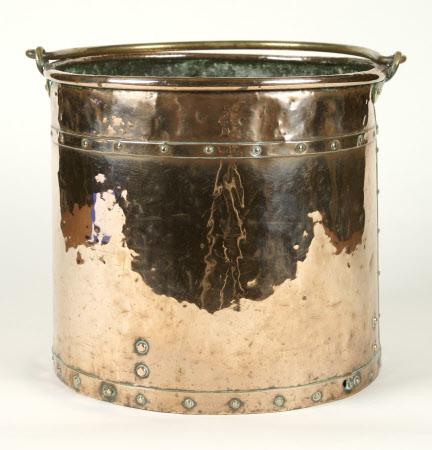
Mid-18th century dinner pail with cover, MMA
Mid-19th century bucket carrier, NTC (UK)

Google defines pewter thus:

pew·ter

/ˈpyo͞otər/

Noun
  1. A gray alloy of tin with copper and antimony (formerly, tin and lead).
  2. Utensils made of this.
Synonyms
tin
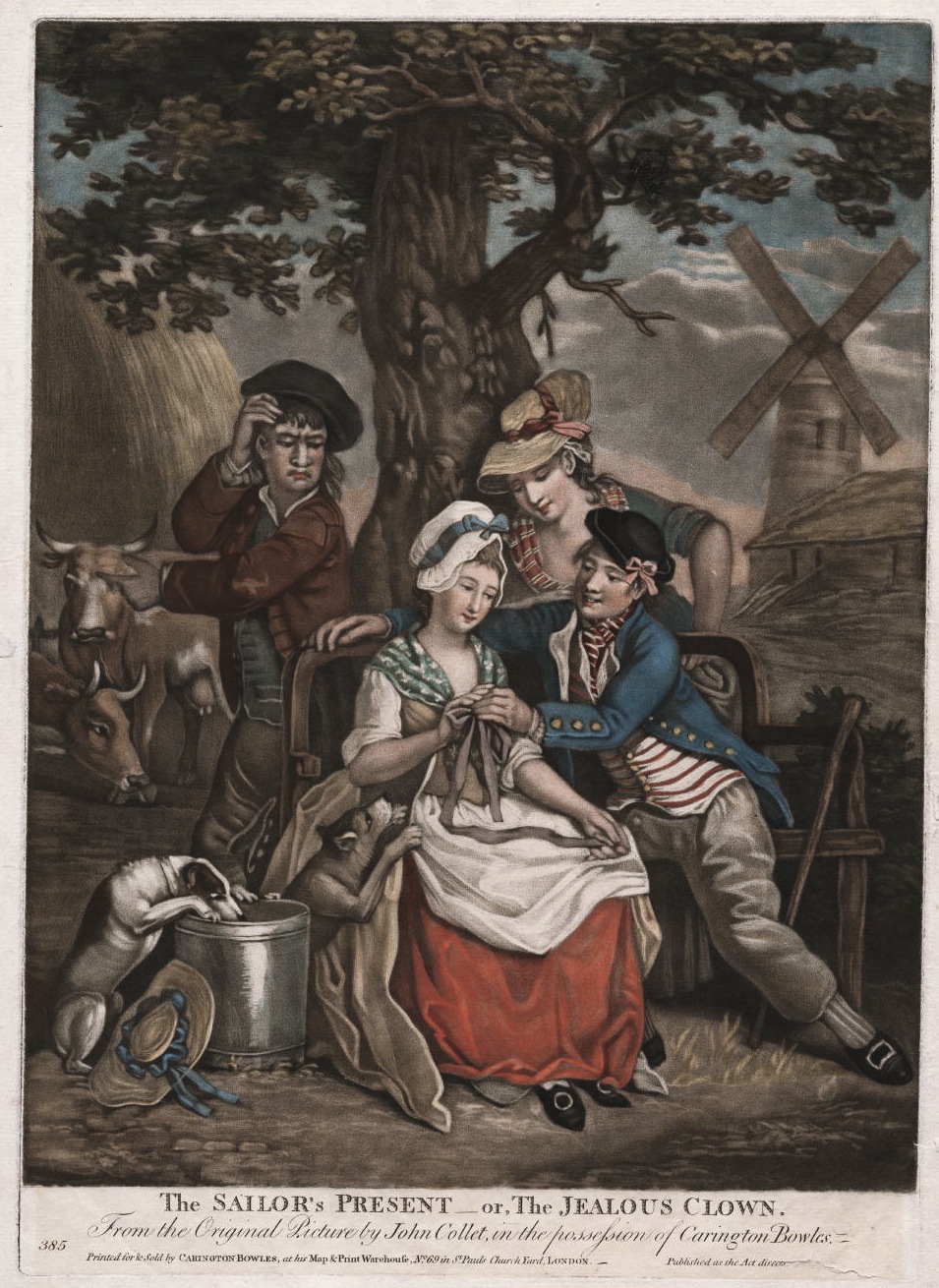
178, Collet: The Sailor's Present, LWL
178, Collet: The Sailor’s Present, LWL
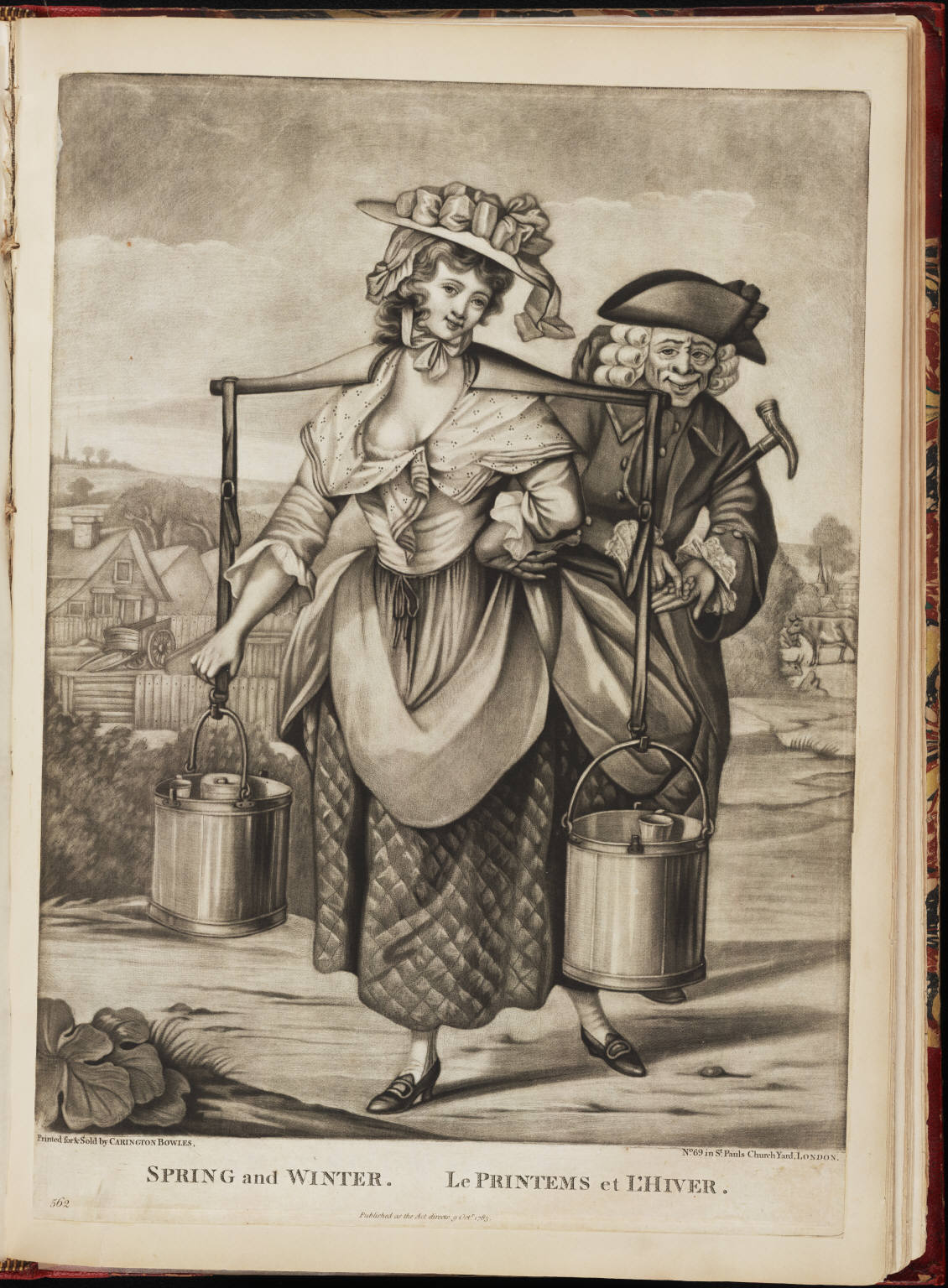
1785: Spring & Winter, LWL

Synonym: tin? That’s pretty interesting, even though I don’t trust Google with etymology.  But don’t these tin kettles look a great deal like the milk maids’ buckets?
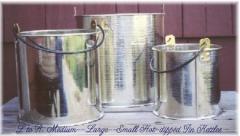
Carl Giordano Tinsmith: Kettles

The Giordano tin kettles can be made with brass ears (that’s the part the bail, or handle, goes through). Look at the ears in the photo, and at this detail from “Spring and Winter:”

Detail, Spring & Winter, 1785, LWL

The ears may be the best lead to follow. There are plenty of ears (handle attachments) if you search the Met for bucket or pail and limit the search the metalwork… but they’re bronze, and Roman. The National Trust (UK) doesn’t turn up much, or the Museum of London (yet).

ca. 1750: Silver cream pail, MFA

There’s a silver cream pail at the MFA, and it sort of looks like its handle attaches with ears, but not in the riveted-on kind of way, but in a purposeful and elegant way. This is just about where I start to ask myself why I care, but then a number of other questions present themselves, like:

  • Where are the milk pails? Are there really no milk pails in museum collections? (Yes, this could be true)
  • Was this pewter milk pail with attached measures specific to London, as my colleague thinks?
  • How does milk taste when it spends quality time in pewter (or tin)?
  • How heavy would a pewter milk bucket be?

Things to ponder as we prepare for heavy snow… In this state, that means dashing out for “French toast supplies.” I’m not originally from here, and I solemnly swear we are legitimately out of bread, eggs, and milk.

Petticoat Burns

Per Hillstrom, Kitchen Scene

You know this site, right? History Myths Debunked examines the stories about the past many like to think are true, and Death By Petticoat is one of the favorites. Here it is on an English site catering to reenactors. There’s a variation I’d never heard, about wetting petticoat hems to keep them from engulfing the wearer in flames. (OK, mild exaggeration: to keep the petticoat from igniting fully, thus… hat tip to Back Country Maiden for pointing this out.)

As someone who just finished mending a petticoat, you’d think I’d leap at the chance to drench my hem in water to prevent future mending episodes, but not so. For one thing, in the house or in the camp, that’s water I had to haul or cause to have hauled, and I’m not wasting it. Wet the hems and what’s next? Caked lumps of ash, mud, and.or other filth. No thanks.

High-tech historical cooking

The burns I got in my dress were acquired at the end of the day when we were hearth cooking and were practically in the fireplace ourselves. That is where you must be if you wish to stir the sauce until it thickens, and there was the hoisting of roast in its pan a couple of times, and general playing with fire in pursuit of food. My ca. 1799 dress is longer than my 1770s petticoats and gowns, and the extra inch or two probably contributed to the burns. But I wasn’t engulfed by flames, because the damn thing is wool. Self-extinguishing wool, worn with linen and wool petticoats and a linen apron. not going to go up in flames. Also not going to get dipped in water–and wouldn’t that result in steam and hence scalded shins?

I don’t know where these rumours start, but they could have started with a cynical curator joking with house tour guides who failed to get the joke. Not that I know anything about a story of about Providence kitten named Georgie in honor of George Washington’s visit to a large brick house on a hill .

Weekend at the Farm

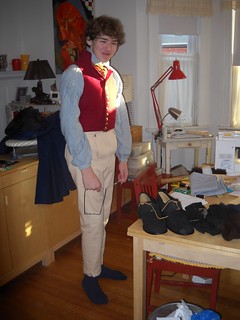
The Young Mr in his new clothes

Fourteen year old boys don’t like to get up early, but we managed to rouse the beast on Saturday, and get him dressed, with only minor hostilities. He’s wearing all new clothes, except for the shirt, which I hope will not have to be replaced before the end of the summer. (I have now guaranteed that his arms will grow several inches in the next week.)

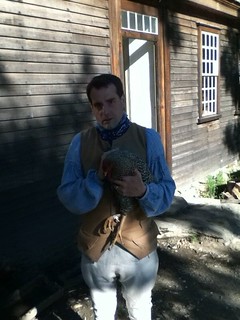
Mr S wore his new waistcoat but it’s hard to see under his jacket. He also got his new hat from Mr B, so he could upgrade from his knitted cap.

New hat, new waistcoat

There are more photos here, including a fabulous stuffed leg of lamb. For mid-day Saturday, we ate a meat pie (pork and apples), sugar cakes, coriander biscuits, bread and molasses bread, all brought from home, along with hat from the farm boiled with parsnips, potatoes, carrots and onions and a carrot pudding. We also made a potato-apple-onion pie for the evening meal, though Mr S, the Young Mr and I did not stay. There is a limit to what the child will tolerate.

Sunday, we arrived in time for Mr S to make more fence pegs, while I joined the kitchen to make soup with ham, squash, parsnips, and onions, which we ate with bread and cheese, and the last of the sugar cakes, for lunch. All the while, a leg of lamb was cooking, masterfully prepared by Mrs B, and stuffed with cubed bread, onion, ham, sage and onion. To go with it, we made a rice pudding with apples, wilted greens, salad, squash pudding, and stewed apples. The sauce for the lamb was particularly fine, with drippings, minced onions, what we think was whiskey, butter and cream. I learn so much cooking with Mrs B!

waiting, wanting, hoping

The cats wanted, but were disappointed. They were calmer on Sunday, though extremely attentive kitchen assistants both days. Pity they don’t do dishes. There were plenty to wash. 1799 was definitely greasy. Even the striped cat feels a little greasy, but that could be because he’s handy to wipe your hands on.

Now it’s on to sewing for something else, though whether that will be wool trousers or clothes for Washington’s Birthday, I don’t really know.

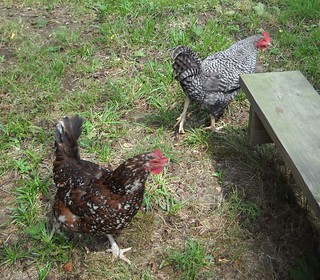
Consider the Chicken

https://i0.wp.com/farm9.staticflickr.com/8311/7995409969_f925f8a7eb_n.jpg
Nobody puts Dumber in a pot

With apologies to the late David Foster Wallace

The majority of us do not consider the chicken. We may consider whether the package of chicken we purchase is free range, organic, cage-free, grain fed, cruelty free. But we are unlikely to think about the implications for the physical being, the essence of chicken-ness, that the chicken’s conditions create for it.

And I am here to tell you that the cage-free, organic, free-range chickens and chicken parts that you purchase at Whole Foods or your other large vendors bear little to no relationship to the actual free-range, catch-as-catch can, ne’er-do-well chicken of the historic barn yard. For one thing, living history chicken is ripped.

https://i0.wp.com/farm9.staticflickr.com/8205/8243387583_072e352ff9_n.jpgIt’s well-developed physically, with strong, sturdy bones and robust ligaments. Its musculature is tight: this is not a bird in need of a personal trainer. Its meat, when cooked, is not white. It is dark meat, not so dark meat, and sort-of white meat. Its taste was described to me as gamey, but I disagree. It was chicken, but earthy, sweet and fresh and rich.

But all that came after the meeting of human, knife, and chicken.

Disassembling the chicken fell to me; I declined rubbing butter into flour having prevented a fall down cellar stairs by putting my hand in fresh goose guano, so I after I washed my hands, I addressed the chicken in its bowl, and took up a knife.

Dumber & Friend

By this time, post-carrots, -parsnips, -squash, -string, -tallow and -suet, the knife lacked the purest essence of knife, that is, sharpness. But it functioned well enough for the task, with some persuasion. The skin was much thicker and more resilient than a store-bought chicken, and greasier, though not in an unpleasant way at first. The muscles were well-developed, and pink. Rosy pink, deep pink, dark like wine. There were no large slabs of the shiny, flaccid, pale meat you find on the chickens in the store. Those aren’t chickens any more: those are products.

The process of quartering the chicken took strength and pressure on the knife, and the strength of my hands. I did have to rip joints apart, and break the carcass’s back. All of this had a sound, and a mild smell of chicken, mixed with the melting tallow. But it was the sound that, with the greasy, slick knife, and the grease that soon covered my hands and wrists, that kept bringing me back to what I was doing, and that, when the bird was broken apart and in the pot and my hands washed, again (they itched), send me outside and up the hill for air and sky.

We boiled the chicken in a kettle we’d already boiled crook neck squash in; later, we added sage, thyme, parsnips and carrots. It was delicious. The broth was incredible, and the whole meal very simple. That’s the whole of the recipe: boil a chicken, add herbs and root or fall vegetables, boil until done, serve. Use any uneaten broth and bones/meat for  stew, pie or other dishes. That’s it.

The product chickens from the market are bred to fall apart. They haven’t got what a running, pecking, eating everything chicken’s got in muscle, ligament, and tendon.

On Sunday, after we came home, I looked at the food in our cupboards. There were boxes, cardboard, plastic, layers of packaging. The cheese was square. These things came from the good market, but were they food, or were they products? I felt like a passenger on the ship in Wall*E, and I was appalled.