Eating in the Field: Playing with Fire

Multi-Day, or Events with Fires

(e.g. Redcoats & Rebels at OSV, “encampments”)
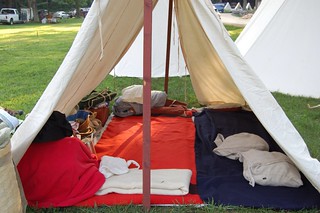
Less will be more next time, I swear.

We use as small a cooler as we can, and save it for things that get dangerous, like meat. We skip dairy. If your impression is that of soldiers in the field, forget cream in your coffee or milk in your tea, unless you can point to the farm you stole it from! (See John Smith’s diary.) We hide the cooler under a blanket in our tent. Yes, the blanket is a red bed cover from Ikea and needs to be replaced.

Carrots, onions, potatoes, parsnips, beets, apples, can all travel in bags, baskets or bowls. Think basics if your impression is common soldier or common person.

Rations were generally a pound of beef for a soldier, half a pound for women on the ration, and a quarter pound for children. You can use these proportions to figure out what to make, and John Buss had a lot to say about the quality and frequency of the beef and other rations. Jeremiah Greenman of the 2nd Rhode Island ate dog on the way to Quebec, and that was one time they weren’t the 2nd Helping Regiment. We draw the line well on this side of that kind of authenticity.
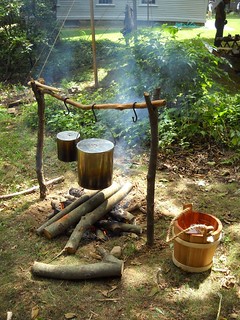
Three sticks, two kettles, one bucket. I love that bucket.

Men carried their rations in haversacks, so yes, a little eeww if you’re thinking a pound of salted beef in a linen sack along with a pound of bread or flour.  That’s where the cooler comes in, and a metal bowl or plate. We use split firewood to cut the meat on, and then burn the wood instead of washing a wooden cutting board in the field.

I have brought home-baked tea bread to events, and taken cookies (little cakes) to the farm. But you have to think about the context of the event, and your specific impression. I’d like to strip everything down to the “three sticks, two kettles, no matches” principle, but we’re stuck with cooler because we cook.

What we did at OSV, which was two dinners (Friday and Saturday) and two breakfasts  and lunches (Saturday and Sunday) was this:

Friday Dinner: pasties

Saturday Breakfast: apples, bread and ham and cheese. Guess who forgot the eggs and oatmeal? Yes, me! The one in charge of stores. Thankyouverymuch.

Saturday Lunch: Apples, bread and ham and cheese.

Saturday Supper: Beef stew with carrots, onions and potatoes. Authenticity would have made this plain boiled beef but fortunately for us, OSV is a farm, and we could pretend John Smith had helped us enhance our rations. We scraped the kettle clean.

Sunday Breakfast: Apples, bread and cheese. The soldier in the tent next to us appeared with a cup of coffee. We eyed him with real envy; sensing peril, he quickly told us we could get our mugs filled at the OSV store, at a discount. Off we quick-marched, and Bob finished his coffee in safety. It wasn’t very good coffee, but it was the best coffee I had that week.

Sunday Lunch: By this point, the child had eaten anything that remained, and we had to buy lunch.

What did I learn from that experience?

  • Bring more fruit
  • Bring more bread
  • Bring the coffee & the coffee pot

When we consider packing for Monmouth this summer, these are the factors we’ll take into account, and one of the largest factors will be the amount the kid is accustomed to eating.
Eating in the Field: Single-Day Events

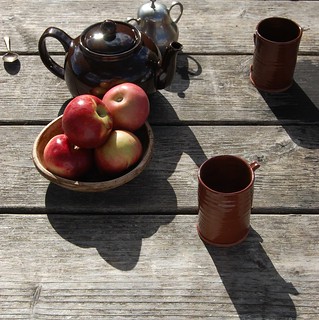
Tea Time at Nathan Hale, 2013

I’m not an expert, and your results may vary, but here’s what I’ve learned.

Single Day Events without Fires

(e.g. Battle Road, parades, Fort Lee)
For single-day, warm-weather events, ice packs covered in cloths at the bottom of a basket or slipped into a market wallet can keep food cold.

Pasties are self-contained, period appropriate, and require no “hardware” to eat. I wrap them in parchment or plain white paper and tie them with string, or wrap them individually in plain white cloths. Because the filling is cooked and then baked in the pastry, they keep and travel very well. I have a basic receipt here for pork pies; they’re good with chicken, too. Keep the filling a little on the dry side, and  you won’t need a plate. I’ve never made an all-vegetable pasty, because I live with T-Rex in a hoodie, but I imagine it would be delicious with parsnips, squash, and maybe even kale.

Another single-day-event solution is bread and cheese. John Buss of the 10th Massachusetts was all about cheese. He writes home longing for cheese, and writes, too, that he can eat cheese again because he’s recovered from the small pox. (That’s one of those historic statements that I try not to imagine too much about.) I’ve never had the time to bake bread from the Amelia Simmons’ cookbook, but I’ve had bread made from it, and it’s great. Pressed for time? Worked later than you thought you’d have to? Whole Foods Take-and-Bake baguettes have played the role of home-made bread, as have various loaves from other grocery stores.

The Hive blog has some good recommendations to fill your basket, so with some repackaging and artful packing, you can assemble an 18th century pick-a-nick basket, or stuff a market wallet with suitable foods. Just please, please: peel stickers off the fruit, and don’t pack bananas, which aren’t seen in the U.S. much before 1880.

Eating in the Field

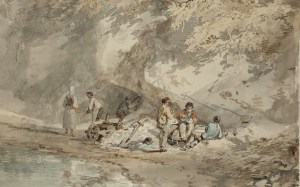
Workmen Lunching in a Gravel Pit circa 1797 Joseph Mallord William Turner 1775-1851
Workmen Lunching in a Gravel Pit, circa 1797. Joseph Mallord William Turner 1775-1851

A compatriot asked how we handle food and cooking in the field. What do we do about “yucky stuff?” by which she meant meat.

She was doing just about the same stuff we were doing, and with Battle Road around the corner, I thought I’d write about food in the field, and ways we handle it. Other people will have other ideas, but the main things I think about are:

  • Maintaining authenticity and food safety (Nobody wants flux.)
  • Historical eating is seasonal, local eating
  • Gear: less is not only more, but easier

Food safety is one of those things where you really don’t want to compromise too much, though from eating at the farm, I think there is more leeway than we admit. I will confess that when I was poor and in school, I stored dairy products on the windowsill of my studio when there was no fridge, so eating at the farm is like eating… when I was a whole lot younger.

Here are my principles. I’m not an expert, your mileage may vary, but this is where I begin.

Universal Truths

Start with who you are.
Objects you bring, and food you eat, should be true to your impression.
Authenticity goes beyond the date of accouterments: a porcelain tea set may be quite correct for a 1778 Newport or 1763 Boston parlor, but it makes very little sense if you are with a Continental private. One chipped plate is different for a woman to carry, or a piece of pewter. How long either would last you is another story, but at least you’d have a story. If you are the Colonel’s wife, it’s a different matter, even more so if it’s a British Colonel.

Food safety trumps purest authenticity.
Cloth covered, hidden ice packs will hurt no one and may save you misery later.

Stay Hydrated.

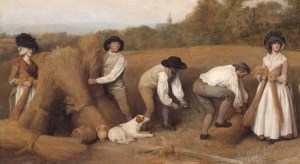
Reapers 1785 George Stubbs 1724-1806
Reapers, 1785. George Stubbs 1724-1806

Soldiers drank water.

In a hot summer camp, we keep a large pitcher full of water (see the Stubbs painting at left). Covered with a white linen or cotton cloth, it will keep coolish and free of dust & insects (or dog fur & fleas, if you’re in the Stubbs painting). We sliced limes into our enormous pitcher, and refilled it all day from the pump at OSV.

Limes are in period; justifying a source can be tricky, but at a certain level, safety trumps authenticity. 98 degrees and 90% humidity means drinking a lot of water.

Chances are you’re a caffeine addict like me, so what do you do? Boil water in a kettle, and bring tea in a screw of clean white paper is one answer. What’s your justification? I’m a personal fan of ‘stole it from my master,’ but in small quantities, perhaps you got it from home, or did a farm woman  a favor. Or stole it from her. John Smith (I kid you not), Sergeant in Colonel Lippitt’s Rhode Island State Regiment, in Continental Service, writes in his diary* of apprehending geese and chickens who failed to respond with the correct password when challenged.

*Published as “Sergeant John Smith’s Diary of 1776”, edited by Louise Rau, in Mississippi Valley Historical Review, No. 20, 1933, pages 247 – 270. NB: Kitty Calash recommends reading, not stealing.

Tomorrow: Food-related recommendations by event type.

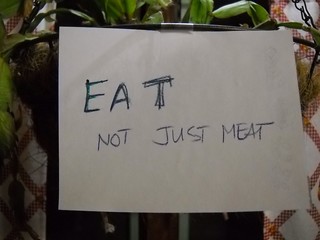
Eat, Not Just Meat

Good advice for every day, if you’re not t-rex

The Young Mr has been  unsupervised some of this week (he’s old enough but not always as mature as one might prefer) and I have left him notes to help him with some basics, as he does prefer to rise long after I’ve left for work. In the bathroom, BRUSH YOUR TEETH is affixed to the mirror (should’ve added + HAIR). In the kitchen, another note is taped to the Christmas Cactus above the sink.

My coworkers, many of whom have known the Young Mr since he was in a stroller and had nicknames like Possum Baby and Seal Monkey (he just shivered a small death when you read those names), found this note hilarious. The kid has a reputation as a one-human plague of locusts: he once ate a third of a pound of ham in a 20-minute span while his father and I went to the grocery store. He will eat a large head of lettuce in the hours between when he gets home from school and I get home from work. Entire tins of Altoids vanish suddenly, and all I get is a sulky, guilty look.

So I found this blog  post, What’s For Supper? very interesting, as I had been thinking of late, How would I feed the kid in the 18th century winter?

Fantastic Hairdress with Fruit & Vegetable Motif, 65.692.8, MMA

Fortunately, there would have been vegetables. And whether the beds were hot with manure or straw, there would have been some greens. At the farm we had salad in January; would it make it to February, or March? Don’t know, but I love the idea of spinach. Parsnips store well (scrub hard) and are delicious, and apples, too.

I think we forget we did not invent the larger world: it was big before we got here, with ships circumnavigating the globe and caravans crossing mountains long before container ships began losing sneakers on the ocean.