Stony Point Part the Second

DSC_5121

No, it’s not my photo of the Young Mr: I didn’t even take a real camera on this trip. These top two photos are thanks to Gary V’s Flickr stream.

Here the kid is eating. I think he spent most of the weekend eating. There are some fine calves in the 10th Mass, aren’t there? Look what a well-fitted pair of overalls can do for you.
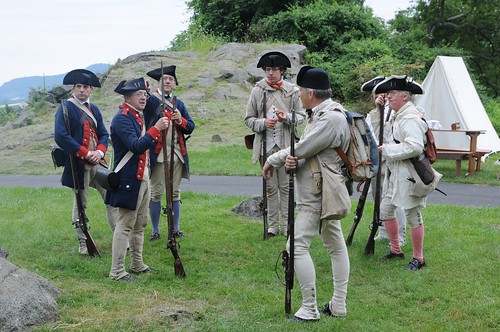
10th MA and 2nd RI: Mr S, Mr HC, Mr P, YM, Mr FC, Mr B, Mr  H

We all benefited from hanging around Niel DeMarino’s historic bakery. Broken cookies are just as delicious as whole, if not better, and the ginger cakes were the best I’d ever had. It’s a pity that one can’t really bake in camp…

Mr S thinks I should tell the story of my 90-minute stint in solitary at Stony Point, but I’m not quite prepared for that.

Instead, I shall recount the Hose Water Coffee.

As fans of the 18th century know, orange water and rose water are not uncommon flavors in the receipts found in Hannah Glasse or Amelia Simmons‘ cookbooks.

Hose water is something else again. It is not improved with age.

At Stony Point, there was water at a stone ‘bubbler’ (props to those who used this Rhode Island term for the street furniture known elsewhere as a drinking fountain), which was hard to see in the gathering dusk the night we arrived. There was also a hose, proximate to a saw horse with a sign for Pedestrian Only traffic, and just down the path from our tents.

Colonial breakfast on a rock
Our kitchen, dining table, and parlour

Following Heather’s excellent advice, I planned to make cold coffee overnight so that we could be caffeinated in the morning. Lazily and unwisely, I used the hose to fill the pitcher of doom that first evening.

What is the essence of tire? L’eau latex? That’s what we had: strong coffee with a strong base note and unmistakable top note and bountiful middle notes of hose. Did we drink it? Of course we did: we were up at 5, and coffee was not provided until 8:30, when we all had second breakfast.

Saturday night, I skulked back to the bubbler and filled the pitcher again for Sunday’s coffee. This time, the clear, strong liquid was redolent only of coffee, and was judged better than the hot coffee (which had, in fairness, not been made with hose water, either). I’ll definitely repeat the coffee experiment, though I think I can use a little less coffee to water– not that I measured.

Ceci n’est pas une cruche

This is not a pitcher

Sometimes a pitcher is not a pitcher. In the same way that Matthiessen‘s Snow Leopard is not about a snow leopard, this was not about me: this was about the woman who approached me as I walked with Cat to the water bubbler with this white ceramic pitcher from Home Goods.

She stopped me to say, “You shouldn’t have a pitcher in camp. You should have a bucket.”

This is true, as far as it goes: but really, I should have a tin kettle (and I do). But the reasoning I was given had to do not so much with the fragility of the pitcher (which I pack in a basket or wrap in our towels and stuff into something in the supply wagon) as it did with the myth of Molly Pitcher. For an explication of the Molly Pitcher myth, I refer you to the Journal of the American Revolution, because, as I said to the woman who approached me, “It’s not my fight.”

So what’s the point? Maybe there are several:

One might be, Everyone has a hobby horse. Some of us are made mad by The Bodice. Some of us cannot abide makeup on “camp followers” who look like stragglers from a high school production of Sweeny Todd. Some of us are material culture and camp equipment fanatics– begone, ironware! Still others twitch at the baggy, off-the-rack cut and fit of some uniforms.

For another, This wasn’t about me– or my pitcher. The woman who approached me had a thing about Molly Pitcher and the myth of the woman on the battlefield with a pitcher, bringing water to the men. My pitcher and I were merely a trigger.

colonial woman with pitcher and kettle
Everybody’s got something to hide ‘cept for me and my…pitcher? or kettle?

And for a third, We all make choices and compromises. I chose not to bring the antique family copper coffee pot into the field, and also chose not to let the coffee and water sit overnight in the tin kettle. I chose, too, to use the white pitcher and a redware one for water that we drank all day long. When it’s hot, I slice lemons or limes into the water to make it easier to drink as much water as we need to in a day spent sweating outdoors, and it prevents scurvy to boot.

Fourth? We can all, always, make better choices. Few among us achieves true 18th century purity– I can assure you that even had I dashed my pitcher to the ground Saturday and dropped to my knees in repentance, I was not 18th century to the skin. There are monthly occurrences that I won’t go old school on, and on this point I shall not be moved.

But back at my ‘rock maple’ table, I could do better. We could/should have but one wooden bowl (mine), and the boys could/should have tin bowls, and we could/should swap out the redware canns with the handles broken off, but they make a nice refugee statement and until they break completely…

And there is a fabulous copper cistern by Goose Bay Workshops that I covet for its copper glory, but since it is not tinned inside, no lemons or limes would be allowed, and it would be hard to argue it for a Light Company. That puts me at another tin kettle, designated for water, and dipping our cups in. I can probably live with that choice.

But then, if I encounter someone who wants to talk about Molly Kettle, I’ll know I’m in real trouble.

An Insomniac Dreams of Pudding

Thomas Rowlandson, 1756–1827, British, Gypsies Cooking on an Open Fire, undated, Watercolor and with pen and brown ink and pen and gray ink on medium, slightly textured, cream wove paper, Yale Center for British Art, Paul Mellon Collection

Once again, I’m sleeping 18th-century-style, but without of the luxury of sleeping late. What wakes you in the middle of the night? Whatever woke me, I finally fell back asleep after 4:00 thinking of what to make for Stony Point.

This will be a cold camp, with very limited cooking, which presents a stiff challenge for the caffeine-dependent, as I must confess I am. (There are gentlemen in the expected party who are also not quite themselves until they’ve had their coffee, too, and they know who they are.)

I’m up against it, this time, given how I will be spending the week leading up to Stony Point (very busy) and that Friday (giving a talk in Newport, instead of baking). As a devoted fan of breakfast, I usually spend the Fridays before a weekend event baking and assembling the provisions for the weekend; this time, however, I will be crossing and re-crossing a bridge.

As I considered prepping a pork-apple-and onion pie Thursday night for Mr S to bake on Friday morning, and the logistics and food safety concerns associated with transporting and eating meat, it finally came to me: Indian pudding. Simpler, easier, filling: all the remains to be done is to talk the Young Mr into eating it, though when presented with no other option, he may acquiesce, at last, to reality.

The HFF: Historical Food Fortnightly

2f053ddd402318588e6c094c0ec0e6b4Every now and again Facebook proves itself useful: without following Dobyns & Martin Grocers, I would not have known about this interesting cook-along, the Historical Food Fortnightly.

The challenges look interesting, and I particularly like the seasonal fruit/vegetable one. This seems like a wonderful chance to cook historical recipes using seasonal, local ingredients, and I do like to remind people that historical eating is grounded in seasonal, local, eating. Plus pounds of raisins and sugar and gallons of alcohol.

Your local historical archive (or whichever one contains the works relevant to your interests) can be a great place to get started assembling documentation on local eating. Receipts for foodstuffs can be mixed into other accounts (cotton for your daughter, a parasol, a pair of shoes for your wife, 5/8 yard pink silk satin self) but you can still quantify tea, sugar, spices, Madeira, and flours. I find fresh produce somewhat harder to track–you won’t count what is growing behind your house– but fear not, New Englanders! Some of that hard work has been done for you.

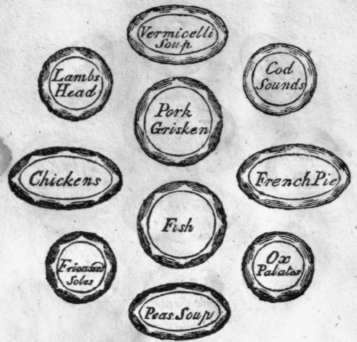
A bill of fare for August

J.L. Bell of the fantastic Boston 1775 blog wrote the book-length historic resource study General George Washington’s Headquarters and Home—Cambridge, Massachusetts, which I read before we went up to the “Washington Takes Command” event last July. (That sentence just seemed crazy, even to me…yes, I read 650 pages plus the event program to prepare for a 6-hour event…)

The report can be downloaded as a PDF, and if you’re looking for food, where you want to go is Chapter 6, Daily Life at Washington’s Headquarters (page 173 and following). On pages 195-197 the Steward’s Purchases are listed, sorted by Fruits, Vegetables and Grain, Spices and Flavorings, etc.

While Washington was maintaining (or causing to have maintained for him) a Genteel Household, the list of purchases is helpful in documenting the variety and types of foods available in Cambridge. I suspect that similar kinds of documentation exist in the historic resource reports or room use studies for places like Gunston Hall.

I cannot manage to keep up with the Historical Sew Fortnightly right now– things went pear-shaped in December— but we have to eat, historically or otherwise!