Cake, and other Things

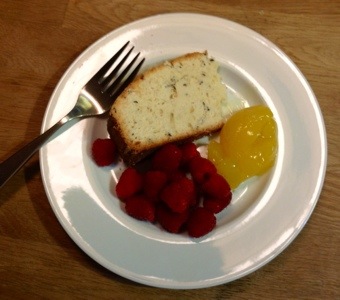
20120617-195748.jpg On Saturday, in preparing for the opening June 28, I made the Seed Cake, called Nun’s Cake, from the Colonial Williamsburg website.

Actually, I made half a recipe. And Baked it too long. That doesn’t mean it’s not delicious served with raspberries and lemon curd, but it does mean that the crust is, well, crusty. And cakes do not have crusts, so there you are. What I learned what that you can’t halve ingredients and not adjust time. Obvious, but not when you are simultaneously finishing a dress.

The dress is done, all but the cuffs and moving the interior lacings, though the photos are sketchy. Mr. S. used to be a photographer, and now he hates photography. He is therefore an unwilling documentarian, and hates even more the basic camera he was handed at the Joy Homestead.

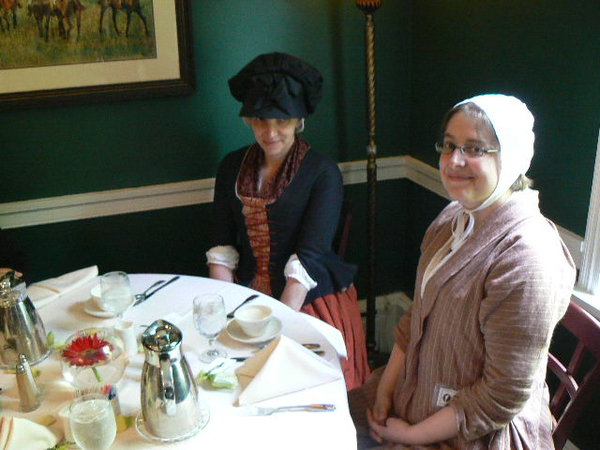
We were there for a tea commemorating the day in 1780 when Rochambeau stopped on his march to join Washington. Rumor, or legend, has it that the Comte ate strawberries, and so we did, too, with biscuits, cream, and Lipton tea.

20120617-195837.jpgThere was some drilling, so the soldiers had an appetite. There were also photo ops aplenty, and some behavior that made me wonder if there are reenactor groupies. One woman was just determined to have a particular uniformed gent in every possible photo…and she took many, many photos of the troops. It’s a curious thing, this hyper-photographic behavior. Makes me want to keep my camera in my pocket.

In any case, the seed cake I made will work for the opening if I can manage not to over bake it and provide fruit with it. Now I just have to find an 18th century punch that isn’t overly full of rum.
And a new camera.

20120617-195852.jpg

Tea Party Madness

There they are, those lower sorts! We had tea, with delicious scones and excellent company in the form of booksellers from Brooklyn. We don’t get out to tea very often, and it was a pleasant introduction to more old-fashioned notions of parties.

This is a useful thing, because the known bonnet wearer must prepare cake and punch for an as-yet-unknown quantity of guests to include the Second Helping Regiment. Perhaps the historic recipes are not so far off in quantity after all..

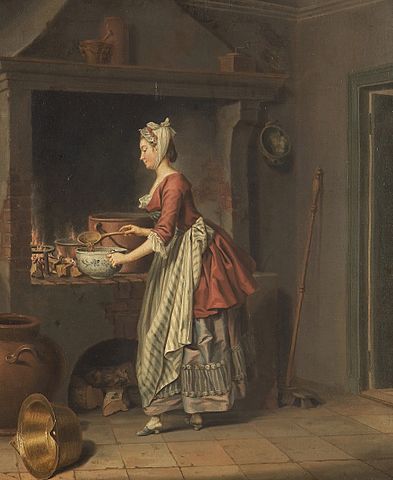
The clip is from The Compleat Housewife: or, Accomplish’d Gentlewoman’s Companion. A similar recipe appears in The Art of Cookery Made Plain and Simple, by Hannah Glasse. You can find it on the Colonial Williamsburg website, along with a translation for the 21st century cook. I think I’ll try it, and I’ll have to start soon to get it right by the end of June.

Now for a punch recipe for an unknown quantity…

Pork Pies in Dighton

The weekend before Memorial Day, we spent two days in Dighton along the Segregansett River. It was a Continental Line event, and as such it was interesting to see that different organizations host reenactments with subtle differences.

The biggest difference for us was we got to day trip it from home since Dighton is so close, and that meant two different lunches. Day one, a variation on pasties. Day two, bread and cheese and fruit.

For the pasty variation, I cheated with store-brought crust. I figured the week my guy fell in a 12-foot-pit, I could cut a corner or two that did not involve safety, since I was getting home so much later.

Here’s how the filling worked, riffing on a Daily Mail recipe:

  • Some olive oil (a tablespoon, perhaps)
  • Half a medium sized onion, diced fine
  • A teaspoon of sage
  • Half to two-thirds of a pound of pork cutlet or boneless chop, whacked thin
  • One firm apple, sliced thin
  • One carrot, sliced thin, or a parsnip, or both, or neither
  • One medium potato, diced small
  • Tablespoon of flour
  • A tablespoon of lemon juice
  • Salt & pepper to taste
  • Small amount of water, as needed
  • 1 egg, lightly beaten

Heat the oil in a skillet; add the onion and sage, cook until soft.
Add the pork, cook until lightly browned.
Add potato, apple, and lemon juice; this is the time to add carrot/parsnip.
Sprinkle lighly with flour or cornstarch.
Cook until pork is browned and vegetables softening but not soft; add water as needed to create some juices.
Season with salt and pepper to taste.

It is best to let the filling cool before spooning it onto the crust.

Cut the circles of crust into halves. Divide the filling into four equal parts, and distribute among the half-circles. Fold the crust over, pinch closed. Brush with beaten egg to glaze, cut small slits for steam holes. Bake at 350 degrees until filling bubbles and crust is brown, about 30 minutes, depending on oven.

Seasonal Eating

When there is a weekend event, I have to start thinking on Wednesday about lunch on Saturday and Sunday. Sunday is the more troublesome day, because there won’t be much time on Saturday to prep for Sunday: the work has to be done now.

This is not so much fun when you’re still trying to work out lunches and dinners for the regular 21st century week.

One solution, based on suggestions made for Battle Road this year, is pasties. They’re delicious and easy to carry, keep well, and are very satisfying. They’re also a meal that can be made with seasonal ingredients, like those outlined  in The compleat housewife: or, Accomplished gentlewoman’s companion, Cookery, etc. by Eliza Smith, 1742.

She presents a Bill of Fare for May that includes:

Chicken pye and a grand sallad might work, if the pretense is that I’m visiting camp. The Battle Road pasty filling was made as follows:

  • Olive oil
  • 1 poached chicken breast, diced (a whole does well for 4 -6 people, half for 3 or fewer)
  • 1 small onion, diced
  • 1 parsnip, scrubbed and sliced
  • 1 carrot, ditto
  • 1 small to medium red potato, cubed
  • 1 apple, cored and cubed
  • Small handful dried cranberries
  • Herbs de Provence, generously applied
  • Salt & pepper to taste
  • A little water
  • A little milk (optional)

Poach the chicken breast the day before, when you are making the crust. I use Martha Stewart’s perfect pâte brisée, but a Joy of Cooking crust works just as well. I toss into the water a bay leaf, a celery stalk top, an old carrot, and slice an old onion—we usually have scraps about from previous meals—and boiling these vegetables with the chicken breast tends to make the meat taste better.

Pre-heat the oven to 350 degrees.

Heat a little oil in a skillet and add the onions and the herbs.
When the onions are soft, add the carrot, parsnip and potato.When these are just beginning to soften, add the chicken and dried cranberries.  Add just a little water—you want the filling to be a little dry so it does not soak the crust—and the apple.
Taste for seasoning and adjust.
Stir and cook over medium heat until all ingredients are hot and the root vegetables only medium-soft. Remove from heat.

Divide the pastry crust into as many balls as you will make pasties; from a double-crust recipe, you can make at least 4 good-sized pasties.

Roll the dough into circles and add filling to one side (you’ll make a semi-circle heap of filling). Wet the edge of the circle with a brush, and fold over the crust, pressing edges together with a fork. Some people have the skill to make a twisted, decorative edge; I don’t. Brush the top of the pasty with water or milk for a brown crust. Poke several steam vents in the top with a fork, or slit with a knife.

Bake at 350 until the filling bubbles and the crust is browned, about 30 minutes. Let the pasties cool, wrap in paper and tie with string.