Baking with the Cursing Sewing Mommy

Meet the cursing baking mommy! On Friday last, she started a full day of work that included a reenacted regiment backing out of the major event at work, a panic attack during her physical, a camera crisis during the visit of an Ambassador, as well as the full complement of broken things, paperwork, Section 106 reviews, and requests for meetings. So of course she came home with a plan to bake, in addition to packing up a full kit of 18th century camping equipment and finishing buttonholes and hems on overalls and that devil dress.

I did bake, actually. I tried a recipe I found on Let’s Burn Something, lavender tea bread.

Nooning with the Reg’t. They enjoyed the tea bread.

The recipe is pretty simple; the cursing part came in when I discovered that baking distracted has its dangers. Yes, I forgot to chop the lavender blossoms before steeping them in the milk. I did it after wards, and then tipped them back into the milk. You’d think the final result would look like, well, a loaf of pound cake with mouse excrement baked in, but it doesn’t. The little flowers look like seeds, so if you’re OK with a Rich Seed Cake, this will be fine, too.

Oh, I also used too much butter. Fortunately, that turned out to be fine, as too much butter usually is. And no, I don’t know my cholesterol levels, but let’s eat some more cake before the test results come back!

The Receipt, from Mom’s a Witch , via Let’s Burn Something :

Lavender Tea Bread

Ingredients:

  • 3/4 cup milk
  • 2 Tbsp. dried lavender flowers, finely chopped, or 3 Tbsp. fresh chopped flowers
  • 2 cups all-purpose flour
  • 1 1/2 tsp. baking powder
  • 1/4 tsp. salt
  • 6 Tbsp. butter, softened
  • 1 cup sugar
  • 2 large eggs

Method:

  • Grease a 9x5x3 inch loaf pan.
  • Preheat oven to 325 degrees.
  • Heat milk with lavender almost to a boil, then steep until cool.
  • Mix flour, baking powder and salt together in bowl.
  • In another bowl cream butter and gradually add sugar, then eggs, one at a time, beating until light and fluffy.
  • Add flour mixture alternately with lavender milk, in three parts. Mix until batter is just blended, do not overbeat.
  • Pour into prepared pan and bake for 50 minutes, or until toothpick inserted in center comes out clean. Let cool in pan 5 minutes, then remove to a wire rack to cool.
  • When completely cool, drizzle with a simple sugar glaze or sprinkle with confectioners’ sugar. Garnish with sprigs of fresh lavender.

I skipped both the sugar glaze and the confectioners’ sugar on the basis of sugar being expensive in the 18th century, and because I thought the final result would be less conducive to transport. It seemed fine, though with white linen uniforms, you wouldn’t notice the powdered sugar if it spilled. It’s just be the informal markings of the Second Helping Regiment.
What Table Manners?

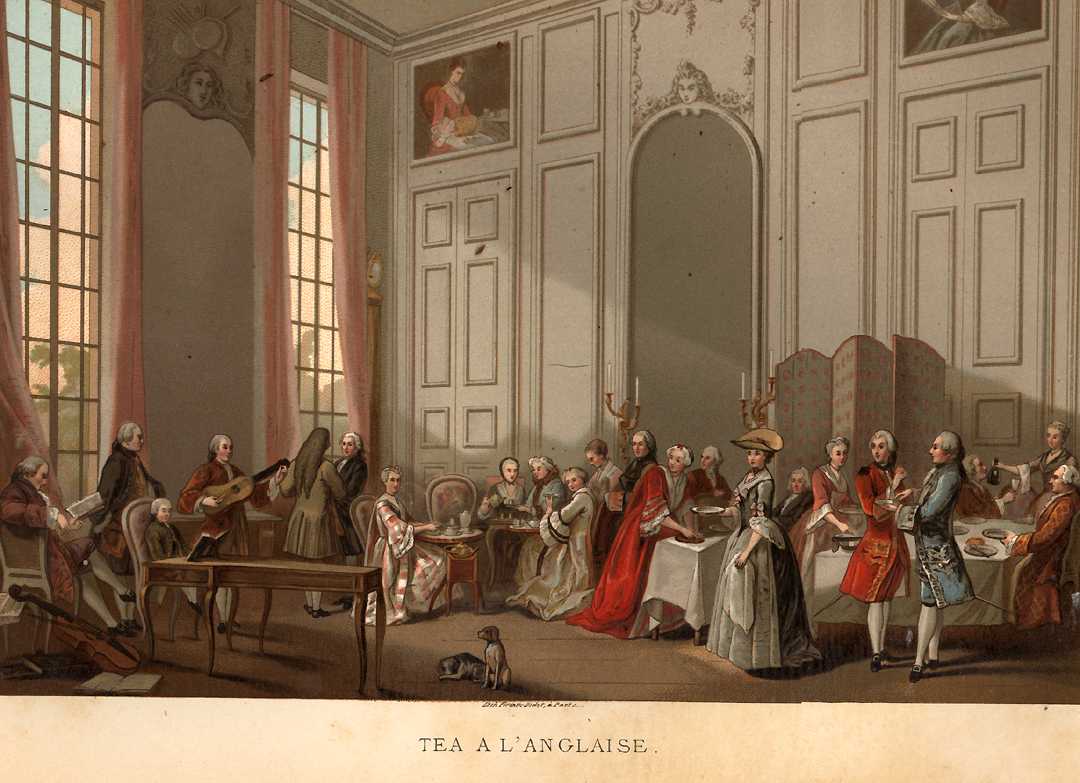
When you think of 18th century dining, which image comes to mind, tea on the left, or the sea captains to the right?

While I did not carouse with sea captains this weekend, at dinner today, I found myself deeply envious of someone’s skill in eating from a knife. I shoveled food onto my spoon yesterday with abandon. I coveted the last three pieces of quince tart today despite knowing that one of those pieces was for my husband. And I am not ashamed. Ok, not too ashamed.

The best part of living history is always what you learn, and I feel a separate blog post should deal with “the public, god love ’em.” What I learned this weekend was less about quilting and more about living old school. Ok, and maybe more about the public’s…breadth….than depth…

The most instructive thing was about being hungry and thirsty. Thirsty as in my lips are dry and I know I need to drink, which means being past thirsty and at dehydrated. Yesterday I went all day without peeing and that’s not right. Both yesterday and today I left the farm hungry, not because there was not food but because I ate mindful of leaving enough for those eating after me. The goose pie was delicious and seriously worth eating standing up in the kitchen. I’d fight for that pie.

Eating boiled dinner (ham, parsnips, carrots and turnips) along with a pudding, with 18th century utensils was challenging. Two-tine forks have great sticking ability but not much carrying ability.  Spoons are your friend. Knives may be better as trowels than cutting implements. No one really cares about your manners, they are too hungry to notice. Boiled pudding is this season’s smash hit.

Coggeshall Farm uses Amelia Simmon’s American Cookery, which I started reading last week. It is full of useful receipts based on American ingredients and I recommend it. Here is the receipt for the fantastic, sliceable pudding we had today:

A boiled Flour Pudding_.
One quart milk, 9 eggs, 7 spoons flour, a little salt, put into a
strong cloth and boiled three quarters of an hour.

There were hot words about those “7 spoons” from the kitchen staff and to be honest, I did not quiz them fully on the size of the spoons they used. But whatever magic they worked, it was truly delicious with and without the molasses cream sauce. Sliced and eaten with spoon or fingers (I snitched some later in the kitchen), it a consistency of solidity like the best parts of a Swedish rice pudding, though smooth.

It is hard to countenance how hungry people must have been much of the time in the past. More than the extreme hunger of the soldiers (like Greenman and Plumb Martin), I think common people experienced days of lacking, and accepted them, with the seasons. Food was not constant, but in flux, and even at harvest, I think, or hope, that one was mindful of the needs of others.

For more on seasonality and 18th century ways of thinking or seeing, read Circles and Lines: The Shape of Life in Early America. That’s what I’m going to pretend to do while I fall asleep.

Camp Cooking

Our first overnight, camping-in reenactment went fairly well. Why the artillerists had to bring a concertina to a gunfight, I’ll never know, but a 2:36 AM rendition of “Good Night Ladies” was truly unnecessary.

The most important thing I can emphasize about reenacting in high summer is to stay hydrated. We brought the big white water pitcher we used at the House Cleaning in April, sliced a lime into it, and filled it repeatedly at the town pump. The Young Mr doesn’t like lime in his water, so he filled the coffee pot for himself, but the rest of our Regiment and members of the 10th Mass helped themselves liberally. It was well worth bringing.

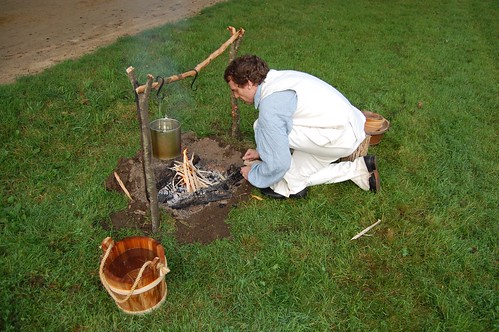
The meals we ate were simple: apples, bread, ham and cheese for breakfast and lunch (I forgot to bring the eggs…) and beef stew for dinner. The stew is the most interesting part of the business. Mr S bought the meat, and without even realizing it, he picked up the appropriate amount of rations. Men were supposed to be issued a pound of beef and a pound of flour or bread a day; women, half that, and children a quarter. The amount we packed was a pound and three quarters. Seemed like too much when I packed it into the cooler, but as it turned out, we ate it all.

Enhanced Ration Stew (feeds 3 to 4)

  • 1.75 pounds beef stew meat
  • 3 carrots, sliced
  • 1 very large onion, roughly chopped
  • 4-5 small, firm, potatoes, cubed
  • Half a small kettle of water
  • 2 packets or cubes of portable soup (beef boullion)

Note: start the fire and get it hot before you bring the meat out…

Cut the meat into smaller chunks, add to the kettle, and place over the fire. Brown the meat on all sides; note that this will take as long as it takes.

When the meat is browned, add the onions and cook until they start to get soft. Add the rest of the ingredients, stir, and cover.

Bring to a rolling boil for at least twenty minutes; stir occasionally. Be sure to add wood to the fire to keep it hot. I think we cooked our stew for about 2.5 hours, but it’s hard to say exactly, as we were not wearing timepieces. We started the fire after the battle, which would have been at about 3:30 or 4:00, and ate around 6:30.

I used my pocketknife to slice the vegetables first, and arranged them in our wooden bowls. Then I sliced the beef into smaller chunks, using a piece of firewood as a cutting surface—since it gets burned, you don’t have to wash anything but the knife in hot water. Thanks to the 40th Foot at the SOI for demonstrating that technique.

Summer Eating

What to eat in the field in August? Redcoats & Rebels approaches, and food must be prepared. This time, we are camping over. That means that pretty much everything must be ready by 1:30 on August 3, and there is nothing like a deadline to focus attention.

To start with, I turned to The Compleat Housewife: or Accomplished Gentlewoman’s Companion, published in 1739. The author presents seasonal menus, because one important thing to remember is that historical eating was seasonal and local. (This concept may sound familiar to fans of Alice Waters or Mark Bittman.)

The suggestions are, of course, beyond the realm of soldiers’ rations.

Westphalia Ham & Chicken.
Bisque of Fish.
Haunch of Venison, roasted.
Venison Pasty.
Roasted fowls a la daube.
White fricassee of Chicken.
Roasted Turkeys Larded.
Beef a la Mode.
Roasted Lobsters.
Rock of Snow and Syllabub.

But take a closer look: beef a la mode is a kind of pot roast, so beef in a kettle with water and veg cooked over a fire ought to do. It’s what we call “officer chow,” and what the boys ate at Fort Lee. I was mostly looking for vegetables in season, or fruits, but the farmers’ market will provide that limitation.

So here’s what I think:
Pasties made Thursday night or Friday morning for supper on Friday.
Gingerbread cake for treats.
Oatmeal and fruit for breakfast Saturday morning, or else boiled eggs, bread, and fruit.
Bread, cheese, fruit and sliced ham for lunch on Saturday.
Tea, shrub, and gingerbread cake for Saturday tea.
Beef stew for supper on Saturday.

Breakfast and lunch will be the same for Sunday, and we pack up and leave on Sunday afternoon, so I won’t need to make Sunday supper in camp.

It’s reasonably authentic to the 18th century, though not to common soldiers’ rations. But the guys won’t want to eat firecake and water.