Furniture Check

The original, in 2013.

Lo these many years ago (one dozen) I embarked upon a gown-making folly based on the familiar Oyster Seller image. There was collective interest in this gown 12 years ago, probably because the original painting came up for auction at Christie’s in London. There’s more than one of these out there, and mine was not the best. I am okay with that.

I think we were using the print derived from the painting as a justification for the cross-barred gown, along with a bunch of silk cross-barred sacques. I don’t remember whether or not I’d clicked onto the Barbara Johnson album page with the “red and white Irish [stuff? skiff?] sack, April 1752” swatch. Good stuff, that, and I would be delighted to find fabric like that. However, I had a cross-bar in hand in a form that I did not love.
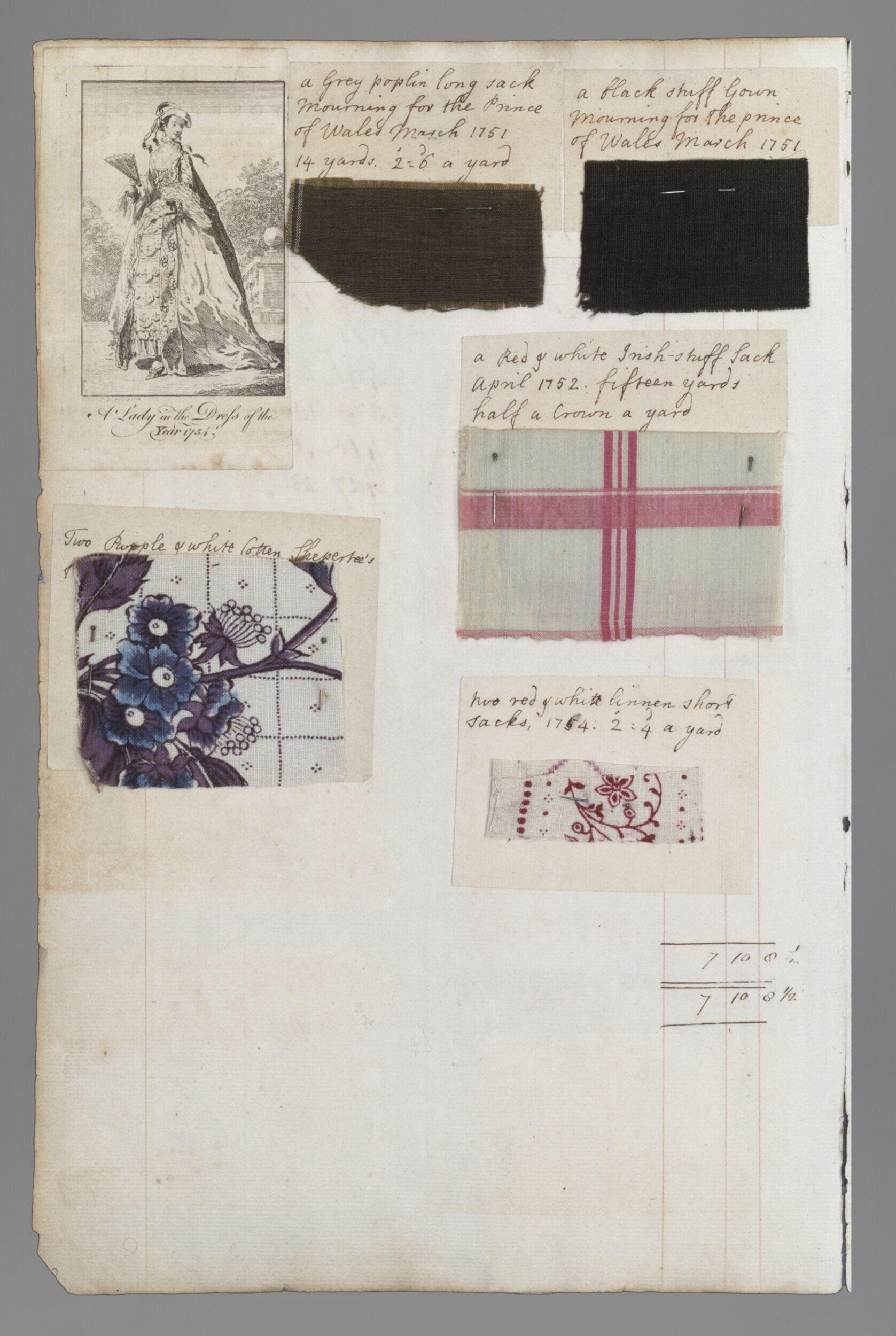
Barbara Johnson Album, Victoria & Albert Museum

I didn’t alter the gown at the time because… I was embarrassed by the failure. The person who pointed it out to me was renowned for lack-of-tact, and did not offer any solutions, suggestions, or offer assistance. (That behavior is why people leave all kinds of hobbies, folks. Being kind really ain’t that hard.)

But it is hot this month, and getting hotter. So although I went to storage to look for, and not find, another wardrobe option, I did see this old gown. Did a klaxon sound? A siren? A choir of angels?


Furniture check on an upholsteress? How could I not?

Equipped with more knowledge, and one hopes, more skills, I spent Friday night and part of Saturday disassembling the gown. 
What I like about this project is that not only will I end up with a new gown, I’ll have a new gown that is obviously remade from an old gown. Props to me for developing the patience to do this.

It’s not a huge change, but the modifications include making the back pleats actually make sense, and doing them the way Adventures in Mantuamaking taught me to; tweaking the overall silhouette to match the sleeves and cuffs; and adjusting the robings. This should also prevent the various wardrobe malfunctions previously experienced.

I did recut the back lining from fresh linen; the back strikes me as the most critical structural element, so I made sure to replace that. I then stitched a center seam in the upper back, as you do, to mark the center of the back and set the total bodice back length. Overall, the back seemed far too long, and the front too short.

Re-pleated and stitched, the back was ready for new fronts. These required piecing (which is period) and I almost managed it on the lining, but they needed extra work. Even if the piecing is “correct,” it will likely be hidden by an apron.

Fortunately, the sleeves worked with the new bodice shapes, and are actually a better match to the style– they are too narrow for the initial style. I have enough to to rework the robings, but I don’t think I can get a stomacher out of what I have– not unless it’s massively pieced, which is also OK. 

I spent some time digging into Pennsylvania newspaper advertisements looking for checks, check’d, and check fabrics. They’re there– plenty of them– though linen checks for women’s gowns are a lot harder to find. Oops. 

Still: I found  “check’d mantuas” (silk for gowns) and “Holland, Laval, Britannia, check’d and striped, linens.” Holland linens tend to be heavier, utility linens; Laval designated linen woven in Laval, in Pays de Lorraine (northeastern France), a town noted for fine linens. Could one of those be a lighter-weight check, suitable for a working woman’s gown? (That’s from the Pennsylvania Journal or Weekly Advertiser, December 26, 1781). It’s hard to say there weren’t checked linen gowns, just as it is hard to say there were. The possibility exists, partially because myriad types and patterns of linen were available in Philadelphia, and partially because we lack visual documentation of non-elite women in the Anglo-American colonies.
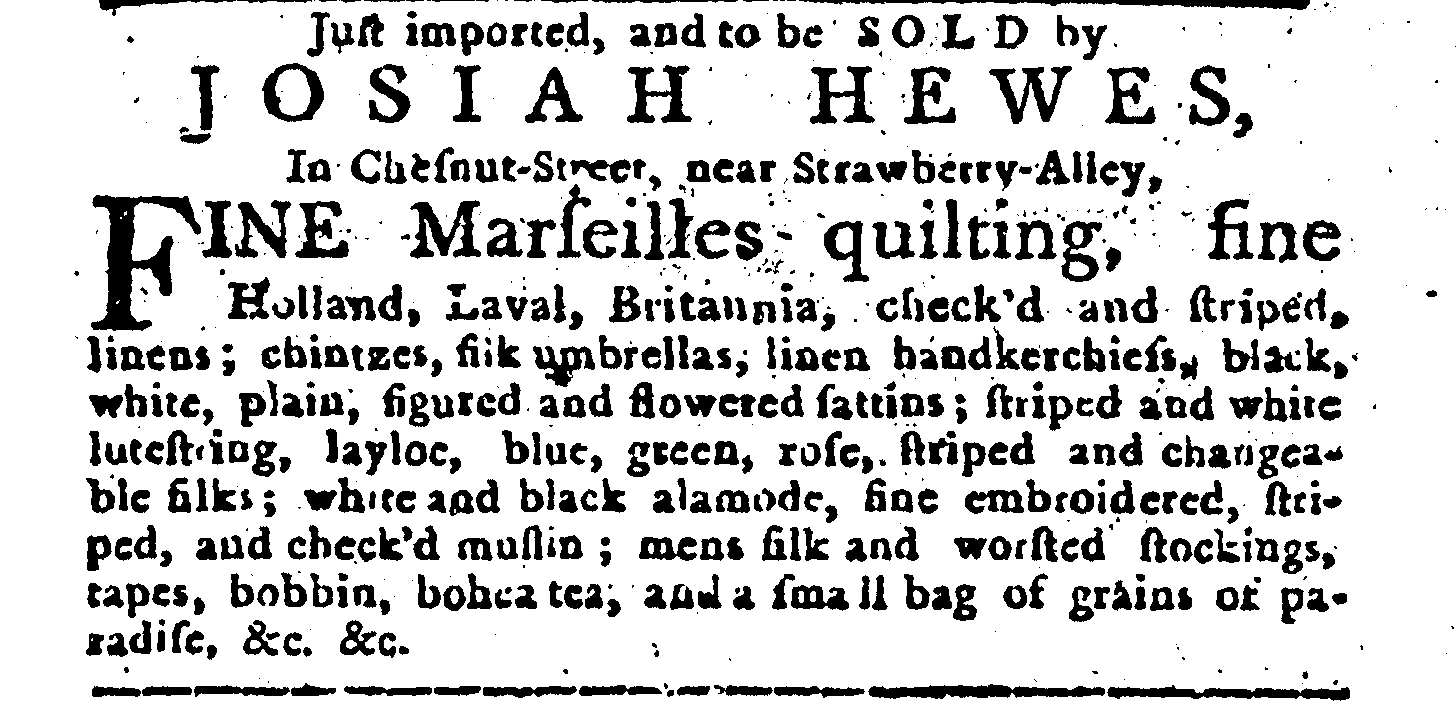
Pennsylvania Journal, or Weekly Advertiser, December 26, 1781

The runaway ads describe some Scots women and one English servant running away in checked gowns from 1753-1778. This does suggest checked gowns are associated with “lower sorts,” which isn’t exactly what I’m going for, but since I portray a working woman while also not melting, I’ll keep going. 

Pennsylvania Chronicle, July 10, 1769

Dreams of Summer

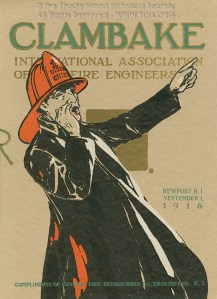
Clambake, International Association of Fire Engineers, 1916. RIHS Graphics Collection G1173

I will visit the beach in Rhode Island any time of year, even to the point of dragging Drunk Tailor there in January (I really like water). But as the wind speeds rise and temperatures drop, I begin to dream of summer, and especially of summer meals.

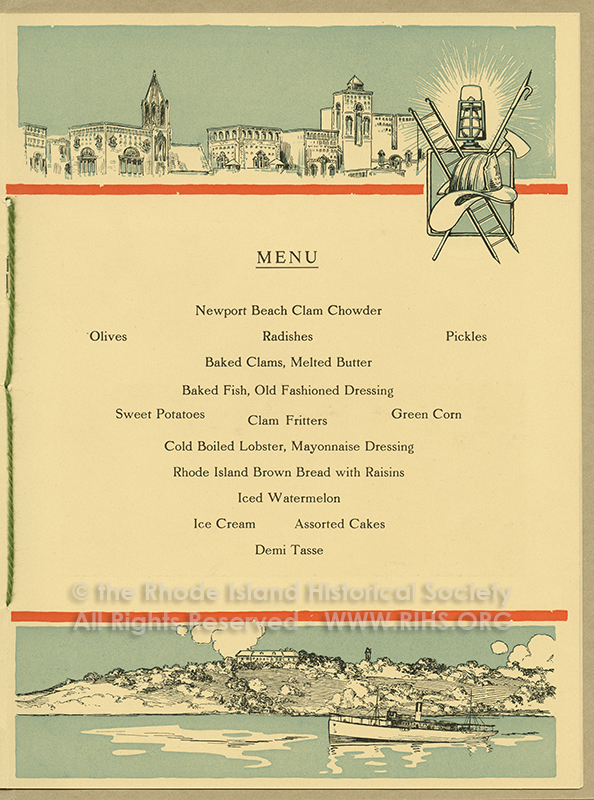
This 1916 Clambake program and menu is in the RIHS Graphic’s Ephemera Collection, and while not quite Wiener Werkstatte quality, the dramatic graphic style captures the zeitgeist of the early twentieth century.

Menu, International Association of Fire Engineers, 1916. RIHS Graphics Collection G1173

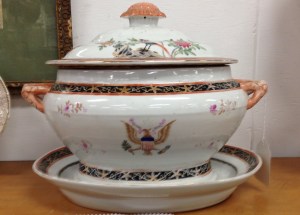
Inside, the menu captures the flavors of late summer New England, from the Baked Clams with melted butter to Green Corn, cold Boiled Lobster and Iced Watermelon for dessert. It’s time to start planning Christmas menus (I finally caved and brought in a tree, much to the delight of the feral cat), and fish is always on the list. Our tradition has evolved from the Christmas Eve bouillabaisse of my childhood through salmon with dill to a New York Times fishmonger’s stew. I certainly have the tureen for such a production, but the capacity is large, and with only three adults to eat the stew, I wonder at the sense of making up such quantities.

Tureen in the wild
Tureen in the wild

Quonochontaug Clam Bake Can ca. 1970. RIHS Museum Collection.

I could assemble a clambake for home, and boil it up on the stove in Don Draper’s 1962 kitchen– that’s a more recent tradition than the sand-pit variety– but it seems slightly mad, as all (potentially) good ideas can seem. It’d be July at Christmas, and although I’d miss the smell of the ocean, the cry of the seagulls, and the warmth of the sun on a late summer afternoon, it might be worth the effort.

Can it!

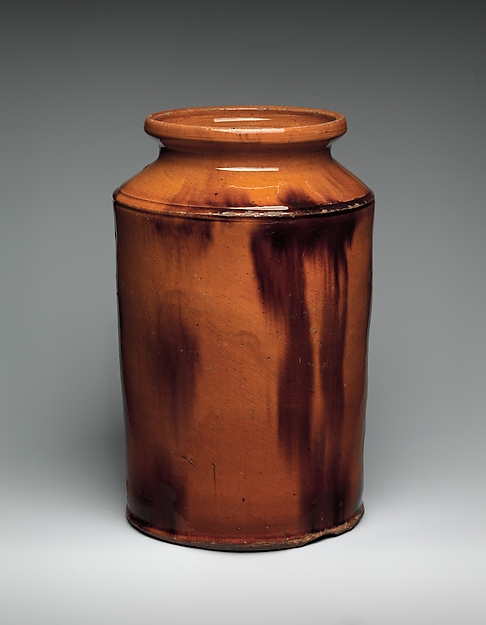
Jar. Paul Cushman, 1805-1833. Stoneware. 20032.475

Or, how do you keep your pickles?

At work, we have found that the road to history is paved with unexpected documents. As often happens, while looking for something completely different, m’colleague and I found two documents that might help illuminate the question of food preservation and storage in the 18th century.

Probate inventories: I read all the way through and had one of those d’oh! moments. Why? Because at the end, there’s all the kitchen stuff. Andirons, warming pans, roasting pans, kettles, firkins, kneading trays, piggins, barrels, casks, bottles. This is the stuff of cooking and keeping food.

There are clues in the receipts (recipes): Amelia Simmons gives a hint in the final instructions “To pickle or make Mangoes of Melons.”

“put all these proportionably into the melons, filling them up with mustard-seeds; then lay them in an earthen pot with the slit upwards, and take one part of mustard and two parts or vinegar, enough to cover them, pouring it upon them scalding hot and keep them close stopped.”

To pickle Barberries ends thusly:

“let it stand to cool and settle, then pour it clear into the glasses; in a little of the pickle, boil a little fennel; when cold, put a little bit at the top of the pot or glass, and cover it close with a bladder or leather.”

Jar, Thomas Commeraw.1797-1819. Stoneware. 18.95.13

To pickle cucumbers:

“put them into jars, stive them down close, and when cold, tie on a bladder and leather.”

To keep Green Peas till Christmas:

“have your bottles ready, fill them, cover the them with mutton suet fat when it is a little soft; fill the necks almost to the top, cork them, tie a bladder and a leather over them and set them in a dry cool place.”

If we tease these apart, we come up with some basics: preservation is done with pickling and “putting up” foodstuffs in pots, jars, bottles, and glasses. These are sealed with bladders, which are tied on; there is a sense in the first receipt that “close stopped” might imply corkage, but the repetition of bladders in the following receipts suggests otherwise for most of these; the entry for Emptins does state “will keep well cork’d in a bottle five or six weeks.”

Covered jar, Connecticut. Earthenware, 1800-1830. 18.27.1a, b

The other key? You’ve probably come across food packages that require storage in a “cool dry place,” and as we have cupboards in our kitchens, or perhaps in our pantries, early cooks also had pantries or butteries (say it but-trees). How’d they do it?

Jar,. Earthenware, 1800-1900. 18.95.11

The 18th century house was not centrally heated. 18th century Providence residents recorded temperatures of 48 and 58 degrees indoors in the winter, in rooms with fireplaces. An unheated room or cellar would be cool, too; here in the Ocean State, maintaining dry conditions could be the bigger challenge.

What did those jars and pots look like? As you can see in this post, the Met has a few– fortunately, these appealed to collectors and wound up in museums. Closer to home for the original question, the Missouri History Museum has a collection with a number of jars. A cursory look showed dates in the 1830-1860 range, but the shares are consistent with those seen at the Met.

I’m not a food historian, and I don’t pretend to be, but as I think about answering a question, these are the steps I take. Recipes, collections, and then more looking. I just hadn’t remembered that probate inventories would list everything, so one might get a sense of a household’s contents and thus its eating and storage habits.

Less is More

Though it may seem contrary to previous posts, there are times when I really believe less is more, and that’s when we’re out in the field.

Each year I’ve tried to improve our kit and impression by replacing or removing items, mostly to increase our accuracy but also to reduce what we carry. The less we have to carry, the less I have to pack and clean and think about and the more I can think about the history. This iteration of “What the heck can I quit?” was prompted by reports of a conversation with someone I respect, which caused me to rethink what we were hauling along and how I could change it.

The Box of Doom with the Pitcher of Inaccuracy

We have stripped away most of what we used to bring for the comfort of the kid; as he has grown up, he’s needed less to feel comfortable and “at home.” We traded ground pads for bed sacks* very quickly, and we never had any iron to begin with. I’ve tried to keep within seasonal and historical cooking guidelines, but the largest hurdle and heaviest literal burden is the wooden cooler box.

Feeding the Young Mr is a tricky thing: he likes what he likes, and he likes a lot of it. What he likes are carrots, apples, and meat. There’s some swapping that can be done with seasonal fruit, but the largest hurdle is meat: if I can scrap fresh, needs-to-be-kept-cool meat, I can leave the cooler box at home. (At this moment, several gentlemen are suddenly feeling empty inside, with a taste of ash in their mouths. Dirt stew, boys: it’s coming.)

No iron, but what goes into the kettle?

I had gotten about as far as pease porridge when, in a completely costuming context, I came across links to The Sewing Academy.

The squeamish and childless may writhe at the handouts on dealing with nursing babies, hygiene, and winter clothes for children, but these Civil War resources have utility for all of us trying to be more accurate in our portrayals of the past.

I had not thought about packing frozen meat and storing it underground, and though I like the idea very much, it will not suit in cases where digging is forbidden. But it is certainly a way around the cooler box, and one I’m willing to entertain. (Check “No Refrigeration Required.”) “The Progressive Questions” help sketch out a responses to a variety of situations.

Quoth the Mavens” contains this excellent definition: A truly progressive mind-set tries to figure out the logic of what was indeed used, rather than rationalizing modern logic into a period situation.

There’s nothing more to add to that pithy statement, but a renewed sense of dedication to accuracy and “less is more” thinking.

*As accurate as my attitude would be after resting arthritic bones on the ground, no one really needs to experience that. Call it a safety measure.