A Saturday in Salem : Jane Austen Ball

Closure: green silk satin ribbon.

With many thanks to the Quintessential Clothes Pen, I was not dancing with myself Saturday last at the Jane Austen Ball in Salem. I was there on a bit of a whim, knowing that the ball happened in February and looking for something to do on a winter weekend– and, as it happened, I actually had a dress to wear. Of course, it wasn’t finished until Friday night, although I had worn it in December for a photoshoot.
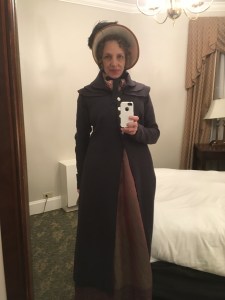
Dressed for the weather: I only seem to wear this pelisse in February.

In the past year+, I’ve been trying to do more and regret less, which seems a bit contradictory: if you do more, might you regret more of what you do? The trick for me, especially in dealing with my baseline high-anxiety self, is to do more things that seem scary but are actually fun.* That’s how I found myself traveling up to Salem between snowstorms to stay in a tiny little room in a historic hotel. It’s a pretty quick ninety-minute trip on a good day, but I know myself well enough now that staying overnight is the safer, less-stressful option for an excursion like this.

Salem on a snowy Saturday was busy, streets crowded with people as I walked to the old Town Hall, feeling very much like a character in a novel. (Having just finished Remarkable Creatures, the scenes of Elizabeth Philpot walking in alone London came to mind as I did attract some attention in my pelisse and bonnet.)

The Town Hall was crowded; I arrived a little late, as dancing was beginning under patient and direct tutelage, so I had the pleasure of watching several dances before I joined in. While not everyone was wearing early-Federal/Regency clothing, the crowd still provided an excellent sense of the social mixing and festivity of a scene from the past.

Unforgivable hotel room selfie to record the dress

Joining in was even better, to be in the swirl of people and skirts, to pay attention to my feet– my shoes were a little slicker than I would like– and to count the rhythm of the music. While I spent years in ballet class, it is true that those years were surpassed by years in mosh pits and on dance floors of questionable clubs. Country dances made me think of four-dimensional math, with the patterns made by the combinations of active and helper couples, the reversals of direction, and the changing positions of partners: it was like being a living fractal.

*With some exceptions including rollercoasters and sky diving.

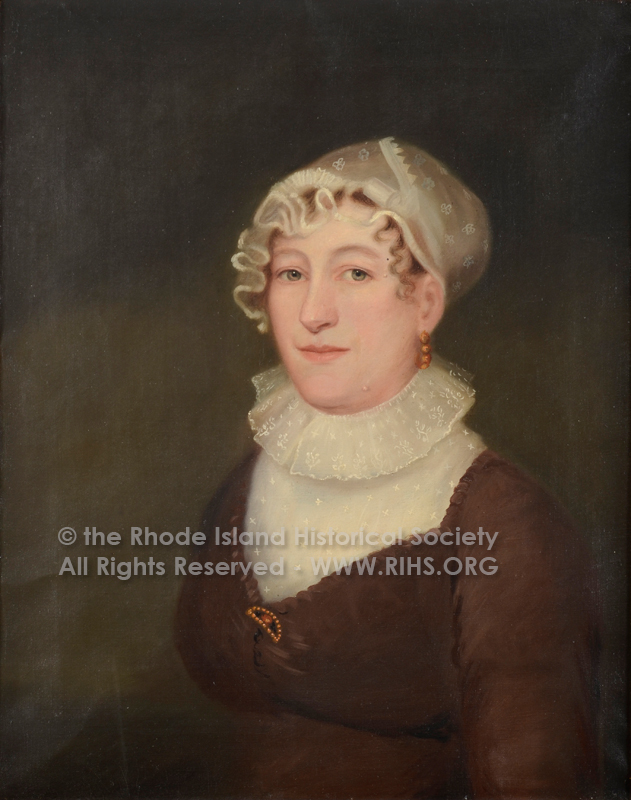
Mrs Pabodie, I presume?

Mrs William (Jane) Pabodie. oil on canvas, 1813. RIHS 1970.60.2

Remember Mrs Pabodie? She appeared a week ago today in Providence after an intense sewing effort left your author with numb fingers. The process was as straightforward as these things ever are, manipulating fabrics to do your bidding once you think you have the right materials.

It took more rounds of white muslins from Burnley and Trowbridge than I care to count, and a variety of book muslins from Wm Booth Draper, just for the chemisette and cap. The laces came from Farmhouse Fabrics in the most expensive small package I’ve yet ordered that did not contain antique jewelry.

Mrs Pabodie attempts to remember when she was born (1771). Photo by J. D. Kay

The gown is a wool and silk blend remnant from Wm Booth Draper, just enough to make a gown (even at my height) though I admit the front hem will need some piecing or a ruffle to give it the proper length. Still, the thing more or less works, though as I compare the details to the original painting, I admit we’re still in beta.

I was joined by three friends from different eras (because you know me: if it’s not didactic, we’re not doing it): a sailor who on the run from a Newport press gang in 1765; Reverend Enos Hitchcock of the Beneficient Congregational Church in 1785; and Sissieretta Jones, soprano of Providence, around 1880. Each of the characters described their lives and their clothing, and I will admit that the Annual Meeting audience may not have been fully prepared for some of what they heard– I’m not certain they had ever considered how apt “balancing a sheep on my head” might be in describing Reverend Hitchcock’s wig.

Mrs Pabodie points out East Side landmarks to a visitor examining the theatre curtain backdrop painted around 1810. Photo by J. D. Kay

In the end, they were entertained, and may even have learned something, as we celebrated 2016’s interpretive theme, Fashioning Rhode Island.

Frivolous Friday: The Pabodie Project

Mrs William (Jane) Pabodie. oil on canvas, 1813. RIHS 1970.60.2

Jane Jewett Pabodie, born around 1771, died 23 March 1846 is buried in Swan Point Cemetery on the Seekonk River in Providence. She was the wife of William Pabodie– which one? Well, it’s hard to tell until I really dig into the genealogy. At the moment I am so besotted with this image that all I can think about is what she’s wearing!

What she’s wearing….about that. I have some work– and some thinking– to do. The cap is slightly confounding. It’s a chance to learn a great deal more about early federal caps, which is good. I don’t understand it, which is unfortunate. The asymmetrical nature of the cap is new to me- or at least I cannot think of another example, so feel free to school me, people. But really: it is asymmetrical! With a ruffle on what is the right side of her head, and a… pinked? Van Dyked? Prairie pointed? band that runs from her left ear around to the back of her right ear? I’m confused. It would make more sense if the cap had slipped, but why would the Pabodies pay for a painting that recorded such a thing?

Honestly, I think the only way to really understand the cap is to make the cap. In muslin first, thankyouverymuch, I’m not that crazy.

Detail, Mrs William Pabodie. Oil on canvas, 1813. RIHS

The chemisette is more straightforward, being made of a sheer figured or embroidered cotton with a slightly gathered collar embellished with floral whitework embroidery. That I think can manage, at least in the basic construction (fabric, well, I’m looking).

Of course, why do I feel the need to manage all of this, with a deadline now less than eight weeks away? For a program, of course– I have only to write the copy for it. The idea (for me, anyway) is to replicate a portrait as closely as I can. Now, Mrs Pabodie and I are not exactly the same age, but I think I can pull this off…the cap, more troubling.

It’s an interesting project for me, not so much from the sewing point of view, but from a conceptual standpoint.

How close can I get? What does exactitude mean?

If I want to represent a character, what’s more important: understanding the clothing, or understanding Jane Pabodie? Constrained as I am by modern materials, unable to match these exactly, how do I navigate choices based on suppositions of what an artist meant to represent? Just my kind of conundrum.

Documented Fantasies

It was three years ago on a warm August afternoon in the museum room we’d turned into a photo studio when I quipped, “All my fantasies are documented.” It’s been hard to live down ever since.

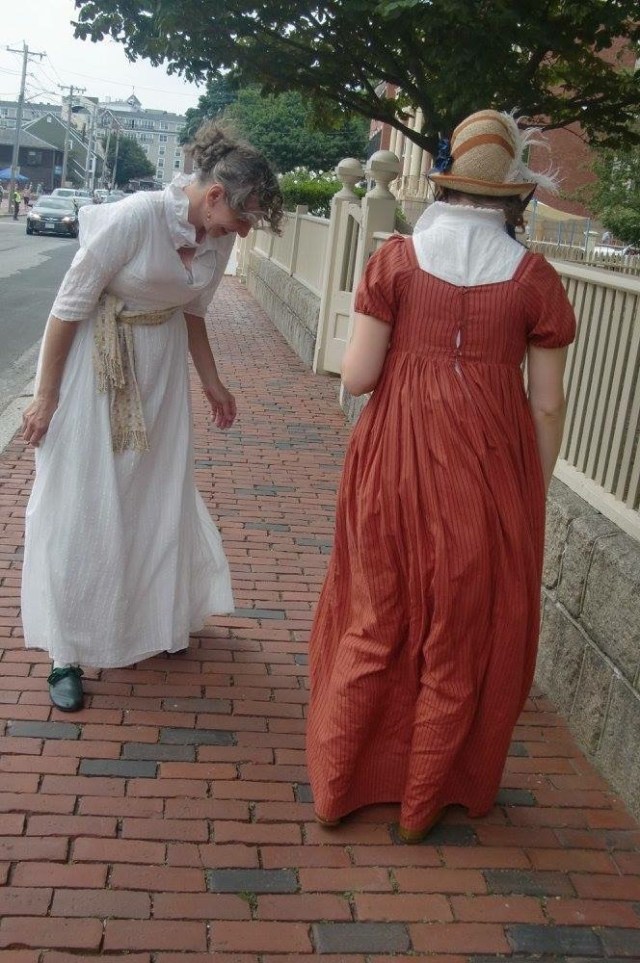
With Mrs B watching Miss B self-perambulate upon the sidewalk.

Documentation, research: we all do it, everyone who reads this blog does it. What matters is how you use it– or, maybe even more importantly, how well you understand how you are using your research. This past weekend was the Salem Maritime Festival, and round number three for me in the West India Goods Store (WIGS, which sounds far more political than it is). The year was 1804, and as you may recall, that required a new dress.

Reader, I wore it. And it survived!

Yes, it is made from an IKEA curtain. The pattern is my own, derived from examples in Janet Arnold, at Genesee, and the KCI. Once again, I discovered the power of upper body strength and leverage. It’s not that my stays are too big necessarily. The busk is too long, that I will grant you. But I think the shoulder straps are as well, and the shift– that slattern! She was rolling a la Renaissance Faire, which is completely unacceptable, of course, as she slid down my right shoulder by the end of the day when the shop had been unpacked into the conveyance.

So let us focus on the non-slattern part of the day, when a mercantile enterprise briefly overtook the WIGS.

There was some custom, though numerous debts were recorded in the ledger.  (Somehow, there are no images of Mr K sweating over the figures in the book, though I recall them clearly.)

IMG_7634 (1)

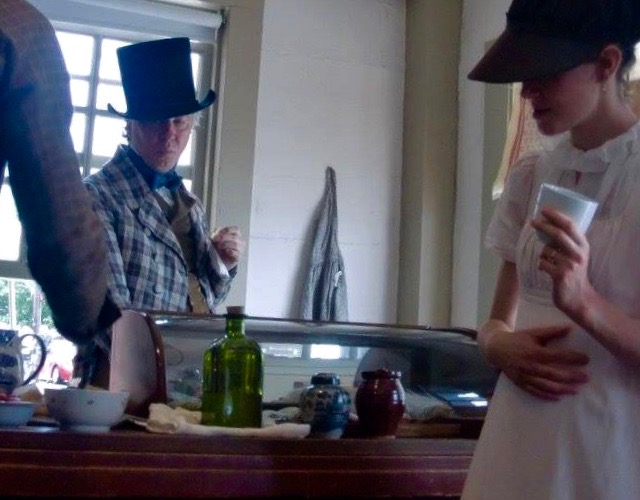
The shop was hot, but we attempted to stay fed and hydrated, as we discussed the various kinds of goods imported to places like Salem and Providence in 1804. Politics were rather difficult to discuss, as Mr K has a marked antipathy for Mr Jefferson that caused a mild agitation; expanding the country does seem a bold and perhaps unconstitutional move, given the deal Mr Jefferson has struck with Bonaparte, but perhaps this is for the best. The Indians will surely benefit from Christianity and education.*

It’s engaging in the moment, and we’ve done our research. But it’s a fantasy nonetheless, a kind of happening grounded in primary sources and material culture. I’m OK with that– I understand what I am doing– but I wonder sometimes if the people I’m watching on social media understand what they are doing with the fantasies they portray.


* To be SUPER clear, I’m staying in character here. I worked in Missouri and I have enough understanding of “manifest destiny” to disagree with this point of view.