Luxury and Fashion


Sometimes this is a hard hobby to love. My hands hurt, my creativity feels dead, and there’s no place to go all dressed up. After a long, unpleasant spring, I finally feel like sewing and playing. Drunk Tailor and I definitely missed some things we very much wanted to do, but now we’re reinspired, we could take baby steps back to our normal semi-hectic pace– except of course, we are plunging back in with three events in August after a whirlwind trip to Ticonderoga.

Wedding dress in cotton muslin ca. 1797. Nationalmuseet Danmark.

With the summer heat in mind, I ordered batiste and voile, thinking I would make the Tidens Toj gown, but when the fabric arrived, it seemed that the purveyor had confused the two fabric types, so a new plan was required. Alas, the trials of costume research and falling down the fashion magazine rabbit hole for hours at a time…

1798 Gown, watercolor by Ann Frankland Lewis, 1798. LACMA, Costume Council Fund (AC1999.154.1-.32)

Next up: an open robe or wrap-front gown over a matching petticoat, trimmed in blue-and-white Greek key trim, with a pair of pointy-toed ribbon-tied slippers and a sleeveless blue silk waistcoat, in three weeks or so.

The waistcoat construction is finished, scaled up from the original garment patterned in the DAR’s “An Agreeable Tyrant” catalog. I chose to line mine, possibly from pure habit of making men’s clothing, possibly because I’m not that great a teeny-tiny hemming and require a lining to hide my sins. With gold silk cord trim and covered buttons, I think it will have a pleasantly military vibe.

For the gown and petticoat, cotton in Virginia’s August heat seems like a solid choice, though by the time the layers are on and the sun is up, it’s possible that nothing will be really cool. (The majority of the day will be spent in air conditioning, so really, anything would be okay.) The trim arrived last night, and has a body that will need batiste (and not voile) for support. The combination causes me to entertain fears that this aesthetic is a little too boat-shoes-and-belts-with-embroidered-whales for 1797-1799, but when topped with something not unlike Drunk Tailor’s militia cap, the aesthetic will tilt from yachting to the Good Ship Lollipop.

Black and White World

Isn’t she grand? She’s on offer elsewhere; I came across her while narrwing down a date for a very different portrait.

She reminds me of a Tamara de Lempicka, if Tamara and Ammi Phillips had set up easels next to each other. From her forthright, slightly sulky gaze to the exuberant folds of her gown bodice to the hints of style in the details, we can learn a lot from this painting. There’s a kind of provincial Hepplewhite sideboard behind her, set with a colorful garniture; the copper hot water or tea urn places us in a parlor. The painting frame has a shell in the center of the bottom rail, the chair a turned knob on the back upright– we are on the edge of fancy, the moment when neoclassicism really gives way to exuberance (think canary yellow rose-painted china, big puffy sleeves on printed gowns, and fancy-painted chairs).

Below, an earlier entry in the black and white world. This lady was sold at auction recently. She’s earlier than our near-Tamara above, plainer in dress, sulkier. She is certainly more academic, and somewhat better painted, in addition to being set in a vaguely classic scene, in a very neoclassical chair, draped with a fine shawl.The artists is definitely showing off some skill in the “painting transparency” department.

The lady in black is firmly set in the neoclassical period. Restraint and moderation are watchwords– despite what you may think of that hair, which is recalling Greco-Roman precedents–much the way certain factions in the Revolutionary period were driven by piety and discipline. Politics and national ethos or mood are embedded visual culture then as now, and even in these portraits, simple as they seem.

Milliner’s Shop Redux: A big, visual project

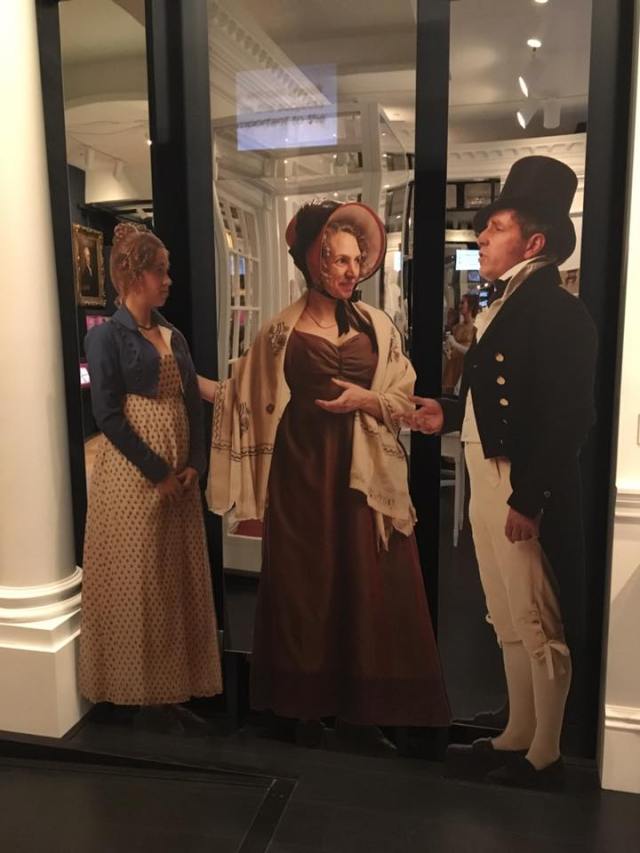
The complete ensemble, under supervision.

When I first moved to Providence, I lived in Fox Point, a slightly fringy-dingy neighborhood of Portuguese and Cape Verdean immigrants and their descendants that was cheap enough for students (and even today remains imperfectly gentrified: Providence, I love you dearly). As my then-boyfriend and I walked my dog, we passed a man whom I later came to know as the Block Captain, who remarked to my boyfriend, “Beeg wooman.” Any project I take on is, therefore, big, since I am nearly six feet tall.

Although I have schemes for a Big New Century Project (a complete 1585 ensemble), I’ll take a shortcut instead to my current enthusiasm and write about last weekend and the 1811 fashion plate reconstruction, which happily includes one of my favorite visual sources, early 19th century fashion plates — thanks to Scene in the Past’s albums and Ackemann’s Repository on the Internet Archive.

I’ve written about the canezou plate before, but not since I (mostly) completed it on the trip up to Salem. This 1811 plate appealed to me first because of the bonnet (checks!) and the necklace (lapis!), but then realized that the canezou and its petticoat were within my ability to complete.

The ensemble also seemed suitable for a summer day in Salem, which, while usually more humid than hot, calls for cool, lightweight, clothing that can withstand a potentially sweat-drenched day without melting.

From start to finish was three weeks: canezou, bodiced petticoat, necklace, bonnet, and shoe trims, all a vernacular rendition of a high-fashion image, adapted to the materials at hand– though I did have to order bonnet taffeta from India, which arrived just in time– much faster than I could have expected in 1811 Salem!

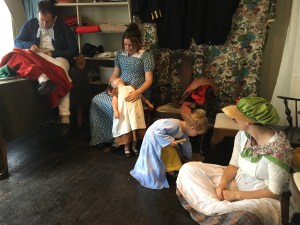
Setting up the shop for the fourth time was as much fun as the first time, and a little easier, given the practice I’ve had. I shared the shop with a tailor, Mr. B, of hat-making renown which made for a nice contrast interpreting men’s and women’s fashions and purchasing habits.

Packing up hat stands, bonnets, accessories, and furniture and driving them 470 miles is a kind of madness, but interpreting women in business and early shopping is one of my favorite historical enterprises.

Fave Friday: Full-On Federal


Favorite Era? Easy-peasy! Federal, of course. Whether furniture or fashion, the early Republic is my thing. I spend a fair amount of time in the 18th century, since there are so many events in that time period, and while I loved the story of the American Revolution as a child, the early Federal* period intrigues me more. Furniture, porcelain, wallpaper, and clothing from 1790-1820 all appeal to me, as well as the notion that women’s roles were in flux in the earliest decades of the United States.

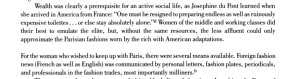
“American Women and French Fashion,” from The Age of Napoleon

I love the idea of women in mercantile businesses and trade, and the way that milliners provided access to fashion (and you can read more about that in The Age of Napoleon).

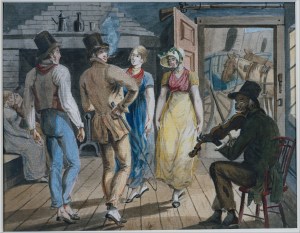
Merrymaking at a Wayside Inn, watercolor on paper by John Lewis Krimmel. 1811-1813. Metropolitan Museum of Art, 42.95.12

I also love the way that American women (and men) translated European high style into a vernacular, as seen in John Lewis Krimmel’s watercolors of Philadelphia and surrounding areas.

This is a time period I’m comfortable in (yes, the stays are part of that comfort) but aside from comfort and aesthetics, I think it’s also because for a brief time, women had slightly more freedom than they had previously.

It was short-lived, and Republican motherhood was confining in its own way before the “cult of womanhood” blossomed fully. But ideals of freedom and fashion very briefly aligned, and for that, I love the Federal– and vain creature that I am, I think it suits me.

*pre-Andy Jackson, amirite?