Good Enough Coat

The great coat is nice, but how ’bout them gaiters?

Winter is firmly here, with the snow, fog and ice that marks the season in the Ocean State. It’s not fun weather for living in the past, though there’s not a lot of that happening right now. Even so, there’s a February program on the horizon and what better excuse for fastening on a garment and making it?

Even if I’ll likely spend the day in a kitchen interpreting life below stairs in 1820 (while the light infantry occupies my living room and denudes my kitchen), an early 19th century event on a winter weekend seemed a worthwhile excuse for making a greatcoat, and, eventually, gaiters.
IMG_2733

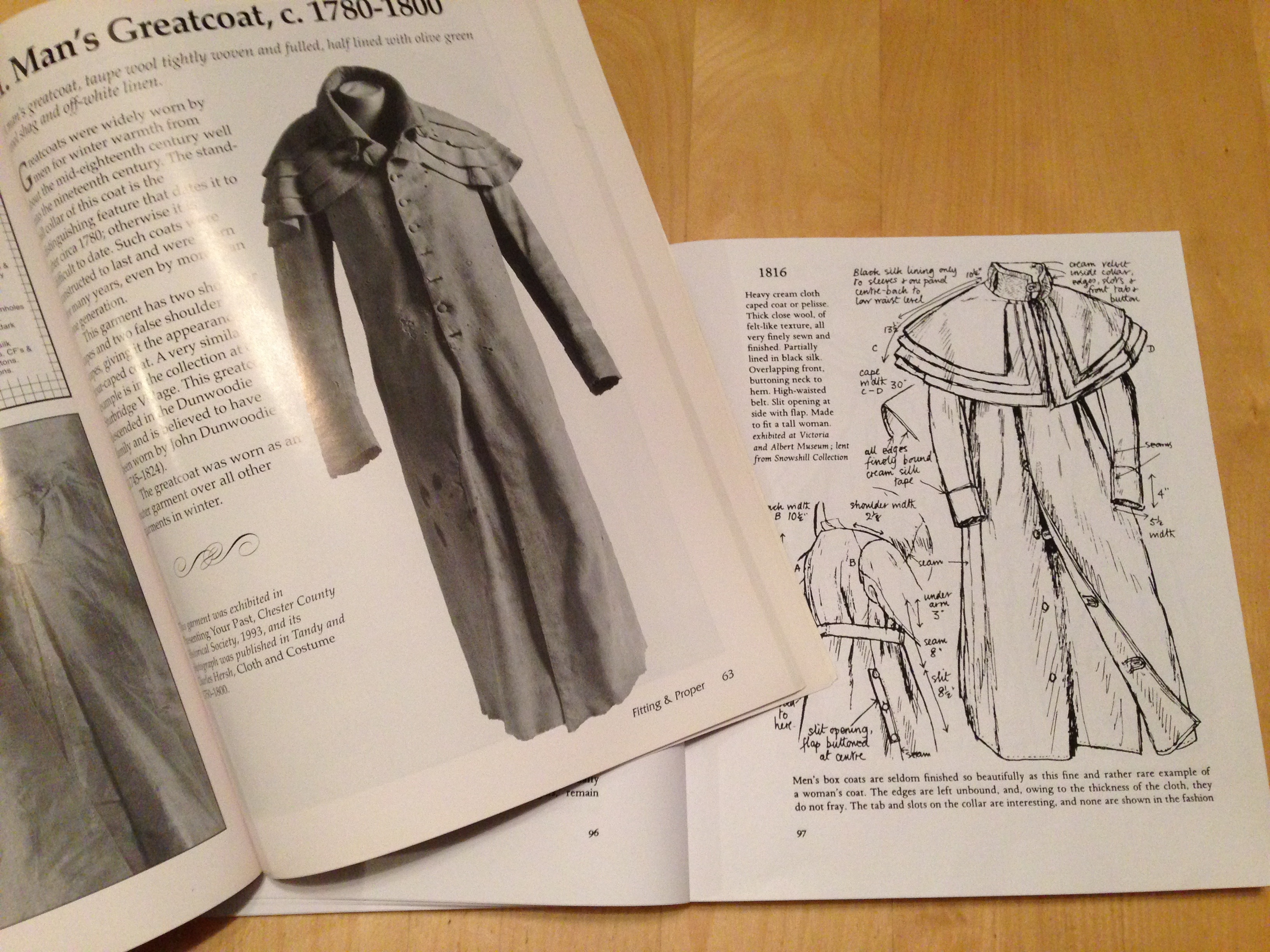
With no pattern, and only 2 and 3/4 yards of thick, soft, grey double faced wool*,  I’m adapting my standard Spencer pattern. I didn’t upsize this too much, because women didn’t have frock coats and waistcoats to wear under their greatcoats or Carrick [carriage?] coats or Reding cotes. (I’m too engrossed with sewing to parse garment names.) The skirts will be attached at the waist, with a belt to hide the seam. At my height, cutting a back in one piece takes yardage I do not possess. Happily, the Taylor’s Instructor describes Redingcoats or Habits for women with attached skirts.

The collar shape diverges from my usual 1790s collar, and is based on another fashion plate, this time from 1815. The program I’ll be doing with Sew 18th Century is set in 1820. As a maid, I think an 1815 coat is pushing it a bit, since red wool cloaks hold up well, but I’ll take any excuse for some tailoring, I suppose.

1815, with a round collar that can stand up.

I plan to use this button arrangement, too, stylish as it is in not-quite-double breasted. Bring on the button-making– we all have to go death’s head sometime, and this wool is too thick for covered buttons without much heartbreak.

The lower front pins are there from the moment when I realized the front was hanging strangely — because I had neither marked nor sewn the bust darts. That oversight, and the pain in my ear, do suggest that the delightful cold I’ve had for weeks may be affecting me more than I think– but that’s just another argument in favor of a cozy wool coat.
IMG_2737

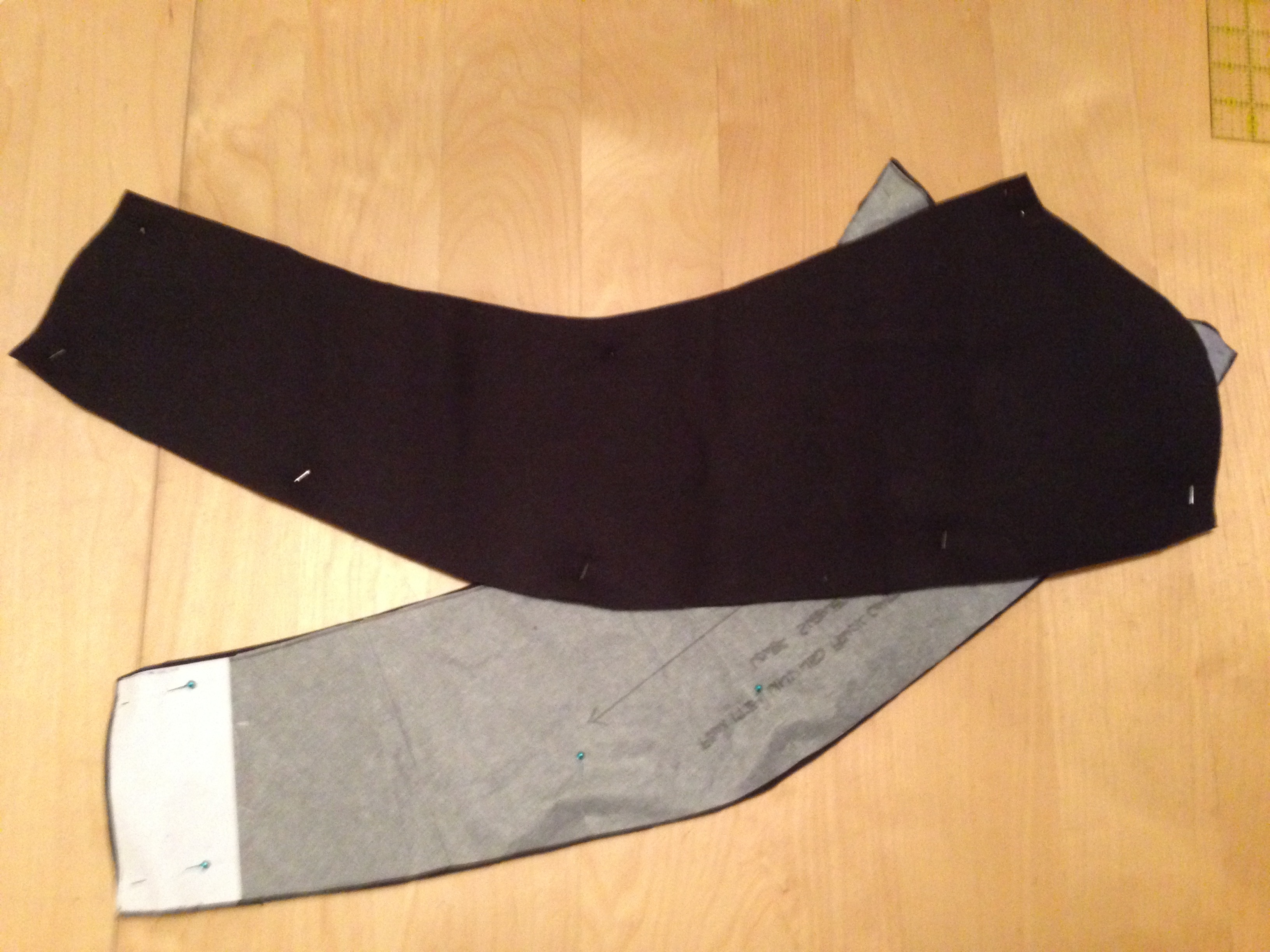
The sleeve pattern (again, not upsized) is once again the old standby two-piece sleeve from Henry Cooke’s 1770s unlined man’s frock coat, so of course it fits well.

I’m hoping to stitch up the sleeves this evening, and set them later this week. I’m still pondering lining materials– there’s just enough silk “persian” to do the body and sleeves–but I have some twilled wool that would increase the warmth and still provide some ‘slip’ in the sleeves.

And those blue gaiters? They’ll come in time, from the scraps of blue wool a friend is making his first ditto suit from. I’ll spot him some remnant table chintz for a summer waistcoat, and expect greater sartorial splendor will grace the spitting stamp inspector in Newport this August in exchange for my blue wool ankles.

*Holy burned hair smell, Batman! Mr Cooke’s right when he says this almost feels like foam, but put a flame to it, and you might as well be smoking sheep.

The Very Specific Spencer, Finished!

Ta da!
JDK_8197_1

Yes, finished! And just in time, too! The braid arrived in the mail three days before the Spencer was wanted, and fortunately I had finished the garment by then, and the baking could take care of itself after a while, and I managed not to get eggs beaten with sugar on any lovely wool or mohair.

JDK_8210_1

I think it looks well enough with the gown and bonnet, though I am fairly certain the darts are too far to the sides in this iteration. How that happens when you use the same pattern twice I do not know.

You may recall that this is the Spencer where I demonstrated an uncanny ability to sew a collar on upside down. The braid went on pretty quickly, again proving that good materials make good sewing.

As mentioned previously, the cuffs are pieced, but this is a perfectly accurate way to deal with a shortage of material and/or cuffs.

I’m fairly pleased with how it turned out, and very pleased with how warm it is.  Over the cotton gown, the Spencer was plenty warm– and I certainly wished I had it after we left the house and went down to the river!

On the whole, I suppose I’m pleased…as pleased as I ever am …which means you can expect pattern revisions in the future!


Why Do We Buy Things?

The Sunday, November 9th Guardian had a series of short articles on collecting, including one on why people collect things. This was similar to the New York Times’“Room for Debate” series on Why We Collect Stuff.

Chair, table, chair.

I liked the Guardian’s “Love, anxiety or desire?” question, and asked it of myself: why do I collect?

Collecting is something that I had given up for a while, given that so much of what Mr S and I had collected was stashed in boxes in our basement after an apartment move nine years ago. Nine years! If you haven’t unpacked in that time, do you really even care about those things?

No, not really. Many the things I unpacked recently as we went through the basement again are destined for Etsy: McCoy pottery vases, colorful Pyrex, FireKing glassware. I bought it at a time when I liked green pottery—it was an outgrowth of the blue and yellow creamware I’d begun collecting when I first lived in Rhode Island.

But now, I’m done with it: done with the mid-century modern, and going back to the early American things. There’s an aesthetic quality I like in both styles: simple lines, bright colors.

The most recent acquisition is a drop-leaf table in a very country Sheraton style, with a tiger maple skirt. I watched this table for months before finally committing to it, and dragging Mr S up there late Saturday afternoon. He was game, and in the past day the table has grown on him.

Why did I want it? For one thing, it reminds me of a maple drop-leaf Sheraton-style table my mother has, so perhaps there’s an element of nostalgia, or a desire for approval. I also imagined it exactly where it is, though it will require some adjustment in lighting. Did I buy a piece not only of the American past, but of my own? Is this what adulthood looks like? Or am I just responding to shape and color?

The table and chairs are low, and not comfortable in the way that modern furniture is: I wouldn’t want to sit in the chairs or work at the table every day, but these things give me pleasure, whether bought for love, anxiety, or desire.

Things Won’t Make You Happy…

DSC_0455except when they do.

I try hard not to be acquisitive, though our home is perhaps more crowded than it might be if I were better at the task or cleaned at work less and at home more. Around the time of What Cheer Day, I became rather obsessed with teapots.

At the local antique mall, I found an attractive Chinese export porcelain cylinder or barrel-form teapot with crossed strap handles, suitable in design and shape for use in 1800 Providence. I made a special mid-week trip fully intending to buy the teapot and free poor Mr S from ever hearing “teapot” again in endless conversation. When the item was out of the case, though, it turned out to have a mended crack right across the bottom, and as I told the woman, “It matters because I intend to use this.”

DSC_0450In the end, I did not have my fabulous teapot for What Cheer Day. In fact, my fabulous teapot arrived just this past Thursday, after patient stalking on eBay. It arrived with a bonus of five cups and a saucer, most with mends, but the pot itself has just a handle flaw or mend (typical, and seen, along with wear, in some museum pieces, too). The quantity of cups suggests that the previous owner had a relationship with them not unlike the one you might develop with a large litter of kittens you were fostering…adopt one, get another! Just to get them out from underfoot.

DSC_0470The cups and pot reminded me of the difficult meals and teas Elizabeth Bennett takes with Maria Lucas and Lady Catherine whilst visiting Mr Collins and his new bride Charlotte Lucas. There’s a tension in these cups, some combination of the dainty and the strong, some slightly misshapen (not all makers were equally skilled) that calls to mind the polite verbal combat of tea parties.

I washed the cups, and was reminded of the duties of maids to clean and care for these delicate items, the kind of thing they were unlikely ever to acquire, though there were grades of china then as now: what sat on John Brown’s table was not what sat on the Dexter’s table, or at least not in the same quantity.

DSC_0452The quantities of china coming into Providence and the rest of the Eastern seaboard after 1788 were enormous: in 1797, dinner sets of 172 pieces could be ordered at Canton for $22, and included 6 dozen large flat plates, 2 dozen large soup plates, 2 dozen small dessert plates, 8 pudding dishes, 2 large tureens, dishes and tops, 2 smaller ditto, 16 dishes of various sizes, 6 sauce boats and stands, and 4 salt cellars. Tea and coffee sets of 81 pieces were bought in Canton for $6 to $9! Just for dinner and tea, you could have 253 pieces of china, and we haven’t even begun to get into custard cups, cache pots, and garnitures!

DSC_0473The indifferent pieces I have acquired may have started out as kaolin, feldspar and quartz in Ching-te-Chen, 200 miles west-southwest of Shanghai. There were important porcelain manufactories there, and porcelain wares traveled by road and boat to Canton, where sets were customized to meet specific orders and then loaded onto ships bound back to America, six months or so after the order was placed in Providence, Salem, or Boston. It’s a lot of work for a fashionable sip of Hyson or oolong, and no wonder cups and pots were mended, saved, and reused.