I Fall to Pieces: Extant Garment Fragments

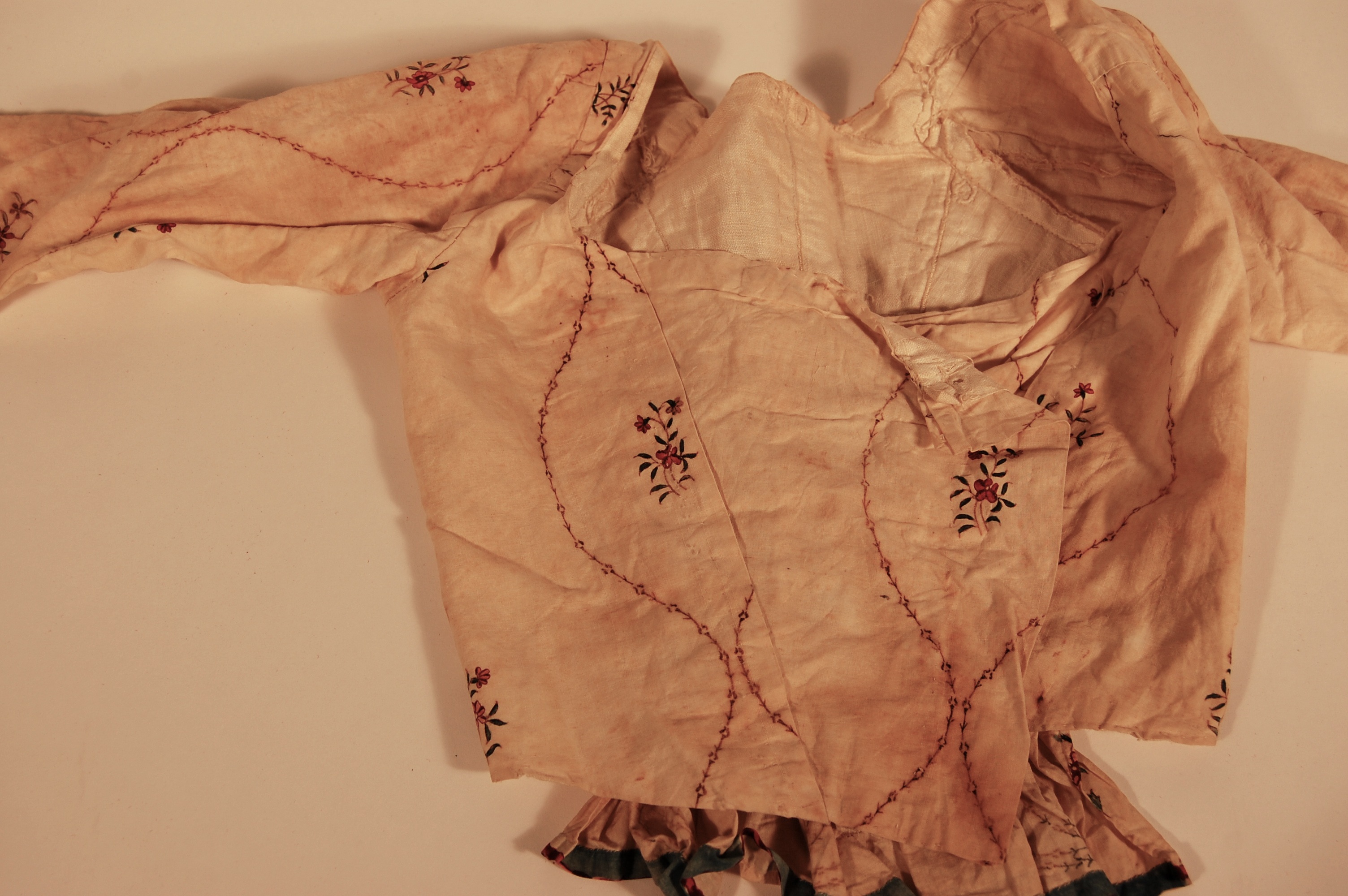
Bodice, painted Indian cotton, 1780-1795 RIHS 1990.36.27
Bodice, painted Indian cotton, 1780-1795
RIHS 1990.36.27

Once upon a time, not very long ago, when I worked in a historic house museum, I was asked to present at a conference in Worcester. I chose to talk about these fragments, and I still like to think about them. The delicate fabric was saved as a pair of sleeves, a bodice with a tiny peplum, a skirt.
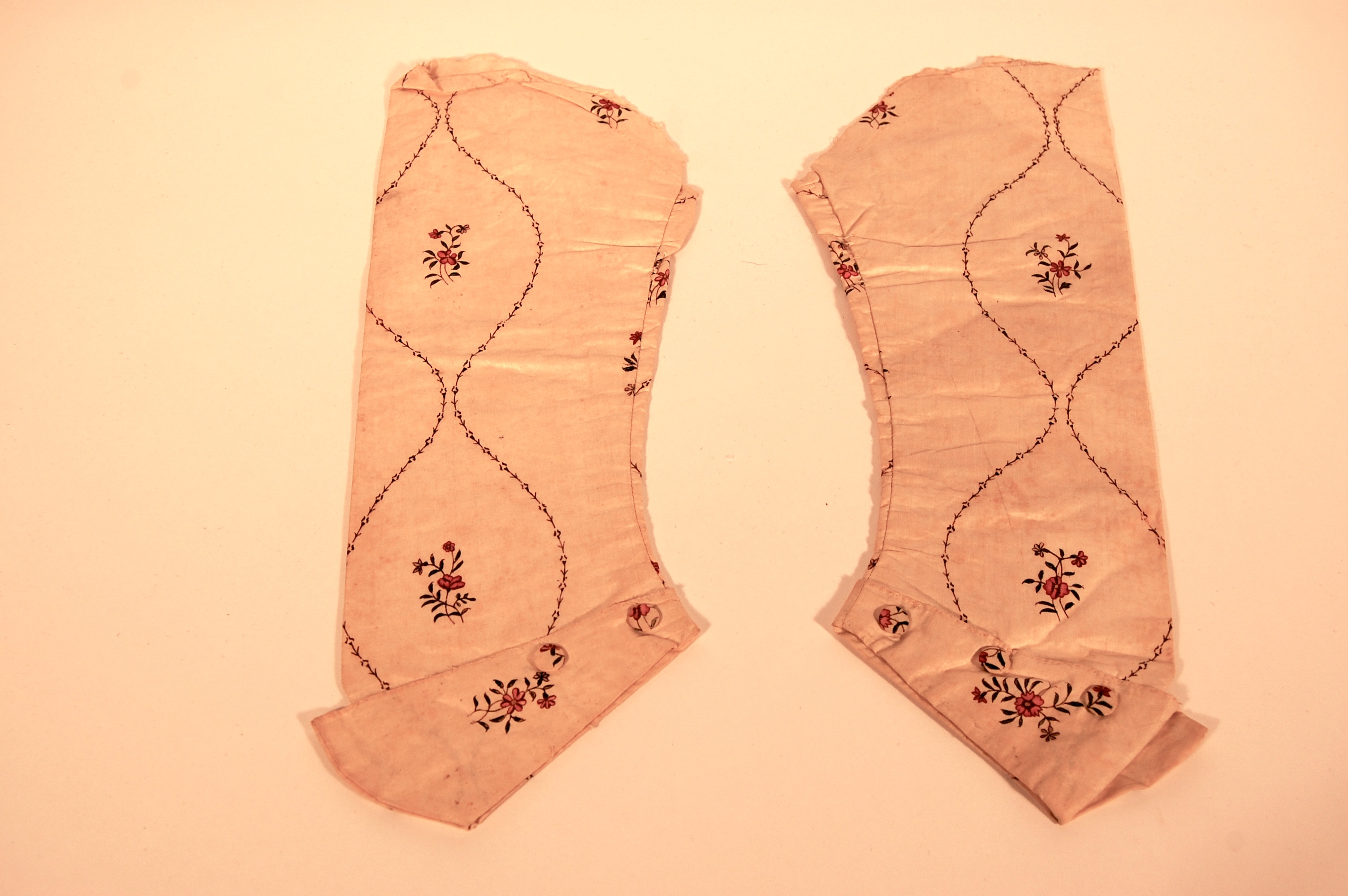
Sleeves, removed from bodice 1990.36.27. RIHS 1990.36.25A-B
Sleeves, removed from bodice 1990.36.27.
RIHS 1990.36.25A-B

The pieces appear to have been part of a pieced-back closed-front gown with a matching petticoat circa 1785. I think someone decided (quite rightly) that the style was too passé for 1795, and altered the gown significantly.

Not only is there evidence of new sleeves being fitted into the gown’s armscyes, we have the sleeves-that-used-to-be. And my dear! No one is wearing sleeves like that this season!

I find these garments in limbo really fascinating. Was that bodice finished and worn with a matching petticoat? (Yes, there’s a panel of that left, too; what a lovely hem!)
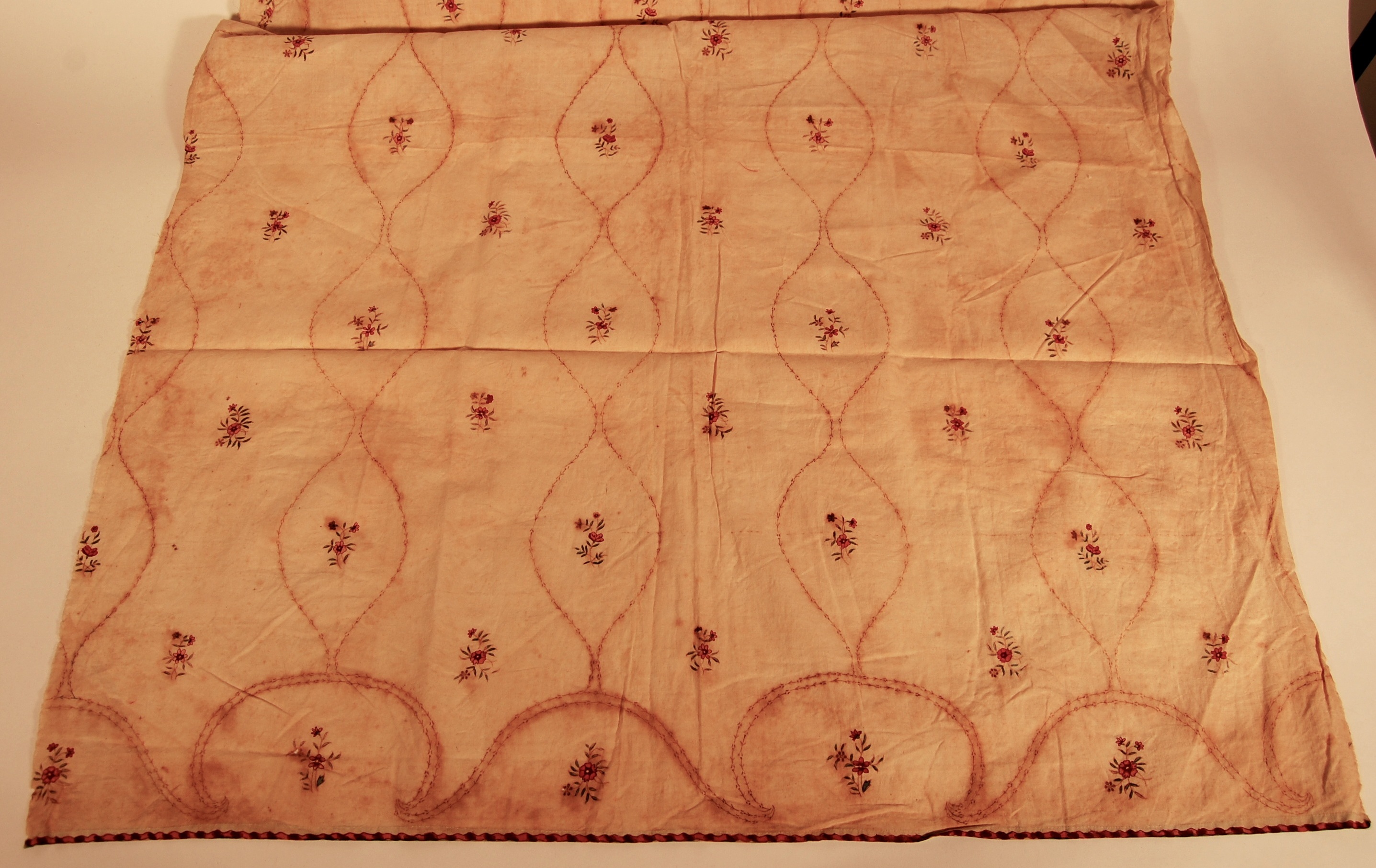
Skirt panel, painted Indian cotton. RIHS 1990.36.33
Skirt panel, painted Indian cotton.
RIHS 1990.36.33

Who wore the gown? Was it Sally Brown, born in 1773? And did she alter it, or did her sister’s mantua maker, Nancy Smith? We can only guess at this point, as so many documents remain in private hands. The alterations are not as finely done as the original gown, so I think there are two hands at work here– whose were those hands? There’s always more to think about and learn.

In case you’re wondering, thanks to the Met, we can see what the gown probably looked like in its first incarnation, and then what the alterations were meant to achieve. (Link to the gown on the left; link to the gown on the right.)

Circles and Lines

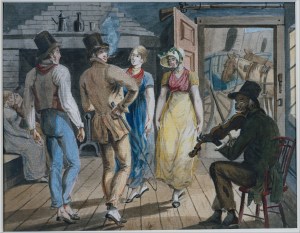
Merrymaking at a Wayside Inn, watercolor on paper by John Lewis Krimmel. 1811-1813. Metropolitan Museum of Art, 42.95.12

By some miracle, I did not have the Polecats in my head all weekend, despite spending most of Saturday only dancing. It has been some time since I danced (February’s adventure notwithstanding) and after two hip replacements, my Giant son is correct: I’m still re-training my muscles. My feet remember more than my hips do, but at least some of my muscles remember!

The Commonwealth Vintage Dancers Regency Weekend was this past weekend, and while I could only manage Saturday (Sundays are for chores when you’re expecting houseguests for Easter), I had a wonderful time and sincerely hope I can retain what I was taught. The company was very friendly and quite genteel, though I can report that I did experience a variety of partners, and, in one unfortunate case, became so confused I had to step out of the dance entirely. (Mixed rhythms and mixed-up steps became far too jumbled in my poor brain.)

The Five Positions, from An Analysis of Country Dancing, T. Wilson, 1811.

The entire day reminded me strongly of being in a novel, or, as Drunk Tailor said on hearing the description, a movie. Let us merely note that some gentleman are more enthusiastic appreciators of music than others, and that a partner can be left feeling a bit flung about in some of the figures that involve the mouliner. My rusty memories of French came in handy: mouliner and mill connect easily enough for me (seen here, in Prince Kutusoff) and the Boulanger made much more sense when I connected it to mixing bread dough. Hey– whatever gets you through the set without stepping on your own, or anyone else’s feet!

I’d like to think I will remember something of this business the next time I get to dance, whenever that may be. The patterns can be found on line in manuals (as in this description of Sir Roger de Coverly) with some occasional, bearable, videos— and, as always, resources close to home.

Next time: the dress. Until then, I’m posting more on Instagram.

A Saturday in Salem : Jane Austen Ball

Closure: green silk satin ribbon.

With many thanks to the Quintessential Clothes Pen, I was not dancing with myself Saturday last at the Jane Austen Ball in Salem. I was there on a bit of a whim, knowing that the ball happened in February and looking for something to do on a winter weekend– and, as it happened, I actually had a dress to wear. Of course, it wasn’t finished until Friday night, although I had worn it in December for a photoshoot.

Dressed for the weather: I only seem to wear this pelisse in February.

In the past year+, I’ve been trying to do more and regret less, which seems a bit contradictory: if you do more, might you regret more of what you do? The trick for me, especially in dealing with my baseline high-anxiety self, is to do more things that seem scary but are actually fun.* That’s how I found myself traveling up to Salem between snowstorms to stay in a tiny little room in a historic hotel. It’s a pretty quick ninety-minute trip on a good day, but I know myself well enough now that staying overnight is the safer, less-stressful option for an excursion like this.

Salem on a snowy Saturday was busy, streets crowded with people as I walked to the old Town Hall, feeling very much like a character in a novel. (Having just finished Remarkable Creatures, the scenes of Elizabeth Philpot walking in alone London came to mind as I did attract some attention in my pelisse and bonnet.)

The Town Hall was crowded; I arrived a little late, as dancing was beginning under patient and direct tutelage, so I had the pleasure of watching several dances before I joined in. While not everyone was wearing early-Federal/Regency clothing, the crowd still provided an excellent sense of the social mixing and festivity of a scene from the past.

Unforgivable hotel room selfie to record the dress

Joining in was even better, to be in the swirl of people and skirts, to pay attention to my feet– my shoes were a little slicker than I would like– and to count the rhythm of the music. While I spent years in ballet class, it is true that those years were surpassed by years in mosh pits and on dance floors of questionable clubs. Country dances made me think of four-dimensional math, with the patterns made by the combinations of active and helper couples, the reversals of direction, and the changing positions of partners: it was like being a living fractal.

*With some exceptions including rollercoasters and sky diving.

Mendy Monday

Best not to be shiftless, so mending was in order. I knew this day would come, and soon, and after doing the post-Genesee wash, the moment had arrived for this shift.

Simple, classic patching. I hadn’t expected to wear a hole in a shift quite this soon, but four years of wear whilst working and sweating have taken their toll.

It’s a toss up, now that it’s mended, as to whether or not I’ll shorten the sleeves. They’re too short for some of my gowns, but fine for others. Ideally, I’d make a second shift for this time period (early Federal) and third for the late 18th century. I’m somewhat concerned because I have taken a notion to make a new dress for Salem, which is just around the corner.

IMG_7481

Now, it’s not this dress– and this may be a pelisse, after all– but I’ve become pretty obsessed with this image, and decided, what with it being summer and all, to finally cave in and make a white cotton gown.

IMG_7460
~thanks to Mrs B for the image~

This is madness, of course, because I am not someone who doesn’t spill on her clothes or happily and recklessly carry strawberry-eating babies. White. Sheer. Really sheer. I don’t know what possessed me, but once I had the idea and the image to inspire me, I could not shake the notion of a white cotton gown for summer. Perhaps the recent heat is to blame: thin, white cotton seemed cool and refreshing. We’ll see how that goes in a little more than a week. Until then, bright light and fine stitches keep me busy.