Memento Mori/Memento Vivere

Late August is the time when kids go back to school, and nostalgia  grows for summers past and the months just gone, and for what you didn’t get done that you wanted to. It’s a time for transitions and remembering, when we’re on the verge of a fresh start. Even at my age, decades out of school, fall represents a fresh start, a time to begin something new. Now it’s more painful to drop my son at the airport than it was to take him to his first day of kindergarten: I won’t see him again until Thanksgiving or Christmas, depending on his class schedule. So to distract myself, I turned to a new-old project: the circular reticule with a pasteboard center.

I’ve been working on a version of the abolitionist reticules made in the 1820s, but recently came across some delightful earlier reticules offered by Skinner, one of a lady and a lamb, and one a Memento Mori.

My disused painting skills just stretch to the naive style of early nineteenth century schoolgirl painting, though it is hard to capture the full style when one has a modern eye. (Once you’ve seen Picasso and Warhol, can you ever go back?)

If/when I make another of these, I’ll definitely make some changes in techniques and materials, starting with the inscription. (Where is my historically correct ink? Where are the pen nibs?) For now, though,I’m happy enough and even ok with the off-centeredness of the painting on the circle. Lesson learned: do not rush through a project without planning all the steps.

I figure I’ll even it out a bit when I attach the bag.

I still have to paint the opposite side, and then decide what silk to use for the bag (I have some embroidered silk that I’m saving for a 1790s ball gown, but should have enough for a bag) and whether or not to line it. The catalog descriptions don’t mention linings, and the images appear to show only a layer of silk, with no lining.

It’s hard for me to wrap my head around an unlined anything, and for embroidered silk, a lining will help keep whatever I’m carrying from tangling in the threads on the wrong side of the fabric.

This isn’t a quick project, and I have to put it aside to work on commissions, but it does give me something to look forward to working on– a small memento vivere, if you will.

Go Big When You Go Home

heading north

A year after moving, Virginia feels like home, even as I continue to experience accent-based misunderstandings and yearn for different apples. But if home is where the heart is, my home is split between the place where my kid grew up and goes to college, and where I live now. After having all vacations cancelled (thanks, Fairfax County Jury System), we scheduled one for the end of the summer, a chance to visit friends, antique (and buy a new school wardrobe for a college sophomore).

You can never have enough eagles or feathers.

The trip hinged on the Militia Days event at Old Sturbridge Village, with Drunk Tailor mustering as a member of the Oxford Light Infantry or “Ollies.” The OLI has a ridiculously shiny and ornamented shako, which contributes to the appeal of the impression. The early Federal-era militia units certainly appeal to me, with gold buttons, chain, tassels, and plenty of eagles everywhere. There’s a lot of visual myth-making to unpack there, and the fact that the muster re-enacts a sham battle makes it ever so much more so wonderful and New England. This is meta-enacting (or re-re-enacting), and I am all for it.

A new time period meant a new dress. And a new bonnet. And new hair– that last complicated by the new summer haircut. (I had a wool gown from the Turkey Shoot several years ago, but wool in August at Sturbridge is possible but not recommended.) So, what to wear? I remembered some lightweight chintz gowns in the Kyoto Costume Institute collections, and happily there’s one on their website (my copy of the book is still in storage). While I prefer the audacity of many of the reproduction cotton prints, the hand of the quilting cottons is often heavier than I want, so I ordered a print from India– one that has been used for many other dresses in different time periods.

The pattern is a straight-up version of the Past Patterns Lowell Mill Operative’s gown. The first 1830 gown I made was from the State Historical Society of Wisconsin pattern, which did not fit as well over the collar bones; the Past Patterns neckline resolves well and fits like a dream– the only change I would make the next time around is to make the back pieces smaller. I had way more overlap than I really needed, but otherwise, I was lucky that this required no adjustments to fit pretty well. Every now and then, it’s nice to have a break from drafting my own patterns and fighting with fit.

Frivolous Friday: Favorite Fabric

Favorite Fabric? Are you kidding? Is it fabric? It’s my favorite.

Dat neckhandkerchief, tho’

There’s the hand-woven handkerchief made by a friend that is my absolute favorite textile accessory.

There’s silk taffeta, and the occasional silk satin, for bonnets.

And linen for shifts and linings.

But my all-time favorite fabrics are Indian block print cottons. I have multiple yards in storage, and multiple yards in the accessible Strategic Fabric Reserve. I try not to look at them in the online shops, for I cannot afford to be tempted.

My favorite three gowns are made of Indian block print cotton:

The Milliner in Red

The Bib-Front Tailoress

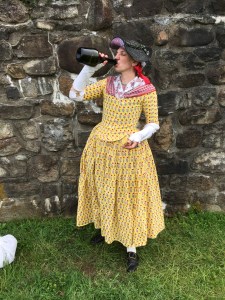
And the somewhat noticeable Nancy Dawson.

It was hot. And humid. That’s only water.

There’s an early red, white, and black calico based on a Philadelphia runaway ad, too, and though I’ve not had it on in a while, it may be due for a renaissance.

Once upon a time in Connecticut…

Oh, and while it requires some shoulder strap adjustments, there’s the brown Indian print I wear as a unsatisfactory Philadelphia servant and Boston sight-seer…and the red print I wore for a 1790 Providence housekeeper.

So, yes, pretty much my favorite, and of the prints? Nancy Dawson, hands down, though I was skeptical at first, for the yellow was so very bright. Made up and worn, though, I love it.

Milliner’s Shop Redux: A big, visual project

The complete ensemble, under supervision.

When I first moved to Providence, I lived in Fox Point, a slightly fringy-dingy neighborhood of Portuguese and Cape Verdean immigrants and their descendants that was cheap enough for students (and even today remains imperfectly gentrified: Providence, I love you dearly). As my then-boyfriend and I walked my dog, we passed a man whom I later came to know as the Block Captain, who remarked to my boyfriend, “Beeg wooman.” Any project I take on is, therefore, big, since I am nearly six feet tall.

Although I have schemes for a Big New Century Project (a complete 1585 ensemble), I’ll take a shortcut instead to my current enthusiasm and write about last weekend and the 1811 fashion plate reconstruction, which happily includes one of my favorite visual sources, early 19th century fashion plates — thanks to Scene in the Past’s albums and Ackemann’s Repository on the Internet Archive.

I’ve written about the canezou plate before, but not since I (mostly) completed it on the trip up to Salem. This 1811 plate appealed to me first because of the bonnet (checks!) and the necklace (lapis!), but then realized that the canezou and its petticoat were within my ability to complete.

The ensemble also seemed suitable for a summer day in Salem, which, while usually more humid than hot, calls for cool, lightweight, clothing that can withstand a potentially sweat-drenched day without melting.

From start to finish was three weeks: canezou, bodiced petticoat, necklace, bonnet, and shoe trims, all a vernacular rendition of a high-fashion image, adapted to the materials at hand– though I did have to order bonnet taffeta from India, which arrived just in time– much faster than I could have expected in 1811 Salem!

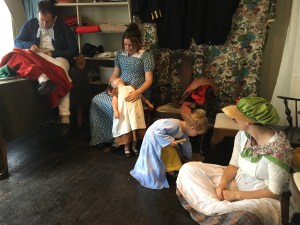
Setting up the shop for the fourth time was as much fun as the first time, and a little easier, given the practice I’ve had. I shared the shop with a tailor, Mr. B, of hat-making renown which made for a nice contrast interpreting men’s and women’s fashions and purchasing habits.

Packing up hat stands, bonnets, accessories, and furniture and driving them 470 miles is a kind of madness, but interpreting women in business and early shopping is one of my favorite historical enterprises.