 I started thinking about calico jackets, short gowns, and bed gowns because OSV is around the corner, and it will be hot. At Dighton, I took off my jacket and worked in my stays because it was cooler, and at OSV I may wish to do the same thing cooking or washing. And what better thing to make than a jacket or short- or bed gown which takes little fabric and not much time.
For short gown/bed gown patterns, I’d been looking at Duran Textiles’ Newsletter, even though it is European. The general principles are the same, and I need to tweak my pattern as I don’t like the fit over the petticoat in the back.

And then I looked at images of women in bed gowns, and the paintings by Chardin, (above, 1738, right, 1747) show women in short garments over petticoats. Lovely. The rich solid of the brown with madder and the print are both attractive and practical, and I have a madder petticoat and pink striped petticoat. I could easily be a Chardin.
To get more grounded, North American Colony-based ideas, I looked through my Vogue for the Lower Sorts, Wenches Wives and Servant Girls, and found a woman running away in a Dutch calico jacket or short gown. She is a Dutch bound servant, but Catharine Mum takes off in New York with “a callicoe short gown, a green camblet gown, two striped camblet petticoats, a Dutch chintz jacket, one white and some ozenbrig aprons, a black bonnet…” and is described in an ad in the New York Gazette, 17 January 1774 (WWSG, p. 69). In Pennsylvania, a Dutch servant girl takes off in a Dutch jacket and a striped lincey petticoat (Pennsylvania Gazette, 30 March 1774, WWSG, p. 74).
Dutch chintz? Interesting–could the white ground bed gown/short gown be made of Dutch chintz? Browsing the Snowshill Collection, I found this:
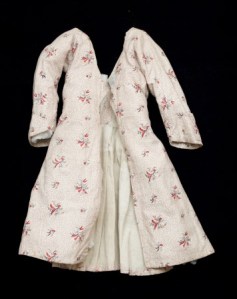
Place of origin? Holland.
Is this Dutch chintz? Snowshill calls this a caraco, 1780-1800. Is it? It is a jacket? Is it a gown that is short? Is the blue Dutch jacket blue chintz, or is the style Dutch?
What are the links between the 1747 Chardin, the woman running away in 1774 New York wearing Dutch chintz, and the ca. 1780 Snowshill garment? Maybe there aren’t any, but it seems like there is a thread of some kind, though it may be a twisted and evolving thread.
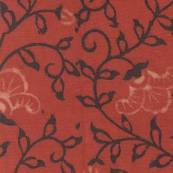
None of this answers or solves my very local working fashion dilemma, except that I feel more confident that a short, skirted garment made of patterned cotton is a reasonable garment to make. I chose some kalam kari fabric and we shall see what I can make.
But first, a muslin.

 Last night, I went to a meeting downtown for my boss, and chose to walk instead of drive. I took some blurry photos along the way as evening became night and the city became more and more like Busy Town. The skill level of local drivers is not too different from Richard Scarry’s drivers…and the hills and the way the houses stack up, and the way we recognize or know each other here reminds me of Scarry’s books.

 At the V&A,


 Kirsten Hammerstrom
You must be logged in to post a comment.