Impressionism, Fashion, and Modernity

The authentic matters, the real matters. It is different. Great art leaps from the surface of the paper and lives. Photographs may burn into the paper, but in that depth, they, too, live and glow.

Gallery 2: En Plein Air

The Met’s installation of Impressionism, Fashion, and Modernity is worth seeing for the coalescence of so many real things in such a [relatively] small space. The monumental paintings, especially Monet’s Luncheon on the Grass in Gallery 2, En Plein Air, need to be seen for real, in the actual matter, to really be appreciated. The brushstrokes, the color, the enormity, all need to be in front of you to be appreciated—to be experienced. It doesn’t work any other way. (Click here for better views of the paintings and costumes; photography was not permitted.)
Gallery 5: The Dictates of Style

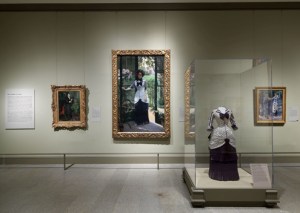
By way of an intimate contrast, consider the portrait of the gown and the gown itself in Gallery 5, The Dictates of Style. Here’s a lesson in the power of art, of paint, and an artist’s vision—and it’s Bartholomé, not Monet or some other genius, though a solid painter all the same.

Behold the cotton dress in conservator-approved lighting and yawn. Well designed, beautifully made, and real, right down to the stain on the upper bodice or collar, a pleat slightly misaligned at the hem. But yawn all the same. Now, the Bartholomé: bam! It’s not about the dress: it’s about light. This contrast is beyond a doubt one of the best lessons I have ever seen on the real nature of painting, and of impressionism: Light.

And if the authentic, the real is important, going to see the real thing is also important.

Here’s the Met’s catalog shot and record for a Degas drawing:

Degas
MMA, 29.100.185

And my iPad photo of the same drawing:

MMA, 29.100.185.

I’m not a wild fan of Degas; I’m more a Joseph Beuys/Caravaggio kind of art lover, but seen in person, this sketch was amazing.

This is an unfair comparison, and I had expected the catalog shot to be in color, because color is so important to this piece. In black and white, you miss the pop of the color contrast between the medium and the paper; you miss the bleed of the oil spot, more subtle in the black and white. You miss the way that image is fast and messy, the simmering tension between the artist and the sitter. Incredible as it seems, there is nothing like the real thing.

Punk is Dead and Buried at the Met

So, I went to New York yesterday and spent the day at the Met. It was a good, if epically long, trip. I saw everything my feet could bear. One show I even went through twice, Punk: Chaos to Couture. I was trying to “get” it.

The [In]famous Bathroom

Punk got a lot of hype in the NYer and the NYT but it was the least imaginative installation in the Museum. Oh, so what about the CBGB bathroom! If we had to walk through it to get to the gallery, now that would be something. Instead, the bathroom and the “store” are offset, afterthoughts to the main drag, which is a drag.

Hall of Classics. Worship these Gods of Fashion.

The galleries main attractions are mannequins lined up as if on a catwalk, above us, so couture, so not punk. Rainbow colored spike wigs do not make Gianni Versace punk. Or, honestly, Vivienne Westwood at this late juncture, let alone Zandra Rhodes. I found the mannequins trite, and the clothing uninspired and only vaguely reminiscent of what I remember of punk.

Naked Raygun at the Metro

As for the store: I never shopped at Clothes for Heroes, or even Trash & Vaudeville (I had to send my Dad for my Johnson’s motorcycle boots) but I did buy Trash & Vaudeville label and band t shirts at Wax Trax, in the back. I wore the zip minis and fishnet stockings (real stockings) and vintage from the AmVets. I made my own tshirts, with spray paint, markers, and my dad’s castoffs. And even in 1980 Chicago, even at The Exit or Lucky Number or the Cubby Bear, I knew I was ersatz. I knew I was not really punk.

Graffiti & Agitpror
Graffiti & Agitpror

The Met show shines with the Alexander McQueen dresses. They are by far the most interesting and best made pieces. They’re clearly genius. Everything else, save for Rei Kawakubo, is merely derivative.

The sections of the show, Hardware, Graffiti & Agitprop, and Destroy, make sense. Yes, safety pins, chains, spikes and belts (hardware) were typical. Slogans and hand-made clothes, also typical, as well as shredded (purposeful or not, often not, but worn), are fitting descriptors or sub-genres of the punk aesthetic. But the clothes displayed disappointed and dismayed, a grand “So what?” And why?

Maybe it’s Andy Warhol, Mr. Anti-Punk in my mind. But I think it is the great postmodernist movement, where by at this point anything once ironic or referential is now merely self-referential. Punk could have a sense of humor. With few exceptions (Kawabuko, mostly) the clothes in this show lack the intelligence for humor, let alone politics.

Am I glad I went? Yes, absolutely. Because now I know there are bigger risks to take installing shows, and I’m ready to think about what they might be. I’d put a couple of those Kawabuko black-sleeve dresses, or McQueen’s black “bubble-wrap” gowns on display with over in Impressionism, Fashion and Modernity, and see what happens. That’s when chaos and couture would really meet.

Holy time piece, Batman!

From Sotheby's Preview magazine
From Sotheby’s Preview magazine

We had some fun with this at work on Thursday. The slightly awful truth is that these catalogs and publications for the super-rich and fabulously fat-walleted arrive with regularity at the historical-cultural complexes that comprise the workplaces of under-paid and over-educated aesthetes, fueling their impotent rage about the eroding American dream. We had several performances of the Reading of the Watch Ad, appreciating the high craft and art of the copy and design.

I’m a Mad Men addict for all the wrong reasons (management tips! vicarious vices!) but long-time fan of advertising, copy writing, and graphic design. As a child, I launched, wrote and self-published F.U.S.S., the members’ newsletter of the Felix Unger Sympatico Society, for which my mother served as managing editor and my father the sole subscriber. This was really direct marketing, or taunting, as the case may be.

But we made a kind of cult of design in my household, so I knew as a kid what Y&R stood for, or DMBB. Mad Men sucked me right in, so when this turned up, I was ready.

This ad is the inside front cover and first page of the Sotheby’s Preview magazine which features Jeff Koons’ vacuum cleaner sculpture for $15M or so. This is serious walking around money, and if you are going to recline in your Manhattan penthouse (hope it’s pre-war) admiring the Koons while your maid vacuums before a party, this is the watch to time her with.

Copy Writer's dream, or nightmare?

The copy combines naughtiness with auction catalog sentence structure, like a sexed-up museum label.

High feminine complication, this flying tourbillon decorated with the motif of the camellia, a tribute to Mademoiselle Chanel’s favorite flower, beats away discreetly and almost secretly at the heart of the Première watch.

That last clause screams affair. When I read, all I can think of is Roger Sterling in a hotel room with his mistress. A colleague said this kind of watch was only given to rapper’s girlfriends—the serious ones—but at $286,814 (last year’s price), perhaps it’s a “don’t divorce me and take half my empire” celebrity wife present. Tisch and the Winklevoss twins were in the event pictures of this Preview, and this watch does scream nouveau riche, not Astor money (that was a fur trade fortune, originally).

Where it gets really fun, I think, is when the text takes on the style of an auction catalog lot description:

Having no upper bridge, the carriage decorated with a camellia appears to be rotating in a weightless state. Limited edition of 20 numbered pieces. 18-carat white gold, set with 228 diamonds (~7.7 carats).

“Having no upper bridge” is a technical description that reminds me of the dentally challenged with poor memories and no mirrors. Note that camellia is repeated here—perhaps to help you recognize the motif, because I’m not sure it reads very clearly.

There it is, the quarter-of-a-million-dollar watch, advertised in a magazine promoting artwork for tens of millions of dollars, pieces that a colleague noted would be displayed in the penthouse for a party and then put into storage as an investment until the art advisor said it was time to sell for a profit. Art as commodity, produced like commodities now, from Warhol to Koons to Hirst.

Townspeople, 1763

I have this friend, DC: I can call him a friend now, but when we worked together, he was more of a nemesis, mostly because of his OCD tendencies, intense perfectionism, and complete inability to meet deadlines. It was a classic example of Mr Failure-to-Plan working poorly with Miss Contingency-Plan-Required. We literally knocked heads installing an exhibition, and I can still feel the hollow ringing pain. But it’s been six years, and with that distance, friendship is possible.

I'm only in this for the cannon.
I’m only in this for the artillery.

But he’s got this idea.  In August 1763, Boston celebrated the Treaty of Peace ending the Seven Years War (known here as the French and Indian War). There are fantastic descriptions of the celebrations and Thanksgiving Proclamations issued by the colonies, and you can read more about it in the Boston Gazette 8-15-1763.

My friend’s idea is to re-create this celebration, complete with cannons and volleys, and to that end he has enlisted local re-enactors, including a unit he didn’t realize I was part of when he asked me if I had a 1763 impression. True to form, we are asking questions he’s not yet prepared to answer… including, what sort of people do you want these townspeople to be? With the calendar as packed as it is, stitching up militia and my own clothes needs to start now, what with the regular regimental requirements due in June and again in August, and oh yes, actually maintaining life and a tolerable standard of cleanliness in the home.  (DC is moving to Europe in the Fall. After this event, when he leaves North America, I expect we’ll be better friends.)

Jean-Etienne Liotard (1702-1789) Portrait of a Woman called Lady Fawkener circa 1760

The reason I want an answer now is simple: I want a hat. After steaming and cramming The Hat onto Mr S’s head, I deeply desire my own Hat. I don’t covet much, really, and a hand-made piece of headwear made by someone you know and respect seems a very innocent thing to covet, even if coveting is wrong.  But to give the Favorite Hatmaker time to create a hat like the one at left, and me time to trim same, I need to know rather soon if I should be a lady or a cherry-seller.

I started a Pinterest board (when all else fails, collect images) of 1763 ideas. It’s a pretty simple thing, really, gown with robings, cap, blah blah petticoats blah blah, but: isn’t it all about the fabric? And the trims? And, lest we forget, the coveted hat!

Paul Sandby, London Cries: Black Heart cherries... ca. 1759. YCBA,  B1975.3.206
Paul Sandby, London Cries: Black Heart cherries… ca. 1759. YCBA, B1975.3.206

The Sandby cherry seller can probably be replicated with an open gown with robings made from B&T’s Virginia cloth; the question is merely of color, drape, and patience waiting for swatches. (Wish Wm Booth still had that yellow and blue striped linen, but my blue and white linsey-substitute would have to do.) This is simple enough, really; I have a cap like the cherry-seller’s cut out, somewhere, or linen to make one, anyway.

Paul Sandby, London Cries: The Fishmonger (detail), 1759. YCBA B1975.3.210
Paul Sandby, London Cries: The Fishmonger (detail), ca. 1759. YCBA B1975.3.210

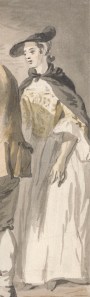
Maybe the compromise is this, yellow, with a black hat. I suspect this hat is straw, but perhaps I could combine the hat above with this idea. The black hat and black cape are very appealing. The answer, of course, is all in research: find out about the men in Thomas Marshall’s Boston Militia, and from there I can find out about, or make intelligent surmises, about the women. But that’s irritating, as military/militia-based history often is–to be dependent on the men. Perhaps the less annoying route lies through JSTOR…. and following up on the memory of a Boston widow-businesswoman.

In the end, I’m realistic enough to know that I shall be lucky to get a new hat trimmed at all, given all the menswear there is to complete between now and August. Even my plans for chitzy sewing this week turned late yesterday into, “Oh, but I thought you liked the Adjutant. We’re going up Saturday for fitting.” I suppose that means they think I’ll finish something enough for fitting.