
Sewing for Zombies

Death by Fitting

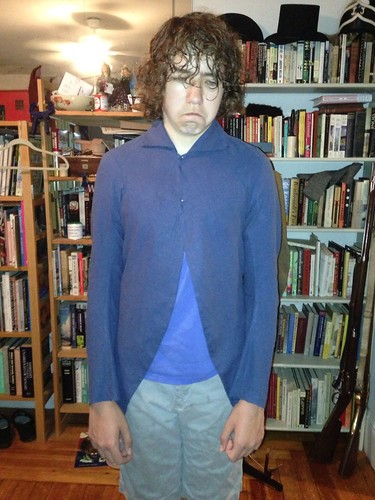
He doesn’t always look this horrible, but when the Young Mr sets out to look like death, he does it very well. Dressing 18th Century style comes at the price of fittings, and while we like to cut a fine enough figure at an event, we want no part whatsoever of the process. Even the promise of playing with a dog won’t get us to a fitting. And he dearly wants a dog…so you know fittings are a trial.
Cutting Out on Sunday

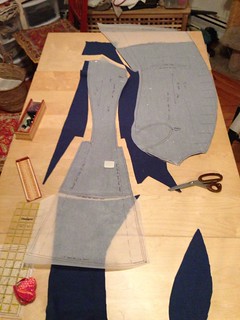
The pattern is by Henry Cooke, based on both a Rhode Island original in a private collection and a jacket in the collection of the Connecticut Historical Society. It is solidly 1770s-1780s, unlined, and both originals made up in brown linen. (From the pattern notes and what I know of the CHS jacket, accession number 1981.110.0; their catalog links are unstable, search for 1981.110.0.)

It goes together well; I started without directions, but as I am more idiot than savant, I got myself confused. I did have to alter the sleeve for the Young Mr, as he has long, thin arms. The rest of the pattern seemed to fit him pretty well, all in all, but a few untoward things happened between measuring, mock-up, basting and fitting. Still, it can be worn, with improvements made next week after he wears it in Cambridge this Sunday. 

More Banyan Business

Prince of Wales' banyan, ca. 1780. Royal Pavilion & Museums, Brighton. ID CT002728
Prince of Wales’ banyan, ca. 1780. Royal Pavilion & Museums, Brighton. ID CT002728

Soooo, what about that banyan?

Cotton chintz printed in red, brown and purple with blue pencil. Batting seems to be cotton by the way it has bunched in the diamonds, but I expected wool. If it is wool, it is super fine lambs’ wool. Since it was for the Prince of Wales, I think that’s possible.

The mariner’s cuffs are pieced onto the end of the sleeves, reducing bulk (no double layer). The buttons at the cuffs are round, domed, self-covered buttons.

The double breasted closure is made with multi-colored silk braid frogs and silk dome-shaped buttons.

The collar is quilted, too.

The center back seam does not bother to match the pattern; it’s just sewn up the center.

Triangular piecing at the side seams helps give this flair in the skirts. You can see this in the photo at left.

The sleeves are set in, two-piece sleeves typical of menswear.

That’s everything I can remember from my visit on Saturday with Sew 18th Century. I really do have to go back with a notebook and a stool!

One Hot Banyan

Prince of Wales' banyan, ca. 1780. Royal Pavilion & Museums, Brighton. ID CT002728
Prince of Wales’ banyan, ca. 1780. Royal Pavilion & Museums, Brighton. ID CT002728

Alert! This item is currently on display at the RISD Museum of Art in Providence, through August 18, 2013. I have been to see it twice now.

As much as I am itching to get this on a table and investigate it, I am limited to craning my neck and squatting in front of the case. Awesomeness in cotton, this banyan has a five-button mariner’s cuff with a double arc like a broken pediment on a chest-on-chest. It would be a crazy thing for a Continental private to come strolling out of a tent in, not to mention impossible to make before the next camping excursion, but holy cats! that’s one fine banyan.

The RISD Museum is free on Sundays. You, too, can entertain the guards by craning your neck–photography is not allowed. Next visit: sketchbook.

There are a lot of other wonderful things to see, too–silk jersey breeches I expect to see on a colleague at some point, an indigo silk frock coat, the greatest great coat ever, and Fred Astaire’s tails, as well as a small section that I think does everything PUNK wanted but failed to do.

A Favorite Gown, at Last


First wearing at the Martin House in Swansea, MA

Most of what I’ve made I’ve hated. It hasn’t been perfect enough. This is pretty much how it works when you are learning something new: your eyes outrun your abilities, and you have to keep working away to build the skills to match your dreams. I’m still building skills, but I have at least managed to get to a place where I can just about trust my ability to make something I can stand to wear.

I’ve also learned that you are likely, in the process of making a gown or what-have-you, to hate the garment in question. My friend hated her Green Gown of Doom, but when it was done and on she liked it. Midway through the Cherry Seller Robe, I hated it, thought it a failure, and wanted to quit.

Persevere: the moment when you are most frustrated is often the moment right before you figure out the thing you have been trying to learn.

Paul Sandby, London Cries: Black Heart cherries... ca. 1759. YCBA,  B1975.3.206
Paul Sandby, London Cries: Black Heart cherries… ca. 1759. YCBA, B1975.3.206

The story behind the Cherry Seller Robe is that I plan to wear it in Boston on August 10, so it is very old fashioned. Based on Paul Sandby’s Black Heart Cherries watercolor, it is open with robings, and made of Burnley & Trowbridge’s wool-cotton “Virginia cloth.” The gown fits in a “v” on the front, and to my eye, has a 1750s look. (I have not finished the cuffs, attached lacing strips, or finished the stomacher; once lacing and stomacher are done, it will fit more like How Now Brown Gown.)

It was windy. Catastrophic hat failure resulted.

For August, I’ll make a white linen petticoat and a tan “Virginia cloth” petticoat, a blue linen apron and, I hope, a new lappet cap. (I had one cut out around here somewhere…) The yellow and blue or yellow-blue-white striped petticoat may have to wait; I have a lead on some in a stash, but no sightings yet.  Making new, lighter-weight petticoats is in anticipation of August weather in downtown Boston. I’m still debating about the kerchief, which seems to be a solid color with a striped border; I may just wear the one I have.

Yesterday was hot and windy, with a chance of hat failure. All in all, a fine day to sew and wear wool.