HSF# 17 Robes & Robings

I started on the HSF#15 Color Challlenge: White, but haven’t finished the white petticoat yet. It’s a bit short, and pieced in the back, but having seen Sew18thCentury’s  curtain along petticoat online, I wanted a bordered petticoat. (There are extant examples in museum collections, and one in Fitting and Proper, if you’re keeping score.) Now that I’ve seen the petticoat in person, I will definitely stick it out for a border….all in good time.
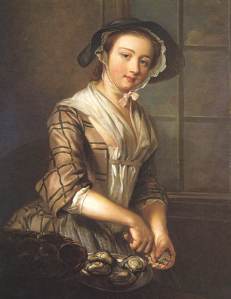
Native Meltons: she's out there in plain and colored lithographs
Native Meltons: she’s out there in plain and colored lithographs

I did originally think that I might get this gown completed for HSF # 15, but I did not. I came close, became disheartened, and stopped work on it for a time. Not only did I think I could not adequately document the fabric, I worried about style, fit, and fabrication. At some point, though, I rallied, and finished the gown. Yes, it looks a lot like Emily’s, because it is based on the same print.

I know, you’re here for The Facts.

The Challenge:  HSF #17: Robes & Robings

Finished! Another garment in the “Am I Blue” Ocean State Line

Fabric:
Indigo Cross Bar Light-Weight Check Irish Linen from Burnley & Trowbridge.
I collected images of checks and “plaids” on a Pinterest board. Remember that plaid doesn’t mean the same thing in the 18th century, but I used the term to help people know what the board included.

Pattern:
My own, based on a fitted lining and draped to the dummy, tried on and tweaked. You can see some construction progress here. Yes, that’s a center-finding ruler. Yes, it has extra pleats. Call it bling for the linen-wearing.

Matching crossbars is crazy, but fun.

Year:
Let’s call it 1760. It’s an open robe with robings and cuffs suitable for 1765, but I’m old enough to keep wearing that style. Actually, the double-lapped robings (which I really like the look of) are earlier– see this Pinterest board–but I like the way the fold creates a decorative element in linen and wool. The probable 1750s date for the double lapped robing caused another round of heartache in the documentation land. Oh, well. Carrying on wearing the older style…

Notions:
Does thread count? That’s all this takes.
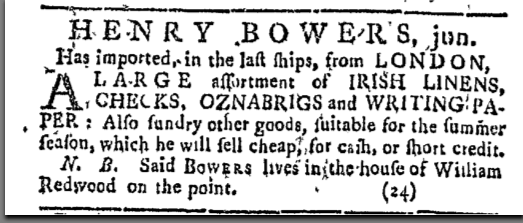
Bowers_check
Newport Mercury, 7/11/1774
Geyer_checks
Boston Post Boy, 3/11/1771

How historically accurate is it?
Well…In the right circles, one could argue that for some time. Is that not the circle one wishes to be in? Consider this, then: The gown is hand-sewn using period techniques as much as I can muster. It is based on pictorial examples from the 1750s through the 1760s. I have found newspaper advertisements for “CHECKS” in Newport (Newport Mercury, July 11, 1774) and “checks of all wedths” in Boston (Boston post Boy, March 11, 1771). Wedths means of fabric in all likelihood, not widths of the checks, so while one can find evidence of people wearing what we’d call plaid, mostly silk but the oyster seller is likely linen or cotton…we don’t know exactly what  every “checks of all wedths” fabric looked like.  I’ll go with 75% accurate and 25% conjecture and choose my wearing venue with care. Yes, I can over-think and rationalize anything.

Hours to complete:

I did this many, many times. It’s like being a carpenter with fabric and pins.

Actual sewing? 16 to 18 hours, I think; it’s a lot of hemming. The body of the gown, the draping and the lining were constructed in about a day while the guys were out doing musket-related things. The agonizing and over-thinking consumed more time. Documentation took, on the whole, perhaps 2 or 3 hours of museum collections and newspaper searching.

First worn: 
Not yet! I’m not sure when I will, now that the weather has turned. I meant to have this done for Sturbridge but despaired of the design and fabric. It’ll be wool for Saratoga, so who knows? I’d like a photo, though.

Total cost: 
Mental agony? Priceless.
Fabric? $60.

Poetry in Papers

From the Newport Herald, 6/26/1788

It’s quite the poem, isn’t it? In October, I’ll be part of an 1800 event at work, and I will be portraying a housemaid, if not quite the housekeeper (we are still trying to sort out the domestic staff; what we can document is far too small a staff for the size of the house).

One of the things I will need is a name, and I thought perhaps I should check my instinct that “Kitty” was an acceptable name for women in the 18th century, and not just for sloops. So to the newspapers I turned, and among listings of the graduates of Philadelphia Seminaries for Girls, and ships cleared through the custom house, I found this poem. It reminded me of Mr S, and I recommend you read it aloud.

The early nineteenth-century maid. By William Brocas (1762-1837), pencil drawing c.1800 (National Library of Ireland)

So, a name: we’ll go with Kitty for now, and I can imagine building a complicated back story that pulls together all of the things I do, from running away outside Philadelphia to encountering soldiers and following them, to ending up a maid in a house in Providence. Except that what I believe about a life like that is this: It would be highly improbable, and I would look wa-a-a-y older than my actual years.

Instead of getting carried away with extreme historical fictions, let’s look at what we can know.

For one thing: clothing. Do you find yourself concerned, ever, that you focus so much upon your historic clothing? Well, you can stop. After a long and excellent conversation this week, think of this: the historical clothing you wear to events of any kind requires a lot of lead time. So you do have to think it through carefully, because every minute will count. It is also a visitor’s first impression of you, from a distance and up close. Getting it right matters, and since that takes so much time, you have to think a lot before you commit scissors to cloth. It does not necessarily mean that you’re a shallow, clothes-obsessed freak. There’s no 18th century mall to go hang out in and watch the leather-breeches boys  posing while they smoke clay pipes.

Benjamin West, Characters in the Streets of London, 1799, YCBA, Paul Mellon Collection, B1977.14.6314

I’ve just about convinced myself that the silhouette we’ve been wearing at the house and formerly at the farm is acceptable. I went looking through the turn-of-the century images I have on Pinterest and I think that a maid would have worn the fashionable silhouette. Another question is age (sigh); all the women in the Benjamin West are younger than I am.

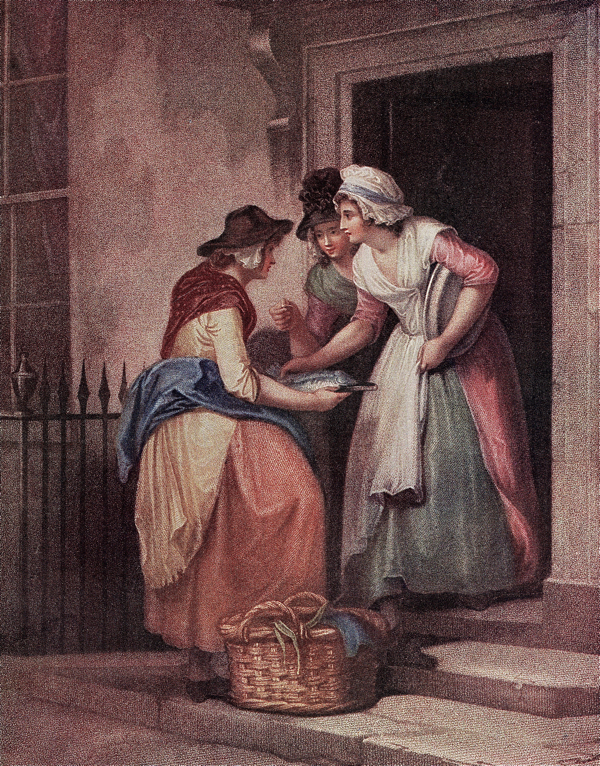
Francis Wheatley, Cries of London. New Mackerel, New Mackerel.

This print from a Wheatley (1792-1795) is useful, though he is such a genre painter and idealizes so much that I use him with caution. (Think of how much grittier–and funny–Sandby is: I trust Sandby more.) But, what can I learn from this? One thing is that I often think and dress more like the people in the street than the people in the houses. This will happen when you spend a lot of time outdoors, with soldiers: you are one of the people in the street. It can be a bit of a trap, historically speaking, and it’s good to challenge yourself to think about another class from time to time.

Back to the doorstep: what I learn here is that I need a white apron that I haven’t spilled on, a white kerchief, and a fancier cap. That cap will tie under my chin, because that’s the cap I see in Providence most often, and that’s the cap that will stay on. I’m not sure if these are maids–I think they are– but they’re women in a brownstone city house. And I can see from the clothes around me that they’ve been made for a woman who sells milk in the street, or works on a farm, or cooks over a fire. They’re not what the richest man in Providence would want his maid to wear answering the door.

You’ll have noticed, too, the different waistlines. The drawing from the National Library of Ireland and the Benjamin West have higher waistlines than the women in the Wheatley. Some of this will depend upon the available corsetry: I have stays that will work for the higher waistline, and I have stays for 1770.  I have a not-quite-right 1790s pair that need revision, but that’s not likely to happen: I have a brown and sea-green coat to make.

Documenting Mr S

The guys are usually easy: they wear what the sergeant tells ’em to wear, and they like it, because that’s what soldiers do.

Mr S in Cambridge

Sergeant’s not a sergeant in quite the same way in 1774-1775: he’s a militia sergeant, and while we can still get up to tricks that get us yelled at, the clothing we wear is more personal. Mr S’s clothes seemed, at first, to be completely undocumentable.

Really? Yes, I have been known to have some anxiety issues over small matters. So I calmed down, re-read the standards, and looked again.

The shirt is checked linen, see here for details. The stockings, which will be replaced by hand-knit blue stockings, are also documented to Rhode Island.  But wait! That’s 1777, can it count for 1775? How long do stockings last, anyway?

I’ll own up to having been described as “literal and precise,” and I’m taking that comment to heart. Reader: literal is where one gets into trouble when one is precise. Literal interpretations can lead you, almost hubristically, into creating replicas of runaway ads  or extant garments that don’t reflect who you are, or what time you are portraying, not really.

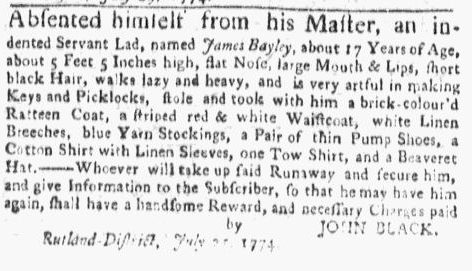
bluestockings_whitebreeches
Boston Post Boy, 7/25/1774

But not to worry, I dug up the blue stockings. This is from the Boston Post Boy, July 25, 1774. “White Linen Breeches, blue yarn stockings.” This is not too bad: Mr S has got his basic extremities covered now. It’s hard not to be distracted by the Cotton Shirt with Linen Sleeves, which reminds me of women’s shifts with finer sleeves, or sleeves to pin on.

browncamblet Waistcoat 7-4-1772 providence
Providence Gazette, 7/4/1772.

Keeping focused, let’s get Mr S more fully dressed, more proper, and warmer, since this is late August. You can’t see his waistcoat under the green jacket, but here you can. I know this broadcloth fabric, and its color, are from the acceptable palette for the last quarter of the 18th century, but can I find one in Providence or Massachusetts? Just about. The waistcoat described in this ad is camblet. There’s no goat or camel in Mr S’s camel-colored waistcoat, but I think we’ll call it found and be grateful that Mr S has not taken any action despite the numerous photos I have posted of him in various “poofy shirts” and “funny outfits,” as some of my friends describe them.

What’s left? There’s John Appleton’s ad in the Essex Gazette of May 17, 1774 for “blue, green and cloth colored bandannoes,” which pretty much takes care of the neck cloth; we’ve a brownish one, and a blue one; the Young Mr likes the orangey one, but I think we have those documented.

1774_greenJacket
Essex Gazette, 12/6/1774
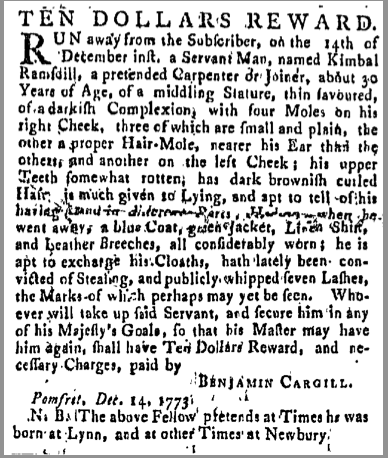
1774_Prov_greenJacket
Providence Gazette, 1/29/1774

The green jacket, that’s what’s left. In the Essex Gazette of December 6, 1774, we find a “green jacket, light breeches, and yard Stockings,” much like what Mr S is wearing.  Nice! Multiple sources of documentation for items are always welcome chez Calash.

And, knowing that, you will not be surprised that I have found another jacket, closer to home. In the Providence Gazette of January 29, 1774, the man with the “proper hair mole” runs away in a green jacket. He’s also got leather breeches, and they’re on my wish list, though other things must come first, given their expense–things like tires, and allergy drops for the Young Mr.

Authenticity: Sources II, or, Stripes!

In any decade, I love stripes.

Stripes. I love them, really, I do. Gowns, petticoats, cats. Why do I want to use them so much?

For the guys, because I can document what they’re wearing, at least based on their current state of residence and their current nominal “home” unit with the BAR.

Here’s why:

1777 Oct 22
An inventory of Searjeant George Babcock’s
Wearing Apparil who was Killed at fort Mercer
Octor 22d 1777 Belonging to Capt Thos Arnold’s Comp’y in Colo Green’s Regemt

Two Check Linen Shirts
one Pair of Striped Linen overalls
one Striped Cotton & linen Jacket without Sleeves
one flannel Jacket without Sleeves
one home spun Woolen Jacket without sleeves
one Linen & Worsted cotee
one Kersey outside Jacket Lined with flannel
one beaver Hat & one Pair of shoes
one Pair of blue worsted stockings
one pair of thread ditto
one pair of blue yarn Stockings
one Linnen Handkerchief
one knapsack

(Clothing inventory, Capt Thos. Arnold, Col. Christopher Greene, Rhode Island Regiment
RIHS MSS 673 SG 2, S1, SSA Box 1 Folder 13)

From RIHS MSS 72, Preserved Pearce papers,  Tailor's and Tavern account books, 1778-1781.
From RIHS MSS 72, Preserved Pearce papers, Tailor’s and Tavern account books, 1778-1781.

This inventory has formed the basis for many of the clothing choices I’ve made for Mr S and the Young Mr from their check linen shirts to their blue stockings. I was criticized for the size of the checks of their linen shirts (too small! I heard), but feel vindicated time and again by the extant garments I’ve found (aprons, mostly) in this period. The checks are small.

The best piece of evidence I found was serendipitous: whilst going through tailor’s books Thursday, looking for stays, I found a scrap of blue and white checked linen used as a binding. The biggest lesson from that scrap is that I need a deeper, more indigo-rich blue and white to begin with.

The “Striped Linen overalls” in the inventory are definitely on the list of things I’d love to make, along with the “Striped Cotton & linen Jacket without Sleeves.”

One of my favorite garments of all time. Boy's frock, ca. 1760-1770. RIHS 1959.6.1
One of my favorite garments of all time. Boy’s frock, ca. 1760-1770. RIHS 1959.6.1

There are extant Rhode Island garments from made of blue striped linen, documented to the period we interpret, and another one, recently acquired (coming soon to a database near you!) from which a pattern has been taken.

After a while, though, blue stockings and checked linen shirts seem…ordinary. Common. You might start to wonder if they’re just another re-enactorism, they’re so ubiquitous.

It’s worth checking again to see that these are, in fact, common garments, probably as prevalent then as they are now.