Any old Shirts?

DSC_0041
The photos people have of the Millinery Conference at Williamsburg– well, they’re a little envy-inducing. All the silks gowns on such a beautiful site are a little overwhelming if you like historic costumes, but if I was all about silk gowns it might be harder to do what I am doing.

I did discover a fool-proof way to unnerve the teenager in the living history household. If you get dressed in your 18th-century clothing early enough on a Sunday morning, the child will ask, “Um, Mom? Are you just fitting, or do we have an event?” You get one glorious moment to decide whether or not to torture the child before he figures out that even you are not crazy enough to go to an event in March without stockings.

Bridget’s gown is done, but for the hem, which is turned up and about a quarter sewn. I tried it on yesterday to make sure it fit. I threw most caution to the wind and made up the new Golden Scissors English Gown pattern without making  a muslin because I’d checked my own self-fitted pattern pieces to the English Gown pieces and found them nearly identical. Anything likely to need work– shoulder straps– I knew could be done in the lining and not matter terrifically.

Why, you ask, did I bother with a new pattern? In part because my own has migrated (my backs have been trending too wide of late) and because I needed a solid, step-by-step guide to more correct assembly. The sleeve pleats still annoy me, mostly because they get done on a dress form and not on me, but they allow movement and that really counts. DSC_0047
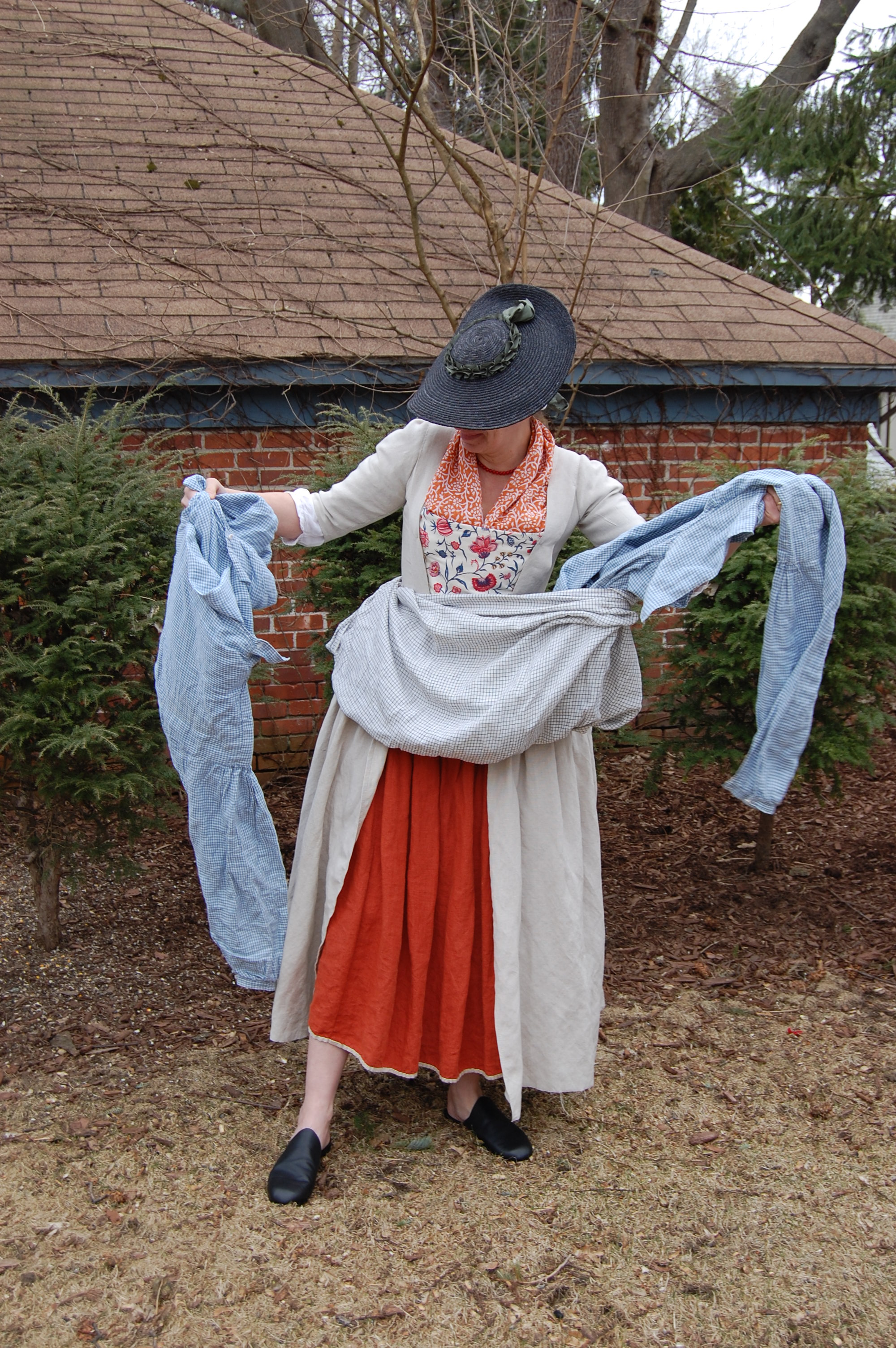
The stomacher front style is a compromise: I want to be able to wear this at events earlier than 1782, so I’m working on the assumption that Bridget didn’t migrate to the more fashionable center-front closing style in the 1780s because she couldn’t.

The accessories are chosen because they were affordable ways to upgrade appearance: it takes hardly any chintz for a stomacher, and a handkerchief is bright but small. The hat is more common than a bonnet among working women, and the mules were chosen because they appear in an engraving of a crippled soldier and his family. All Sandby’s women wear heeled and buckled shoes in styles not to be found ready-made in my size, so  mules are my compromise.

I still think Bridget looks too clean and too pretty, but until I find fabric I like for a bedgown, this will have to do. The details, should you care for them:

Hat, Burnley and Trowbridge, lined with a Wm Booth remnant, trimmed with B&T ribbon. My hair is out up with straight pins from Dobyns & Martin, and under the hat in a lappet cap with the strings tied on top of my head.

The coral necklace is from In the Long Run, I’ll replace the grey poly ribbon with black silk ribbon once it’s in from Wm Booth.

The neckerchief is from B&T, again, and selected because the pattern was similar to the one worn by the young woman in the Domestick Employment: Washing print.

DSC_0051The gown fabric is from the second floor discount loft at the Lorraine mill store in Pawtucket. It’s 100% cotton, yes, it really does flame, and I’ll just have to be careful. (The women who cook in cotton at OSV are probably vastly more graceful than I, and do not fall into things.) It’s a light brown and white tiny check weave, and looks a great deal like a homespun gingham. I chose it because it tends to wrinkle badly and should show the dirt well: in short, I chose it because I don’t expect it to wear particularly well.

The petticoat is from the last of some ‘madder’ linen Burnley & Trowbridge had a few years ago, and the mules are from them; I think the apron linen was, too, but I can’t remember.

Those shirts are blue and white check from Wm Booth, and I have no idea how they got into my apron. Stop asking, or I’ll get my stick.

Once Upon A Time…

Betsy Ross and friends: A Child Guidance Educational Activity

This is the third set of these paper dolls (Educational Activity) I have owned. The very first set was given to me by my mother, Lo, at the Dawn of Time, in the Dark Ages known as the 1970s.

I wore them out.

A new set was purchased, probably once again at Marshall Field’s, possibly in the book department. They now reside in an attic outside Philadelphia (how appropriate).

From this Educational Activity flowed many more home-designed outfits and home-made paper dolls of historical and literary origins, which have led to this moment, when I make myself and my family into historical characters, make us outfits, and set us in motion with friends and colleagues in scenes of historical play-acting, by which I mean Educational Activity.

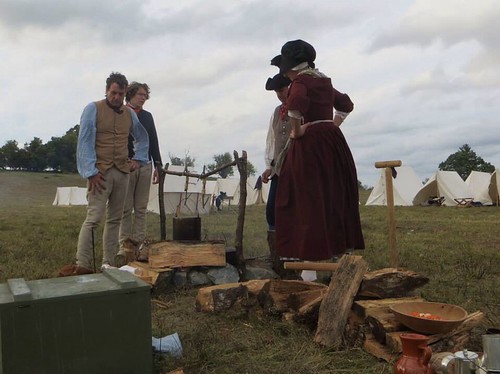
Cooking at Saratoga: very Educational. Photo courtesy D Molly Ross.

I like to think that the clothing we wear is more correct than the “Authentic Costumes” advertised on Betsy Ross’s box, but there is always more to learn. I am in no way denigrating Betsy Ross, or paper dolls, or suggesting that I see my family, friends and colleagues as paper dolls. But I do know that as long as I have been playing, I’ve been playing history and reading history, and drawing history, and using books and paintings and yes, even paper dolls, to figure out the world present and past.

If January Jones played Betsy Ross...
If January Jones played Betsy Ross…

Even though I always thought I wanted Betsy’s birthday cake gown, the one I really liked was the work gown. The “construction” of her garments confused me even as child: how the heck does that kerchief work? And the bodice front? Never mind, have a slice of dress, I mean cake. (Field’s had a cafeteria that served slices of pink-iced layer cake that I somehow conflated with the paper dolls, thanks to the shopping trips my mother and I made.)

Memory and fact, impression and citation: when we reenact the past as an Educational Activity, we should remember that some will walk away enlightened, and others will walk away thinking about birthday cake. Our job, beyond getting the facts right, is to engage our visitors, to interest them, and to excite their imaginations. What they do from there is up to them, but we will know that we have done our best to present them with a scene that can take them one step closer to being there.

The Society of Friends

Courtesy Newport Historical Society

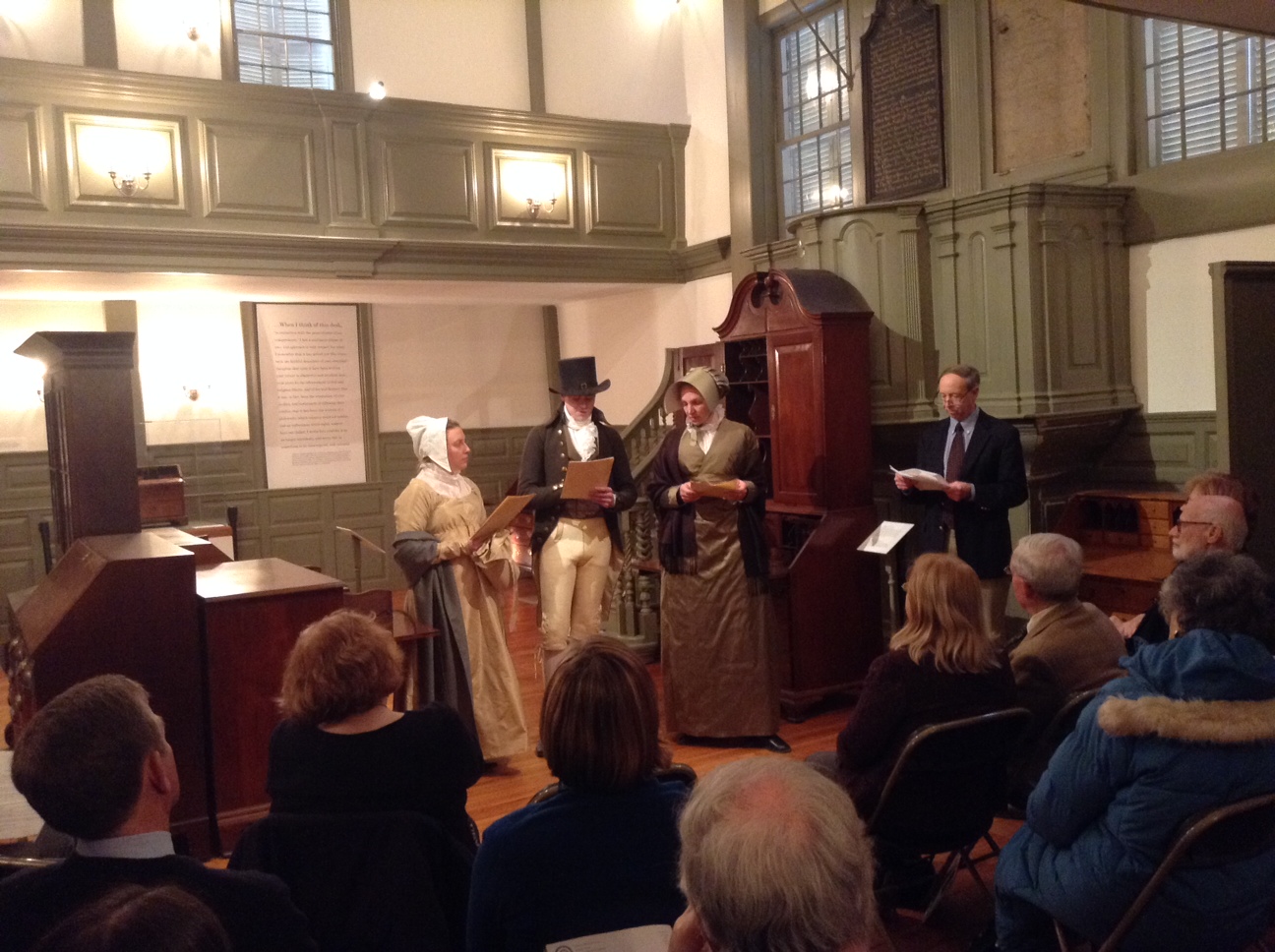
Last Friday, I joined my friends in Newport for a program at the Newport Historical Society.

We stood in the Seventh Day Baptist Meeting House behind the NHS’s headquarters building and read excerpts of letters from the Williams Collection.

This is a simple, elegant concept for a program, and works incredibly well if the correspondence have the gift for expression that these people did. Even quotidian details–the price someone wants to get for their dining set, the likelihood of moving one’s mother, who must be carried ‘as carefully as a box of China’–take on humor when read aloud.

Courtesy Newport Historical Society

The best letter might well have been the last one, read by Sew 18th  Century. The latest of the selection, the writer described a visit to Newport around 1844, arriving at the dock to the bustle of wagons, walking streets and finding a barber who knew the old fish hawker, the enormous jaw bone of a whale on a street corner, and even lifting the latch to walk inside the Seventh Day Baptist Meeting House where we were standing.

It was a lovely way to end the program, resonant with details the audience could connect with.

My dress turned out all right, and I managed to get it on and keep it on, which seemed a small miracle requiring only two pins.

When I tried it on at home, the front panel didn’t wrinkle, so I think I pulled it too tightly around me on Friday. I kept my bonnet on because I didn’t have time to make a new cap, so made do with the housekeeper’s cap from last fall. The chemisette was made by Cassidy, and saved me from the migratory ‘charms’ of a kerchief. The ‘shawl’ was a gift  Christmas from my mother, who rightly saw it as a scarf, but those who wish to keep warm do not quibble when they cannot find exactly what they want. Before I wear the dress again, I have to attend to interior seams of the skirt and scoot the cuffs down to lengthen the sleeves. Four yards of 48-inch wide silk was just enough, but needs a little tweaking when you’re a tall as I am.

Criss Cross

Dolly Eyland, by Alexander Keith, 1808. (c) The New Art Gallery Walsall; Supplied by The Public Catalogue Foundation

I like Dolly. The colors, the textures, the style of her gown, shawl and cap all please me. She’s rocking some serious class for a woman headed towards a certain age. And she’s wearing a cross-front gown, which is what I settled on for my Quaker costume. 

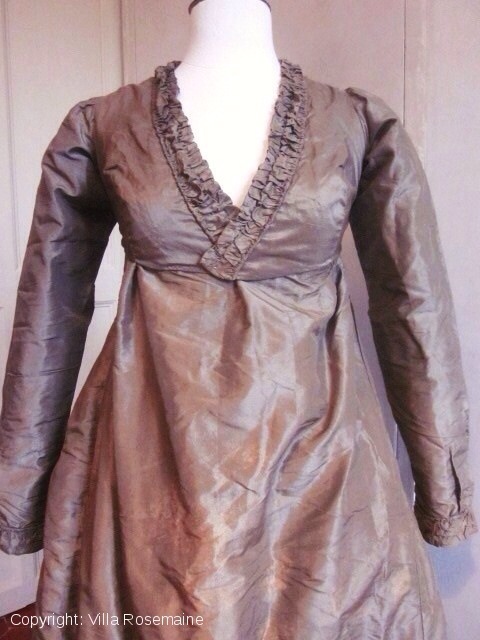
Taffeta dress, ca.1800-1810, Originally found on Villa Rosemaine site, where it does not appear now.

The trouble with making a gown based on an artistic sketch in a book is that you don’t have the most complete sense of what that garment looks like, or how it goes together.

Not to worry, I went ahead anyway, because this is as close to Everest as I will ever get.

But I wanted comparable garments to help guide me. Ages ago I found the gown at left on a French costume site. That’s helpful, in that it explains the trickiness of assembling and wearing this style of garment. Three pieces coming together in the front may be one piece too many. 

In making up my pattern, I used the pattern for the Spencer as a starting place because I knew that the set of the sleeves and arm scye were what I wanted. No reason to re-invent that process!

That left me with the luxury of concentrating on the neckline.

That took a few goes with the tracing paper and muslin:  I did lose count after a while. There may have been tears, there definitely was swearing. Mr S at one point made jokes about this process appearing on the Discovery Channel’s “How it’s Made” as “the Quaker dress.” He’s really very patient, and I do understand the selective deafness he’s had to develop as a defense against the dark arts of sewing historic clothing.

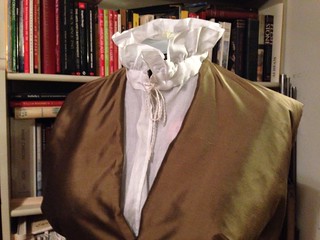
Thank you, Cassidy, for the chemisette!

Eventually, I had a decent lining and even some silk bodice fronts. I fiddled with the fronts, and settled on gathers instead of pleats, but couldn’t quite figure out where the casing went. Some days I can process drawings into objects, some days I can’t. I’d just about reached the point of cutting it all up into the gown I always make when I discovered that the excellent women of the 19th US had patterned the gown from the drawing, too. (If you don’t already use this site, I highly recommend it. Excellent work.) Those pattern pieces look like my pattern pieces, so I decided it was worth carrying on with what I have.