It’s so nice to have enabling friends. If it’s not one tipping me off to a sale on fabric at Williamsburg (over now, keep calm) it’s another tipping me off to costume auctions.
My most recent tip-off came from Mr Cooke, about the Whitaker auction coming up April 25 and 26 in New Hope, PA. There are some very nice things from the collections of the Met and LACMA coming up in that sale. It’s hard to understand deaccessions from the outside, so I won’t comment on that part of the sales.
Whitaker’s got copyright notices on their images, so I won’t post them here, but I can assure you, the visit will be worth your while. But my tip to you is this: forget those estimates– from what I’ve seen lately, they’re all too low by a factor of 10.
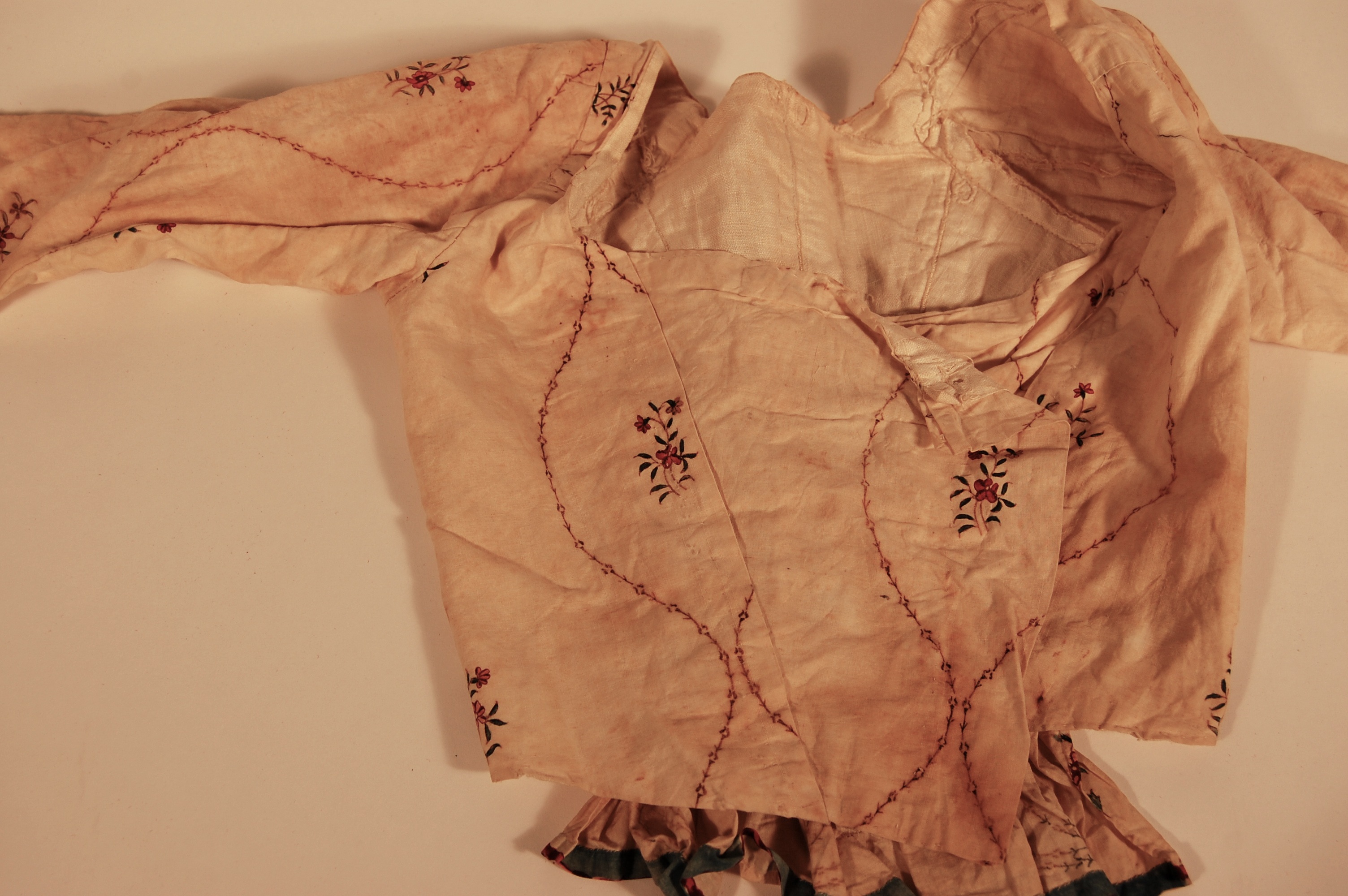
Bodice, painted Indian cotton, 1780-1795 RIHS 1990.36.27
I’ve fallen behind again, as I spent considerable early morning time this past week working on a short presentation for a program in Worcester this past weekend. If you are among the people who do not wake at 4:00 AM panicking about the organization of your thoughts, or whom, exactly, might have worn a heavily-remade bodice, you are lucky indeed.
But I managed to present without falling all over myself, putting out someone’s eye, or causing mayhem and self-embarassment, so, phew! (I do this so much less often than I used to that my anticipatory anxiety is always high.)
Above you can see one of the items I talked about: a re-worked bodice from the collection of the Rhode Island Historical Society.
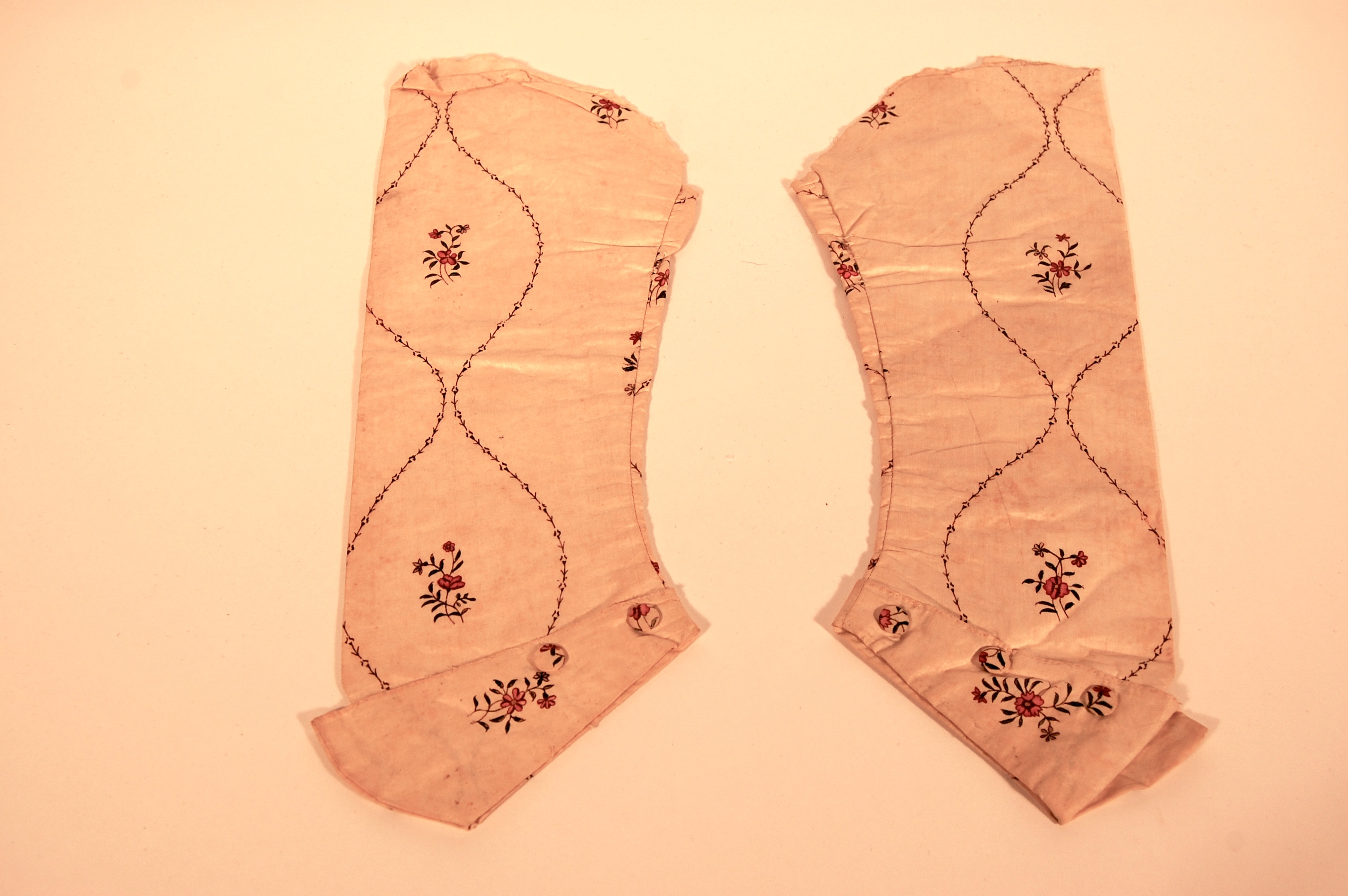
Sleeves, removed from bodice 1990.36.27. RIHS 1990.36.25A-B
I think, once upon a time, that bodice was part of a pieced-back closed-front gown with a matching petticoat.
And then I think someone decided (quite rightly) that the style was too passé for 1795, and altered the gown significantly.
Not only is there evidence of new sleeves being fitted into the gown’s armscyes, we have the sleeves-that-used-to-be. And my dear! No one is wearing sleeves like that this season!
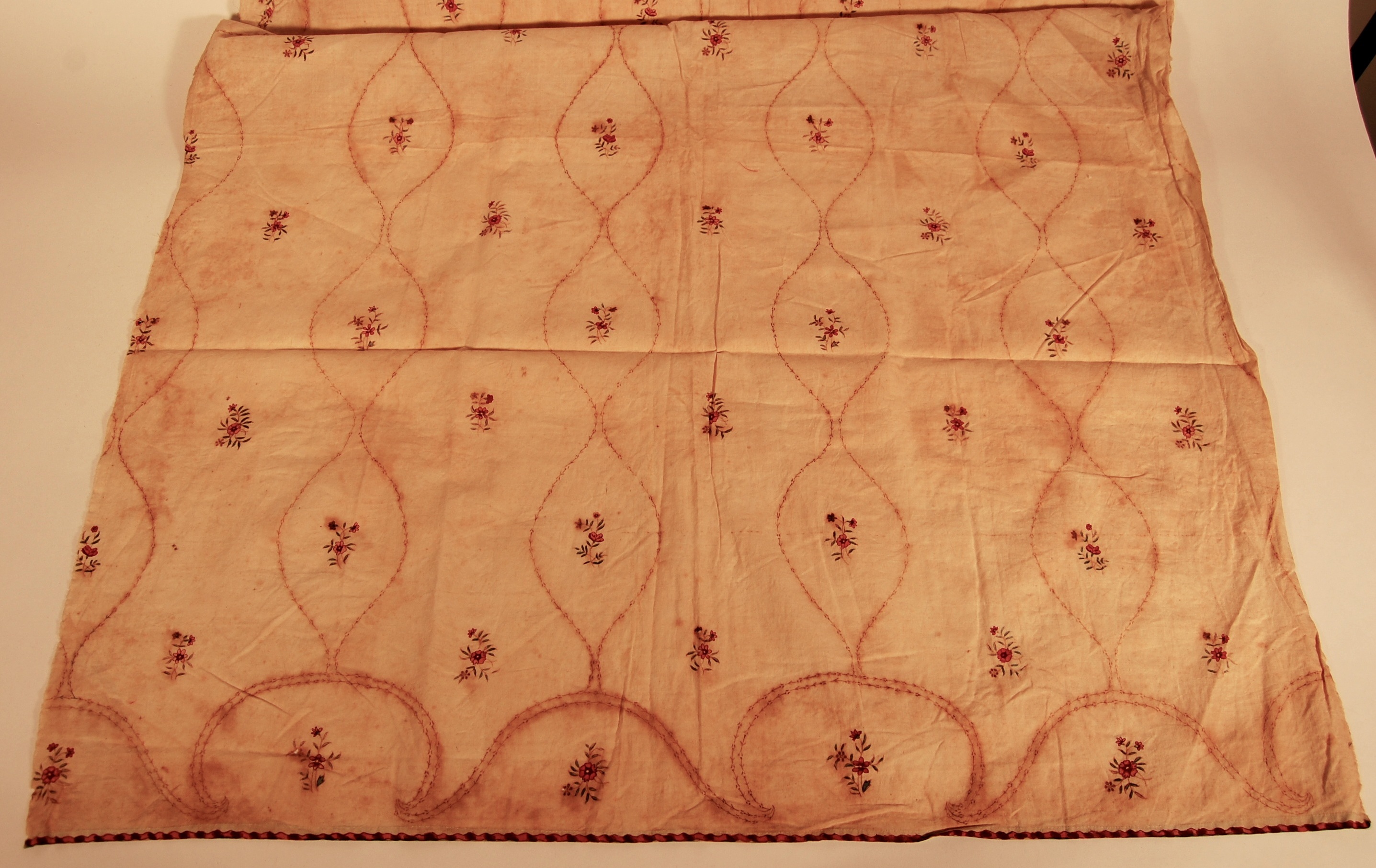
I find these garments in limbo really fascinating. Was that bodice finished and worn with a matching petticoat? (Yes, there’s a panel of that left, too; what a lovely hem!)
Skirt panel, painted Indian cotton. RIHS 1990.36.33
Who wore the gown? Was the woman who wore it originally the same woman who wore it altered? I can only guess at this point, and may never find the smoking diary or mantua-maker’s bill. The alterations are not as finely done as the original gown, so I think there are two hands at work here– whose were those hands? There’s always more to think about and learn.
In case you’re wondering, thanks to the Met, we can see what the gown probably looked like in its first incarnation, and then what the alterations were meant to achieve. (Link to the gown on the left; link to the gown on the right.)
Pocket ca. 1784, American cotton, wool Brooklyn Museum Costume Collection at The Metropolitan Museum of Art, Gift of the Brooklyn Museum, 2009; Bequest of Marie Bernice Bitzer, by exchange, 1996 MMA 2009.300.2241
Sharon Burnston, on the Historic New England site, points out that “Pockets thus represent the kind of dilemma that objects of material culture can present to scholars. Much is known about how and when these items were made, but evidence of how they were used remains fragmentary and tantalizing.”
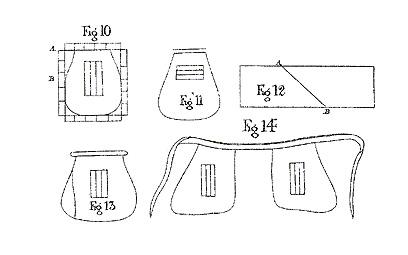
As we can see from this diagram from the Workwoman’s Guide, pockets could take many shapes, and the extant evidence bears this out. There are oblong pockets, and more rectangular pockets, rounder pockets, longer and shorter and wider pockets. One suited one’s self, and cut one’s pattern to one’s cloth.
A pair of silver buttons A pair of buckles A pen knife Thimble Coins A silver spoon A pair of scissors Keys Needlecase Biscuit Nutmeg and grater Smelling bottle An orange or an apple A pocketbook Comb Snuff box Jewellery Needlebook Pocketbook Paper Pen or pencil
When Pamela runs away, she takes with her, in her pocket, two handkerchiefs, two caps and five or six shillings.
Of all the listed things, what might Bridget have carried? Some of the things she carried would be needed, but others would be wanted.






 Kirsten Hammerstrom
You must be logged in to post a comment.