Well, sort of. The Young Mr sported a brand-new, all-hand-sewn frock coat and breeches, as well as brand new size 15 shoes (thank you, USPS Priority Mail and Robert Land’s stock of the raraavis size 15.) He was spotted in photos that were shared with me later, and there he is, front and center, in his new, blue wool broadcloth suit. (I do like the side eye Mr C is giving as he checks on the second row.)
When he was dressed on Saturday, the Young Mr had a real presence. There is something about a suit that changes a man– well, in this case, a boy into a man. On the ride home, he told his father, “Now that I’m growing up, it feels weird to call you mom and dad. I think I should call you by your first names.” (I’ll wait here while you finish laughing. Yes, it is funny. No, we did not laugh at him.)
It’s a curious idea to us now, marking transitions with clothes. For some, coming of age is marked with a car or at least a driver’s license. For others, it may be a first job, or apartment. But once, stages were marked in clothing, as boys moved from gowns to breeches, and later from dresses to short pants to long pants.
Our clothing is so much less formal, that we are less accustomed in most cases to seeing men in suits. Even as young as I was in those last “Mad Men” years, I remember more formal times, and shopping with my parents, seeing coats marked up in chalk and thread for my father, and the ranks of shirts and heavy-hangered trousers and coats at Brooks Brothers downtown in Chicago. (I went there once as a teenager with a friend to buy a present for her father; we were not warmly welcomed in our punk clothes, but the glass cases were unforgettable.)
For the Young Mr, that kind of formality is lost. There’s not much point in buying him a modern suit: he’s all t-shirts and hoodies and hand-me-downs from a friend at work he’s rapidly growing past. He’d never wear a suit, except as he steps into the past, and his fittings happen in private homes or workshops, and not in front of a three-panel mirror.
The Young Mr steps into the past to step into adulthood, and comes back to a present where he has many more years and rites of passage before he will truly be an adult.
Once upon a time, I worked (twice) for an interim boss I called (behind his back) Shiny Buttons. You know I’m in a coastal state, so you can guess what he wore: a navy blue blazer with brass buttons. It’s a uniform of its own kind, even in civilian life. For a new show at work, one of the things we’re looking at are blue coats and shiny buttons.
It got very “Hey, sailor!” in painting storage earlier this week, as we pulled out portraits looking for gents in blue coats. Sea captains are definitely representing.
Captain John Gladding, 1810-1820. Miniature. RIHS 1980.80.1Philip Crapo, ca. 1801. Miniature attributed to Thomas Young. RIHS 1906.3.4
There are other gents in blue, and it’s interesting to see the proliferation of style across time.
Portrait of a Man in Blue Coat, French, early 19th century. Metropolitan Museum of Art, 48.187.735
William Man Godschall by John Russell, Pastel on paper, laid down on canvas, 1791. Metropolitan Museum of Art, 61.182.1
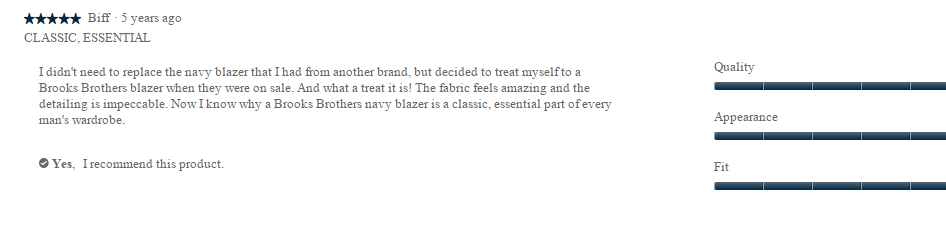
It’s a classic look, often seen in the preppier enclaves. It’s an easy target, but don’t you love this review of a Brooks Brothers blue blazer by Biff? Timeless.
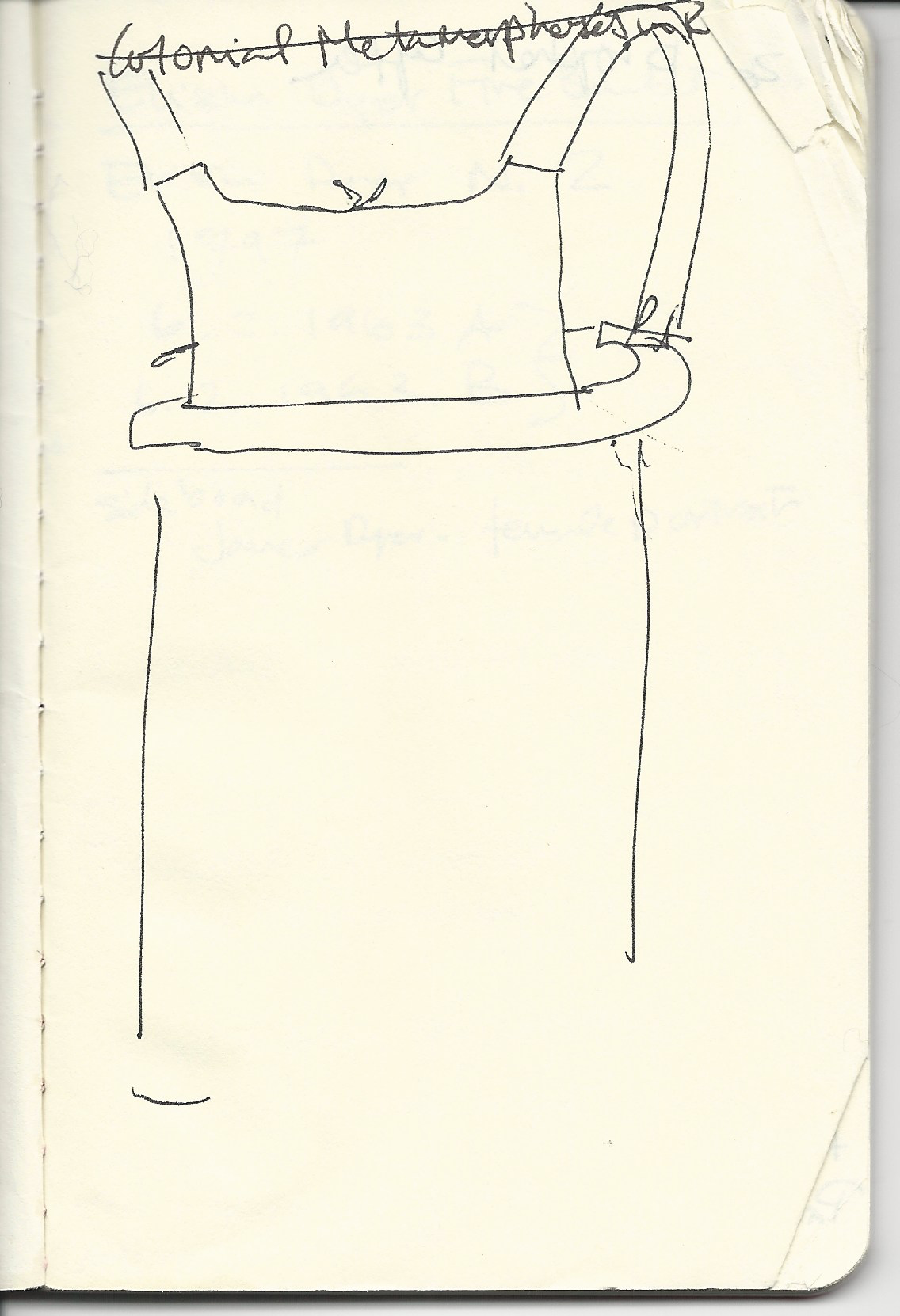
Edited to correct numerous typos and to add a bad sketch of the OSV apron. Don’t try to do research while conducting a small but energetic boy through a musket exhibit.
Two aprons, many questions, all of them excellent.
It’s really tough when an extant garment lacks provenance or even faux-venance, as in the “Revolutionary War” garments that turn out to be later. So, where do we look to figure things out when we a) like a garment a lot and don’t know if it’s right or b) are embarking on something a little new? And yes, in this case, we are talking bibbed aprons in the first quarter of the nineteenth century, in Rhode Island and in the Missouri Territory.
We start with questions:
1. What documentary sources can I find?
2. Is the form plausible for time period/area?
3. What is the typical fabric for the time period/area?
4. Is the item appropriate for my character/persona/impression?
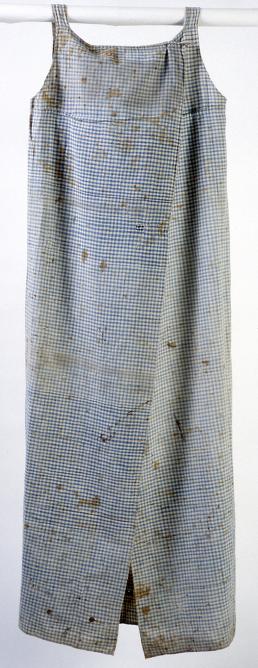
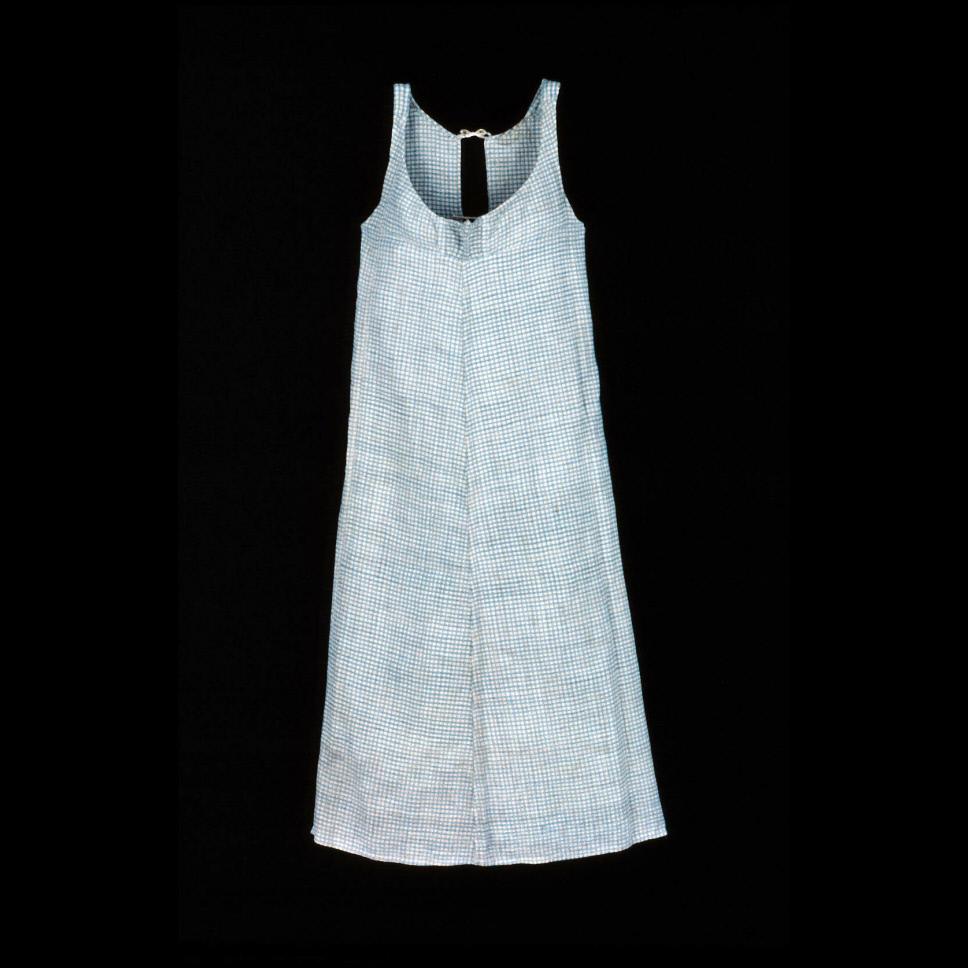
Apron, checked with high waist, 1800-1820. Plain weave linen, probably Southeastern US. Colonial Williamsburg 1995-53
What documentary sources do we have?
OSV’s apron: I do my best work on the fly.
We have some extant garments, two with images.
1. Extant apron 26.39.4, Old Sturbridge Village
2. Extant smock ca. 1800, Pocumtuck Valley Memorial Association 2000.01.869
3. Extant apron 18100-1820, 1995-33, Colonial Williamsburg (unstable links, search for accession number)
4. Apron 2005.24.4 at Historic New England has an intriguing description: A reddish brown linen apron with blue and white plaid. The apron is smock-like, with two holes for the arms and ties that extend from under the arms to the back. The bottom has a double hem. The neckline can be tightened or loosened with a blue and white string. What does that look like? Could it look like the Stonington plaid? It’s certainly a plausible New England weave 1810-1820.
5. Apron 1989.3, also at Historic New England, with a description similar to the CW high waisted apron:Cream & blue plaid linen; tucked at waist; no waistband; long cotton tape ties. (The tucked waist is similar to CW’s)
What else is out there? MHS’s database has an Apache error today, so not sure what aprons they have, though they’re exactly where we need to look for one instance. I’ve looked and failed to find aprons of this description in the following catalogs: Historic New Orleans, Chicago Historical Society, State Historical Society of Wisconsin, Connecticut Historical Society, the Met, MFA Boston, Maine Historical Society, New Hampshire Historical Society, Ohio Historical Society, Newport Historical Society and Little Compton (RI) Historical Society. I’m now really tired of interacting with Past Perfect software.
Is this form plausible?
We have 5 objects and one image, all found in a cursory afternoon. Me, I’m still liking this form for the first quarter of the nineteenth century in the United States. I think the form varies somewhat, as can be seen in the descriptions; the OSV apron is the outlier, with the other 4 extant garments seeming more smock-like.
From RIHS MSS 72, Preserved Pearce papers, Tailor’s and Tavern account books, 1778-1781.
Fabric type?
Neither the OSV apron nor the PVMA smock have much (any) provenance, but the fabric is very typical of New England from the Connecticut River to the coast; it appears in inventories from 1777, on home- bound volumes, extant aprons in Deerfield and and in sample books from 1815.
Blue and white check: I am comfortable saying that those two aprons are 1800-1820 New England based on form and fabric. I am delighted to have found it in the apron at Colonial Williamsburg, which is thought to be from the Southeastern United States. I think that expand the range down the eastern seaboard. With the evidence of the extant garments and fabrics typical in New England, I am still OK with this form of apron, even if my rendition of the OSV apron is rather poor, thank you for noticing.
But what about Missouri? What should you wear out there, on the banks of the Mississippi?
Creole woman and boy. Acc. # 1953.158.37. Watercolor and pencil on paper by Anna Maria von Phul, 1818. Missouri History Museum Collections. Von Phul 37
Enter Anna Maria Von Phul. She is a little sketchy on some details– these are watercolors, after all–but I think she would have made the apron blue if it was made of blue and white check. She has rendered some stripes (?) in the head scarf, so she does hint at some detail.
Because I know AMVP, I believe that she is documenting fashions pretty typical of the time and place. The ladies she portrays in St. Louis in 1818 are fashionably dressed and not behind the times for the year, even if we cannot see every detail of dress.
If I were to make the cognitive leap that women across what is now the eastern half-or-so of the United States wore bibbed-style smocks or aprons between 1810-1820, and made them up in the most common fabric of their area (cue blue and white checks for New England), I might step back from that link in Wm Booth’s catalog. If I were to copy this image’s apron, I think I would make it in plain, unbleached linen, based on how I read this color and shading.
Ideally, you would find bracketing aprons– that is, some a little earlier and some a little later– in a “typical” fabric. I didn’t find those animals in the Western Reserve or Louisiana Purchase Territory collections available online, but that only means I didn’t dig in hard enough.
I don’t think these utilitarian garments will turn up in shop records, and I don’t think we are likely to find detailed probate inventory descriptions– mostly it says “apron,” which is too general for our purposes. We won’t find runaway ads: it’s too late for those, and a little early for newspapers in the Territories, though it wouldn’t hurt to search online.
I think our best alternate documentary sources in this case will be in diaries (again, we may not get the specificity we want; Sylvia Lewis only makes Spencers differentiated by color, so we are ignorant of collar shape, trims, number of buttons, closures, etc.) and in watercolors and drawings, often amateur, of everyday life. After all, you can never have too many sources.
Is it appropriate?
Well…the evidence on the PVMA smock is of some use, though stains can be acquired in storage, too. The CW smock-apron is less used. I think this form in a checked or plain linen fabric would be best suited for everyday and working wear, cleaning, cooking, gardening, but not for serving at table (in a house that supported that), and not for dress or best, when white would have been what was wanted.
Not that this is an exhaustive or final chronicle, but Jackie asked about the apron.
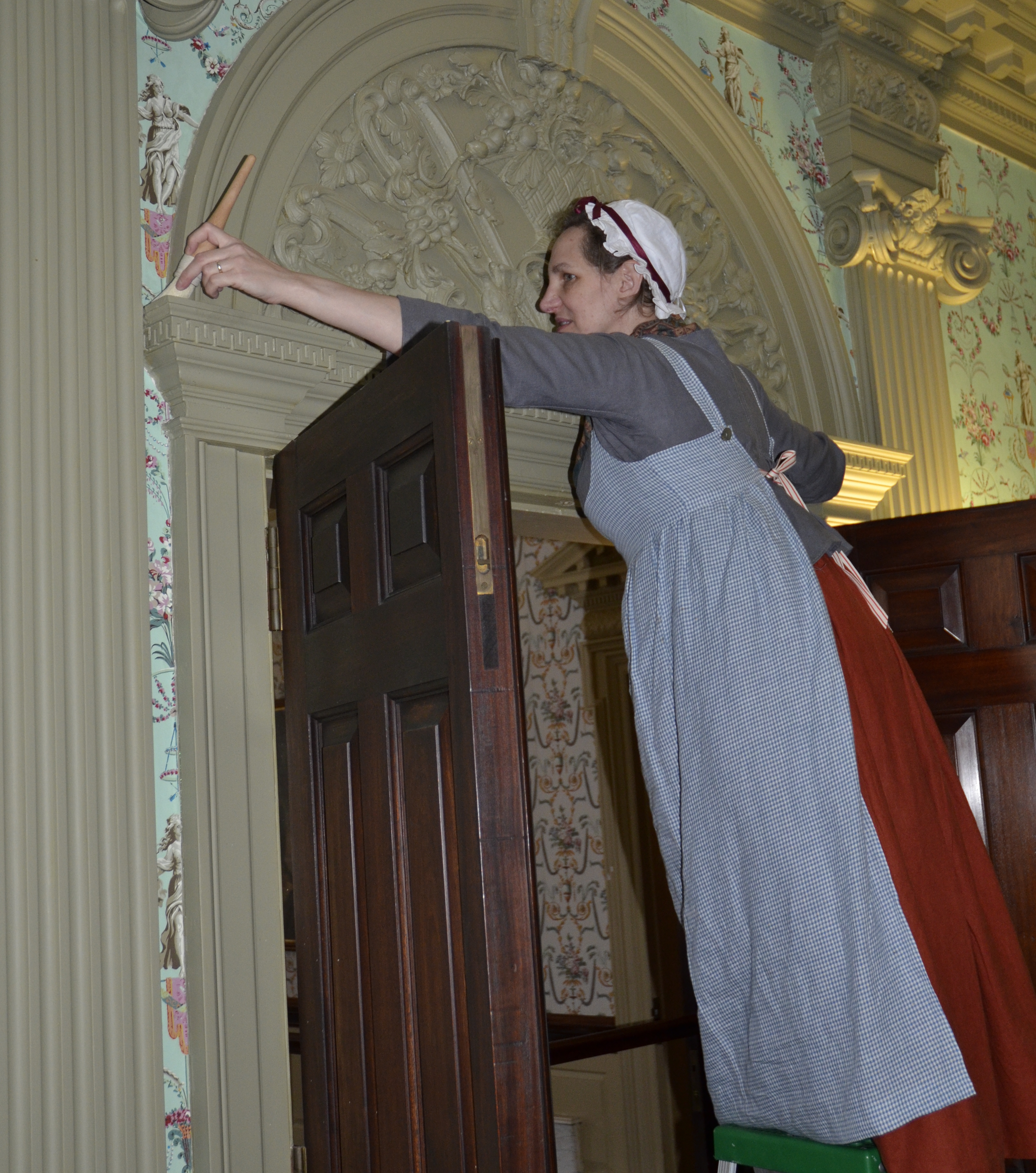
Spring Cleaning, 2012
I first encountered this form of apron at Old Sturbridge Village, on display in the Firearms and Textiles exhibit space, which I think of as “Muskets and Muslins.” The accession number given on the exhibit label was 26.39.4, but the object does not appear in the OSV online collections database (they do warn that it contains just a selection of their total 60K-plus object holdings). The original at OSV, as sketched and described by me in April 2012 has a drawstring at the neck, straps that button, string at the back opening, and is slim, without gathers. That means the bodice is very similar to the gown bodices of the early part of the 19th century.
Smock, 2000.01.869 PVMA
There is another original checked bodiced apron in the Pocumtuck Valley Memorial Association collection in Deerfield, MA. This original appears in color in The Needle’s Eye by Marla Miller. As you can see in the images of my apron, I mashed the two styles together to suit the amount of material I had on hand, the skills I had three years ago, and the amount of time I had between seeing the apron and the day of the program, which was probably two days during which time I had pleurisy.*
This is also wrong, but funny.
To refocus: I chose to wear this apron at Whitehorse House in 1820 for a really wrong reason: it was what I had.
Papering the Saloon at Tickford Hall, watercolor by Diana Sperling, 1816.
Since we deal in confessions here, I will tell you that I did buy material for a black apron, and I planned to make a strapped or bibbed one, much like the one Sabine made. The appearance of the dark apron in Diana Sperliing’s watercolor of the ladies papering the saloon at Tickford Park put the dark strapped and sometimes bibbed apron the in English-speaking world. And still I did not manage to make one. If I were to do an 1820 program again, or even an 1813 or later millinery shop again, I like to think I would find the time to make a black strapped and possibly bibbed apron. I do think they were the height of fashion, and are likely to have been worn by women in shops, and by maids.
Do I think the checked apron is wrong? Given that I can rationalize anything, of course not! I think a checked apron is probably reasonably appropriate within the context of a kitchen, even in 1820, especially in New England. Since we did not cook on Saturday, the black apron would have been ideal, but I think the checked apron passes. To make it pass with a higher grade, I will freely admit it requires button and tape upgrades. Since the next dates on the horizon are 1775 and 1780, chances are good those upgrades won’t happen anytime soon. * Do not attend an all-day outdoor event in the cold when you are not well. Do not attend said event without your cloak, or in stays you have laced up a little too firmly. Do not deny that the cold you have might actually be the start of something bigger, when it includes a productive cough. Lo, the lessons of living history are many.

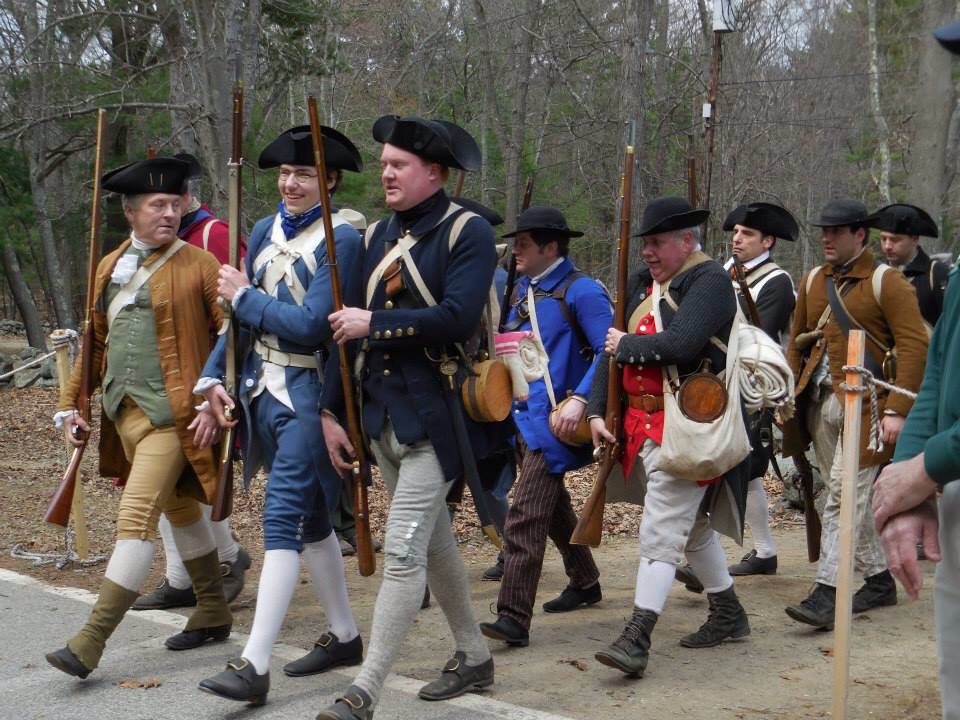 Well, sort of. The Young Mr sported a brand-new, all-hand-sewn frock coat and breeches, as well as brand new size 15 shoes (thank you, USPS Priority Mail and Robert Land’s stock of the rara avis size 15.) He was spotted in photos that were shared with me later, and there he is, front and center, in his new, blue wool broadcloth suit. (I do like the side eye Mr C is giving as he checks on the second row.)
 Our clothing is so much less formal, that we are less accustomed in most cases to seeing men in suits. Even as young as I was in those last “Mad Men” years, I remember more formal times, and shopping with my parents, seeing coats marked up in chalk and thread for my father, and the ranks of shirts and heavy-hangered trousers and coats at Brooks Brothers downtown in Chicago. (I went there once as a teenager with a friend to buy a present for her father; we were not warmly welcomed in our punk clothes, but the glass cases were unforgettable.)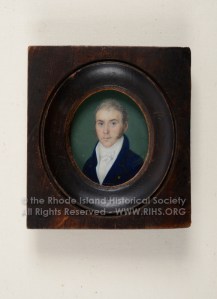






 Kirsten Hammerstrom
You must be logged in to post a comment.