On & Off the Grid

It’s been a very busy time chez Calash, with many changes underway and to come. It’s hard to keep up with all the writing I’m doing everywhere, but eventually I’ll be back on topics of authenticity, standards, and whimsical Wednesdays.

This week, though, is all about checks. (Most weeks are, in some way, aren’t they?) Not paychecks, silly: linen checks.

We are headed out to Eastfield Village Friday afternoon where Mr Hiwell and the Young Mr will join in the 1833 militia muster, and Mr JS and I will occupy a house as a shop/tailoring business/punch-making and cooking establishment of one kind or another.

Mr Hiwell has been warned to expect a diet unlike his norm, and since his roundabout is white, we will quickly know if he is smuggling Oreos and barbeque sauce.
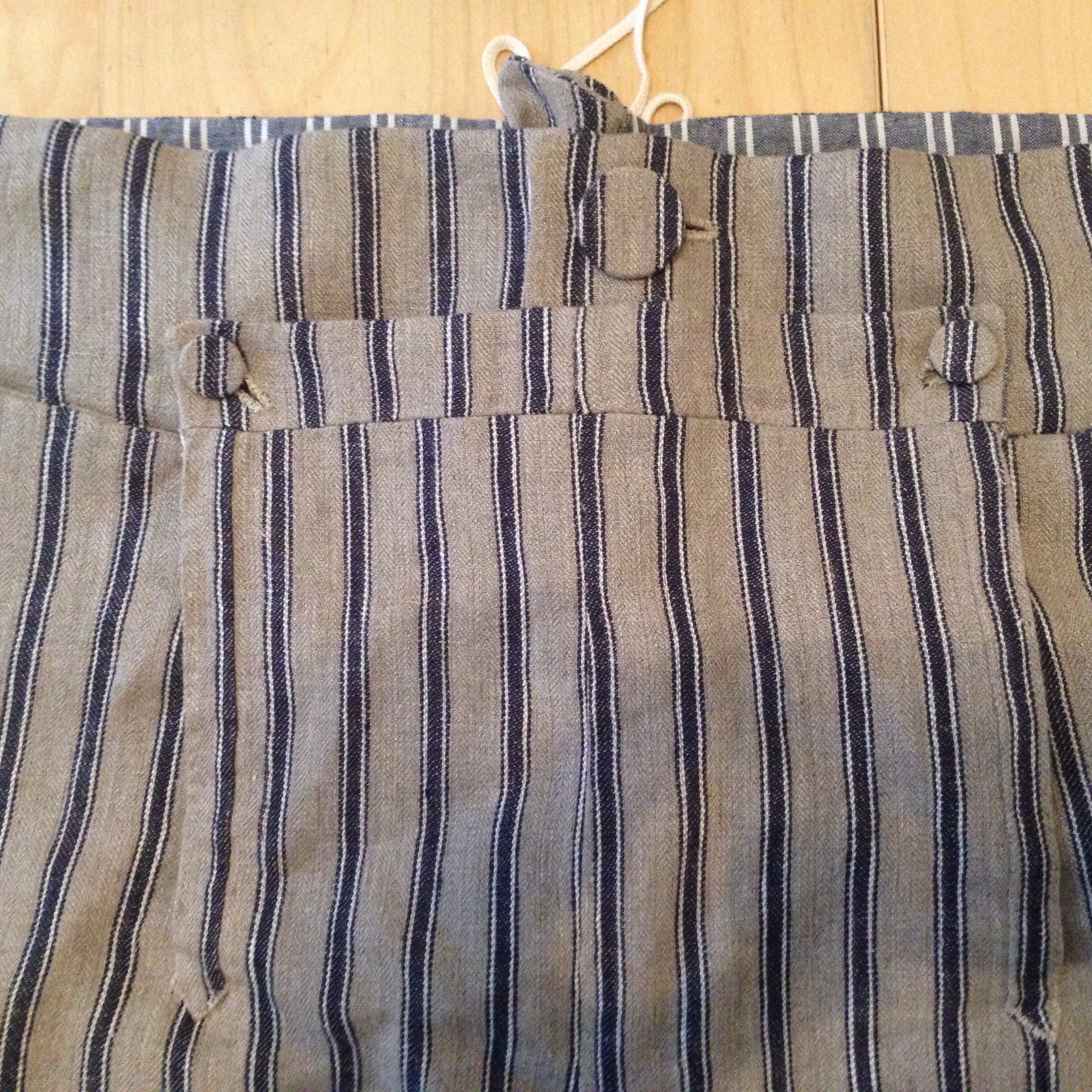
 For the Young Mr, I have been making trousers. Yes, I do like things to line up. I wasn’t even paying that much attention when I cut these, but apparently that was  was enough.

Yes, even the buttons.


Sigh. It’s a thing.

He’s also got a roundabout in the works, which I must focus on more closely to finish. This is patterned from an original in Henry Cooke’s collection, but… Mr. Cooke and I, on a very sticky Tuesday afternoon, did not have the Young Mr at hand to measure again. The original was too small: that we knew. What we did not know was that the boy had taken on a man’s shape– or, as a friend says, “he’s dude-shaped now!”–and the additions we made were not enough, except (barely) to the sleeves.


Oh, well. There was just enough to make it all work, and after some trials I realized it needed a lining. What kind of lining? A checked lining, of course!
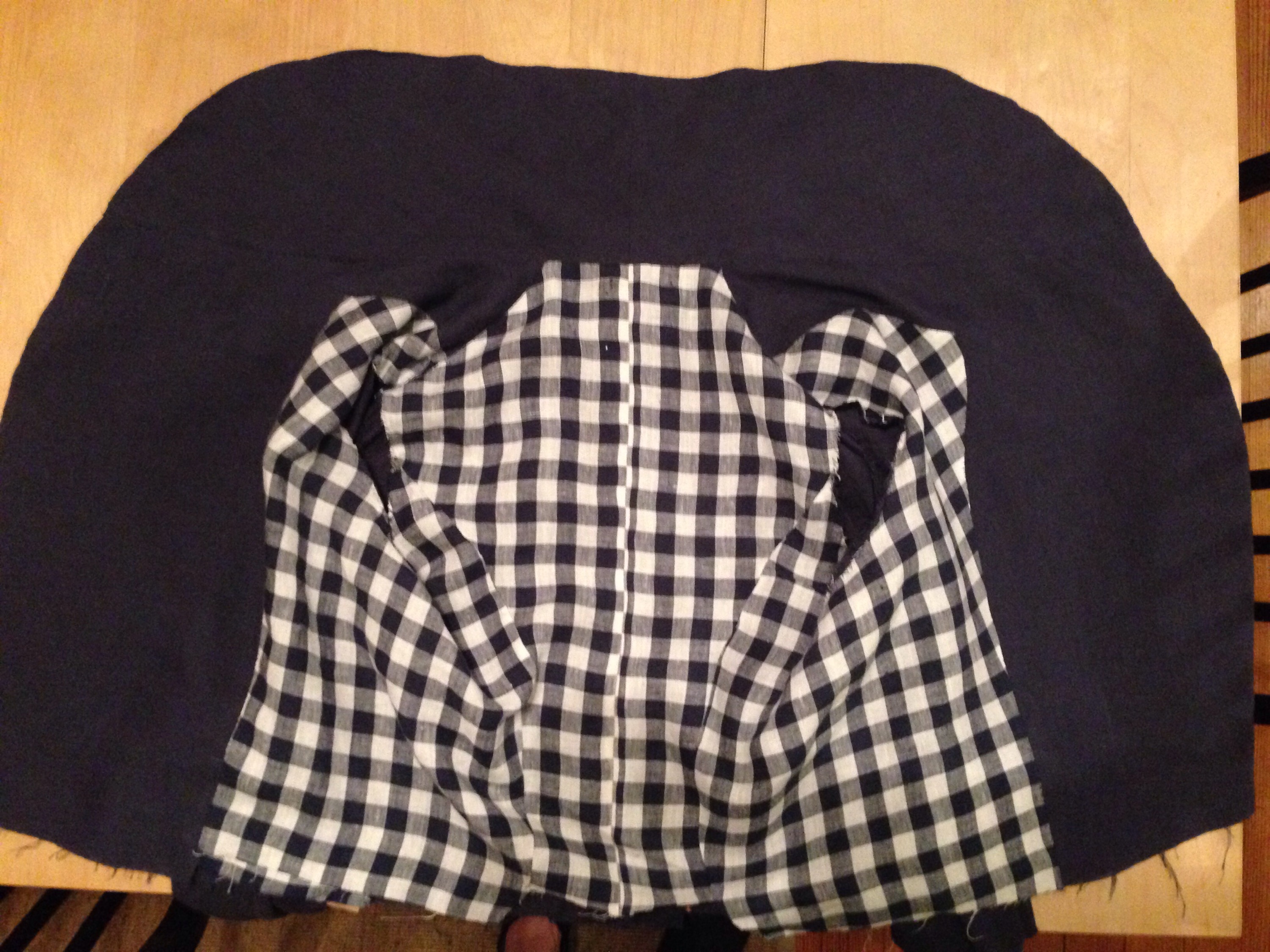
It seems okay, but these collars are strange to  me.


Well, at least he will be clad.

Let you think  I’m sewing only for the lad, I am in fact working on a gown for myself. There’s a hopeful yard or so of another check’d  linen from the stickiest fabric store on 39th Street lurking, but I do not think that apron will happen this week. Perhaps John Brown’s housekeeper will finish it someday.

At least there are already gowns and aprons ready-made that can travel with me. Someday soon I’d like to finish my new stays… winter will come soon enough, and more sewing then.
Frivolous Friday: Festive but Frigid

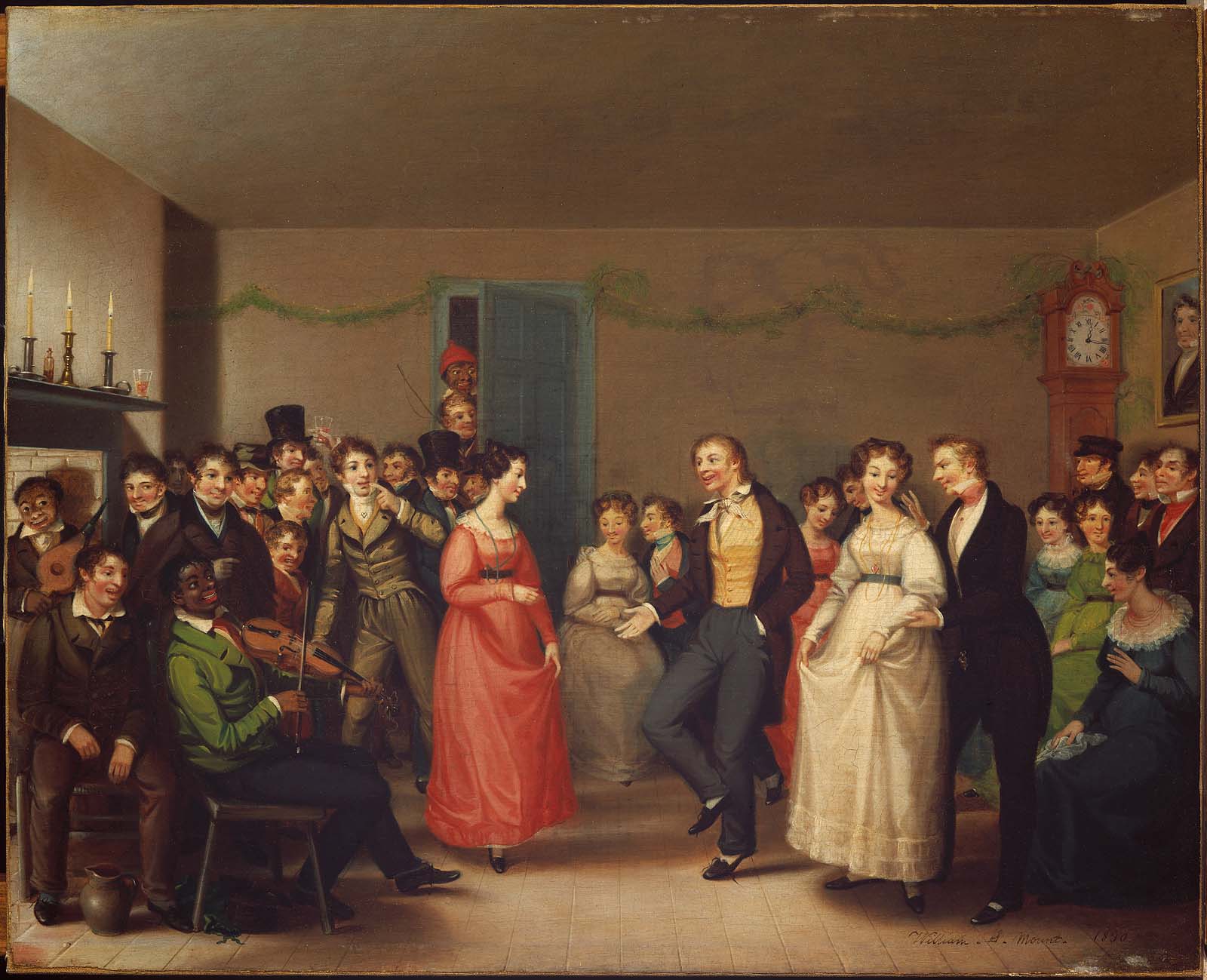
Rustic Dance After a Sleigh Ride, 1830. William Sidney Mount MFA Boston 48.458
Rustic Dance After a Sleigh Ride, 1830.
William Sidney Mount MFA Boston 48.458

I don’t know about your weather, but we’re in full summer in New England, sultry and humid, with the occasional thunderstorm and power outage to enliven the evening. A sleigh ride sounds like fun today– and I know we all just finished complaining about the snow of February– but a brisk ride followed by a dance would certainly round out this week.

1833 approaches faster than expected, so it’s time to pick that back up and get serious. Not just a gown but petticoats and, ideally, a new shift should be made. This may be the project that breaks my resolve and finds the Bernina back on my table for cording a petticoat.

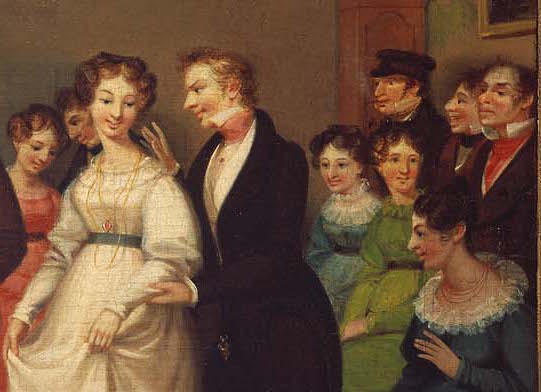
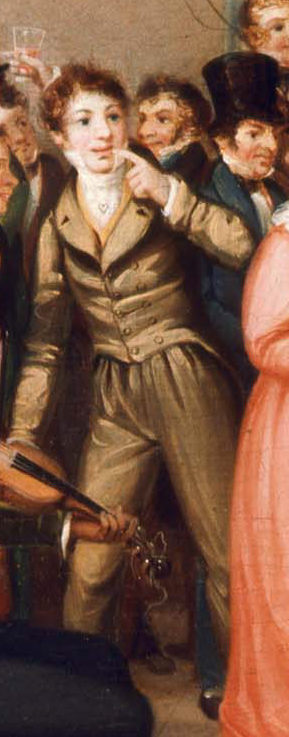
Detail, Rustic Dance After a Sleigh Ride, 1830. William Sidney Mount. MFA Boston 48.458

This image helps define the look of the early 1830s: not nearly as exaggerated as the fashion plates, these dresses and coats seem to fall into a progression from the 1820s– as you’d expect this early in the decade.

The gentleman at the back, in the drab colored suit, sports an interesting pair of trousers. I don’t think I know anyone ready to bust out the cossacks, but Mr Drab may be sporting a slightly modified pair. The collars and lapels show a shawl-shape that seems new, and modified from the more serpentine form seen in fashion plates– or else not yet as developed. There’s a range of headwear, too: tall hats on the left, a soft cap on the right. The Ladies’ Workbook has a pattern for one of those caps. Wonder how hard they are to make?

Detail, Rustic Dance After a Sleigh Ride, 1830. William Sidney Mount. MFA Boston, 48.458

In the detail, we can also see the women’s hairstyles, less exaggerated than the fashion plates with their high top knots, and within the realm of possibility for those of us not practiced in historical hairstyle recreation.

So much has carried into this decade: colored neck wear, ruffles or chemisettes under women’s gowns, men’s hair brushed forward. As always, it’s the details that count. Tall shirt collars, rounded lapels, ladies’ sashes, the shape of sleeves. This should be a fun decade to represent.

Mind the Gap, or, The Basket Case

I was in the midst of planning yet another maid’s dress (some of us have all the luck) when a friend alerted me to an online discussion that drew from my recent post on baskets. The comments — which I skimmed but twice– made me think about philosophy and intent.

Engraved by John Raphael Smith, 1752–1812, British, A Lady and Her Children Relieving a Cottager, 1784, Mezzotint and line engraving on medium, slightly textured, cream laid paper, Yale Center for British Art, Paul Mellon Collection

There are two approaches to developing a living history persona and appearance I’ll consider here: one prescriptive, and one not. The prescriptive, didactic approach tells you what to wear and carry. Some folks like that. It is completely correct in some cases: soldiers, for example. You want to fall in with a unit of Light Infantry in 1777, it’s generally more convincing if you don’t wear the 1781 coat. Not everyone cares: some people will keep on wearing the Brighty Whitey Hunting Frocks and 1780 coats at reenactments commemorating events of 1776. Those folks can no longer be reached by prescriptive standards, and my preferred approach probably won’t reach them either.

Joshua Cristall, 1768–1847, British, Young Woodcutter, 1818, Watercolor with scraping over graphite on moderately thick, slightly textured, beige wove paper, laid on thick, slightly textured, beige card, Yale Center for British Art, Paul Mellon Collection

Mindful reenacting or living history sounds pretty nutty, but that’s what I would encourage. Thoughtfulness. Consideration. Not just the what, but the why. Why you wear or carry something can be as important and interesting as what you’re wearing and you’ll be all the more convincing for thinking it through. Thinking, not rationalizing. How appropriate is it to be in your best clothes carrying a basket also used to carry fire wood? You have to answer that for yourself, and if you’re doing it right, the answer will not always be the same– nor will the question!

Print made by James Bretherton, ca. 1730–1806, British, A Maid, 1774, Etching on moderately thick, rough, blued white laid paper, Yale Center for British Art, Paul Mellon Collection

This isn’t the easiest way to go about anything, asking all these questions, but for some of us, the experiences make it worthwhile. You won’t always be able to do, carry, or wear what you want.* But the picture you create of the past will be more accurate and more engaging if you think more and justify less.

Look, I threw down about that floppy bird basket, but I have to provide food to troops this Saturday in Cambridge. What the heck will I carry it in? What will I take my sewing in?**

Probably a wallet and a bag, unless I can pack that floppy basket convincingly– it is entirely suitable to my lower sorts-stained gown impression– but if I can’t, I won’t take it. And that’s just one less thing to carry.

*I’m pretty much always the maid to make scenarios work, and while it doesn’t come naturally, art imitates life.

**Prays no one gets the bright idea to bring (shhh) tents to work on.

Context is Critical

Context: it’s everything, right? We so dislike our statements taken out of context. But what about our clothes? They make statements, too, and so do our accessories.

A friend noticed that market baskets were fairly prominent carriers used by reenactors portraying the Boston gentry greeting L’Hermione this past weekend, and asked, “What gives? Is there something I missed?”

There are two images that people often turn to in documenting these baskets:

The Farmer’s Return, by Zoffany

Johan Joseph Zoffany RA, 1733–1810, German, active in Britain (from 1760), David Garrick and Mary Bradshaw in David Garrick’s “The Farmer’s Return”, ca. 1762, Oil on canvas, Yale Center for British Art, Paul Mellon Collection

and

The Harlot’s Progress, Plate 1

The Harlot's Progress, Plate 1. William Hogarth.
The Harlot’s Progress, Plate 1. William Hogarth.

In both of these, the context is working class and food-oriented. As my friend asked, “Are these floppy baskets for floppy birds?”

Two images from 1740 to 1760 aren’t a lot of documentation to go on for 1775-1783, so I checked the Rhode Island newspapers for 1770-1790, searching for “basket.” No mention in ads, but “baskets of grapes” appeared in stories, and a mention of Chinese dogs in cotton-lined baskets (apparently the “basket dog” is the 18th century equivalent of today’s purse dog).

As satisfying as basket-dogs might be, they’re not helpful in this instance.

The Yale Center for British Art helpfully adds keywords or tags to their catalog records, which allows one to look for “basket.” Aside from The Farmer’s Return, this ovoid, market-basket form isn’t really seen. What is seen?

For one thing, not many upper-class women carrying baskets, or any kind of burden or bundle. A woman carrying a kind of ovoid basket over her arm is shopping for food, not perambulating.

The upper class girl with her father has an open basket full of flowers (hint: probably symbolic) which appears to be made of what we lump into “wicker,” in an open design. (BTW, that’s not a pinner apron; zoom in and you will see shoulder straps. Fight at your leisure.)

Arthur Devis, 1712–1787, British, An Unknown Man with His Daughter, between 1746 and 1748, Oil on canvas, Yale Center for British Art, Paul Mellon Collection

In the most class-appropriate image, The Virtuous Comforted by Sympathy, the workbasket at the woman’s feet is a tidy, round form with a lid, more similar to Nantucket baskets* than to market baskets. It really doesn’t look like the kind of thing you’d leave home with. It’s a sewing basket.

Edward Penny RA, 1714–1791, British, The Virtuous Comforted by Sympathy, 1774, Oil on canvas, Yale Center for British Art, Paul Mellon Collection

On balance, I think it appears that public basket carrying is more suited to carrying foodstuffs than personal items, and that the most common use of baskets in this period is to collect and carry food, whether from a greengrocer, fish stall, or gathering apples— at least if you are trying to be quite precise in the use of documented accessories. If you’re using a market basket to carry food, you do so knowing that it’s only (thus far) documented to England, and that the handles must be woven and not leather riveted to the side.

The material from which the baskets are made is another question altogether, along with the proper woven form. As I noted to my friend, I don’t care that much. And why?

Balthazar Nebot, active 1730–1762, Spanish, active in Britain (from 1729), Fishmonger's stall, 1737, Oil on copper, Yale Center for British Art, Paul Mellon Collection
Balthazar Nebot, active 1730–1762, Spanish, active in Britain (from 1729), Fishmonger’s stall, 1737, Oil on copper, Yale Center for British Art, Paul Mellon Collection

Pockets, of course. My enormous pockets contain multitudes, sometimes even camera and water bottle along with wallet and phone, even if that much stuff distorts the line of my skirts somewhat. I can also fit my knitting in a pocket, and a slim, if dangerous novel (perhaps Moll Flanders). For carrying more than that, a wallet is probably best, or a cloth bag, or a portmanteau. But for a day in town, even if you’re a lady, you can carry quite as much in your pockets as I can as Bridget, though of course of a better quality.

* I am not advocating carrying Nantucket baskets, to be quite clear.