Sandby’s Women

20130109-061710.jpgSara Hough’s date of ca. 1805 piqued my curiosity and Cassidy was suspicious, too. So I went looking into Paul Sandby a little bit more.

Many of us know him for the sketches and watercolors of working people in mid-18th century England. They’re oft-used references for people doing Rev War reenacting as they’re full of the kinds of details seen in the watercolor of Sara Hough. I hadn’t thought of Sandby for later 18th century references, which shows how little I was thinking.

Sandby: Figure with Lute & Tamourine, YCBA

Thanks to the 18th Century Material Culture Resource Center, I found the Sandby “People and Places” presentation, which led me back to the Yale Center for British Art, and this image of musicians, horses and women. There’s no date in the record, though the presentation calls it ca. 1785. There seems to be a series or portfolio of Sandby sketches similar in size and type from about 1785, so it’s a reasonable assumption…with the usual caveat about assumptions, but no aspersions on the compiler of the presentation.
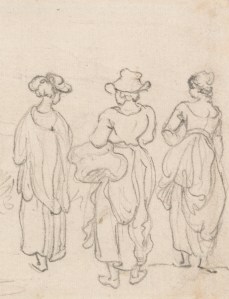
Sandby, detail, YCBA
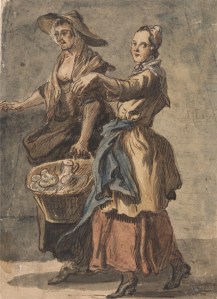
Sandby: Two Women and a Basket, YCBA
Sandby: Two Women and a Basket, ca. 1759 YCBA

Let’s look at a detail of the women in the drawing. Their waists are higher than we see in earlier Sandby drawings, and their profile slimmer, more classical, particularly the figure on the far right. Her bodice looks to me like a late 18th-century bodices.
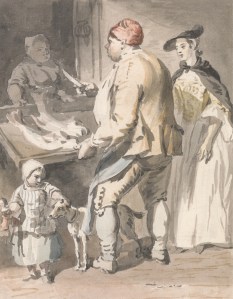
Sandby: A Fishmonger, YCBA
Sandby: A Fishmonger, ca. 1759 YCBA

Sandby had the skill to depict clothing with minimal gestures, as he does below in A Fishmonger, part of the London Cries series.

It’s that circa that gets you. I believe it for the ca. 1759, all the way. The figures fit into the visual continuum of Sandby’s mid-century work as I know it. (You’ll just have to trust me that I have a visual memory, and that, for once, the years of art school matter.)

And I kept wondering if he really had worked late into the 18th century, and then I found this:
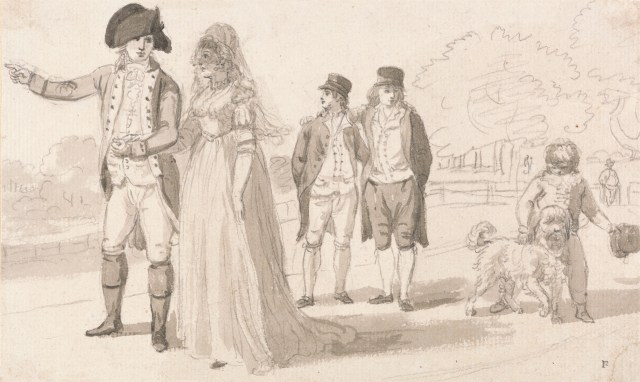
Sandby: Family in Hyde Park, YCBA

Again, no date, but there are distinctive markers to tell us this is post-1780, even inching to the early 1790s. The waistcoats on the adolescent boys are shorter and double-breasted. The shape of the boy’s hats has changed: these aren’t cocked hats, and they’re not soft round hats. But look even closer and you’ll see the ties at the knees of their breeches, very typical and fashionable for the 1790s. All this before we’ve even gotten to the woman! Look at what she’s wearing: that’s certainly a plausible ensemble for 1794, isn’t it? The waist has moved up, the skirts are lighter, likely mull or muslin, and the skirt of what I interpret as an open robe, much like Sara Hough‘s, is trained on the ground. If this is a Sandby drawing, which I don’t doubt, then I think we definitely see him working into the mid-1790s.

And just for one final kick, I checked the Met again, where they have a Paul Sandby drawing dated 1798-1799. I wonder…but the coat collar and waistcoat might have it.

Sandby, Group of 4 Children and a Dog, MMA

I’m still not sold on ca. 1805 for Sara Hough (why no ‘h’ on Sara when the drawing is inscribed by Sandby, “Sarah Hough…”?) but I’d endorse 1795. The tricky part, as always, is the circa: so much depends on how a museum interprets ‘circa.’ For some, it’s 5 years either side of the date; for others, it’s 10. When I see a circa date, I get skeptical, and start doing math.

Dresses and Evidence

Sandby: Sara Hough, YCBA

Here is Sara Hough, Mrs. T. P. Sandby’s Nursery Maid drawn by Paul Sandby ca. 1805, from the Yale Center for British art. She’s rather lovely, and though I’d tend to put her date earlier than 1805 based on the clothing, I don’t know enough (anything) about the Sandbys, and it may be that the dates of Sara’s employment fixed the date of the drawing. But doesn’t that robe and train look distinctly 1790s?

What I like about it is that here is a maid wearing an open robe and train–how impractical, especially in a nursery–so the drawing makes a third kind of evidence in addition to fashion plates and extant examples.

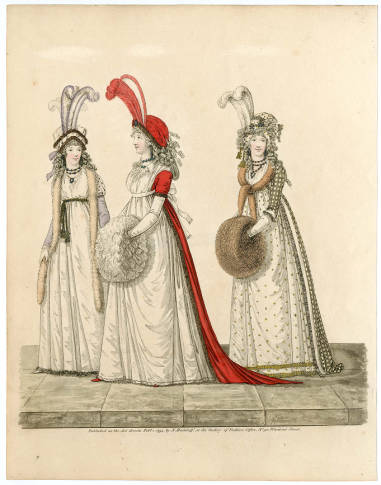
1794, V&A
1794, V&A
1795, MMA
1795, MMA

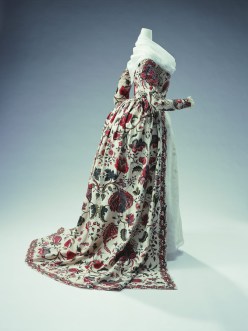
1794 and 1795 fashion plates from the V&A and the Met show similar robes, though the V&A is described as a walking dress, and the Met’s plate shows evening dress. Extant examples include the Kyoto chintz gown, and this chintz gown at the V&A.

1795-1800, V&A
1795-1800, V&A
1780s, KCI
1780s, KCI

I like how art once again blows up my expectations and makes me think more about the time frame when styles can be worn, and why: maids lag mistresses in style? Comfort and personal taste? or is the assigned date just not right? It’s an evasive “circa,” which can wiggle 5 to 10 years either way, depending on the collection’s standards. The drawing could be 1795, and it’s not later than 1809, when Sandby died.

Aside from the questions and quibbles over the date, the image gives us great information about how to wear an open robe with an apron, how to carry scissors, what watering cans looked like around 1800, the profile of shoes and caps, and how hair might be styled.

Projects & Supplies

From the Franklin Mill store

On Saturday, my friend Dana and I went to the Franklin Mill Store in, yes, Franklin, MA. Their 20% off everything sale ends this coming Saturday, when Dana is working and I am taking the Young Mr to an admissions open house at a local school. So off we went, and here’s what I came back with.

From the left:

  • Green English broadcloth for Mr S’s frock coat.
  • Dark blue Italian linen-cotton blend heavy weight plain weave for Mr S’s summer frock coat, to be modeled in part on one at work that a historic costume specialist calls “Joe Providence.”
  • Interfacing for waistcoats and frock coats, already successfully applied to the Young Mr’s new waistcoat collar.
  • Green ribbon for a black taffeta bonnet to be made from the black taffeta seen here, and enough taffeta for a petticoat.
  • Brown wool for buttons. Expect tangling.
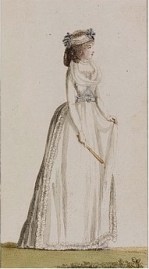
Magasin des Modes, June 1787, thanks to Dames a la Mode

The taffeta for the petticoat seems out of character for my linen and wool life, but I have a plan. At the Artee Fabrics store in Pawtucket, I picked up a remnant of green silk taffeta, but not enough for a full dress or gown. There is enough for an open robe, though, and I got an idea watching The Duchess.  One costume is dark redingcote over a rose petticoat: not my colors. But then I found this fashion plate, with green over black, and there you are. Pure costume fantasy, but  fun to make. Or at least fun to think about making–there’s always swearing.

To keep track of these insane plans, I started a projects page to list the schemes and deadlines. We’ll see how it goes.

Fashion Plates & Subject Headings

Women_17901799_Plate_009Ah, the Met. You have to love them, so much wonderful material available online, and free. Collections of immeasurable depth and wealth, an incredible professional staff–this is the pinnacle, right? And yet…

They have a weakness. It’s a weakness shared by many places, but it is a major one, for the online user. It’s the lack of subject headings or dates assigned to their Library’s Digital Collections. They use OCLC’s ContentDM which has a pleasant enough interface, and fields that, in the Met’s Costume Institute Fashion Plate Collection, include Thumbnail, Title, Subject, Description, and Date.

They’re only putting data in Thumbnail (see image; I love that dress), Title, and Description. Description is what I would call Credit Line, and contains the donor name.

Title is a trifle vague. The image above is “Women 1790-1799, Plate 009.” No date, no subjects. The date is October, 1791, right there in the image, but not searchable, not sortable.

Women_17901799_Plate_049 Catalogers, I implore you: subject headings. If not subject headings, the date, please, when it is on the item. That makes the collections not only sortable, but searchable.
Enough with my lunch-too-late commentary! I’ve been immensely grateful to have a new digital plaything while waiting for the lunch room to clear, and this plate is delightful: April 1797, which was certainly blustery, if not cruel.

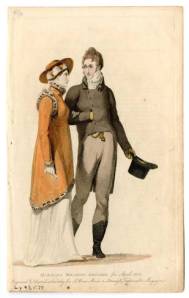
Mens_Wear_17901829_Plate_002And, since we’ve been on the topic of men’s wear, here’s a well-dressed gentleman and his lady in Morning Walking Dress for April 1807.

This weekend, I am off to the Farm for the Christmas Sale. Not such a pretty dress as these, but one I am pleased with nonetheless, and which (with wool petticoat, stockings, and cloak) should keep me warm–I do expect to be quite busy.