[An amazonian dress]. London : Pubd. May 26, 1797, by G.M. Woodward, Berners Street. Lewis Walpole Library Image Number lwlpr08972, Call Number 797.05.26.02
I was wondering about contrast revers on women’s clothes, and if I could really get away with such a detail on a Spencer, when I happened upon this image on Pinterest. Well found indeed from 1797, and very nice hat as well. Bonus: Giant Muff.
The dog has a coat, too, and now that it’s cold in New England, the local whippets are turning out in their winter coats. Mr S and I had a slightly crazy notion to dress a dog we know in a canine-scaled replica of a certain very special coat, but would need access to the hound (for measurements) and a particular scrap pile. With those circumstances not in the offing, let’s just be delighted that dogs in 1797 wore coats, and had bows in their topknots, which means that the end of civilization has been coming for a lot longer than previously thought.
Of course it may be that the dog has to dress as a human to keep from being eaten by the ENORMOUS and possibly carnivorous MUFF of DOOM. I think you could make one from the sheepskins at Ikea, if you could settle for white.
I don’t know exactly what “that certain age” is, but I think I’m headed there downhill on an icy street in a speeding carriage.
Here’s another good question: What about age? I didn’t address it directly in working out Kitty’s Brown Gown, but I did consider it. She’s in her 40s, and if you look at portraits by Copley and other artists, older women are often dressed in brown. These are respectable ladies, and when Kitty’s feeling more like a bad servant, she’s happy to wear her ca. 1774 red and black calico dress, and make tracks for Germantown.
I’ve been thinking a lot about personae and impressions, and first person interpretations. One of the best things I learned at a recent workshop was “first person thinking,” and in the historic costuming/re-enacting/living history/ historic re-creationist context, when you wonder what to wear, do, say, pack, eat, I think this is where it starts:
Know Your Self. It all flows from who (and when) you imagine yourself to be.
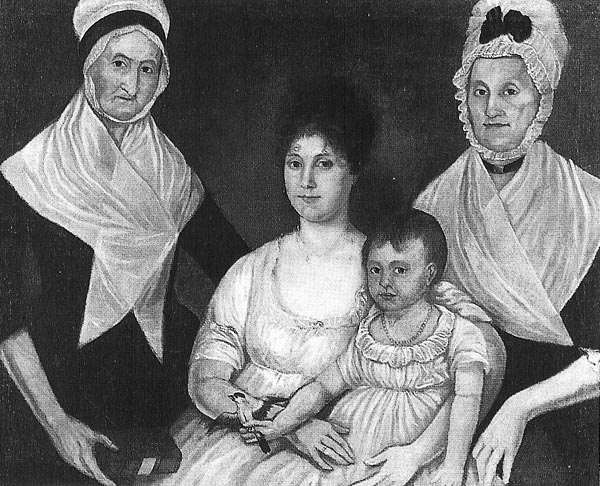
The Ege-Galt Family, 76.100.1, Abby Aldrich Rockefeller Folk Art Center
So let’s take age in account. For Battle Road, 1775, Kitty’s in her 40s. That means she was born around 1735, and came of age in the 1740s and 1750s. Knowing the styles of that time I’m even more comfortable choosing cuffs, because that’s what she grew up with. She’s not going to be very fashion forward–not just because of her class, but also because of her age. (For added fun and dimensions, start thinking about what she saw and read.)
What about choosing fashions for the older set in 1812? That’s where it gets really interesting, to me. Check out the Ege-Galt family portrait, ca. 1802. The older women are NOT in the high-waisted filmy gowns. Left to right, the sitters were born in 1724, 1779, 1801, and 1748. They are wearing more traditional-looking, darker, firmer-stays-underneath, gowns.
John Middleton with his family, ca. 1797 Museum of London 93.28
The same pattern plays out in this image of the artist’s colorman, John Middleton. The older servant is wearing a dark, older-style gown, while Middleton’s daughters are wearing the most fashion-forward clothes.
For anecdotal, quasi-experimental archaeological evidence, here’s my experience. I started out with solid, carapace-like ca. 1770 stays. (Mr S says touching me in them is like hugging a lobster, and then raps my ribs.) They’re not unpleasant, but they are confining, and even comforting. For an event at work, I made a pair of soft, semi-ribbed, transition stays with cups. They felt very strange after fully boned stays.
Long-line stays with cording and a busk? They felt better: more containment. It’s not just about my avoir du pois. It’s about the enveloping sense that the stays provide. The physical difference of the stays made me look at the Ege-Galt portrait again: what would I have felt comfortable and appropriate in, when styles changed radically?
Fashion plates, then as now, have bias in them. Know your self.
Here’s how I’d work it out:
Let’s say Kitty is 45 in 1812: she was born in 1767, turned 20 in 1787: she grew up in full stays. She turned 30 in 1797, just in time to adopt shorter stays, but probably tending to longer line stays with corded bust gussets. Let’s say Kitty’s cousin is 55 in 1812. Born in 1757, she turned 40 in 1797. Chances are good she favored a longer stay with more boning, and maybe corded gussets, too.
1813, chapeau de velours, robe de Merino.
What does that mean for her silhouette? It means that she lowers the waist of her gowns (You win again, gravity!) She also wears darker colors. Filmy gowns of the Regency era fashion plates aside, what did women wear for everyday? If you check Pinterest boards of fashion plates, or the various collections at NYPL, Claremont College, LAPL, and the Met, you can find Griselle, and that’s a help. Better yet, searching extant collections can turn up lovely-in-their-own-right gowns…with color!
The “real people” wore colors, and ajusted styles to their circumstances. I find the 19th U.S. 1812 site useful, not just for their studies of extant garments, but also for their presentations. The 1809 apron front gown from MHS is an excellent example of a non-filmy gown worn by a real woman. Caveat: it’s supposed to be Quaker. MHS has also has a nice set of watercolors online bny Anna Maria vonPhul, painting the town of Saint Louis in the first part of the 19th century. Her characters range in class and age, and reflect what she really saw.
Dolly Eyland, Alexander Keith, 1808; New Art Gallery Walsall P11/02
We have a gown at work worn by Mrs John Brown (also, perhaps, a Quaker) in the late 18th or first quarter of the 19th century. While it has a higher waist and does mimic fashionable trends, it reminds me of the Quaker gowns at the MFA (I think it is earlier). But it’s brown! Practical, attractive in the right shades, brown. Which does at least come in a variety of shades, and can be thought of as an excuse for darker red…
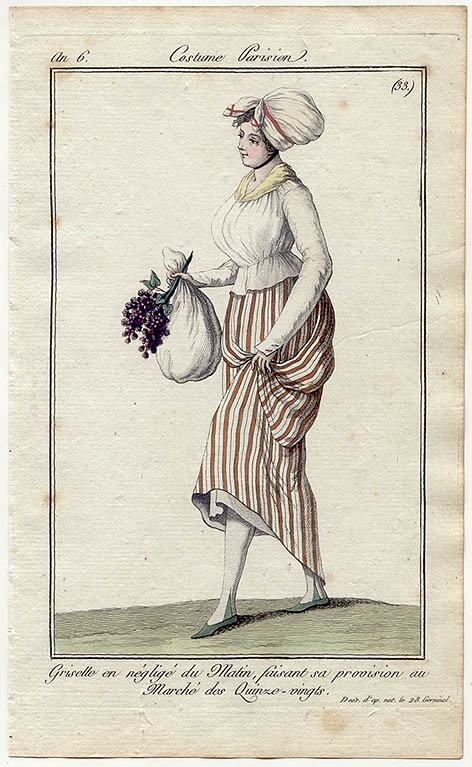
Griselle en négligé du matin, faisant sa provision au Marché des Quinze-vingts
Griselle en négligé du matin, faisant sa provision au Marché des Quinze-vingts
Very roughly, Griselle, in morning undress, goes to the “Three Hundred” market for provisions.
Said to be on Paris maps of 1760 and 1771, the Quinze-vingts Market was probably razed for the Rue de Rivoli. Interestingly, the major ophthalmic hospital in Paris is the Three Hundred, and there has been a Three Hundred hospital since 1260. (Sorry, Mr S: even in history, there is no escaping hospitals or eyeballs.) The neighborhood takes its name from the hospital, so Griselle is headed to her neighborhood market. You wouldn’t go far from home in négligé du matin.
Let’s look at what she’s wearing: It’s the reenactor’s frenemy, the short gown. Griselle here is post-1789, check the raised waist line and the non-cone bosom shape. Is it 1790, 1792ish? Probably in that range. If you don’t want to wing a version of this based on illustrations and Costume Close Up, you can get a pattern for a similar garment. It was workshop tested; my version is here.
What I like are the basic details: turban scarf, kerchief, simple short gown, striped petticoat, clocked stockings, slippers, just a bundle for the market.
The simplicity is key here, also tiny details. Look at the end of her sleeve: buttons. This is fantastic news for those of us who need to get our enormous hands through slender 18th-century sleeves. It’s taking a lot of will power not to head down to the stash and start on a mock up of this short gown right this minute…
The silhouette matches the pouter-pigeon, full-bust look of more formal wear of ca. 1792, so I don’t think she’s gone stay-less. The striped petticoat could be cotton or linen; Wm Booth had some variegated stripe linen that could work for a version of this. Are we seeing her shift, or another petticoat under the stripes? It’s so similar in length, and her shape so full, that I think it is second petticoat and not shift.
The stockings and what I will call their clocks, but look like decorative gussets, that coordinate with the slippers, are a nice touch. Visible beneath this shorter hem, they provide another bit of color and decorative accent to this plain look.
If I didn’t have those guys to sew for, this is what I would have chosen for Peasants and Pioneers. Not that I don’t love my boys…but menswear is time consuming.
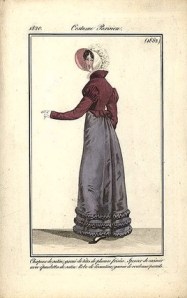
For no good reason, I’ve been feeling 1820ish. This is a huge distraction from my primary objectives, which for the short term are 1775, 1799, and points in between. The in-betweens depend on what unit Mr S is fielding with, and at which event. Monmouth, for example, is the 235th of the battle fought June 28,1778 in New Jersey. The Second Helping regiment was at that Battle, (I checked the order of battle and know from diaries like Jeremiah Greenman‘s) and that means that his regular old hunting frock (called the “fluffy shirt” by my Facebook friends) would do, if—and only if—he fields with the Second Helpings. If not, then it is another piece of work altogether. Major casualties at that engagement were from heatstroke, by the by, so it may be that wearing two layers of wool in New Jersey in June is not recommended by most physicians.
But I digress, yet again.
I am feeling 1820sish because Robert Land has, at long last, shipped my Regency Lady’s Boots. They should arrive by Saturday, and for having ordered them in mid-October for a mid-January event, we are actually on fairly normal Robert Land time. Sigh. I’d get mad, but the man’s shoes fit my pedal extremities, which really are colossal.
So the boots are on their way, in green, and while they won’t be exactly like these, they can be modified, with blue laces to begin with, and tape later.
And that has led me to think about the obstreperous bonnets of the 1820s, like this fantastic quilted item from the MFA,
Quilted Bonnet, MFA
There are dresses at the V&A for which I have comparable fabric, and Spencers at the Met, and many fashion plates to delight (see the Pinterest board. I may not get any of these things made, but they’re fun to think about—especially the bonnets.
This is all supposed to be fun, isn’t it? It’s surely more fun than moving 18,240 books (some of them twice) which we did this past week at work.

![[An amazonian dress]. London : Pubd. May 26, 1797, by G.M. Woodward, Berners Street. Lewis Walpole Library Image Number lwlpr08972, Call Number 797.05.26.02](https://kirstenhammerstrom.com/wp-content/uploads/2023/03/0a76a-reverse_lapel.jpg?w=370&h=485)



 Kirsten Hammerstrom
You must be logged in to post a comment.