Robe à la Polonaise ca. 1775 British silk Length at CB: 56 in. (142.2 cm) Purchase, Judith and Gerson Leiber Fund, 1981 MMA 1981.314.1
Scrolling through Pinterest lately, I was struck by how different two presentations can make one gown look.
Above, a lovely Ikat-type silk gown with en fourreau back and trim, center front closing and probably a little closer to 1778 or 1780 than 1775.
It’s presented on a mannequin that supports the gown for photography and allows us to see it clearly, from the trim at the neck to the pleats down the back and the pleasant fullness of the skirt.
The gown is shown, we get the details.
And then, in another image, another view.
Robe à la Polonaise ca. 1775 British silk Length at CB: 56 in. Purchase, Judith and Gerson Leiber Fund, 1981 MMA 1981.314.1
In this image, the gown (and its companion) have been styled and accessorized, fichus, hats, ribbons, sashes. The skirt is more fully and completely supported, showing off the silk to even better effect. We lose the trim and pleating details, but the gown is much more attractive in this view.
This is not meant to criticize the images or the handling of the costumes, but to point out that you have to look past the plain record shots in museum databases, and see the gown as it would have been worn. Working with database images, and re-creating garments from those images, requires a leap of imagination.
The more you look (at database photos, exhibition photos, extant garments, fashion plates, other re-creations) the better you will be able to imagine the garment as it might have been, and to make it yourself.
To be fair, original garments cannot always be mounted in stylish and appropriate fashion, but they can still tell us something. The more you look, the more you’ll see.
For this challenge, I initially thought I’d be working on the compere fronts for a silk sacque, but then I took another look at the calendar and realized March was awfully close! Instead, I opted to spend the past week working to better understand the Quakers, especially Quakers in Rhode Island, in advance of a program in early March. (I did do #1, Make Do and Mend, but do you need to know about re-stitching a petticoat binding?)
‘Quaker’ bonnet
To help get myself out of a sewing rut and panic, and a general malaise, I made a bonnet. A ‘Quaker’ bonnet. Bonnets are like cupcakes: delicious, sugary, but lower in calories and committment than a full garment.
Quaker bonnet ca. 1800, Nantucket Historical Association, 1928.54.7
Quaker women in the late 18th and early 19th century did not, as far as I can tell, wear the black ‘sugar scoop’ bonnet we now associate with Quakers.
There are numerous entries in Amelia Gummere about bonnets, and types of bonnets, and the reflection of particular sects of Quakers in the pleating of the bonnet caul. But early in the 19th century, at the dawn of the Age of Bonnets, Quaker and non-Quaker styles seem to have been closer.
Fashion Plate: Promenade Dresses, 1801. Museum of London. 2002.139/1397#sthash.YsOpwKG2.dpuf
The fashion plate from the Museum of London presented a style that I thought I could approximate, and that made sense to me for 1800-1810ish, but I chose an olive green silk (actually yellow and black sort-of-changeable taffeta) because I have seen Quaker bonnets in olives and tans, especially earlier bonnets. Going with a color that was less distinctive, and a form that was undecorated, seemed to me to strike the best balance between plainness and style in this time period.
I chose this for innovation because the new bonnet forms of the early 19th century are departures from the full, round, pudding-on-the-head styles of the late 18th century, and the Quakers took it a bit further. In standardizing the appearance of their bonnets (simple, unadorned, eventually ossified in form and signaling sect in pleat patterns), the Quakers were innovators in clothing as outward symbol and sign of inner faith and affiliation.
There’s your rationalization, how about some facts?
The Challenge: HSF # 2,Innovation
Fabric: Sort-of-changeable black and yellow silk taffeta in olive green for the body and ribbons, white linen for the caul lining and brim interlining, white poly taffeta for the brim lining, and pasteboard for the brim.
Notions: Thread, PVA (acid-free white glue for book binding)
How historically accurate is it? Well, white poly taffeta aside, pretty accurate. All hand-stitched and assembled in a period method. Gentlewomen can disagree about accuracy of style, but we could call this a plain bonnet ca. 1803 and be safe. After March, I can decorate the bonnet. The poly will remain, so, well, 60%? (How many points from Gryffindor for using the right weave in the wrong fiber?)
Hours to complete: Five, perhaps? These are quick, so five would be from start to finish, not including agonizing in advance.
Mr S’s day took a bit of turn.
First worn: First by Mr S, who wasn’t feeling well, but to be carried along by me on March 7.
Total cost: All supplies came from the Strategic Fabric Reserve and chip board depot. It takes so little of anything to make a bonnet…maybe $2.50 in silk, $3.00 in linen, .50 in chipboard, so $6.00? (The silk came from the remnant table at $10/yard, chipboard is $2.00 a sheet, and linen about $12/yard.)
Les Oublies. Le Bon Genre Plate 79: three ladies and a child look at a sundial in a garden, watched by a man. August 1815 Hand-coloured etching. British Museum 2003,U.14
I was first attracted to this image by the gentleman and his shapely legs, as you might expect, since tight buttoned gaiters or overalls do turn my head. This plate doesn’t make much sense to me: I can’t really grasp the satire, I can only guess. The explanation given for the series doesn’t help immensely. “The series is devoted to costume, mostly set in fashionable interiors, but the plates are treated in a semi-caricatural, humorous way that links them with French social satire.”
My best guess is that this plate from 1815 is showing off the latest filmy white fashions and tiny pink Spencers in contrast to the forgotten origins of the classical influence, personified by the gentleman in common dress at left. His hat and the gaiters suggest the French revolution, now forgotten (see “oublier” though the reference is also to the small cakes being eaten by the woman under the tree). The clock provides a reference to the passing of time, and forgetting, but I don’t think it is actually a sundial. The strap makes it look as if the man can carry it, and that’s a needle, not the fixed vane of a sundial.
Whatever it all means, I do find this more interesting for the man’s clothing than the women’s; after a while, the subtle differences between white columns is lost on me, but that’s a pretty interesting buff-colored waistcoat.
Remember the Amazon? She has the dressed-up dog and the Muff of Doom. I’ve gotten a little obsessed with her, and that obsession has led to some interesting places.
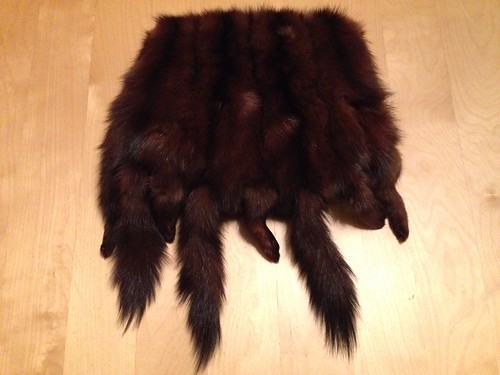
The Muff of Dooms Past. Poor minks.
For one thing, it’s winter, and everybody has cold hands, so everybody is making muffs.
Here at Crazy Scheme Central, I had thought about making the great Ikea sheepskin Muff of Doom, but that’s a place I generally don’t go until after the Christmas madness, when the store in Stoughton does look as if it had been plundered by orcs.
Instead, I bought a Muff of Dooms Past at an antique store. I wouldn’t buy a new real fur anything, and I do feel bad about the poor minks, but at least no new minks were harmed. Or sheep. But golly, it’s soft and delicious and it’s easy to see why people wanted fur, given that we’re essentially hairless mammals. It measures 11 inches high (not including decoration) by 11 inches wide at the narrowest point, and 14 inches wide at the base.
Pupils of nature Maria Caroline Temple delt. ; TS. sculp. London] : Pubd. April 30, 1798, by S.W. Fores, No. 50 Piccadilly, corner of Sachville [sic] St., [1798]. Lewis Walpole Library Call Number 798.04.30.01+
The Muff of Dooms Past is not nearly as large as the Amazon’s muff, or as large as the ones seen in fashion plates and satires. The sad little tail-and-paw fringe has precedent (see left), though I believe at least one tail has been lost. As far as I can tell, with no label, this is probably a 1950s muff of local manufacture (there is a fur company, now in Warwick, that started in Providence, and is now going out of business). It could be earlier, but the flexibility of the pelts suggests a more recent vintage.
The Met has some fantastic late 18th/early 19th century muffs of a color that screams warmth. The size of the brighter one is just 8 by 7 inches. In case you think that’s anomalous, here’s another muff of similar type and size.
Muff, early 19th century.
French, of feathers, wool MMA 2009.300.1397
Muff, third quarter 18th century. British of feathers, fur
MMA 1984.101
They seem small compared to the Amazon’s muff, and even the Student of Nature’s. And yet, there they are. It’s hard to know exactly where the measurements were taken, and if they include the extreme fluff of the feathers; I tend to think not, but that the measurements are for the firmest part of the muff. (That’s how we would measure, and then include the largest “fluff” measurements in a ‘special measurements’ field with a note.) There is a 1780-1820 swan’s down muff at the V&A with a record but no photo or measurements.
Satires are hard to use: we know they’re depicting some grain of truth, usually in the background details, but also in what they’re portraying. How do we interpret those enormous muffs? They appear over and over, in consecutive years of satirical engravings and fashion plates. Maybe the way to interpret them is to see those muffs as the extreme end of fashion– Alexander McQueen muffs, if you will– and the extant muffs represent the more reasonable dimensions of fashion. I wouldn’t call red feather muffs typical, and I wouldn’t suggest we all carry them. But based on what exists in museum collections, maybe a smaller-than-satire muff is within the bounds of reason for actual use.



![Pupils of nature Maria Caroline Temple delt. ; TS. sculp. London] : Pubd. April 30, 1798, by S.W. Fores, No. 50 Piccadilly, corner of Sachville [sic] St., [1798]. Lewis Walpole Library Call Number 798.04.30.01+](https://kirstenhammerstrom.com/wp-content/uploads/2023/03/9a3bb-lwlpr09239.jpg?w=267&h=300)


 Kirsten Hammerstrom
You must be logged in to post a comment.