1813 Bonnet of untrimmed velvet, Redingote of Merino
1817 Velvet bonnet and broadcloth coat
I cannot manage to find the button I need to sew onto my real-world everyday winter coat, but I’m pondering and plotting how much broadcloth a Redingote (Redingcoat or Redingcote) would require, and internally debating the merits of red versus green.
Greatcoats have their attractions, and while Mr S would undoubtedly enjoy the warmth of a greatcoat, with a February 14 program in the offing, I am pondering a greatcoat of my own.
I can rationalize [almost] anything, but a Redingcote is a stretch even for me, despite that February program (indoors). I suppose the real appeal of one of these coats, aside from the pleasure of handling delicious green or red wool, is the challenge of making one. I have even found a front view to aid in the patterning.
1813 Hat of velvet and broadcloth coat
What stops me? Some unfinished projects, and a certain feeling of unease about buying quantities of expensive wool. I have two yards of dark green broadcloth, but I’m pretty certain that I will need three to make even the shorter red coat. Without making a firm resolution, I had determined that I wanted to sew down my stash–and I suppose the answer is to sew it down, or put it on Etsy. Or to buy the wool, make the coat, and wear it in the winter. It would be a spur to winter program ideas, after all.
Now, if only I could find the missing button from my winter coat…
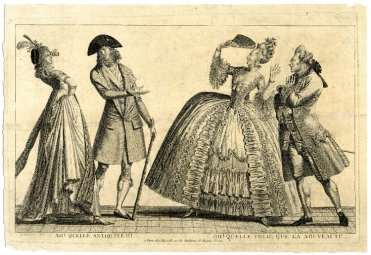
Ah! Quelle antiquité!!! Oh! Quelle folie que la nouveauté … Engraving, 1797. 1892,0714.755 British Museum
Regency, Federal, Early Republic: we use these terms to cover (roughly) the period from 1790-1820, though technically the Regency period would mean only 1811-1820, when George IV served as Prince Regent, ruling for his incapacitated father, George III. In the United States, “Regency Costuming” is a bit of misnomer if you’re copying early American gowns, but it does serve as a handy short-hand we all tend to understand.
Grossly, the principles of dress are rooted in neo-classicism and republicanism rising from the American and French Revolutions. Specifically, we see a turning away from the heavily-boned, panniered, and formal gown styles to the looser, short-stayed, flowing, simpler gowns. The transition is summed up for me in this satirical print.
So, you’re no longer side-to-side wide, baby: you gotta have back.
How do you get back? There are a couple of perfectly authentic tricks that do not require you to stuff a cat into the back of your dress, though you can do that if you want. The combination I have found to work is two-part: a small, crescent-shaped pad, and the method of pleating. How you deploy the pad and the pleats will give you the silhouette you desire.
First, though: which silhouette? In really the 1790s, the silhouette is rounder than you might think. It really is a round gown.
Ann Frankland Lewis, 1793. LACMA
The Frail Sisters, 1794
To get that look, I use a small rump pad, bustle pad, or bum roll (call it what you like), which is stitched to the inside of my petticoat.
Pad from the inside
Pad from the outside
That’s the white IKEA curtain petticoat I made during the extended snow days of last year, and which I have worn with the red curtain-along open robe and under the petticoat and open robe for What Cheer Day. The pad is the same natural light-weight linen I use for a many gown linings, filled with bamboo stuffing. If I’d had wool on hand in the small hours of the morning I made this pad, I would have used it, but all I had was bamboo in the rush to finish up and have something to wear for a photo shoot.
The other key factors are pleating styles and fabric weight. Pleats can add lift, but in general, the lighter the fabric, the more lift a small pad will give you.
Double and triple box pleats, exterior view
Double and triple box pleats, interior view
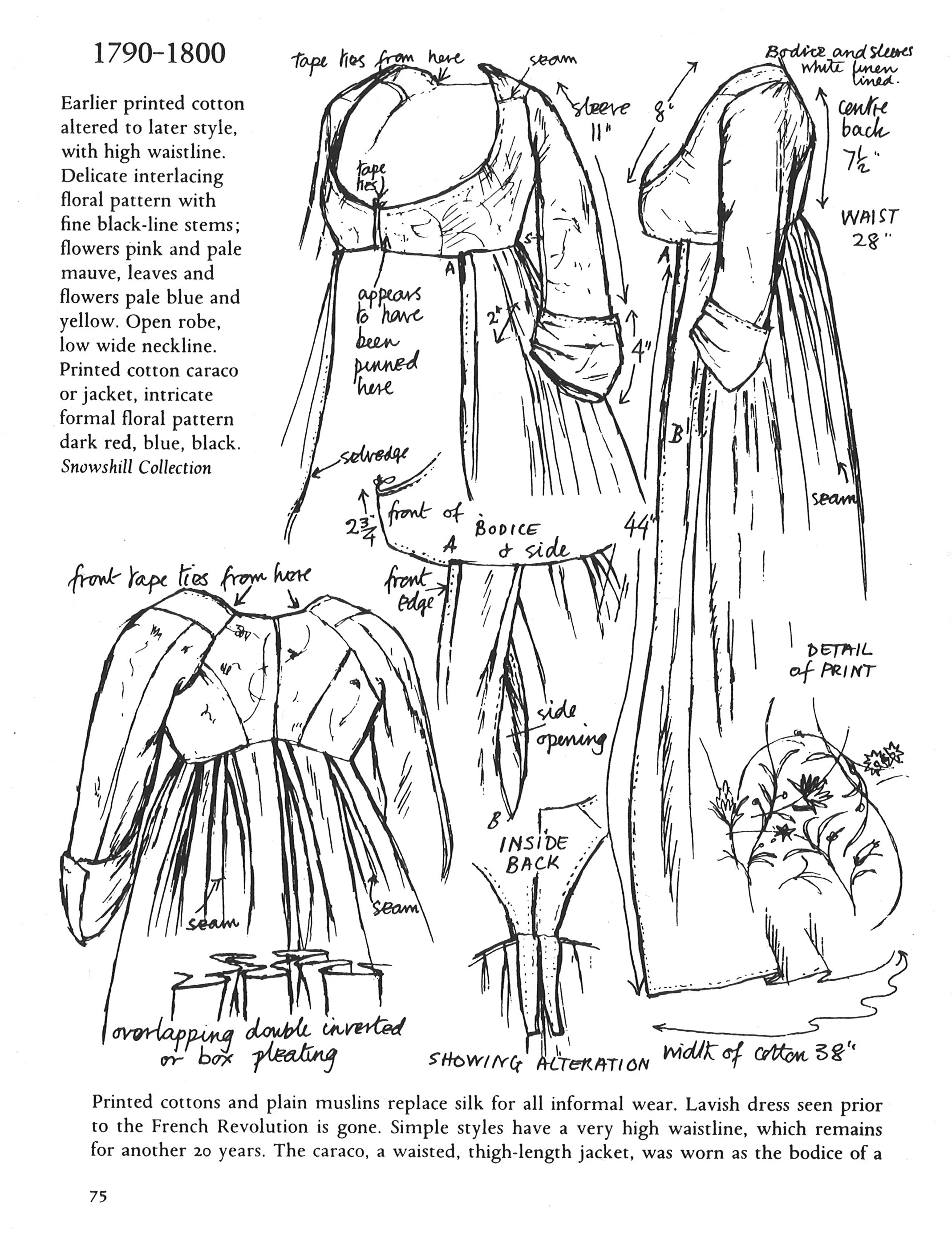
I’m particularly fond of the pleats used for the gown shown on page 75 of Nancy Bradfield’s Costume in Detail. I’ve used this as a guide several times, and I am very pleased with the results. They do vary, of course, depending on fabric weight, fibre, and length. Stiffer cottons, like the Waverly Felicity of the curtain-along gown, will make a round shape; tropical weight wool does fairly well, also, but the most amazing 1790s rendition I have achieved to date is the light-weight India print cotton short gown.
On Cassandra
On me
Now that’s 1790s back. The bustle-like shape surprised (OK, shocked) me, but on the whole, I think I’m pleased. So there you are: pad, petticoat and pleats: that’s how you get back.
Day dress of roller-printed cotton, 1810-1815. Susan Greene Collection, GCVM 90.25
Lately, I have developed an obsession with this roller-print day dress from the Greene Collection At Genessee Country Village Museum. I first encountered it on the 19th US Infantry’s website, a haven for those of us consumed with the early Federal everyday.
The 19th US site provides more photos and a drawing of the dress, so that if one were to become impossibly obsessed with the dress, one could recreate it. And if one were up late nights, one might consider how to create a copper-engraved roller for printing cotton.
Johann Klein dress, 1810
A more productive line of thought might be to consider this fashion plate, found during an early-morning Pinterest session. I think it gives us a sense of how rapidly fashion crossed the Atlantic (just as quick as engravings could be printed and bound into magazines, and boats could make the trip), and how avidly women copied the latest fashion.
That avidity would have been tempered by access to fabrics, but the resemblance between the dress at Genessee and the fashion illustration is striking, indeed.
Portrait of a seated young lady, watercolor on paper by Anna Maria von Phul, 1818. Missouri History Museum, 1953 158 0013
Ladies’ Monthly Museum, v. 5, plate 71. July 1, 1816. Casey Fashion Plate Collection, Los Angeles Public Library
Anna Maria von Phul’s delicate watercolors of Saint Louis in 1818 (example at left) remind us that cities in the hinterland of America have never been as far behind the times as coastal dwellers might imagine. As a former resident of the Great Fly Over, I know how defensive people can be about their relative sophistication, and that could be why our Young Lady here appears slightly defensive in her posture.
The young lady is certainly fashionable in that white gown, and literate, too, though we cannot see what she is reading; perhaps Maria Edgeworth.
It took some doing to find a similarly posed and dated fashion plate with a book, for fashion has always been more fantasy than reality.









 Kirsten Hammerstrom
You must be logged in to post a comment.