Driving Miss Lady

In the midst of loading the moving van, the Giant cut his thumb. 18th century pocket knives are no substitute for 21st century tools.

Or, where I’ve been, what I’ve been up to, and why I haven’t posted.

Six weeks ago, I left the museum where I’d worked since the Giant was a toddler, and the duplex I’d lived in for more than a decade. I spent the next two and half weeks packing up my possessions and pondering the benefits of minimalism.

Three weeks ago, I was southbound on I-95 with my ridiculous cats and an assortment of baggage (of which I have a great deal). It’s such an American act, “lighting out for the territories,” as Huck or Laurie Anderson might have it, setting off for someplace new, spurred by an itch similar to Pa Ingalls’.

After an 8 hour drive that culminated in extreme excitement and some confusion on the Beltway (Why do some Maryland drivers proceed at speed in a travel lane with their hazards on? Why did that truck think we could occupy the same space, when we both have a corporeal presence?), I arrived in different weather to a new home already occupied by two gentleman cats and Drunk Tailor.

After three weeks, I am nearly unpacked and nearly back to normal operations. I’ve missed a couple of events, including one in central New York I really hated to miss, and few I discovered at the last minute. Still, I am looking forward to reprising my lament for New England as I travel farther south to once again portray a terrible servant married to another terrible servant.

Summery plans to finish in between stitching for the shop

With any luck, the yarn I’ve ordered will arrive before we leave and I can begin the tedious work of tent stitching a wallet in a Rhode Island pattern to remind me of home.

Until I’m working full time, I’ll be making mitts, bonnets, and boxes both for a future millinery shop of the past and for Etsy. I’ve also got two gowns and two Spencers underway, at least one of which I’d like to have before August.

Spring Spencers

Spencers are not unlike bonnets, in my mind. They’re more work than a bonnet, sure, but compared to the layer cake that is an English gown, a Spencer is a batch of cupcakes.

I’ve fondled more silks than I may care to admit (oh, remnant table, how I love thee), and often picked up and put down a small length because it was patterned. Not enough for a gown, just enough for a Spencer. But Spencers are always solid.

No, they’re not.

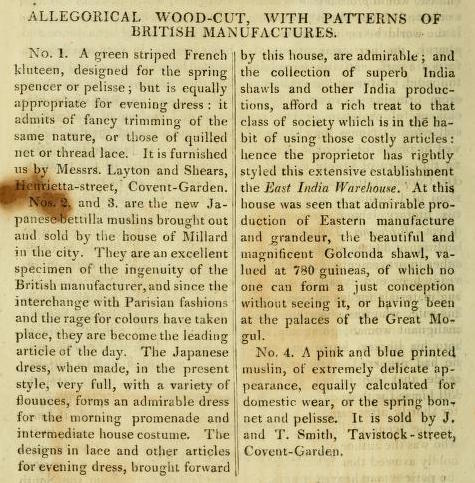
Allegorical Wood-Cut, with Patterns of British Manufactures. May, 1815. Ackermans's Repository of Arts, etc. Volume 13.
Allegorical Wood-Cut, with Patterns of British Manufactures. May, 1815. Ackermans’s Repository of Arts, etc. Volume 13.

It’s a Homer-quality forehead-slapping moment.

Caption, Allegorical Wood-Cut of British Manufactures. Ackermans's Repository of Arts, etc. Volume 13, May, 1815. page 298
Caption, Allegorical Wood-Cut of British Manufactures. Ackermans’s Repository of Arts, etc. Volume 13, May, 1815. page 298

Not only are there extant cotton roller-print Spencers, and wild printed cotton Spencer ensembles in North American collections, there’s print evidence of patterned silks for Spencers. Somehow, until I came across this plate and the description in Ackermann’s, I could not make the leap from cotton to silk.

Despite the existence of this.

My sole defense is that one patterned Spencer is still a zebra among horses.

But additional evidence, in the form of recommendations for spring in Ackermann’s? The zebra’s looking a little more like a horse.

Want more Ackermann’s? You know you do. The links are better sorted here.

Many, many thanks to Mr B for the tip!

Frivolous Friday: Checkin’ it Out

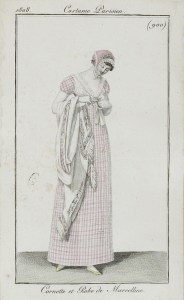
Costume Parisien 1808 Cornette et Robe de Marcelline
Costume Parisien 1808
Cornette et Robe de Marcelline

One gets ideas. I often get ideas about checks. In particular, I get ideas about loud checks. The gown in the fashion plate is appealing, when you’re looking for checks, and all the more so when you know how similar it is to an extant garment in your actual location.  The cornette I can do without– that’s the headgear, which looks like she’s crammed a sugar Easter egg on her head– but at least it could hide a short hair cut or the melting pomade of humid summer.

Costume Parisien 1808 Chapeaux et Capotes en Paille Blanche et Rubans
Costume Parisien 1808
Chapeaux et Capotes en Paille Blanche et Rubans

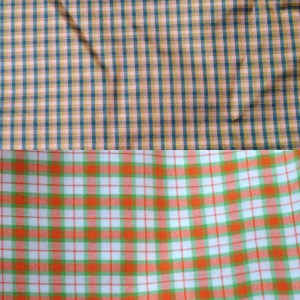
But wait! What check through yonder tastefulness breaks? It is the fashion plate, and  the checked bonnet is my sun. My goodness, that bonnet on the lower left is satisfying. It appeals to me the most because it is by far the most check-heavy bonnet I’ve seen, and making it would not involve plaiting straw, which I know nothing about. It’s a direct trip to obnoxious via silk taffeta, and that’s a trip I’ll buy a ticket for.

Top: check silk taffeta, Artee Fabrics Bottom: check cotton, Mood Fabrics
Top: check silk taffeta, Artee Fabrics
Bottom: check cotton, Mood Fabrics

Actually, as the result of a train ticket last August, I am the proud possessor of some delightfully bright lightweight cotton check in search of a fashion plate. The year I’m targeting (which is not 1808, but 1818) hasn’t yet provided published inspiration, but there are more places to search. In any case, an orange check gown with a blue check bonnet is pretty much crying out to be made. Bring your hanky, in case your eyes water, but make sure it’s check, too.

Reflecting Fashion

Whilst serving as the commandant for a research-paper writing prison*, I spent some time perusing the Met’s digital collections, in particular the Costume Institute’s collection of Men’s Fashion Plates, because, you know, stuff.

I stopped at Plate 002, because I knew I’d seen that coat somewhere before. Why, yes: at the MFA in the Art of the Americas Wing, where I recently spent a pleasant afternoon with the Drunk Tailor. After some initial joy at discovering dust on a teapot, we got down to the business of setting off proximity alarms, reading labels, and contemplating  the occasional neck stock.

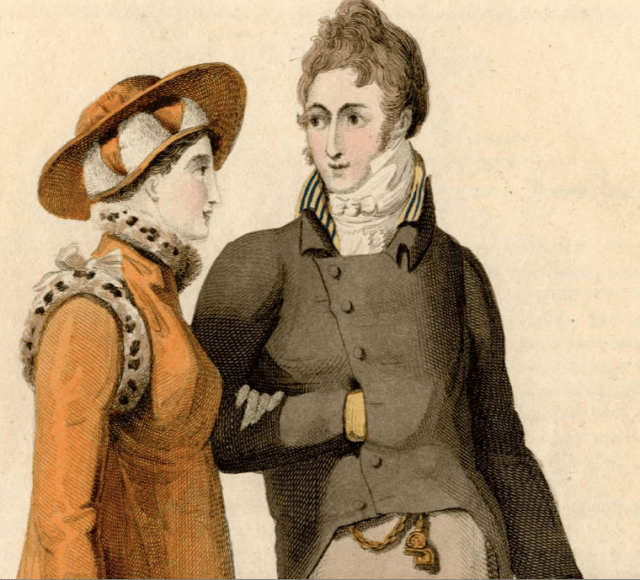
Mr Myers stopped me, though: what a handsome coat. High shoulder seams, long cuffs, buttoned all the way up. Nifty high-waisted grey trousers, too, and what seems to be a yellow waist coat. The portrait is dated 1814, and the fashion plate 1807.

Detail, 1807 fashion plate

Hmmmm…

Men's Wear 1790-1829, Plate 005, 1807. Gift of Woodman Thompson, Metropolitan Museum of Art
Men’s Wear 1790-1829, Plate 005, 1807. Gift of Woodman Thompson, Metropolitan Museum of Art

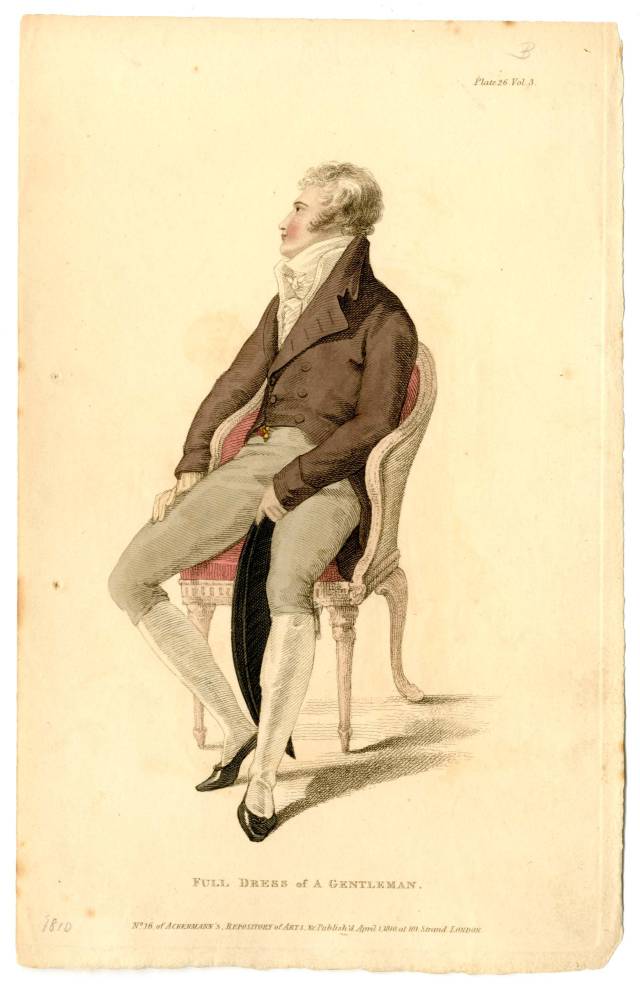
The brown M-notch collar coat is clearly a thing in 1807. It’s popular in 1802. So popular. 1802 on the left. On the right, 1812.


And our friend Sully paints one in 1814.

After seeing Copley and other early American painters use English prints as references for portraiture, I wondered if Sully was at all influenced by fashion plates, and then to what degree American men and their tailors were influenced by published fashion plates.

Portrait of the Artist. Thomas Sully, 1821. Metropolitan Museum of Art, 94.23.3

Brown coats are clearly classic: Sully’s got one himself in 1821. I’m sure there’s a dissertation out there somewhere on the influence of fashion plates on American men’s  fashion and representation in portraiture–  I can almost remember stumbling across the reference. So that echoes and re-echoes and reflects through time even as I recall not just the the folk wisdom about brown suits, but the significance of well-tailored suit. Maybe from 1802-1821, brown is the new black.


*Ah, teenagers. The Young Mr failed to complete a paper by the due date, so I spent some quality time ensuring he got back on track.