Pink on My Brain

I no longer remember where in the wilds of the interwebs I found this charming servant, but find her I did, three years ago. I probably came across her researching servants, and found her striking (since she is), so saved the image while moving on to Pyne or Krimmel for more geographically appropriate sources. Still, I’d picked up a remnant of brown and pink printed cotton at Genesee, and had a start to this ensemble.

A scrap of that print was in my pocket when my dear friend (formerly m’colleague) and I went took the train down to New York for a fabric spree. We went in late June (Genesee was early that year), trying to use up vacation time so we didn’t lose it before the end of the fiscal year– any year I didn’t have a hip replacement, I tended to lose a week of vacation so we were motivated to take time off.
I remember that my favorite dress demonstrated a peculiar friendliness, and required a safety pin for modesty’s sake. I remember m’colleague being overwhelmed in the crosswalks at Herald Square, and taking her hand to get her through the sea of bodies and cars. (She grew up in a very small town in northern Rhode Island, where apple orchards were within walking distance; I grew up on the north side of Chicago, taking the bus to the Loop.) But at Mood, I found the fabric that I knew would make the petticoat.

Pink tropical weight wool, don’t ask me how much a yard. I don’t remember, but it was certainly more than I’d paid for any fabric before, with the exception of silk dupioni I bought for a wedding dress. Madness, I thought– but beautiful madness. I started on the short gown (see above) with an extant European garment as inspiration (probably found through Sabine’s work); then I started on the petticoat.

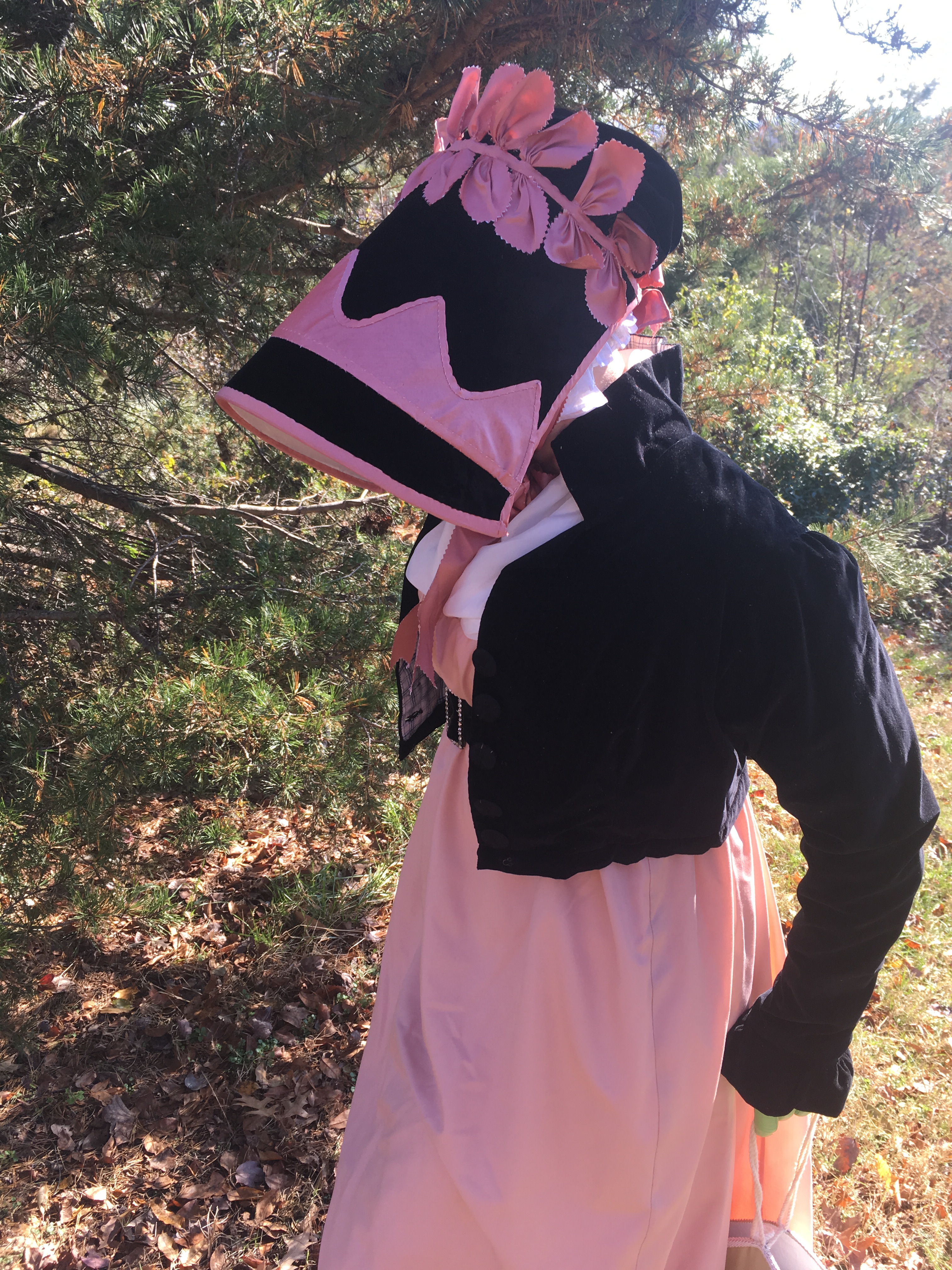
And promptly dropped the project while I changed my life completely. The short gown I finished, and wore as a housekeeper for some Wednesday afternoon programs, but I never managed to get that petticoat finished– until this past week. The pink and black bonnet needed an ensemble, and half of it was present, in the form of the Spencer.

But what I wanted to do was to recreate that plate, short gown, cap, and all. I’m still short the black silk apron, and my cap will always be Anglo-American, but I got close enough to be satisfied that I reached the goal I set three years ago. What I did discover in trying to replicate this image was slightly unexpected, and entirely useful. Just as fashion images are exaggerated today, so too were they exaggerated in the past. M’lady in the image at top is elongated– I’m nearly six feet tall, and I cannot achieve her length. Granted, the waist on my short gown is lower than hers, but still: she’s drawn as if she has the proverbial “legs up to here.” What’s useful about this, and about trying to recreate images from the past, is that these exercises reveal some of the foibles and preferences of the past, which help us see past the filter of the present and get closer to understanding the past.
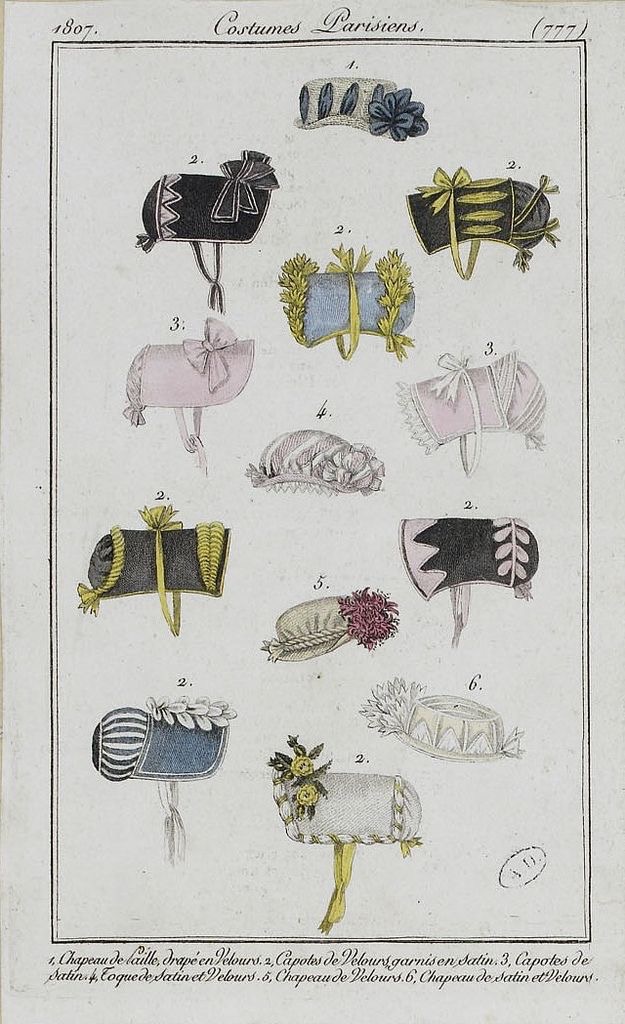
Capote de Velour garnis en satin

Costumes Parisiens, 1807

This plate has stuck with me for years: those mailbox shapes, in velour! In 1807, velour was not what we think of today (and I don’t mean Zapp Branigan). Valerie Cumming’s Dictionary of Fashion defines velour as “Wool or wool mixture cloth, soft and smooth with a closely-cut pile or nap resembling velvet.” Not having access to wool velour in the scrap bins at work, or in the fashion aisles at the local fabric store, I opted for velvet; the scrap bin provided pink silk taffeta, which I thought made a nice contrast to the texture and finish of the velvet. It is true that “velure” dates to the 17th century, and describes imitation velvet. The wool velour I’m familiar with from upholstery is too dense and heavy to drape well over a bonnet (it’s really made for sofas and armchairs), so erring on the hand of the fabric seemed a reasonable choice. Wool velour with silk satin would be an amazing textural contrast, but with this color combination, almost any fabrics will give a pleasant optical shock.

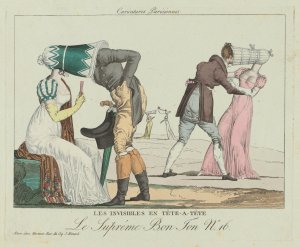
French 19th Century, Les Invisibles en tête-à-tête (Tête-à-Tête with Poke Bonnets), c. 1805, etching with publisher’s hand coloring in watercolor on pale green laid paper, Katharine Shepard Fund 2015.49.4

Shaping the brim was an exercise in paper and pasteboard, winging it a bit until I achieved a length and width that was mailbox-like but not too drainage tunnel. The cartoons of the period make clear that these are deep brimmed bonnets. I do like that the bonnet on the left is trimmed so like the ones in the fashion plate; the one at right is probably corded or reeded, judging by the ridges.

The trickiest bit was shaping the silk to the compound curve of the brim. Three patternings got me there– until I realized the silk needed body to hold up to binding, and took a short cut. Ask not of the sin of fusible interfacing, for I have learned my lesson. Yes, the silk piece shrank and no longer curved evenly from the front edge. Thank goodness Drunk Tailor was watching The Pacific, so any foul language I may have used was disguised by movie dialogue. The binding is bias-cut silk, easy enough. After the debacle of the Vandyke trim, I opted not to cut and bind the leaf shapes, but rather to cut the ovals with pinking shears and attach them along a silk band. Would I do it differently another time? Possibly, if only because I like to imagine the different ways an American milliner might interpret a French fashion plate.

Once I settled on making the bonnet, I decided it was time to finish a pink wool petticoat I started in 2015 after a trip to Mood. It’s a tropical weight Australian wool, according to its selvedge, and has a high-waisted bodice with a drawstring closure. I covered the bottom drawstring (and added some bling) with a black velvet belt closed with a period paste buckle. (Every now and then someone doesn’t know what they’ve got, and lets it go for a price I can afford.) On top, the gathered back cotton velveteen canezou/Spencer made for my first trip to Genesee. Having a wardrobe extensive enough to mix-and-match almost the way I do from my modern closet is pretty satisfying, if a little crowded.

This isn’t a bonnet for wearing while crossing a busy street, though it will successfully shelter the wearer and a cat from any sudden downpours, and one is unlikely to get sunburned wearing this. I didn’t find it distracting to wear– but I didn’t go far, and I had a companion. But what price fashion?

Flipping a Lid

In a continuing effort to simultaneously destroy my hands and make all the bonnets, I set out recently to recreate a bonnet in the Met’s collection.

Silk Bonnet, British, ca. 1815. Brooklyn Museum Costume Collection at The Metropolitan Museum of Art, Gift of the Brooklyn Museum, 2009; Designated Purchase Fund, 1983 2009.300.1613

It’s a curious thing, isn’t it, with that flipped-up brim? It looks more 1915 than 1815. But a little looking turned up this fashion plate:

Items 2 and 6, while not of silk, show the turned-up brim seen in this example. (To be fair, the original black and white photo suggests some confusion about the bonnet’s orientation.)

My version is admittedly imperfect, but a home-made interpretation that gets as close as I can (for now). I started with a lightweight buckram frame, to which I stitched slim round caning.

The brim is covered in two layers of the copper silk, and edged on the bottom side with the contrasting silk trim. the crown, or caul, is a simple tube gathered to a silk-covered buckram circle. In the absence of matching (or even sort-of-close) ribbon, my choices are to trim what’s left of the fabric and piece it together…. or start an online-ribbon hunt. At least the extant example has ribbon that’s close but not a match, giving me some leeway if I decide to save my hands for other projects and click instead of stitch.

Frivolous Friday: All of Everything

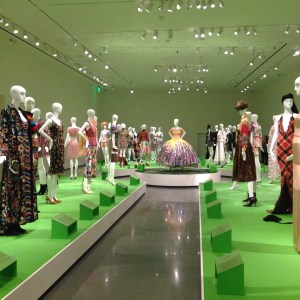
All of Everything: Todd Oldham at the RISD Museum of Art

Some days were made for a bit of hooky. This week, it was Tuesday– though how much can you consider a museum visit hooky when it’s the business you’re in? We took an outing down the street to the RISD Museum, long one of my favorite places in Rhode Island. The Costume and Textiles curatorial staff mount some amazing exhibits, from Artist Rebel Dandy to this latest, All of Everything: Todd Oldham Fashion.

Every time I go to the RISD Museum’s exhibits, I have serious wants, whether mochaware coffee pots or the Chinchilla Outfit– which my grandmother would also have coveted. There was a tinge of nostalgia in the visit, since most of us had lived through the 1990s, and recognized the styles that eventually leached into ready-to-wear from couture. Cropped sweaters. Shrunken jackets. Embellishments. Pattern mixing. Hey– I still dress that way!

Unknown artist Horace Vernet French, 1789-1863 Illustrations from the Journal des Dames et des Modes, ca. 1810 Engraving on wove paper, hand-colored Museum collection INV2004.506
Journal des Dames et des Modes, ca. 1810
RISD Museum INV2004.506

And legit it is, this pattern mixing. Funny how we stick to the same shapes and forms once we find what we like; so much of what I make and wear are variations on similar themes, no matter the century.

For some, dressing in the past is the only time they’re dressing up; their daily style is almost aggressively (or passive-aggressively) anti-style. But when the top hat comes out, look out: they’re dressed to the nines.