Passing Strange

Inspiration: gown, 1740s (silk) remade 1775-1780. Colonial Williamsburg 2000-133

In representing Magdalen Devine at the Museum of the American Revolution’s Revolutionary Philadelphia event, I decided to make a brown silk gown. This is an easy and solid choice for nearly any (every) woman in any location in the Anglo-American colonies in the latter half of the eighteenth century. If you want another option, go blue. But the reason I chose brown is not just because it’s common, or because I have achieved a certain age, but because both Magdalen Devine and Anne Pearson, although members of the Church of England, were associated with prominent Quakers. 

Magdalen Devine, known to Elizabeth Drinker as “Dilly,” accompanied Drinker on trips to Bath at Bristol, Pennsylvania, where the two visited the waters. In what is now Bucks County, these baths were chalybeate or ferruginous, meaning they contained iron salts. These mineral baths,  initially described as “nasty,” were eventually sought for their medicinal uses. (There is a handy book on American spring resorts called They Took to the Waters: the Forgotten Mineral Spring Resorts of New Jersey and nearby Pennsylvania and Delaware.

Devine and Drinker visited Bath several times in July and August of 1771. Drinker seemed hesitant to take to the waters at first, and while it is not clear whether “Dilly” helped her overcome her nervousness, the two made multiple trips over the course of several weeks. Eventually, Drinker recorded sharing a bed with Devine, so the two must have achieved a level of comfort, if not friendly intimacy, with each other. (You can read the diary entries here.

A Lady, ca. 1747-1752 watercolor by Paul Sandby. Royal Collection Trust, RCN 914415

There is nothing in Drinker’s diary to suggest Devine’s appearance or clothing, which, although disappointing, is normal for a diary of the period. But this level of comfort suggests that Devine projected a pleasing, non-jarring appearance and blended in with Drinker and her family and friends fairly well. This could easily be achieved in a brown, grey, or other dull-colored gown. Any of these colors would have been appropriate for Devine, who by 1771 was likely in or approaching her 50s, having been married in Dublin in 1748. (Lest you think Dublin means Catholic, Devine was married at Saint Catherine’s Church, https://www.saintcatherines.ie/our-story, an Anglican church originally built in 1185 and rebuilt in 1769. The Catholic St. Catherine’s in Dublin was completed in 1858.)

Similarly, milliner and trader Anne Pearson is recorded visiting Dr. John Fothergill in London in February 1771. Fothergill wrote to James Pemberton of Philadelphia:         

“Dear Friend,

I have just got the enclosed in time to send by our valuable acquaintance Nancy Pearson, who has been so obliging as to see us as often as her business would permit. We were pleased with it as she acts the part of a mutual Friend; brings us an account of our esteemed Friends with you, and carries back all the intelligence she can get that may be acceptable to you.” Pemberton Papers, Etting Collection, II, 65, Historical Society of Pennsylvania.

I know this is Anne Pearson, because she wrote to William Logan of Pennsylvania describing her meeting with Dr. Fothergill. Anne was known as “Nancy” to her mother and family. “Nancy” is described in a footnote by editors as “A Quakeress, well esteemed in her ministry,” but I believe they have mistaken the meaning of “mutual Friend.” 
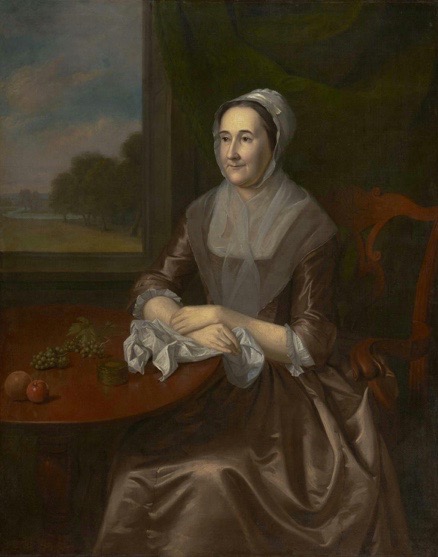
Hannah Lambert Cadwalader (Mrs. Thomas Cadwalader). Oil on canvas by Charles Willson Peale. Philadelphia Museum of Art, 1983-90-2

Did Fothergill assume Anne was a Quaker because she came from Philadelphia? Or did she dress in a manner that suggested she was a Quaker? It would have been easy enough to achieve a level of “plain” dressing with a brown gown and simple accessories like a white handkerchief and apron, and a lappet cap or a relatively unadorned cap. Did Anne and Magdalen (Nancy and Dilly) dress in ways that made their Quaker customers feel at ease? It would be possible to dress both plain and well, with neatly made fine accessories that would appeal to the eyes and instincts of Quakers and Anglicans alike. Perhaps. While there is no way to know for certain, and two passages do not make data, they do suggest something about these businesswomen and their ability to move among and between distinct groups.
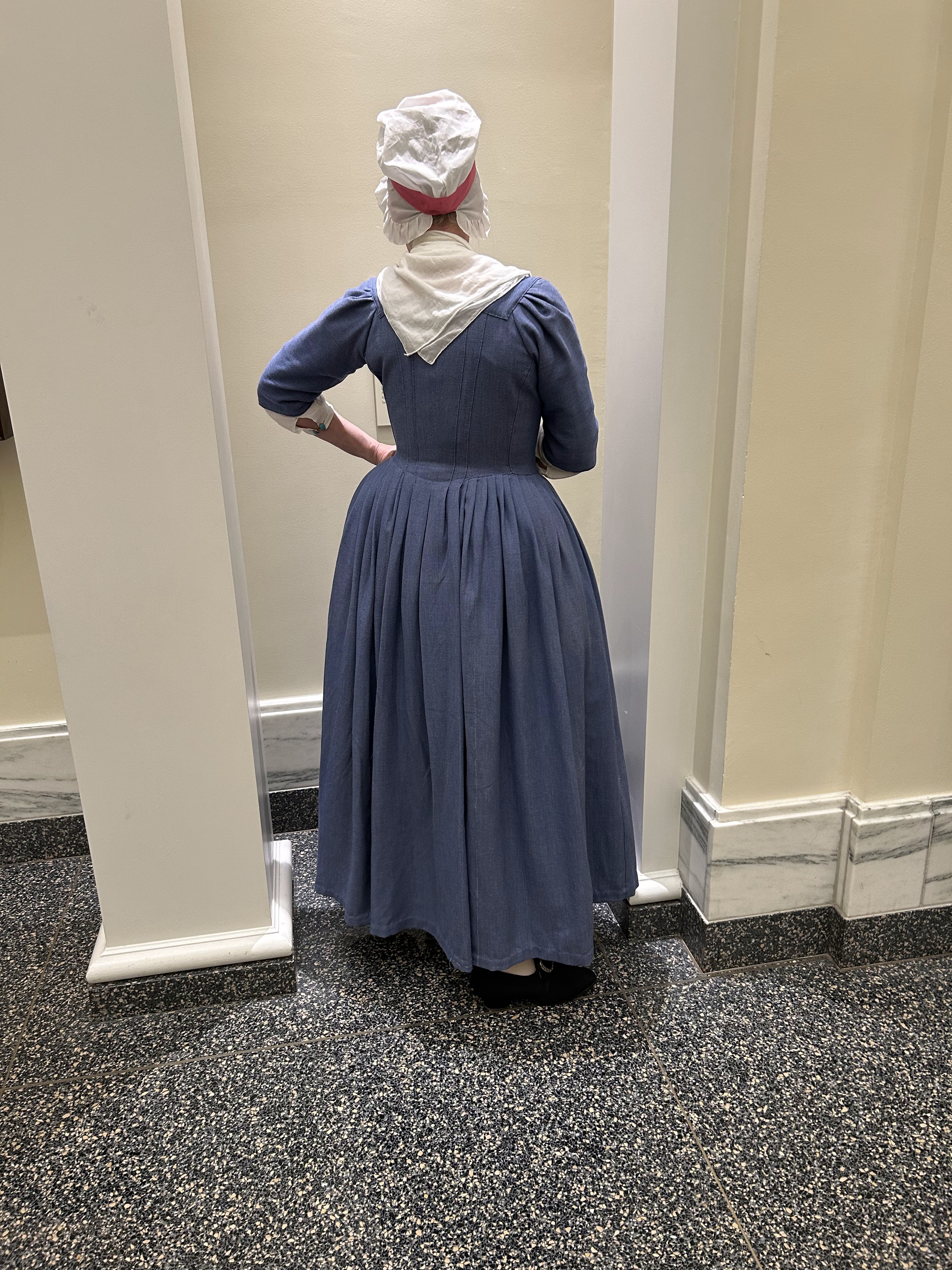
A Blue Homespun Gown

How long does fabric need to ‘season’ in your stash? 

I like to savor yardage for half a decade or so, as once I have fabric I really like, I never think I’m adept enough to use it. I need to build up more skills before I cut into that silk/wool/what-have-you.

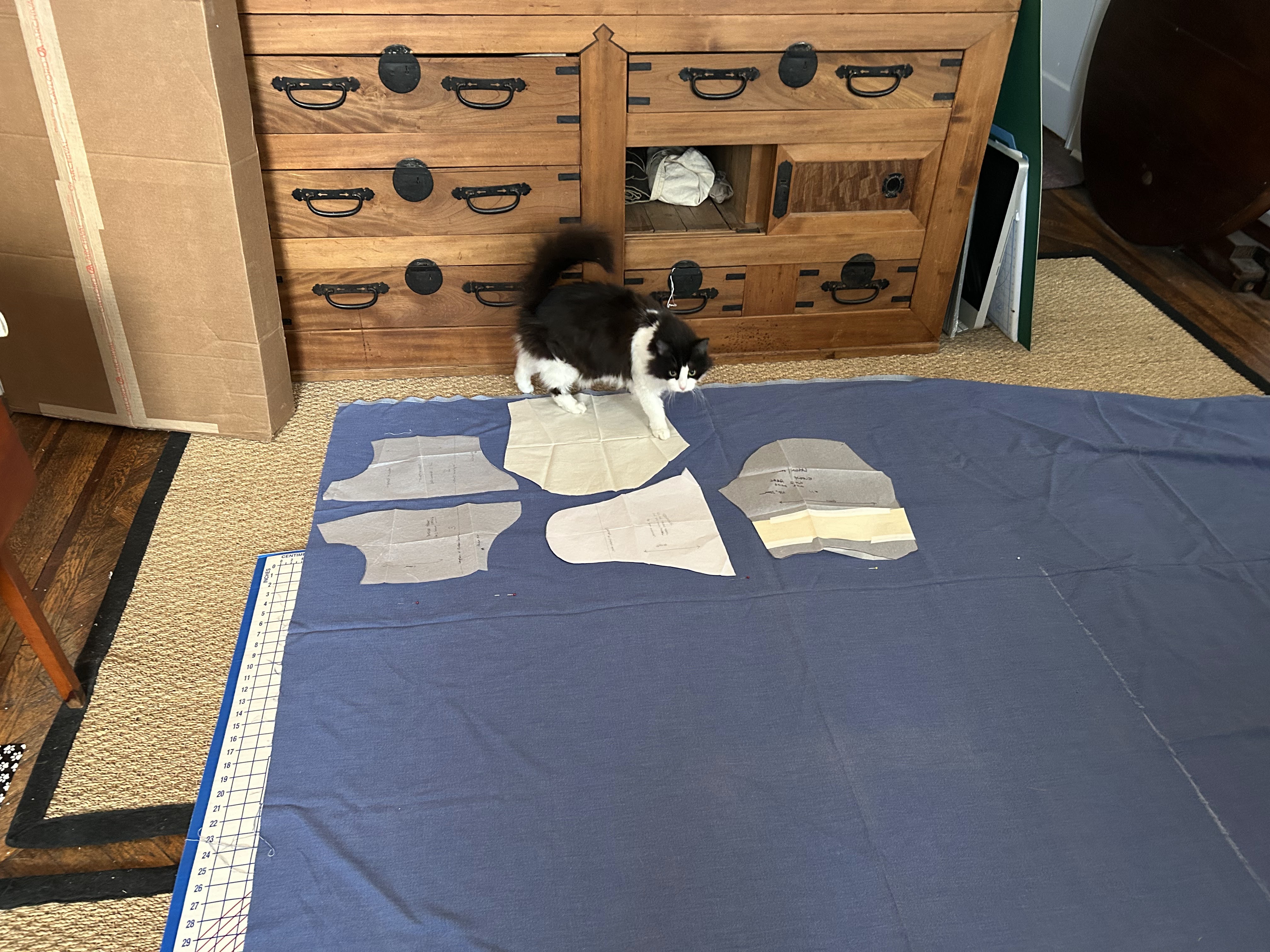
So, five years ago or so, I bought some lovely blue homespun from a friend who had determined she would not manifest her plans for it. It’s the same Burnley & Trowbridge fabric that Mr. K’s 1824 coat was made from, just not washed, and thus retains a smoother texture.

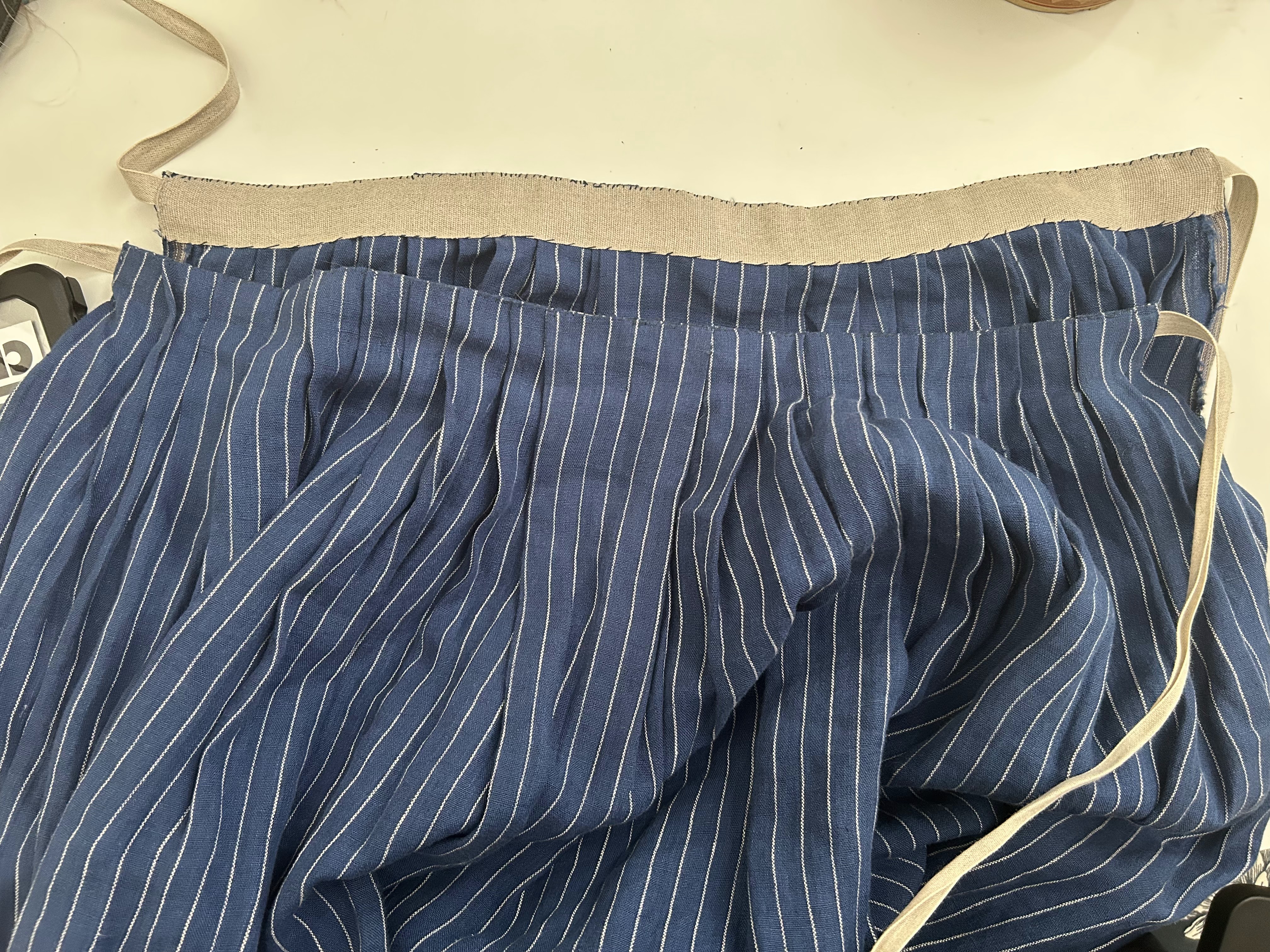
There was not quite five yards, but that never matters. Josie and I argue about whether or not I can make what I have work, and while she always says no, I can usually get an English gown out of four and a quarter to four and a half yards if the fabric is wide enough.

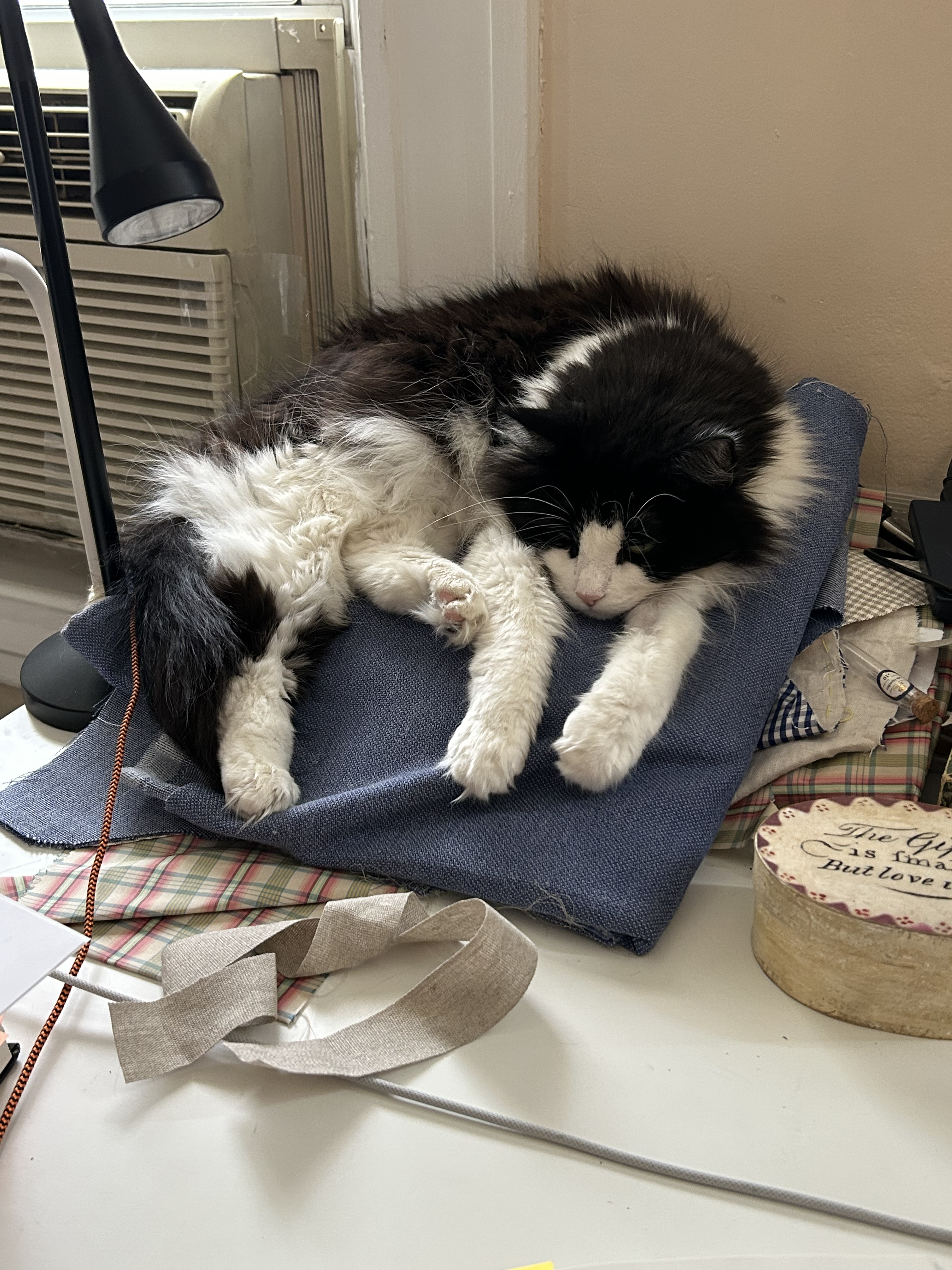
It took long enough to make that the fabric became a bed for the cat.

I was interrupted in the process: I took two classes this semester, taught a workshop, went to a friend’s birthday party in Philadelphia, tried to buy a house, and endured the world. I was glad to get back to the work, though, since sewing is always satisfying. It’s “just” another English gown with a pleated back and stomacher, in classic blue. I wore it to the Makers’ Event at the Museum of the American Revolution in May, just days before my final papers were due.

To make it fully a colonial lady stereotype, I wore it with a blue petticoat. The petticoat was remade from the first gown I ever made. Not only did the gown no longer quite fit, it wasn’t made to the standards I live by now. The linen was far too nice to let sit, another Burnley & Trowbridge fabric from over a decade ago.

Le retour au Baltimore, 1824-2024

The Marquis came back (or his analog did, at least) last October 7, and we were there.

two men in 1820s clothing stand in front of Baltimore harbor. They are wearing tall hats and long coats. The man on the left stands astride a red velocipede.
Hell’s Dandies at Fort McHenry

Way back in January 2024, Mr. K and I were asked by the Museum of the American Revolution if we would be interested in joining them (and their tents) at Fort McHenry to celebrate the Lafayette Centennial in Baltimore at Fort McHenry. Of course, I said yes, figuring that 10 months or so was ample time to prepare. 

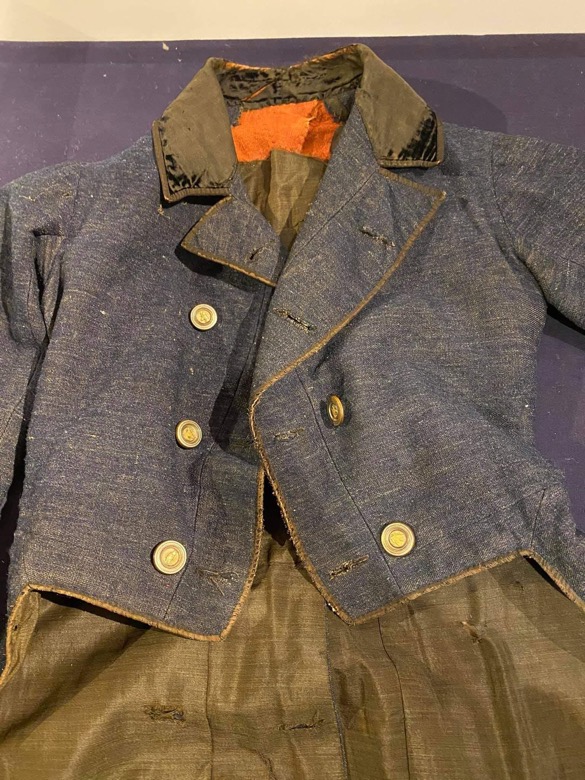
a blue denim coat with a very worn black velvet collar
The coat, posted on social media in February 2021

Reader, I began a dress in a workshop in May. I made another dress to wear and finished it the evening before the event. Why am I like this? (ADHD, I think.) Mr. K needed a new coat, so I patterned one for him to stitch from an older Burley & Trowbridge homespun. In 2021, someone (Genesee Country Village & Museum, maybe?) posted a fabulous image of a coat and waistcoat, which was the primary inspiration, along with coats including a blue broadcloth number at the DAR seen in the An Agreeable Tyrant exhibit. (Sadly, not in the online gallery.)

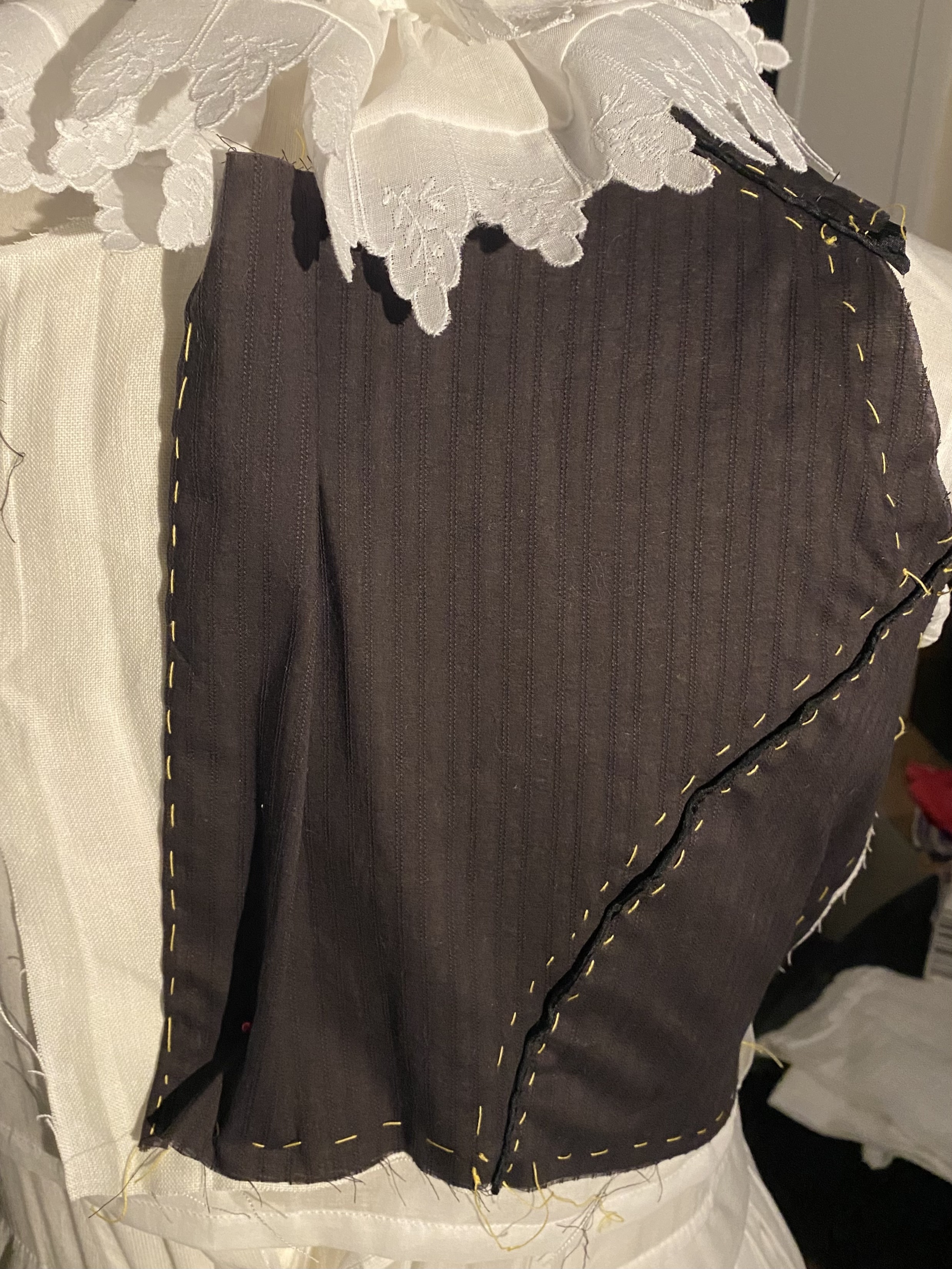
a purple cotton bodice back on a female mannequin, with a frothy chemisette with a pointy collar underneath
In progress: bodice back with piping in place

An Agreeable Tyrant also provided the inspiration for the dress I wore. I had almost too little sheer purple cotton fabric with a woven stripe, purchased at Lorraine Mill in Pawtucket a very long time ago. I meant to make an early 1800s gown, and had even started on the bodice around 2018 when life began to go very sideways and I stopped. I loved the fabric, though, and the deep color. 

I started on Sunday, September 22, and finished on Sunday, October 6. I have a full-time job and am in graduate school, so I’m not entirely sure how I managed to do schoolwork, work-work, and gown-work but I’m pretty certain the One Weird Trick was to do no housework. It’s embarrassing when the cat’s fluffy tail picks up thread and lint, but it is a reliable measure of how much vacuuming is needed. 

The bodice closes in back with a drawstring, which is much the easiest method for me– I did not have time to fuss with the fittings buttons require. The front panel is a gathered rectangle with a band at the top, piped on both the top and bottom edges. A waistband joins the bodice and skirt. The sleeves and skirt were based on shapes I drafted in the Burnley & Trowbridge workshop (I swear I’ll finish that dress). The sleeve has a piped petal cap, which was a pain to make but very gothic, to go with the points that decorate the bodice neck edge, and of which I have no images. Since I had the space at B&T to draft the skirts full-size, they actually work now– astonishing– and make a satisfying conical shape. I’ve struggled with skirts since 2014, and it’s nice to have that solved after a decade! 

gold colored geometric shapes on a white background show the layout of skirt pieces for a historical garment
1820s gown skirt layout

I’ve started using Illustrator to figure out layouts when I am short on fabric. In this case, I only had a little more than 3 yards of fabric, but managed to get what I needed out of what I had. Sure, bigger sleeves would’ve been nice, but I managed long sleeves and that seems like an accomplishment.

a man on a red velocipede followed by a boy on a foot bike
Riding School at Fort McHenry

Mr K. was able to debut his very apt and very dangerous velocipede, another project a decade in the making. We picked it up in February in Williamsburg. It is a handsome and impractical beast, tough to ride, but fun all the same. Charles Willson Peale and his sons had the first velocipede in the States, in Baltimore, so the Fort McHenry “1824” was truly appropriate. We entertained spectators, saw Mr. McC (who also took a turn about the site), and spent the day as very decorative appendages to the Museum’s tents. All in all, a day well spent. 

Sacques-Piration

Once upon a time, I fell in love with cross-barred sacques. The style appealed to me for the way it combined a high-style 18th-century feminine form (the sacque, worn over hoops) with a tailored, streamlined look (the cross-barred fabric). That was 2013. Ten years elapsed before I tried again, without success (i.e. finishing the gown).

IMG_3414After a workshop at Burnley & Trowbridge led by Brooke Wellborn, I realized how little thought I’d given sacques in the past decade, and how little I actually knew. Workshops tend to produce that effect in me, which I why I sign up for them. When, in 2023, I looked back at what I’d been doing in 2013, I thought only of trying to complete the project. Now when I look back, I see so many things I need to change. So long, bodice fronts. So long, pleat stitching. I’m almost sure I have enough fabric left to make those changes. The width of the back pleats on the 2013 sacque suggest a style from a period earlier than I typically represent, but not impossibly early.  Still, they are stitched too far down my back– the pleats should release where the armscye starts its descent to the underarm. Deeper than that, the pleats look clumsy.

As I look even more closely, I begin to wonder if, instead, I need to make that gown over completely, possibly into an English or nightgown. The side pleats are not where I want them;  the back pulls in the wrong direction; and I don’t like where the side seam lands.  There is so much to change.

IMG_5149
Back pleats! Finding the rhythm– but also, notice the direction of the grain. Opposite gown # 1.

The gown I started at Burnley & Trowbridge was made differently from the start. The largest difference was setting a baseline from which to generate the rest of the gown. It’s a different process entirely, which is not to say that one is better than another, only that I understand the results of one better than the other.

Screenshot
Screenshot of the gown at the end of the workshop

There are points of fitting to correct in this new cross-barred sacque, all focused on smoothing the bodice. Whether that can be done while maintaining the initial sleeve set remains to be seen. I can imagine ways to manage that, but it’s definitely sewing without a safety net.