Stay Thy Hand

IMG_6784

Stays. They’re infrastructure: absolutely necessary, a major time commitment, and decidedly unsexy. I am in dire need to two new pairs, one for late 18th century use and one for early 19th century, and each with deadlines looming.

I can manage 19th century attire and Genesee with the chopped-and-dropped corded stays I already have, but New Jersey will not happen at all unless new stays are made. It was like a weekend of penance chez Calash, two straight days of stay mocking up and making.

Of course I bled on them. That’s how I know they’re mine.

IMG_6786

And let’s get this out of the way: I thought backstitching the back seam was a little more difficult on this side, but ascribed it to sore fingers. Wrong! I failed to notice that I was stitching through all the layers, and not leaving one free to fold over and finish.

IMG_0806

A glass of cider and an hour later, I’d rectified the error. These are now fully bound along the bottom edge, and ready for the top edge binding. Somewhere there’s coutil for the straps, and then numerous hand-sewn eyelets later, I will have a finished pair of hand-sewn stays.

New stays deserve a new gown, and since I found this lovely image, I know what that new gown should look like (as well as a portfolio).  Happily, there’s a dress in Cassidy’s book that will serve as a reasonable basis for recreating this image. I’m still pondering the portfolio, and what it might be made of: paper or leather covered pasteboard? As the clock ticks down to June, I suspect I will be using a portfolio I already have on hand.

And then there are the the 18th century stays, with their history of woe.

File_000

I’ve gotten this far with the new 18th century pair, and an interesting business it is. I altered the front side pieces and the stomacher, but cannot see the back well enough (even with a camera and a mirror) to adjust it by myself, so further changes will have to wait until I have some assistance.

The tabs aren’t right in the back, and while the advice is to shorten the stays when the tabs flare this way, I found the fronts were still too low, once again riding at nipple-cutting height. Finally it occurred to me that the problem– slippage–might actually be one of waist. I lengthened the fronts half an inch and nipped the waist in, and found the fit more pleasing.  I suspect the back pieces need to be trimmed a bit before they’ll fit (they’re stitched closed in this version, so you know they’re too big).

Another weekend of work awaits– with focus, those early 19th century stays may be done by then, if there are no more finger injuries.
Bustin’ Out

tightlacing_lg
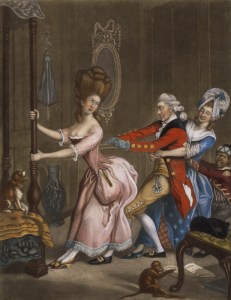
Tight Lacing, or, Fashion before Ease

Grand weekend, right? Spent a happy day cleaning, missed any hints of the reported near-fracas, inappropriate hostility, or snide commentary, and thus had a perfect weekend, you think.

Almost…except of course the whole thing nearly derailed into a visit to the Princeton Art Museum. Why, you ask? The Great April Stay Failure.

Confessions of a Known  Bonnet Wearer are what we’re all about, so here you go: Despite a quick stay alteration that appeared to solve the too-big shimmy, the Stays of Yore continue to chafe and annoy.

Turns out that lacing yourself up the back is nowhere near as effective as having someone else lace you up. Leverage: you don’t has it the way another person standing behind you does. And if that person naturally possesses greater upper-body strength than you, well, there you are. You will find yourself experiencing a great deal more containment than you might find desirable. Actually, the stays were more like nipple guillotines, as the fault shown here made itself all too well known.

Yes: the fool things were not made properly in the first place, exacerbating any fit issues that can be ascribed to weight loss, fabric stretch, or general high-level-of-activity use. Reader, I am up against it.

Not only do I have a pair of 1800 stays on the table needing to be finished, I have a banyan to make up and a bedgown to finish, all by April 21 for a program at work. A mere two weeks later, I will need really serviceable and decently-fitting stays if I plan to go back up to Fort Ti. Quickie torso measurements, anyone?

It tried, and did well, considering the circs.

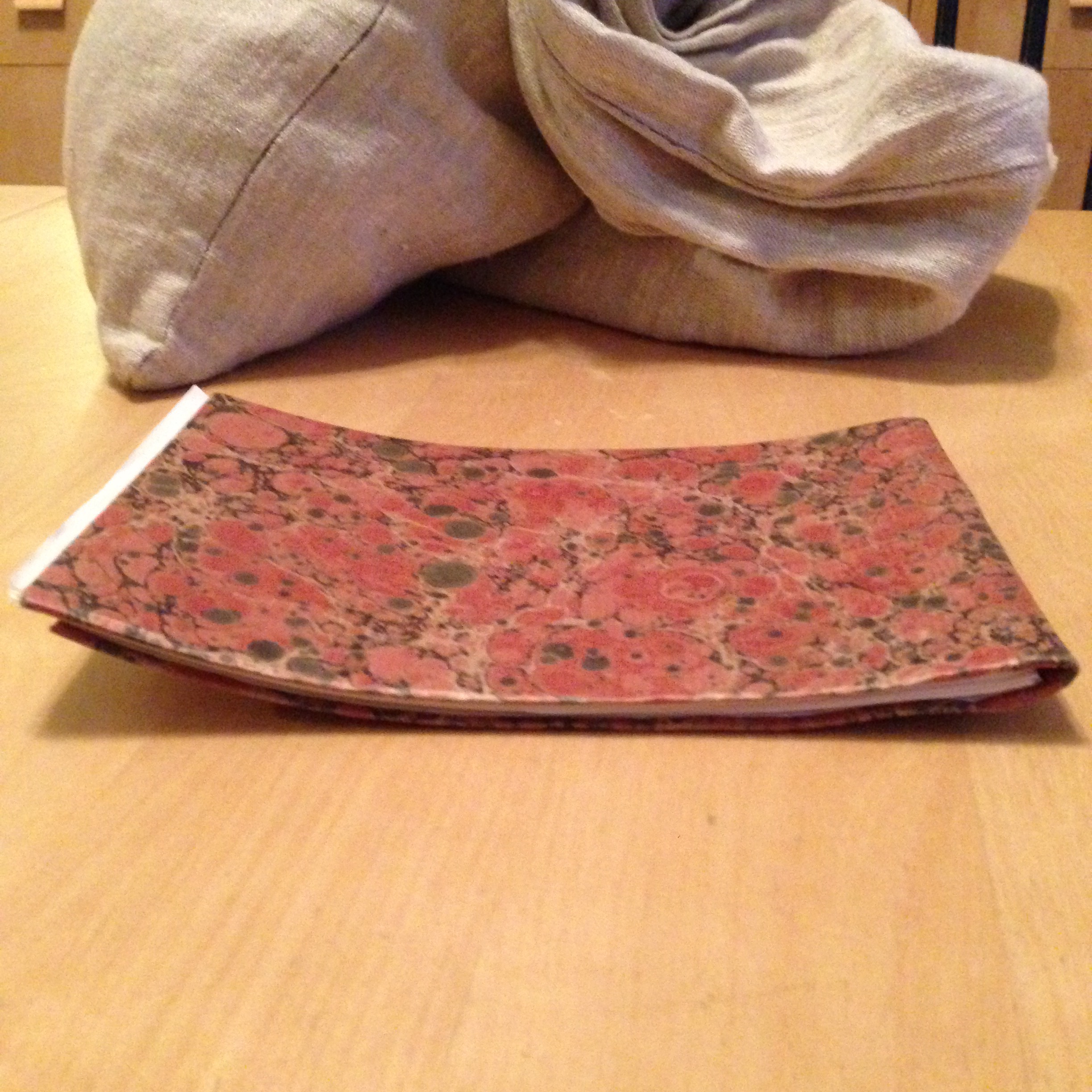
Of course, the thing is that these ought not to be done quickly, but correctly. I recognize that after four years of wear, these imperfect stays made of modern (linen and caning instead of wool and baleen) materials could legitimately be wearing out. But the really important thing is this: They turned out to be so (literally) painfully wrong that turning them around and wearing them backwards was better. No, that was not an ideal solution. I have a sizable bruise on my left underarm area and a red wear spot on the right and my poor handmade (just finished!) sketchbook is bent from use as a stomacher/busk.

Granted, I do have the materials I need to make new stays, but what I lack is more critical: time and a second pair of hands to help me measure torso length. I suspect that even a new pair (of wool and linen, thank you for reducing stretch) will take more alterations than I currently credit. Hilariously, while these pattern pieces may require some lengthening, the 1800 stays needed shortening to fit properly. So on my table sit one pair, shortened, and another pair, seemingly in need of an opposite alteration. Get fit or die tryin’, right?

Peddling a Myth

Paul Sandby RA, 1731–1809, British, London Cries: Last Dying Speech and Confession, ca. 1759, Watercolor over graphite on medium, cream, slightly textured wove paper, Yale Center for British Art, Paul Mellon Collection

Every now and then, I reach the dammit! point of my research, where I am forced to realize that Everything I Assumed Was Wrong. I try to make those moments a cause for celebration, even though they’re often deeply frustrating. Do not pass GO, Do not collect $200, Go directly to the Library.

What now?

Well… Boston ain’t London. And the North American colonies ain’t Great Britain. The business structure, the size of the cities, is different. Distribution of goods is different, thanks to tariffs and non-import/export laws. Which means?

Peddling. It’s not a thing. Or it’s a very difficult thing to document.
Which means that all the things I’d thought about doing for the Massacre (day or night) are probably wrong. (Remember, this is when we celebrate!)

Hey, I’m not the only one rethinking my approach.

But there it is: I’ve looked in the Boston Selectmen’s Minutes for 1768-1771, and while there is plenty of small pox (yay!) and many lemons being imported (yay! punch!) and there are licenses being granted for selling strong drink in inns and houses, there are no peddlers licenses. There are no licenses for street vendors of any kind. Hmmmm….

I’ve also read the Dublin Seminar publications Itinerancy in New England and New York (1984) and Life on the Streets and Commons, 1600 to the Present (2005). Not looking good here for street vendors and hawkers pre-1800.

While I never particularly trust early 20th century monographs and articles without footnotes, the somewhat entertaining Hawkers & walkers in early America : strolling peddlers, preachers, lawyers, doctors, players, and others, from the beginning to the Civil War informed me that street vending was not common in North American British Colonies, and in fact, was not commonly seen until after 1800.

What the ever-loving heckers?

I found peddlers’ licenses in Philadelphia for 1770: all men. But so far, nothing in Providence, Boston, or Newport (or Connecticut). The theory is that itinerant sales people didn’t pay taxes the way merchants did, and that merchants therefore lobbied against them. In Providence, the earliest mention I’ve found thus far is a lobster and fish man at the Great Bridge in 1818.

Just as the watch of Boston differed from the watch in London, so too, it seems, did the petty retailers. I still can’t quite believe there were no street peddlers and hawkers in colonial cities, but I’ll need a new way to approach this question.

Rumours of Bore

Detail, The Letter. Pietro Longhi, 1746. Metropolitan Museum of Art, 14.32.1

My time-travel was cut short this weekend after a trip to eight-nine-teen-something in Salem, as I had a trip to the Central Fly Over* for work instead. Still, through the magic of telephony and the interwebs, I heard about the Sunday OSV Experience and the Great Drawn Sabre of Saturday. (Caution: Strong language) One presumes and hopes that aside from whatever disciplinary action OSV will take– and they will–the CL commanders will address this clear safety violation.

The news photos show the usual collection of baggy menswear (are those painters’ pants? is this 1812?) and the Bodice of Myth and Legend (St. Pauli, anyone?) along with obligatory musket firing and “gotcha” shots of fallen soldiers sneaking peeks at the action. I don’t even have to say what we all think when we see those images.

But the Sunday report that struck me the most was this: The tactical went on for 45 minutes, very few soldiers fell, and the public began to leave before it was over. Got that? They got bored. As the teller of this tale said, The magic is gone. You can consider that a public endorsement of either more civilian events or a re-imagined tactical. I prefer the former, you may prefer the latter. But either way, if you’re going to use The Public as your justification for playing armed dress up on a hot day, you’d better engage that public. What that could mean will have to wait for another time, but when people head for the exits, the show won’t last.

* More on that later