Three Simple Tricks to Change Your (Sewing) Life…

Practice will make you as happy as this cat.

Yesterday was #difference day in Pinsent Tailoring’s #modernlessmarch challenge, and while I’m not participating, finishing up a cap order yesterday got me thinking about what makes a difference in what I make.

I fished out the very first cap ever made, and here’s what’s made a difference:

1. Practice. Make more things. Make practice pieces. The more you sew, the better you get. That is the only way to get better.

As with writing, “butt in chair” is what will make a difference, and there is no short cut.  But the more you sew, the better you get.

2. Materials. Buy the best materials you can afford. This first cap was made of linen from JoAnn’s, while the most recent cap is made of linen cambric from Burley & Trowbridge.

Selecting the right material for the task is critical, and higher quality materials will give you a better result. Silk and linen will give you very different results (yes, silk caps are a thing. They show up in inventories and ledgers in the Carolinas). Even poor and working-class women’s caps were made of finer materials than we can typically get today, so for caps, you are looking for a fabric that combines fineness of weave and thread with crispness.

Cap the First was made nine years ago, while Cap the Recent was finished this week. The first real cap breakthrough I had was in 2016, with the Cap of Floof, made with a finer material that allowed me to make smaller seams and successful whip gathers for what felt like the first time.

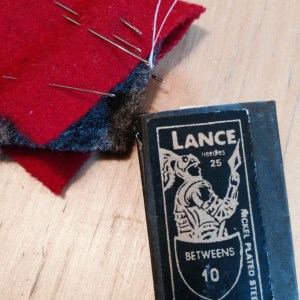
Lance needles: the best I’ve used.

3. Tools. The smaller the needle, the smaller the stitch. You want to use the smallest needle you can (different sizes are appropriate for different fabrics; thicker fabrics need longer needles). It can take time to get used to using a smaller needle, but the practice (see point 1) will pay off. Appropriate thread (finer for finer fabrics), a thimble, and sharp thread snips will make your work easier. A good iron is another necessity, and while you can substitute a rolled towel for some pressing forms, tailor’s hams and sleeve boards also make life easier and sewing smoother.

All of these things take resources, whether time or money, but the rewards are worth the investment.
Frivolous Friday: Favorite Fabric

Favorite Fabric? Are you kidding? Is it fabric? It’s my favorite.

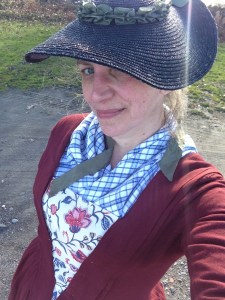
Dat neckhandkerchief, tho’

There’s the hand-woven handkerchief made by a friend that is my absolute favorite textile accessory.

There’s silk taffeta, and the occasional silk satin, for bonnets.

And linen for shifts and linings.

But my all-time favorite fabrics are Indian block print cottons. I have multiple yards in storage, and multiple yards in the accessible Strategic Fabric Reserve. I try not to look at them in the online shops, for I cannot afford to be tempted.

My favorite three gowns are made of Indian block print cotton:

The Milliner in Red

The Bib-Front Tailoress

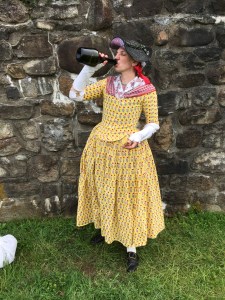
And the somewhat noticeable Nancy Dawson.

It was hot. And humid. That’s only water.

There’s an early red, white, and black calico based on a Philadelphia runaway ad, too, and though I’ve not had it on in a while, it may be due for a renaissance.

Once upon a time in Connecticut…

Oh, and while it requires some shoulder strap adjustments, there’s the brown Indian print I wear as a unsatisfactory Philadelphia servant and Boston sight-seer…and the red print I wore for a 1790 Providence housekeeper.

So, yes, pretty much my favorite, and of the prints? Nancy Dawson, hands down, though I was skeptical at first, for the yellow was so very bright. Made up and worn, though, I love it.

To Name a Thing is to Know theThing: Vocabulary Exercises

Today’s CoBloWriMo prompt is vocabulary, which in my case usually means blue, NSFW, or unprintable in the New York Times according to their Style Guide, (but now OK in the New Yorker, thank you Tina Brown).

Captain Haddock proclivities aside, I find myself trying to remember to use period-correct terms as I work, which means trying to figure out what the terms mean. It isn’t always easy, but there are number of printed and online sources.

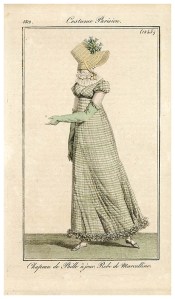
Here, for example, is the Robe de Marcelline fashion plate I’ve been obsessed with since at least 2011, when Sabine made hers. I finally tracked down some dark green gingham fabric in Framingham, but, d’oh! It’s cotton and not marcel(l)ine.

Google Books provides many useful lookups, through dictionaries and, best of all at the moment, The Dictionary of Fashion History, which helpfully illuminates marceline as “a brilliant but slight kind of sarcenet.” That helps narrow down “lining fabric for women’s clothes,” and confirms that this is a lightweight, probably plain weave, silk.

That doesn’t solve my fabric issue, but given that I am still lack full-time work outside the house, Imma stick with my remnant table cotton. But at least I know what I *should* be using, and have expanded my vocabulary along the way.

Fabric Selection Resources: Printed & Online

Jackie asked about fabrics: how do you choose?

I’m going to start with prints, cottons, linens and silks; the second part will cover wools and sutlers.

There’s no substitute for feeling up the real thing, or samples, and while I do not have the book, I’m told by a very reliable source that it is worth buying Swatches from Wm Booth or from Hallie. I also order Burnley & Trowbridges swatch sets, which are often  more extensive than what’s on their website. Those samples help me gauge fabrics online– comparing the actual square with a thumbnail online is helpful.

Barbara Johnson: a typical page
Barbara Johnson: a typical page, this from 1803

Where else can you look for guidance? One of the best books that spans a wide range of living history time periods is the Barbara Johnson book of swatches. Owned and published by the Victoria and Albert Museum, A Lady of Fashion is out of print, but the pages have been scanned and are available online. The print version is better– it’s big!– but you can download the images and get a better sense of the scale of the samples.

What is particularly useful is that Barbara Johnson dated the samples, and wrote down how they were used. You can’t get better than that!

Susan Greene’s Wearable Prints is neither small nor cheap, but it is extensive, covering 1760 to 1860. This is a very hand book to have to help sort out typical looks for different time periods, and the likely range of colors.

Textile Sample Book, 1771. Metropolitan Museum of Art. 156.4 T31

Other museums have digitized sample books: the Met, for example, has multiple images of woven fabrics from a 1771 sample book online.

What you need to remember here is fibre: those homespuns at JoAnn will not behave the way linens behave, even if they look the same. Hand and drape are everything, and cotton, or cotton-poly will not do want linen does. Buy the linen, it’ll look, feel, and wear better.

There are many more sample books, but you have to be careful: some are dated only “19th century.” Great. That’s where Susan Greene and Barbara Johnson can help you sort out which *part* of the 19th century you’re looking at.

Swatch book, 1763-1764. Victoria and Albert Museum, T.373-1972

For silks, you can see a very specific and detailed range of silks in Selling Silks, which reproduces another sample book at the Victoria and Albert. Not all samples are 1763-1764; you will need to read the descriptions, but this can be helpful in figuring out how to use fabrics. I have come into some red silk damask that I can make into a gown; it’s vintage silk from France, probably pre-World War II. The pattern is large, replicating a 1740s fabric, but when I make up my gown, I think it can be 1760s, but not a lot later.

Part of looking and buying is understanding how textiles might be bought, saved, made up, reused and repurposed over time.