Domestic Bliss

Museum of London
Museum of London, John Middleton &tc

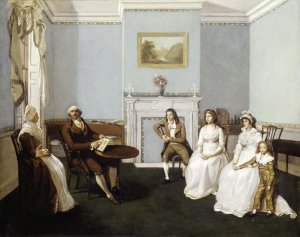
I’ll come back another time to John Middleton & His Family, 1797 from the Museum of London, but today, this group portrait represents one of the online galleries at The Geffrye Museum of the Home in London. Their website has some nice features, and while I did get distracted playing the Topsy-Turvy Timeline game, what I really like playing with exploring is the Life in the Living Room 1600-2000 gallery.

The Geffrye Museum

This has proven useful in keeping on (slightly distracted) track as we polish silver and think about lighting, entertaining, and the ways rooms were used in the past. In particular, since we settled on the idea of setting a formal table for the “holiday themed tours,” and on the After Dark tours, I’ve been thinking about lighting.

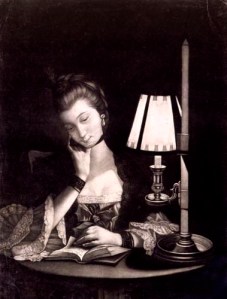
Not only is it clear that the expansive use of candles represented expense and disposable income, it’s also clear that it was uncommon. Special occasions on high-style homes: yes. Everyday use in middling homes: no. Even the charming and well-dressed lady reads by just one candle (though that is also a composition choice, and not purely documentary).

More hilariously to the point, this satirical engraving from the Lewis Walpole Libary:

The Pantry Apparition
Lewis Walpole Library, The Pantry Apparition

Surprise!

Warning: Museum content ahead.

I found this link in the AASLH.org twitter feed yesterday: a post at The Uncataloged Museum about the Museum of Hunting and Nature in Paris.

CW Peale: The Artist in His Museum

What a great find, a wunderkammer in the 21st century. After this weekend, I was thinking even more about the ways in which museums engage (or fail to engage) their viewers. Working where I do, I can’t light a fire in a fireplace and hearth cook: for one thing, it wasn’t done in that house (and chimneys are all capped now, anyway).

But wait: isn’t there some place other than a living history museum where people have immersive and transformative experiences? Perhaps art museums? The last time I went to the MFA I did have to keep convincing my companion to stay a little longer–but even the 13-year-old was convinced when each gallery led us to a new surprise.

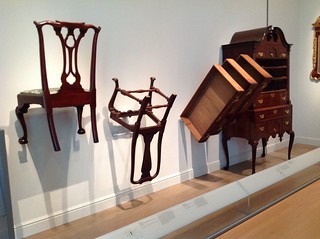
MFA: American Wing, with replicas

Take away lesson: surprise. wonderment. unusual presentations.

My colleague at work said one of the best things we ever did was to install a post-party room with a broken plate on the floor. You don’t see broken things in a museum! You don’t see messes. But that’s normal for a house, so why not for a house museum?

In preparing a room for a display change, we removed the manservant mannequin, and stashed him temporarily outside a storeroom (former bedroom) door. There’s a niche, and he was partially hidden, and looked guilty, as he reached for the door knob. That’s another kind of surprise, the hidden history of of a house–not just the servants, but also the gossip– that could be brought to life.

The Public: Not Quite the Enemy

Ah, the public. We’re not really much without them—we need an audience, don’t we? Living history practitioners/costumed interpreters/re-enactors are all looking for an audience. We like to tell people about the past, so we need the public. Sometimes, though, the public is a trifle confounding.

In one weekend, I heard or heard about the following questions or comments:

Are you Jane Austen? (This from a 10-year-old girl in a grocery store, so it’s actually score one to the girl for knowing Jane and getting the dress period right, and one to Dana, who answered with grace.)

Look, it’s the Pilgrims!

Gosh they must have been hot back then. I guess they had to adapt, but they must have been awfully hot, even if they didn’t know any better.

Why is it like it used to be in here? (My favorite!)

Did children chase chickens back then?

What are you chopping all that wood for?

Oh, look, the fire’s on!

I thought you’d all look pretty like the ladies on British TV. [i]

There was also a group that trouped in and just stared. Stared. Hard. I couldn’t manage to say anything, though Vicky and Johanna did an excellent job explaining what we were doing. By the time it was my turn, they’d stared in silence for several long minutes and it was just too weird to say anything.

So, what to do? Not much, I think, but to join and support your local history organization to encourage history education for all. And for those of us on the receiving end? Take a break, eat a snack, stay fresh, and park the snark. Wait until the tour has left the building to react.

I had only one not-great experience. A child came behind my quilting frame, popped on my bonnet, and left the room while I asked several times, “May I have my bonnet back, please?” Her mother turned to me and said, “We thought this was interactive!” Well, yes, but that is my personal bonnet. So the lesson for me is hide my bonnet better, and for the public? It never hurts to ask if you can try on the item sitting next to the interpreter, or to touch the things they’re clearly working with. And never touch an interpreter or re-enactor unless invited to. Yes, it has happened.

Manners transcend centuries: please and thank you always work.


[i] This is similar to what a guide at work said the first time I did a program in period dress, wearing a linen gown. “I guess they were more comely at Colonial Williamsburg than in New England.” I am not a fancy lady. But not comely? Well, maybe I’m built for speed.

Black Bonnet Miscellany

Lot 102
AMERICAN OR ENGLISH SCHOOL LATE 18TH / EARLY 19TH CENTURY
LADY IN BLACK BONNET
In the original giltwood frames and glass, on original wood backing.
Pastel on paper
22 by 18 inches

The Sotheby’s Americana catalog arrived at work, and I had a pleasant walk browsing the sale lots as I walked from one building to another. This lovely lady is offered with her mate, a gentleman in a blue coat with brass buttons. They’re of a school of portraits made as the centuries turned, pastels rather than oils, less expensive and perhaps easier to drag about for an itinerant artist. She’s lovely, in her frothy white ruff, with that well-made bonnet. That’s a bonnet I’d like to try making…eventually.

For now, the most brilliant thing I can recommend is Hallie Larkin’s blog post on 18th century buttonholes. Needless to say, I have not been doing them right. Read, learn, and look forward to better buttonholes. Brilliant. Did I mention brilliant? The photos from Neal Hurst at B&T are especially helpful, and honestly, I am so glad I didn’t tackle the green coat’s buttonholes yet. Or a spencer. See? Value in procrastination, distraction, or whatever you want to call it. Better buttonholes…it’s like salvation!

More on the quilting process later, when I manage to download the photos I took of the stencil process, and when I take some of the sandwich and frame situation. And then there’s more documentation…along with a couple of meetings, mailing my mother’s birthday package, I forgot breakfast, and pitching the boiler repair to my boss–and finishing the new cap I started. And this is an easy day!