
Impressionism, Fashion, and Modernity

The authentic matters, the real matters. It is different. Great art leaps from the surface of the paper and lives. Photographs may burn into the paper, but in that depth, they, too, live and glow.

Gallery 2: En Plein Air

The Met’s installation of Impressionism, Fashion, and Modernity is worth seeing for the coalescence of so many real things in such a [relatively] small space. The monumental paintings, especially Monet’s Luncheon on the Grass in Gallery 2, En Plein Air, need to be seen for real, in the actual matter, to really be appreciated. The brushstrokes, the color, the enormity, all need to be in front of you to be appreciated—to be experienced. It doesn’t work any other way. (Click here for better views of the paintings and costumes; photography was not permitted.)
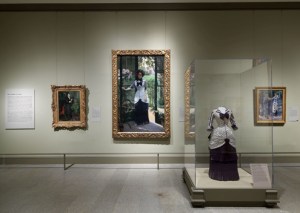
Gallery 5: The Dictates of Style

By way of an intimate contrast, consider the portrait of the gown and the gown itself in Gallery 5, The Dictates of Style. Here’s a lesson in the power of art, of paint, and an artist’s vision—and it’s Bartholomé, not Monet or some other genius, though a solid painter all the same.

Behold the cotton dress in conservator-approved lighting and yawn. Well designed, beautifully made, and real, right down to the stain on the upper bodice or collar, a pleat slightly misaligned at the hem. But yawn all the same. Now, the Bartholomé: bam! It’s not about the dress: it’s about light. This contrast is beyond a doubt one of the best lessons I have ever seen on the real nature of painting, and of impressionism: Light.

And if the authentic, the real is important, going to see the real thing is also important.

Here’s the Met’s catalog shot and record for a Degas drawing:

Degas
MMA, 29.100.185

And my iPad photo of the same drawing:

MMA, 29.100.185.

I’m not a wild fan of Degas; I’m more a Joseph Beuys/Caravaggio kind of art lover, but seen in person, this sketch was amazing.

This is an unfair comparison, and I had expected the catalog shot to be in color, because color is so important to this piece. In black and white, you miss the pop of the color contrast between the medium and the paper; you miss the bleed of the oil spot, more subtle in the black and white. You miss the way that image is fast and messy, the simmering tension between the artist and the sitter. Incredible as it seems, there is nothing like the real thing.

Installation Progress

Faith & Freedom Case 2: Establishment

It starts with words on a wall, and then we bring in the objects. They get hung up, placed, arranged, listed, reported. They’ve already been photographed and cleaned.

Faith & Freedom Case 4: Thomas Wilson Dorr

This might be my favorite case, though it is very brown. We’re adding a daguerreotype today. The Dorr Rebellion was a local phenomenon, but then, all politics is local.

The biggest goal this time? Washing the inside of the glass!

Busy!

[French Barracks] T. Rowlandson, 1786, Drawings R79 no. 13, Lewis Walpole Library
This is a busy week chez Calash, so here’s an image by Rowlandson, as described by the Lewis Walpole Library:

A view of the interior of busy French barracks shows a more domestic atmosphere than military although weapons and other gear adorn the walls and lay scattered on the floor.

And now you know what can feel like trying to get an exhibit mounted, though at least the cats are only at home and the children are in school.

Those English Gowns…

GMFS2At the V&A, a fun interactive exhibit on 18th century costume allows you to turn the costumes around and zoom in for a better view.

V&A Screenshot
V&A Screenshot

My favorite, because I need to start making something like this, is the Gown made from a Shawl, about 1797.
There’s a good description of the gown, and you can always search the collections for the catalogue record and more non-turnable images. This is a good thing because the 3-D image player requires Flash, so it doesn’t work on an iPad.

I found the viewer helpful in understanding the sleeve-collar relationship, which was confusing to me with the contrasting colors. The description in the catalog record helps, too:

“An open robe with a medium high waist, the material stitch is pleated down the back, and then flowing into the skirt. The sleeves are of white satin, trumpet shaped, with a short green silk oversleeve. The oversleeve is bound with cream ribbon, and the undersleeve at the wrist where it fastens with three pearl buttons, with metal shanks, has a narrow green ribbon turn back cuff. There is a shaped falling collar of green silk bound with white, and a green ribbon binds the front of the gown. The bodice is lined with linen, and extends in front to cover the bust. The sleeves are lined with white linen.”

Fairfax House
Fairfax House

The oversleeve makes me think of this Fairfax House dress. I’ve not been able to find a larger image so I can’t get “close enough” to determine how it all goes together. Time to collect images of extant examples and fashion plates in a Pinterest board, and start comparing them. And time to think about whether or not this is a style seen in New England…and time to get ready for work.