
Fashionable Friday: Floral Embroidery Galore

Colonial Wedding dress altered 1830
Elizabeth Bull Price’s Wedding Dress. Bostonian Society, 1910.50.35

On Tuesday evening, sensibility won over sense as my friend and I boarded the T for Boston to make a long day longer. The trip was worth it, though, for the One Night Only engagement of Elizabeth Bull’s wedding dress at the Bostonian Society. In truth, I bought the tickets for the event before I was even back at work and navigating our Fair City on my own– and who wouldn’t? That dress is amazing! (Tons more images of the embroidery are in the catalog record.)

Perhaps even more wonderful than the 14-year-old ElizabethBull’s needle skills is that the dress remains with us today. Kimberley Alexander and Tricia Gilrein reminded us on Tuesday of the many ways this dress, and other remnants of Bull’s wardrobe (oh, the petticoat, and the wonderful kerchief) connect us to the past in surprising ways. Elizabeth Bull was wealthy, married to Roger Bull, a Church of England official 22 years her senior: though they lived in Boston, they were British. (They were married in the 1730s, and Elizabeth died in 1780 at about 67.)

It’s a little hard to see past the 1830s alterations, but the embroidery of the gown helps chart that course, as well as the petticoat. As important to remember is that this wedding gown was not white: it has faded from a celadon green to its current off-white color. Wedding dresses weren’t white in the 18th century, or even long into the 19th, and it’s helpful to remember that as we look at what remains and reconstruct this in our mind’s eye.

It’s easy to forget we were British first here in the United States, and that the American War for Independence did not have a foregone conclusion. We forget, too, that churchmen and their wives were socialites as much as they were people of the cloth. Put Mr Collins out of your mind, and remember (my favorite minister & fashion maven) Reverend Enos Hitchcock and his pink satin waistcoat and suits of black silk.
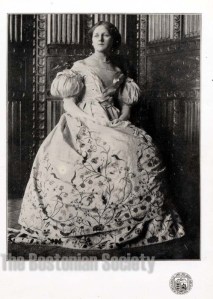
Photograph of the altered gown. Bostonian Society, 1910.0050.057

Like many 18th century gowns, this one was remodeled in the 19th century, its shape altered to reflect the current fashion. We are lucky to have so much preserved, not just in the gown but also in the petticoat. Paths to understanding of women’s education, the customs and habits of Boston’s colonial elite, and the persistence of past can all be found within this object.


Frivolous Friday: Whitaker Auction Waistcoat

It’s so nice to have enabling friends. If it’s not one tipping me off to a sale on fabric at Williamsburg (over now, keep calm) it’s another tipping me off to costume auctions.

My most recent tip-off came from Mr Cooke, about the Whitaker auction coming up April 25 and 26 in New Hope, PA. There are some very nice things from the collections of the Met and LACMA coming up in that sale. It’s hard to understand deaccessions from the outside, so I won’t comment on that part of the sales.

Unmade waistcoat ca. 1790. RIHS 1990.36.15

I was particularly taken with this waistcoat.

The lapel embroidery and button details remind me very much of an uncut dimity waistcoat in the collection of the Rhode Island Historical Society.

Whitaker’s got copyright notices on their images, so I won’t post them here, but I can assure you, the visit will be worth your while. But my tip to you is this: forget those estimates– from what I’ve seen lately, they’re all too low by a factor of 10.

The Checkered Past

Some gentlemen I know should consider what they might want to do to avoid (or alternately, encourage) having this coat made for them. It’s really a lovely thing, found as the best things are, while looking for something else.

It reminded me, too, of the textile sample book at the Met, currently on display in the Interwoven Globe exhibition. (No, I haven’t seen it; I’m going to try, but…).

Wm Booth has a new linen coming in the winter, and as the men in my house have outgrown or outworn their shirts, I am thinking of making new check shirts. I did finish a white shirt at Fort Lee, which will go to the Young Mr (his small clothes being now his too-small clothes). I will have to make Mr S a white shirt for best wear, but they could each use a second working shirt. At least with checks you get “cut here” and “sew here” lines.

Last week, I found a weavers’ book in the Arkwright Company Records (Box 1, Folder 1, 1815). It’s a slim, blue paper-covered volume with small samplers glued in to the pages, and full of checks and stripes. Blue and white, red and blue, checks and stripes were prevalent in the late 18th and early 19th centuries. The more I look at extant garments, sample books, and ads, the more I think the streets must have been a vibrant, if grimy, visual riot.

One Hot Banyan

Prince of Wales' banyan, ca. 1780. Royal Pavilion & Museums, Brighton. ID CT002728
Prince of Wales’ banyan, ca. 1780. Royal Pavilion & Museums, Brighton. ID CT002728

Alert! This item is currently on display at the RISD Museum of Art in Providence, through August 18, 2013. I have been to see it twice now.

As much as I am itching to get this on a table and investigate it, I am limited to craning my neck and squatting in front of the case. Awesomeness in cotton, this banyan has a five-button mariner’s cuff with a double arc like a broken pediment on a chest-on-chest. It would be a crazy thing for a Continental private to come strolling out of a tent in, not to mention impossible to make before the next camping excursion, but holy cats! that’s one fine banyan.

The RISD Museum is free on Sundays. You, too, can entertain the guards by craning your neck–photography is not allowed. Next visit: sketchbook.

There are a lot of other wonderful things to see, too–silk jersey breeches I expect to see on a colleague at some point, an indigo silk frock coat, the greatest great coat ever, and Fred Astaire’s tails, as well as a small section that I think does everything PUNK wanted but failed to do.