Frivolous Friday: All of Everything

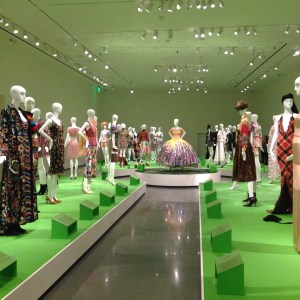
All of Everything: Todd Oldham at the RISD Museum of Art

Some days were made for a bit of hooky. This week, it was Tuesday– though how much can you consider a museum visit hooky when it’s the business you’re in? We took an outing down the street to the RISD Museum, long one of my favorite places in Rhode Island. The Costume and Textiles curatorial staff mount some amazing exhibits, from Artist Rebel Dandy to this latest, All of Everything: Todd Oldham Fashion.

Every time I go to the RISD Museum’s exhibits, I have serious wants, whether mochaware coffee pots or the Chinchilla Outfit– which my grandmother would also have coveted. There was a tinge of nostalgia in the visit, since most of us had lived through the 1990s, and recognized the styles that eventually leached into ready-to-wear from couture. Cropped sweaters. Shrunken jackets. Embellishments. Pattern mixing. Hey– I still dress that way!

Unknown artist Horace Vernet French, 1789-1863 Illustrations from the Journal des Dames et des Modes, ca. 1810 Engraving on wove paper, hand-colored Museum collection INV2004.506
Journal des Dames et des Modes, ca. 1810
RISD Museum INV2004.506

And legit it is, this pattern mixing. Funny how we stick to the same shapes and forms once we find what we like; so much of what I make and wear are variations on similar themes, no matter the century.

For some, dressing in the past is the only time they’re dressing up; their daily style is almost aggressively (or passive-aggressively) anti-style. But when the top hat comes out, look out: they’re dressed to the nines.

Two Shells, One Man, Dozens of Stories

Yesterday I felt like an anthropologist on Mars, or perhaps more precisely, like Ariel and her collection of human objects, as my friend suggested.

TALY. Anzio. January, 1943. American soldiers rejoicing upon reaching Italian soil, after their beachhead landings. © Robert Capa © International Center of Photography

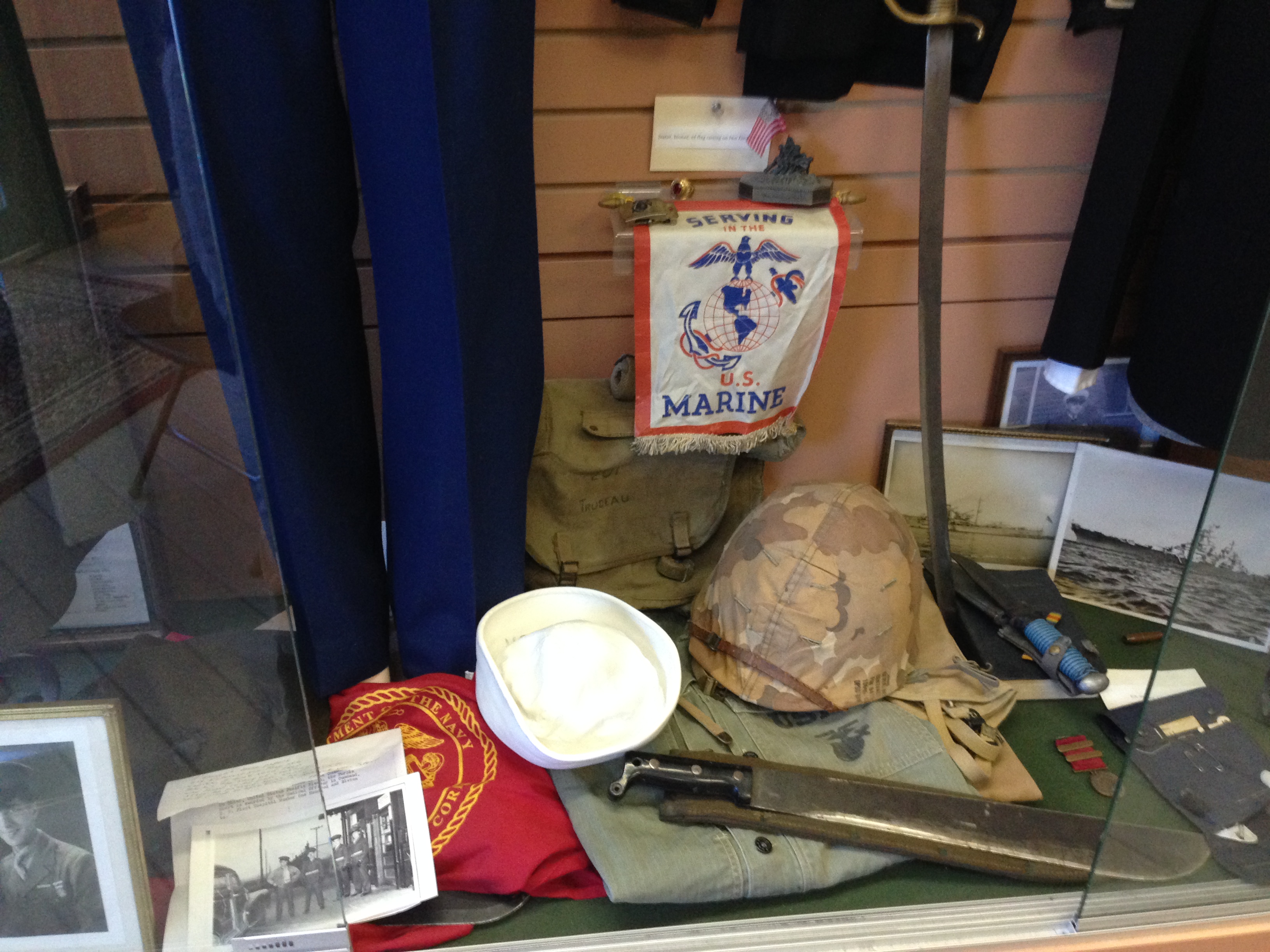
We are inventorying a collection of militaria currently on display at a museum in the northern part of our tiny state, and while I recognize most of the things, I don’t have the intensive knowledge that some of my friends and acquaintances have to recognize the subtle changes in accouterments over time. Fortunately, plenty of things are marked: the military tends to do that. And fortunately, there are books and the Google and I remember enough of what I learned to ask the right questions.

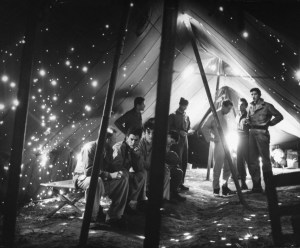
American soldiers inside hospital tent riddled w. holes caused by German schrapnel from long range gun attacks which killed 5 & wounded 8 patients in the tent. Photograph by George Silk. Life Magazine

The most meaningful items are the ones that have been personalized in some way, or that were never issued at all. There were, for a long time, two small shells picked up at Anzio and Nettuno, each white interior curve labeled in ink, one Anzio and one Nettuno. I could only guess at their significance, as you probably can too: what I did not know was that the soldier who picked them up was only 18 in January 1944—and how appropriate it is to have returned them to his daughter this month.

Not about Anzio, but this is a typical case.

The cases are packed with things he and his friend collected, all of which had some meaning to them: that guy, this place, that story, these memories. The soldier who picked up the shells could never tell his daughter or granddaughters any of what he had seen, though later on, he began to tell his nephews. But he assembled this collection and in that, I think, he was telling us all. Our job at the museum is to translate mute, general issue objects into meaningful individual narratives.

Street

Street_featuredVideo art has often left me bored. It can be too schlocky, too stupid. Not that I don’t appreciate simple, silly work. The first piece of video art that made an impression on me was at the Museum of Contemporary Art in Chicago. It was  William Wegman’s  Heads With Tails, featuring the ultra-patient Man Ray. This simple video was an excellent introduction to conceptual for a 10-year-old. (I could not have been more than 10 or 12 to tolerate going to a museum with my mother…by 13 and 14 I was going on the bus by myself.)

Flipping a coin and turning a dog around, while hilarious, is not necessarily what everyone thinks of as art; for others, Nam June Paik is a more valid artist.

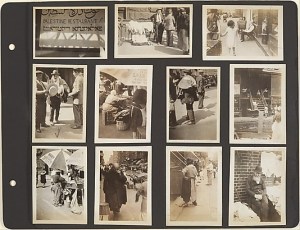
Album page, New York City. Bernice Abbott, 1929-30. MMA 1982.1180.106–.116

I give you James Nares, and his Street project at the Met (which closed 5/27/2013, sorry). There’s a short clip (2:17 out of 60 minutes) if you scroll down the page. This isn’t the section I stumbled upon, but it captures much of the essence of the piece. I think it was the best thing I saw all day, and even better, the video is bracketed by galleries of photos and objects selected by Nares from the Met’s permanent collection.

These are can be found online, though they are not divided or arranged the way they appear in the galleries. Still, you can see connections between the pieces.

For other interesting and rather less famous street still photographers, check out Vivian Maier, orJoe Sterling (who lived around the corner from us when I was growing up).

Please enable flash to view this media. Download the flash player.

Impressionism, Fashion, and Modernity

The authentic matters, the real matters. It is different. Great art leaps from the surface of the paper and lives. Photographs may burn into the paper, but in that depth, they, too, live and glow.

Gallery 2: En Plein Air

The Met’s installation of Impressionism, Fashion, and Modernity is worth seeing for the coalescence of so many real things in such a [relatively] small space. The monumental paintings, especially Monet’s Luncheon on the Grass in Gallery 2, En Plein Air, need to be seen for real, in the actual matter, to really be appreciated. The brushstrokes, the color, the enormity, all need to be in front of you to be appreciated—to be experienced. It doesn’t work any other way. (Click here for better views of the paintings and costumes; photography was not permitted.)

Gallery 5: The Dictates of Style

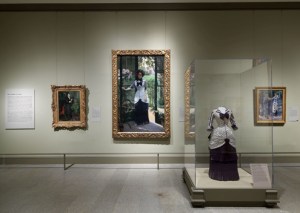
By way of an intimate contrast, consider the portrait of the gown and the gown itself in Gallery 5, The Dictates of Style. Here’s a lesson in the power of art, of paint, and an artist’s vision—and it’s Bartholomé, not Monet or some other genius, though a solid painter all the same.

Behold the cotton dress in conservator-approved lighting and yawn. Well designed, beautifully made, and real, right down to the stain on the upper bodice or collar, a pleat slightly misaligned at the hem. But yawn all the same. Now, the Bartholomé: bam! It’s not about the dress: it’s about light. This contrast is beyond a doubt one of the best lessons I have ever seen on the real nature of painting, and of impressionism: Light.

And if the authentic, the real is important, going to see the real thing is also important.

Here’s the Met’s catalog shot and record for a Degas drawing:

Degas
MMA, 29.100.185

And my iPad photo of the same drawing:

MMA, 29.100.185.

I’m not a wild fan of Degas; I’m more a Joseph Beuys/Caravaggio kind of art lover, but seen in person, this sketch was amazing.

This is an unfair comparison, and I had expected the catalog shot to be in color, because color is so important to this piece. In black and white, you miss the pop of the color contrast between the medium and the paper; you miss the bleed of the oil spot, more subtle in the black and white. You miss the way that image is fast and messy, the simmering tension between the artist and the sitter. Incredible as it seems, there is nothing like the real thing.