This is the house at the farm museum where we went to work on Sunday. That bright orange under the window is squash. The part painted red is an office addition and not interpreted space.
This is the view from the site. It is not exactly what the tenant farmers would have seen, even discounting the power lines and road surface. But even with the caveats of constant change in mind, I do not have access to a better lab for understanding the past. There are times when even the smart and sophisticated among us cannot come up with a better (just between us) interpretation than, “1799 sucked. And it was greasy.”
That’s not what we want the visitor to learn (everything in the past was hard) though sometimes I fear that is all they take away. Callie, seen here swearing in my hand, was trying to take away leftover chicken and so was taken away herself.
The more time I spend stooping to reach a vat of tallow, or tearing a chicken carcass apart with my hands and a dull, greasy knife, the more I think that what we fail to grasp is not that people thought differently in the past. It’s why they thought differently.
Lives could be a great deal smaller: tasks were hard and all-consuming. Even as I realized that work would be faster with greater familiarity, I also saw that repetition would not breed enlightenment, because increased speed would only make the next task come more quickly.
What to eat in the field in August? Redcoats & Rebels approaches, and food must be prepared. This time, we are camping over. That means that pretty much everything must be ready by 1:30 on August 3, and there is nothing like a deadline to focus attention.
To start with, I turned to The Compleat Housewife: or Accomplished Gentlewoman’s Companion, published in 1739. The author presents seasonal menus, because one important thing to remember is that historical eating was seasonal and local. (This concept may sound familiar to fans of Alice Waters or Mark Bittman.)
The suggestions are, of course, beyond the realm of soldiers’ rations.
Westphalia Ham & Chicken.
Bisque of Fish.
Haunch of Venison, roasted.
Venison Pasty.
Roasted fowls a la daube.
White fricassee of Chicken.
Roasted Turkeys Larded.
Beef a la Mode.
Roasted Lobsters.
Rock of Snow and Syllabub.
But take a closer look: beef a la mode is a kind of pot roast, so beef in a kettle with water and veg cooked over a fire ought to do. It’s what we call “officer chow,” and what the boys ate at Fort Lee. I was mostly looking for vegetables in season, or fruits, but the farmers’ market will provide that limitation.
So here’s what I think:
Pasties made Thursday night or Friday morning for supper on Friday.
Gingerbread cake for treats.
Oatmeal and fruit for breakfast Saturday morning, or else boiled eggs, bread, and fruit.
Bread, cheese, fruit and sliced ham for lunch on Saturday.
Tea, shrub, and gingerbread cake for Saturday tea.
Beef stew for supper on Saturday.
Breakfast and lunch will be the same for Sunday, and we pack up and leave on Sunday afternoon, so I won’t need to make Sunday supper in camp.
It’s reasonably authentic to the 18th century, though not to common soldiers’ rations. But the guys won’t want to eat firecake and water.
Warning: Heavy Re-enactor/Museum Management/Philosophical-type Content
Battle Road, with photographers
Who is this authenticity for?
I think that is the core of the question. I spent much of yesterday (when not banging head here at work) banging my thoughts on the question of Fort Ticonderoga’s standards, and the relative abilities of my family to meet them. Somehow, out of that and previous thoughts about bullying, research, cattiness, and the general meaning of “living history,” “reenacting,” and “The Hobby,” I reached a simplistic conclusion, or perhaps it was a question:
Who is the “good enough” for? Moving past that wretched verbal construct, think about this:
Each event, each unit, each individual is like a museum or historic site in microcosm. The unit I belong has a mission: to re-enact the 2nd Rhode Island Regiment of the Revolutionary War. The regiment and its members belong to the Brigade of the American Revolution (BAR), which has a mission, “The Brigade is a non-profit living history association dedicated to recreating the life and times of the common soldier of the American War for Independence, 1775-1783.”
Clear enough, right? Following from the mission would be standards. And those standards would, in an organization’s strategic plan, be goals. (The vision statements or values statements would be different–and I don’t know what they would be for the BAR. For my unit, I can only guess but I think one of our value statements would be “Tolerance, kindness, patience.”)
So, let us consider the nexus of the BAR and Fort Ticonderoga from the mission and standards point of view. They clearly overlap where the recreation of the life and times of the common soldier are considered in the context of 1777’s assault by the Continentals on the Fort. Excellent. Because everything you do as an organization should point toward, or be derived from, or further your mission. The BAR, in fulfilling its mission to recreate the life of the common soldier, creates an event that fulfills Fort Ti’s mission “to ensure that present and future generations learn from the struggles, sacrifices and victories that shaped the nations of North America and changed world history. They serve this mission by:
“Preserving and enhancing our historic structures, collections, gardens and landscapes.
Educating and inspiring our visitors about the history of Fort Ticonderoga and the diverse peoples who met here in war and peace.”
The BAR event would fall under the “educating and inspiring” part of “how” the Fort fulfills its mission.
Clear enough so far, I think, how the BAR and the Fort overlap. Now comes the tricky part: the people part.
Looking at the Fort Ticonderoga event, my first thought weeks ago was, “We can’t do that; no Rhode Island troops were there.” I’m not just a stitch counter—I’m a troop counter too. Then I realized that there aren’t necessarily enough MA and NH re-enacted troops to make the event possible without “reinforcements” from other states.
Conquering that, I began to consider the standards, and as previously stated, I’m a stitch counter so I have to follow them or be a hypocrite. And that’s when I started thinking about “who is this good enough for?” What’s my mission? Is it aligned with my unit’s mission, the BAR mission, or even my own family’s mission?
Because the place of overlap, given that this is a hobby, is in the conjunction of my desire to have fun, and the mission of the BAR: If I think it is fun to “recreate the life and times of the common soldier,” then we’re good. I love to sew, the challenge of creating 18th century garments for the three of us is fun the way art school was fun, but it’s not any fun to be all dressed up with no place to go.
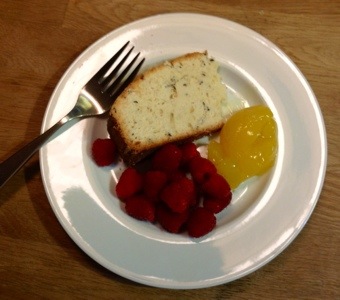
Actually, I made half a recipe. And Baked it too long. That doesn’t mean it’s not delicious served with raspberries and lemon curd, but it does mean that the crust is, well, crusty. And cakes do not have crusts, so there you are. What I learned what that you can’t halve ingredients and not adjust time. Obvious, but not when you are simultaneously finishing a dress.
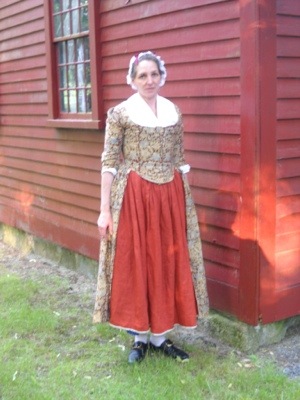
The dress is done, all but the cuffs and moving the interior lacings, though the photos are sketchy. Mr. S. used to be a photographer, and now he hates photography. He is therefore an unwilling documentarian, and hates even more the basic camera he was handed at the Joy Homestead.
We were there for a tea commemorating the day in 1780 when Rochambeau stopped on his march to join Washington. Rumor, or legend, has it that the Comte ate strawberries, and so we did, too, with biscuits, cream, and Lipton tea.
There was some drilling, so the soldiers had an appetite. There were also photo ops aplenty, and some behavior that made me wonder if there are reenactor groupies. One woman was just determined to have a particular uniformed gent in every possible photo…and she took many, many photos of the troops. It’s a curious thing, this hyper-photographic behavior. Makes me want to keep my camera in my pocket.
In any case, the seed cake I made will work for the opening if I can manage not to over bake it and provide fruit with it. Now I just have to find an 18th century punch that isn’t overly full of rum.
And a new camera.

 This is the house at the farm museum where we went to work on Sunday. That bright orange under the window is squash. The part painted red is an office addition and not interpreted space.
 It is not exactly what the tenant farmers would have seen, even discounting the power lines and road surface. But even with the caveats of constant change in mind, I do not have access to a better lab for understanding the past. There are times when even the smart and sophisticated among us cannot come up with a better (just between us) interpretation than, “1799 sucked. And it was greasy.”
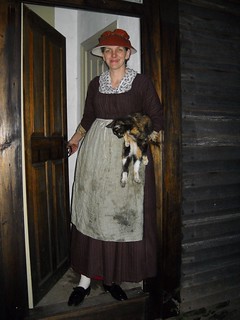 That’s not what we want the visitor to learn (everything in the past was hard) though sometimes I fear that is all they take away. Callie, seen here swearing in my hand, was trying to take away leftover chicken and so was taken away herself.



 Kirsten Hammerstrom
You must be logged in to post a comment.