Starting Over, Again

Autumn is my favorite time of year, a time for fresh starts and new beginnings. Surely for many, that season would be spring, but for me, after summer’s dreary end, when the world seems stale, flat, and unprofitable, autumn is something else again.

This year, it was the time when my Kickstarter campaign succeeded, I quit a job I hated and stumbled into another that paid twice as much for fewer hours and was situated completely within my competencies. All of that was unexpected and probably hinged almost completely on taking the leap to quit a thing I hated doing.* The most successful moments– the most satisfying ones– come when I start something entirely new that scares me completely and for which I have no script. Those are dramatic and risky: big gestures, where failing will be public and painful.

There are other ways to change, smaller, incremental, but still meaningful, and sometimes still painful. Failure is always an option.** So this fall, in addition to the big changes, I took on some small ones.

I signed up for a Burnley & Trowbridge workshop, An Introduction to Mantua-making. When I signed up, I knew I would need to quit the job I had in order to take the workshop– and I had zero regrets. (There was no way to take three days off that included non-negotiable Sundays). I also knew I would be making a dress in miniature rather than a full-size gown, and I was thrilled: I do not need another gown.

What I wanted from the workshop was a skills reboot. I’ve been sewing and fitting clothing off-and-on since I was in middle school, and after a few years making my own clothes, toys and quilts for my son, and exhibition props for work, I took up historical costuming. Along the way, I took some workshops, did a lot of research, and developed habits both good and bad. What I wanted from the workshop was to unlearn my bad habits and acquire new skills, and Brooke Welborn delivered. I understand construction in ways I didn’t before, and now that I’m back home, my sewing is fast again (thank goodness!).

The joy of taking a basic workshop when you’re experienced is that you have a higher likelihood of completing the project, and you get to see a technique laid bare, broken down, and simplified. Sometimes we forget how important a regular, fast, backstitch can be– and how lovely it can be.

Ballet dancers take classes at all levels: they are always working on technique. Apollo or Coppelia: both are built on basic steps repeated endlessly unless perfect and apparently effortless. There’s always something to refine, perfect, polish, re-examine, or an old habit to break. Dancers also take classes in different genres: jazz, modern, ballroom, hip-hop: these require movement and gestures very different from classical ballet, but help expand a dancer’s abilities and understanding. And to that end, I took up something new as well.

I signed up for a new-to-me event at Fort Dobbs, the military timeline. Muskets and guns really aren’t my thing anymore, but the possibility of embarking on a new time period, and a character full of laments, appealed: the Lost Colony of Roanoke. This requires a new realm of research and new garments to make.***

Attributed to Abel Grimmer, The Marketplace in Bergen op Zoom, Flemish, c. 1570 – 1618/1619, probably 1590 and 1597, oil on panel, Gift of Mr. and Mrs. Earl H. Look

Working in the 16th-century aesthetic is pretty different from my usual comfort zone of the last half of the 18th century. Bodied petticoats or kirtles instead of stays; smocks with square neck openings or even collars instead of the more open shift neck; transitioning silhouettes; waistcoats and doublets as well as gowns; coifs and forehead cloths instead of caps: all pretty different. But all helpful in thinking about how fashion evolves, how we get from loose gowns to bodies to mantuas to open robed gowns to chemise gowns. Looking back can help us see the present more clearly, and so it is with fashion.
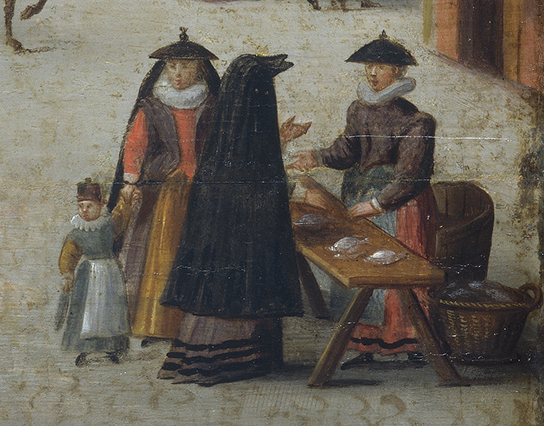
Detail, Attributed to Abel Grimmer, The Marketplace in Bergen op Zoom, Flemish, c. 1570 – 1618/1619, probably 1590 and 1597, oil on panel, Gift of Mr. and Mrs. Earl H. Look

It has also been an interesting look at the effect of climate on economy, society, and dress. In addition to reading about Roanoke and the archaeology of early English settlements in North Carolina and Virginia, I picked up Nature’s Mutiny from the Library. All the wool and layers make more sense in a period when temperatures were 2℃ colder than they are now. Blom’s arguments began to tire for me (the Times review is fair), but overall, thinking about the push of lower harvests on European exploration of the “new” world was a helpful angle to consider.

Riverside, Jan Brueghel (I) (copy after), 1600-1650.oil on copper. SK-A-68, Rijksmuseum, Amsterdam

Finishing all the pieces I need to be a sad shopkeepers wife who wishes she’d never set foot on the Lion is a challenge, but the effort has definitely been worth it for all the things I’ve learned along the way.

*Retail was hard the first time I did it of necessity, and several decades in public service made it only slightly easier.

**I am a big Adam Savage fan, and if you’re a maker or just enjoy my blog, I recommend Every Tool’s a Hammer. It was a birthday present this year, but you can likely find it at your local library. Short version? Keep learning, be adaptable, and put your tools away.

***Yes, an entire 1585 wardrobe at the same time I am working on patterns, researching the Lost Colony, finishing commissions, starting commissions, and starting a new short-term contract untangling collections. This kind of load is not new and is a habit that needs unlearning.
On the Street Corner

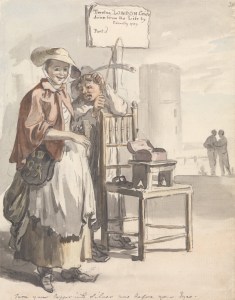
Paul Sandby RA, 1731–1809, British, London Cries: "Turn your Copper into Silver Now before Your Eyes" (Title Page Design), 1760, Watercolor, pen and gray and brown ink over graphite on medium, cream, slightly textured laid paper, Yale Center for British Art, Paul Mellon Collection
Paul Sandby RA, 1731–1809, British, London Cries: “Turn your Copper into Silver Now before Your Eyes” (Title Page Design), 1760, Watercolor, pen and gray and brown ink over graphite on medium, cream, slightly textured laid paper, Yale Center for British Art, Paul Mellon Collection

Not everyone who’s standing on the corner is up to no good. Some have legitimate business.

In the London of the past, just as in, say, the Manhattan of today, street vendors hawked a variety of goods. Having gone through multiple versions of Cries of London, I’ve come up with a basic list of the items sold on the street.

Love songs
Stationery
Oranges
Boot laces
Reeds for chair mending
Saloop See also salop.
Gingerbread
Muffins
Hot cross buns
Doormats
Cats’ and dogs’ meat
Coal
Lavender
Ribbons

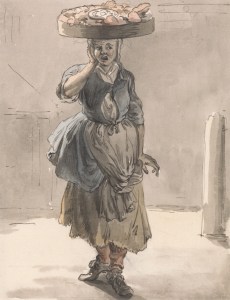
Paul Sandby RA, 1731–1809, British, London Cries: A Girl with a Basket on Her Head ("Lights for the Cats, Liver for the Dogs"), ca. 1759, Watercolor, pen and brown ink, and graphite on medium, cream, slightly textured laid paper, Yale Center for British Art, Paul Mellon Collection
Paul Sandby RA, 1731–1809, British, London Cries: A Girl with a Basket on Her Head (“Lights for the Cats, Liver for the Dogs”), ca. 1759, Watercolor, pen and brown ink, and graphite on medium, cream, slightly textured laid paper, Yale Center for British Art, Paul Mellon Collection

Boot black
Brushes
Flounders
Rhubarb
Walnuts to pickle
Cucumbers
Bandboxes
Baskets
Brooms
Rabbits
Pins
Mops
Wash balls (soap)
Strawberries
New peas
Rosemary and bay
Strings of onions
Turnips and carrots

There’s seasonality to this, of course. Strawberries and cucumbers are not being hawked on the streets of London, Boston, Newport or New York in February. I’ll tell you: being a Cat’s-meat-[wo]Man is practically a childhood dream, since I knew I could never really learn to speak to the animals, and as it happens, Sandby depicts one. It seems there was gender equity in supplying food for pets and stinking of meat.

Paul Sandby RA, 1731–1809, British, London Cries: A Milkmaid, ca. 1759, Watercolor, pen and brown ink with graphite on medium, cream, slightly textured wove paper, Yale Center for British Art, Paul Mellon Collection

I’ve long been fond of the milkmaid, probably because she’s relatively clean, has a cloak for warmth, and I can understand what she does. As much as I love “Turn your copper into silver,” I lack real skill at charlatanry. And gambling. I don’t play poker: my face is too easy to read. Still, if you’re doing this right, there’s a lot to invest in being a milkmaid: kettles (likely pewter), measuring cups (tin? or possibly pewter), and a yoke. It’s a commitment. Cat’s meat– if you’re good with stank and have the right basket*, you’re pretty okay.

If not stank or drank, then gaming. It looks like the object of the game is to knock down the three balls at left in the background by hitting another ball, or perhaps a stone, with the stick. Ha’penny a throw? Maybe you just throw the stick.

Paul Sandby RA, 1731–1809, British, London Cries: Throws for a Ha'penny Have You a Ha'penny, undated, Brown wash, gray wash, graphite, and black chalk on medium, cream, slightly textured laid paper, Yale Center for British Art, Paul Mellon Collection
Paul Sandby RA, 1731–1809, British, London Cries: Throws for a Ha’penny Have You a Ha’penny, undated, Brown wash, gray wash, graphite, and black chalk on medium, cream, slightly textured laid paper, Yale Center for British Art, Paul Mellon Collection

This is another instance wherein I am faced with historical things I don’t know nearly enough about: gambling and street games, pet care and keeping. Cat boxes: when we were they invented? We know cat litter is a 1947 invention, and that sand or ashes were used in cat boxes when cats were kept inside, but for the most part, they went in and out, and mostly out, until cat boxes and neutering became common, though an 1895 manual recommended that “the cat in civilization must be fed, looked after, and guarded in its moments of freedom.“**

cat care
Yes, I went there. I looked it up.

It’s more than 100 years after the time I’m investigating, but I don’t want to fall too far down this cat’s meat rabbit hole– but this does tell me that the historical images of indoor cats come with oat or straw filled baskets in sunny corners, and recommendations for galvanized pans filled with sand, clean earth, or sawdust, which may be ideal, as it can be burned.

Right, I need to focus and not entertain myself with children’s books about Old Dame Trot and her cat…dressed up. In 1810.

My point is, there’s a lot to sell on the streets of any town, images to support the material culture and reference books from which we can derive contextual clues to the impression of something as random as a cat’s meat man or woman. I don’t know that I’m leaping to be a Cat’s-meat-Woman, but it leads to a lot of interesting interpretive points about domestic life, pets, and families that visitors can relate to much more easily than street sales. Of course, if you choose to be the Cats-meat-Man, I won’t stop you from calling yourself Mr Friskies.

*See that flat do-da? I have a similar basket. It does appear one could hawk oysters from a basket like the one I have. Mmmm good.

**Huidekoper, Rush Shippen, 1854-1901. The cat, a guide to the classification and varieties of cats and a short treaties upon their care, diseases, and treatment. 1895: New York, D. Appleton and company

Frivolous Friday: Flip your Lid

Print. Drypoint by John Theodore Heins, Jr. 1747-1771. British Museum 1858,0417.362
Drypoint by John Theodore Heins, Jr. British Museum 1858,0417.362

Bonnets. Who doesn’t like them? They’re the cupcake of costuming, just enough sugar to be delicious, not enough trouble to count. I know I have far too many, they fall from the hall shelf nearly every time I get my coat.

But I started asking myself questions about bonnets when a friend asked me questions about bonnets: shape, color, and how they’re worn (rakish angle? pulled down low?).

We’re planning on going to an event in March, and I’ve been thinking about head wear, especially bonnets. Now that the question’s been asked, I don’t want to randomly cram black silk taffeta on my head and call it a day: I’m back to “don’t know mind.” Time to start looking. So far, I’ve searched the Tate, the British Museum, the National Portrait Gallery UK, the Lewis Walpole Library, the Yale Center for British Art, the Met,  the V&A, and the BBC’s Your Paintings site.

I started at the British Museum. Here are the results for a collections search using the term bonnet and the production dates 1765-1772.  Hmm. No classic black bonnet. Dammit, actually, because I really like mine.

Print made by James Caldwall, A Ladies Maid Purchasing a Leek, 1772, Line engraving and etching Yale Center for British Art, Paul Mellon Collection. B1977.14.11105
James Caldwall, A Ladies Maid Purchasing a Leek, 1772, YCBA, B1977.14.11105

Yale Center for British Art, same search parameters. I know you know this print.

Man, this is a pain, right? Where are the bonnets? 1772 is actually too late for my purposes in this instance.

The Lewis Walpole Library Digital Collections lack a feature for limiting or sorting by date, but they tag bonnets in their prints. Still: no big black bonnets in early prints.

I’m starting to think it’s lampshade or saucer for the 1765-1770 period. You remember lampshade, don’t you? One of my post-operative slightly narcotized creations based in part on the Marquis of Granby (Relieving a Sick Soldier).

The Marquis of Granby (Relieving A Sick Soldier) Oil on canvas by Edward Penny after 1765 (c) Royal Academy of Arts
The Marquis of Granby (Relieving A Sick Soldier) Oil on canvas by Edward Penny after 1765 (c) Royal Academy of Arts

Lampshade seems pretty fashionable in 1760. There are more portraits at the National Portrait Gallery (UK), but bonnets are scarce in them, primarily, I suppose, because they are not indoor wear.

Lady Fenoulhet is wearing a lampshade. Nelly O’Brien is wearing an interesting, more hat-like device. Her imprint is ca. 1765-1780, but other impressions are dated ca. 1760. The 1762-1764 seems plausible. But that’s still early for my purposes. The lampshade really is, too; Mrs Mary Smith of Portsmouth may be wearing one, but considering that the artist who drew this plate died in 1766, I think we can place this form in the 1750s to early 1760s. Lampshade is too early. The”Lady’s Maid buying a Leek” is too late.

Next, please.

Men, Women, and Work

After a late afternoon meeting that left me raw from the way men speak over, interrupt, and dismiss women, I began to think again about a conversation I’d had with a friend at lunch about women’s roles at living history events, primarily military, but also militia, so let’s call them Gun Shows.

14999323655_5d9dcf2259_o

What do women do at the Gun Shows? They cook, for one thing, tied to camp fires. That’s at least a little better than the spinning that can happen, but it’s still not always right. I think a lot about how we’re not truly representing the ways that armies moved, slept, provisioned themselves, and how that affects the roles that women, children, and the (forgive me ) Invalid Corps might play. Yes, there are options: laundry, petty sutlering. There are women doing those things and doing them well, which is fantastic. When I think about how I might complement that, I end up thinking about women even naughtier than Bridget– and I think Bridget must have been very naughty indeed.

Even when you move away from military events, let us say to militia events, similar segregation occurs: women cook and wash dishes, men fire weapons. It just makes me tired, this notion of women forever being pendant to a gun, dependent on housework. It leaves me wondering what else I can do.

Perhaps more Gaskell than Austen, here

That’s easier in a civilian context. Women ran boarding houses, had small shops, ran needlework and boarding schools, worked as seamstresses, soap makers, tailoresses, milliners, mantua makers, painters and silhouette cutters. None of those things belong in a camp, and I begin to think that unless I can figure out a feminist interpretation of women’s lives of drudgery, I will have to give up the Gun Shows completely. And yes, for those of you who know me, that will be a natural transition, won’t it?